Permission To Utilize Property For a Motion Picture Or Photography Shoot
About this form
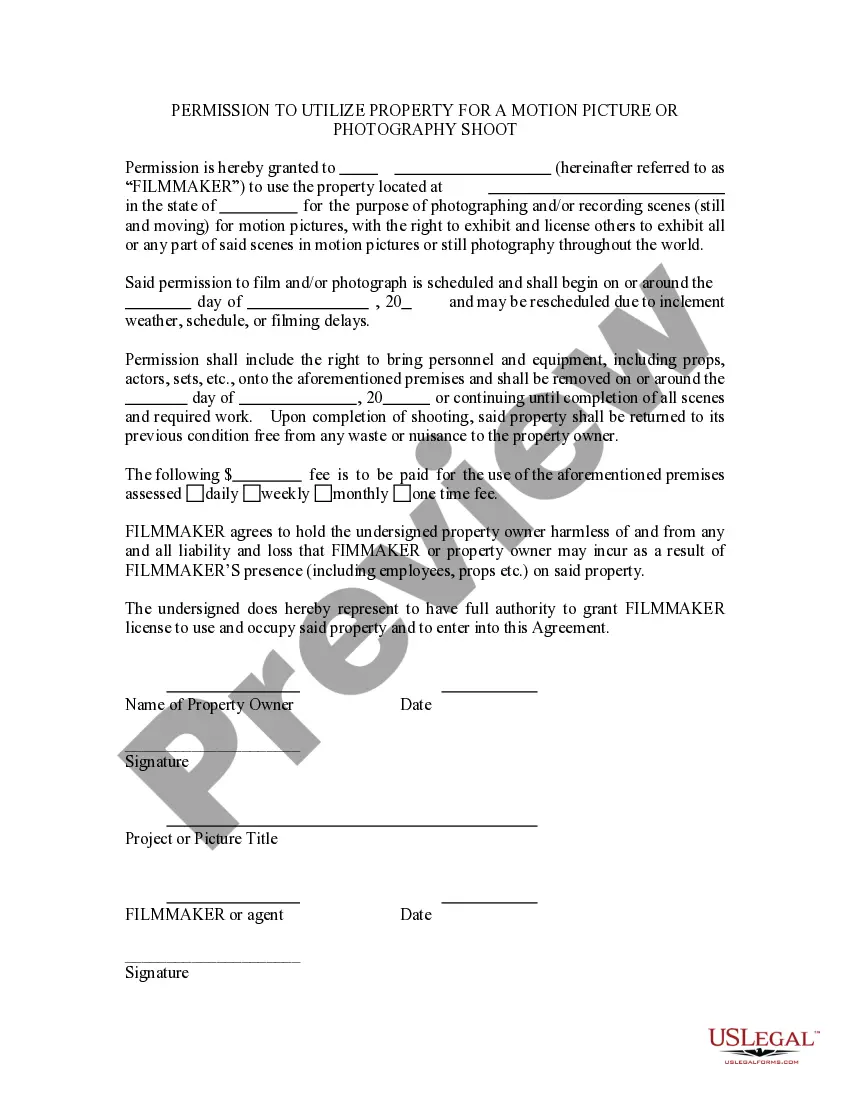
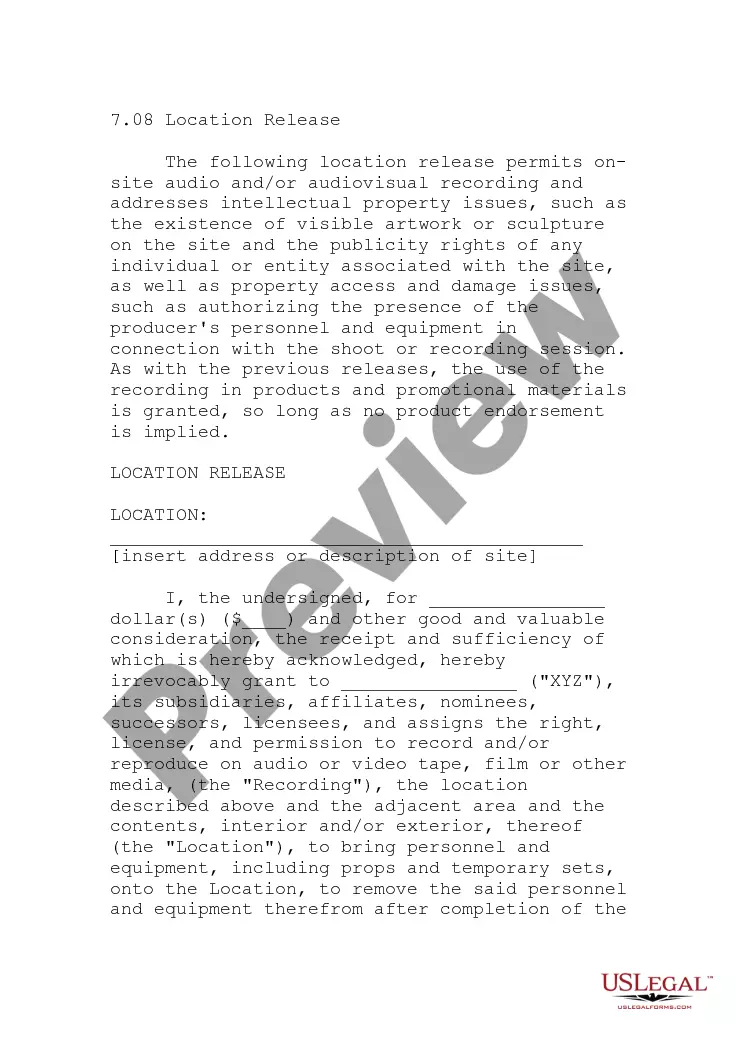
The Permission to Utilize Property for a Motion Picture or Photography Shoot form is a legal document that grants permission from a property owner to a producer or photographer to use their property as a filming location. Unlike rental agreements or lease contracts, this form specifically addresses the permission aspect without detailing payment terms or extended use. It is crucial for legal protection and liability management during film or photography shoots.
Key components of this form
- Identification of the property owner.
- Details of the property being utilized.
- Explicit permission for filming or photography.
- Liability clause that holds the property owner harmless.
- Spaces for signatures of both the property owner and the filmmaker.
Common use cases
This form should be used when a filmmaker or photographer intends to use a private property for shooting a film, advertisement, or photographic project. It serves to secure permission from the property owner, ensuring that both parties have a clear understanding of their rights and responsibilities. It is necessary to avoid legal disputes regarding unauthorized usage of private property.
Who needs this form
This form is suitable for:
- Property owners who wish to permit filmmakers or photographers to use their property.
- Filmmakers and photographers seeking authorization to shoot on private property.
- Production companies in need of liability protection while on location.
Instructions for completing this form
- Identify and enter the names of the property owner and filmmaker.
- Specify the location and address of the property being used.
- Clearly state the purpose of the property usage (e.g., filming, photography).
- Include the date of the shoot.
- Both parties should sign and date the form to confirm agreement.
Notarization requirements for this form
Notarization is generally not required for this form. However, certain states or situations might demand it. You can complete notarization online through US Legal Forms, powered by Notarize, using a verified video call available anytime.
Get your form ready online
Our built-in tools help you complete, sign, share, and store your documents in one place.
Make edits, fill in missing information, and update formatting in US Legal Forms—just like you would in MS Word.
Download a copy, print it, send it by email, or mail it via USPS—whatever works best for your next step.
Sign and collect signatures with our SignNow integration. Send to multiple recipients, set reminders, and more. Go Premium to unlock E-Sign.
If this form requires notarization, complete it online through a secure video call—no need to meet a notary in person or wait for an appointment.
We protect your documents and personal data by following strict security and privacy standards.

Make edits, fill in missing information, and update formatting in US Legal Forms—just like you would in MS Word.

Download a copy, print it, send it by email, or mail it via USPS—whatever works best for your next step.

Sign and collect signatures with our SignNow integration. Send to multiple recipients, set reminders, and more. Go Premium to unlock E-Sign.

If this form requires notarization, complete it online through a secure video call—no need to meet a notary in person or wait for an appointment.

We protect your documents and personal data by following strict security and privacy standards.
Common mistakes to avoid
- Not specifying the exact location being used.
- Failing to include the date of the shoot.
- Omitting signatures of both the property owner and filmmaker.
- Assuming verbal permissions are sufficient without completing the form.
Benefits of using this form online
- Convenient downloadable format for easy access and completion.
- Editability allows for customization to fit specific needs.
- Quick access to legal forms drafted by licensed attorneys.
- Reduces the risk of legal disputes by documenting permissions clearly.
What to keep in mind
- The form allows for legal permission to use private property for filming or photography.
- It includes essential details such as property location, involved parties, and liability clauses.
- Completing the form correctly protects both the property owner and the filmmaker/photographer.
Looking for another form?

Form popularity
FAQ
Don't ask: get the camera out and start filming. Understand a bit about the law: Trespass on railway property, electricity sub stations and places like military installations is a criminal offence. Get insured. Don't look like a film crew. Act like a Diplomat: Nominate one of your team as the Diplomat.
A required New York film permit costs a non-refundable fee of $300.
Location agencies charge homeowners from 10% to 40% of the shooting fee, which the agencies help the homeowners negotiate with the production companies. Many homes command $2,000 to $3,000 a day as locations, and the rates have been known to climb as high as $25,000 a day.
Do I need a film permit for Los Angeles? Yes! Commercial filming without permission is illegal in Los Angeles. If you're filming with a Los Angeles film permit, FilmLA provides numerous resources to make your production a success.
A film (or stills) permit allows you to legally carry out your production in the region that gave the permit. A permit is always issued prior to the shooting, after submitting details about the shoot including locations, dates, times, equipment, cast and crew, use of special effects, pyrotechnics, actions and stunts.
1) Register Register yourself with the FFO website to start your application process. 2) Fill Application Form - Fill out the application Form for seeking permission for film shooting in India. 3) Upload Documents The application form will ask for the following information/documents.
Contact your film commission. If you need to film in a well-known, public, or historic site, you will likely need a permit. Start the process early. Contact your local government. Ask other filmmakers. Get permission in writing, and bring the permit or release agreement to set. Contact your film school.
Generally speaking, though, when you are in public, it is legal to record someone, video record or audio record, as long as they don't have what is called, an expectation of privacy, or rather a reasonable expectation of privacy.