Destruction Clause Long Form
What this document covers
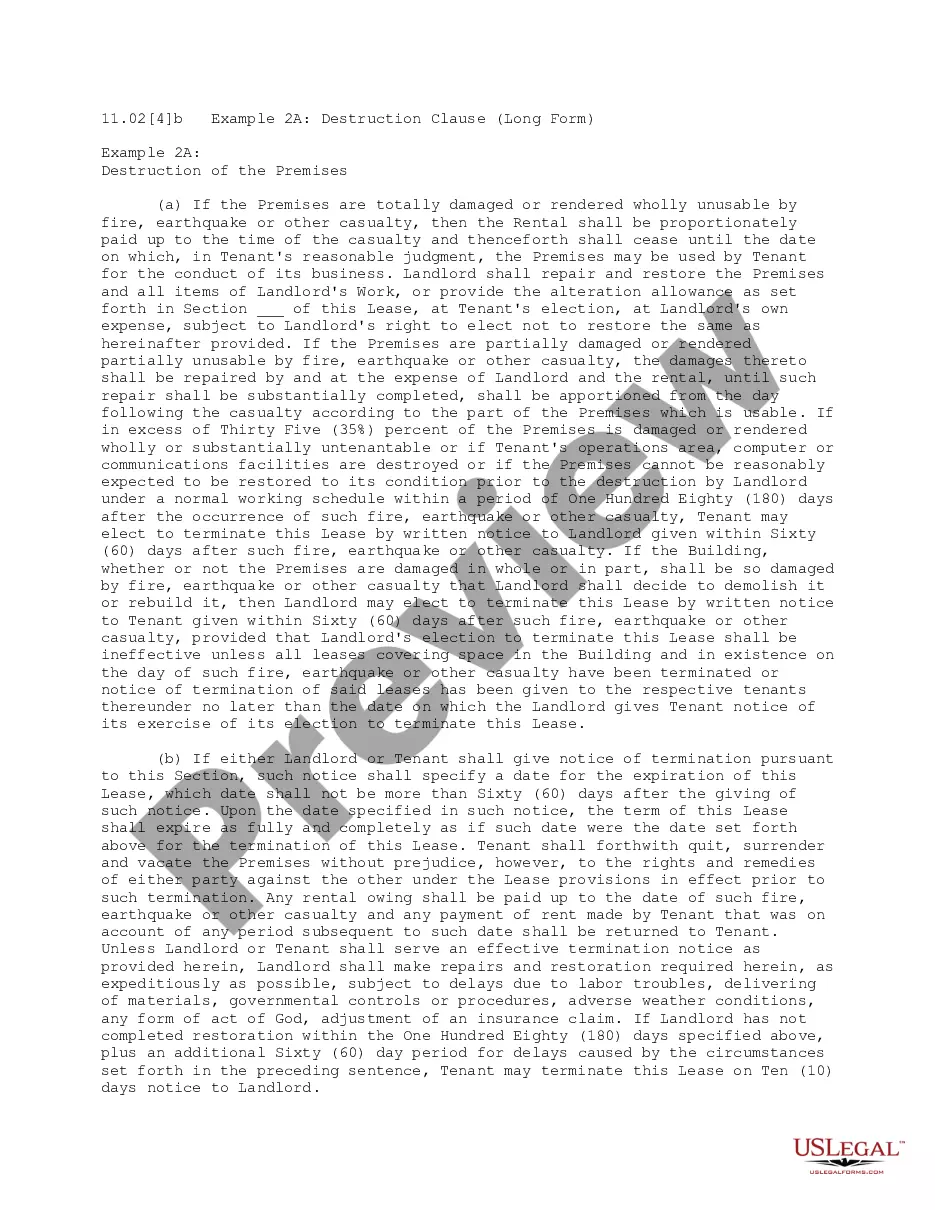
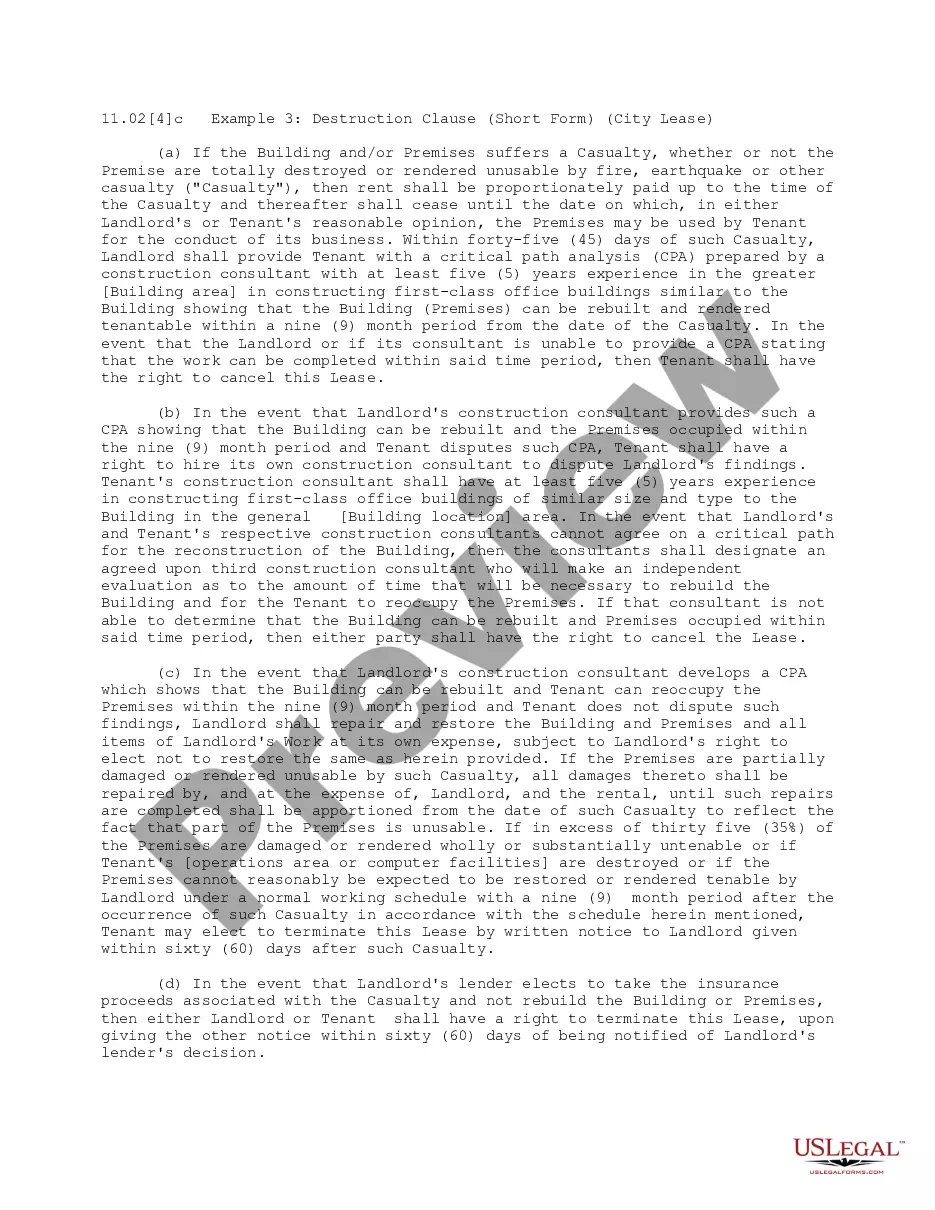
The Destruction Clause Long Form is a legal document used in office leases to outline the responsibilities of the landlord and tenant in the event that the premises are destroyed or rendered unusable due to various casualties, such as fire or earthquake. This form specifies the conditions under which the rental payments cease and the obligations of the landlord to repair or restore the property, differentiating it from shorter or simpler lease provisions related to destruction.
What’s included in this form
- Definition of circumstances causing total or partial destruction of the premises.
- Details on rental payments during the repair period.
- Landlord's obligation to restore the premises at their own expense.
- Tenant's options to terminate the lease based on degree of damage.
- Procedures for giving notice of termination by either party.

Common use cases
This form should be used when entering into an office lease agreement that includes a need for a detailed clause handling potential destruction of the premises. It's essential for lessees and lessors to know their rights and responsibilities before any unforeseen incidents occur. Typical scenarios for use include leasing properties in areas prone to natural disasters or in situations where past incidents of property damage have been documented.
Who needs this form
- Landlords of commercial properties looking to clarify their responsibilities in case of destruction.
- Tenants leasing office space who want to ensure their rights are protected in case of property damage.
- Real estate attorneys reviewing lease agreements for clients.
- Property managers overseeing commercial leases.
Instructions for completing this form
- Identify the parties involved in the lease: landlord and tenant.
- Specify the premises being leased, including address and any specific details.
- Enter the terms regarding destruction and the obligations for repair or restoration.
- Include conditions under which the tenant can terminate the lease post-casualty.
- Obtain necessary signatures from both parties to finalize the document.
Is notarization required?
This form does not typically require notarization unless specified by local law. However, it is always advisable to check local requirements to ensure compliance.
Get your form ready online
Our built-in tools help you complete, sign, share, and store your documents in one place.
Make edits, fill in missing information, and update formatting in US Legal Forms—just like you would in MS Word.
Download a copy, print it, send it by email, or mail it via USPS—whatever works best for your next step.
Sign and collect signatures with our SignNow integration. Send to multiple recipients, set reminders, and more. Go Premium to unlock E-Sign.
If this form requires notarization, complete it online through a secure video call—no need to meet a notary in person or wait for an appointment.
We protect your documents and personal data by following strict security and privacy standards.

Make edits, fill in missing information, and update formatting in US Legal Forms—just like you would in MS Word.

Download a copy, print it, send it by email, or mail it via USPS—whatever works best for your next step.

Sign and collect signatures with our SignNow integration. Send to multiple recipients, set reminders, and more. Go Premium to unlock E-Sign.

If this form requires notarization, complete it online through a secure video call—no need to meet a notary in person or wait for an appointment.

We protect your documents and personal data by following strict security and privacy standards.
Mistakes to watch out for
- Failing to clearly define what constitutes destruction of the premises.
- Omitting details on repair timelines and procedures.
- Not specifying conditions that allow for lease termination.
- Neglecting to obtain signatures from all parties involved.
Advantages of online completion
- Quick access to professionally drafted legal forms tailored for specific needs.
- Convenience of downloading and printing forms immediately.
- Editability allows landlords and tenants to tailor agreements to their specific situations.
- Reliability from forms prepared by licensed attorneys ensuring legal compliance.
Legal use & context
- This form is enforceable in a court of law, provided it is executed correctly and in accordance with state laws.
- Understanding the terms laid out in the destruction clause can help prevent disputes between landlords and tenants.
Quick recap
- The Destruction Clause Long Form protects both landlords and tenants in case of property damage.
- The form clearly outlines responsibilities regarding repairs and rental payments.
- Using this form can prevent misunderstandings following a major property casualty.
- It's important to consider state-specific rules when using this form.
Looking for another form?
Form popularity
FAQ
10 Important Rental Lease Clauses. #1 Rent Liability. #2 Severability Clause. #3 Access to Premises. #4 Use of Premises. #5 Holding Over. #6 Sublet Rules. #7 Disturbance Clause.
The lease is mutually beneficial. A tenant can't stop paying rent or vacate the property during the lease term this is a violation of the agreement.A rental agreement, by contrast, is a month-to-month agreement. At the end of each 30-day period, the landlord and tenant are both free to change the terms.
Names of all tenants. Limits on occupancy. Term of the tenancy. Rent. Deposits and fees. Repairs and maintenance. Entry to rental property. Restrictions on tenant illegal activity.
Most leases and rental agreements include a clause in which the tenant agrees that the premises are in habitable (livable) condition and promises to alert the landlord to any defective or dangerous condition. Tenant's repair and maintenance responsibilities.
The term is the length of the rental. The document should include the beginning date and whether it's a month-to-month tenancy or a lease.Leases often have a term of one year. The term of the tenancy is usually the primary difference beween a lease and a rental agreement, and the choice is typically the landlord's.
Amount of rent, security deposit, other payments. Duration of agreement and renewal criteria. List of fittings, fixtures. Registration of agreement. Restrictions.
Most rental agreements are short-term agreements, such as month-to-month tenancies, while lease agreements are usually for longer rental periods, such as six months, a year, or more.
Overview. Alberta has 2 types of rental agreements: Fixed term agreement. A fixed term tenancy begins and ends on specific dates. Periodic agreement. A periodic tenancy has a start date but no end date. Boarding and employer accommodations. Application of the legislation.
Unless the landlord is grossly negligent in getting the repairs made, the tenant does not have any recourse (other than to sue for breach of the lease) against the landlord and the tenant's insurance should cover his losses.Often, a tenant will request mutual indemnification from the landlord.