Easement and Agreement for Highway Purposes
About this form
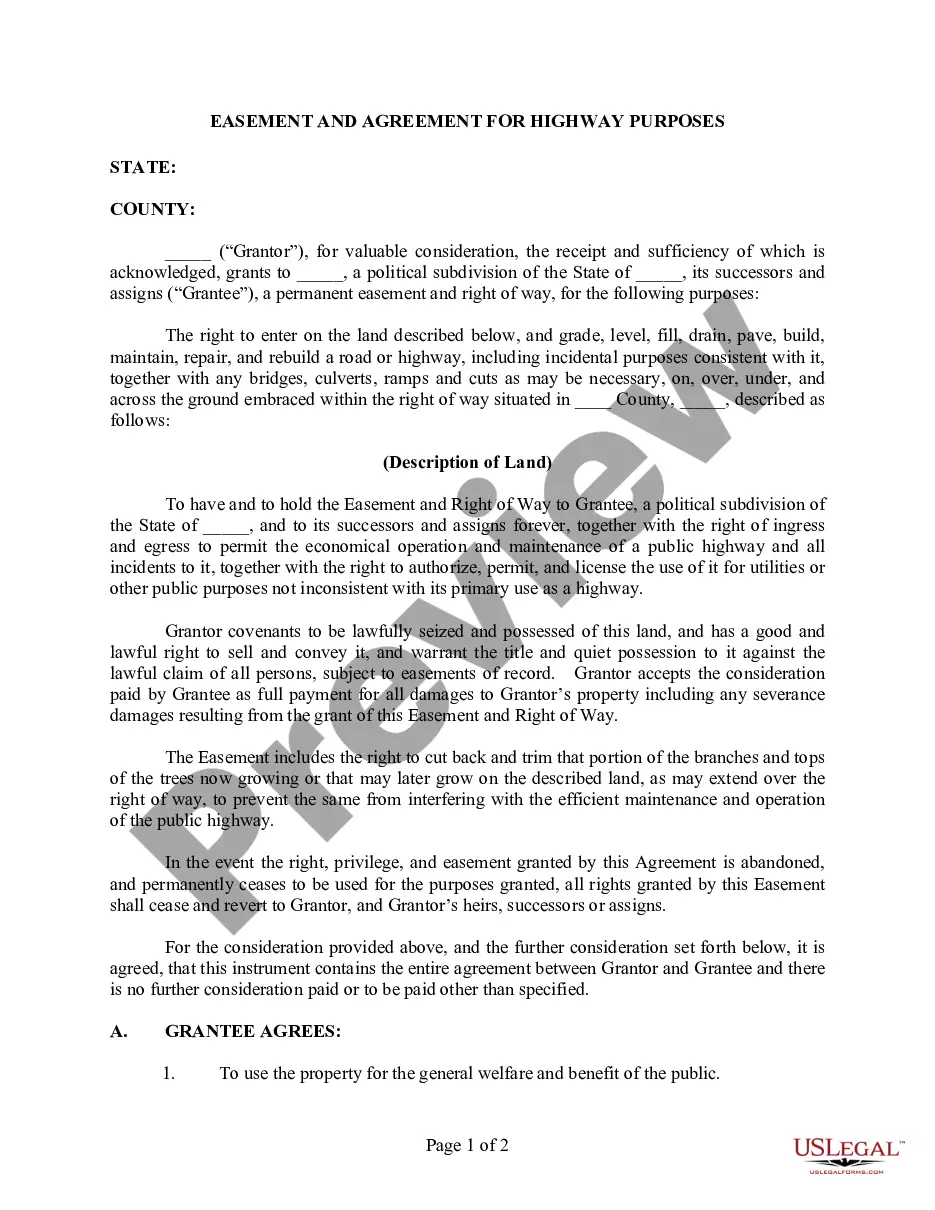
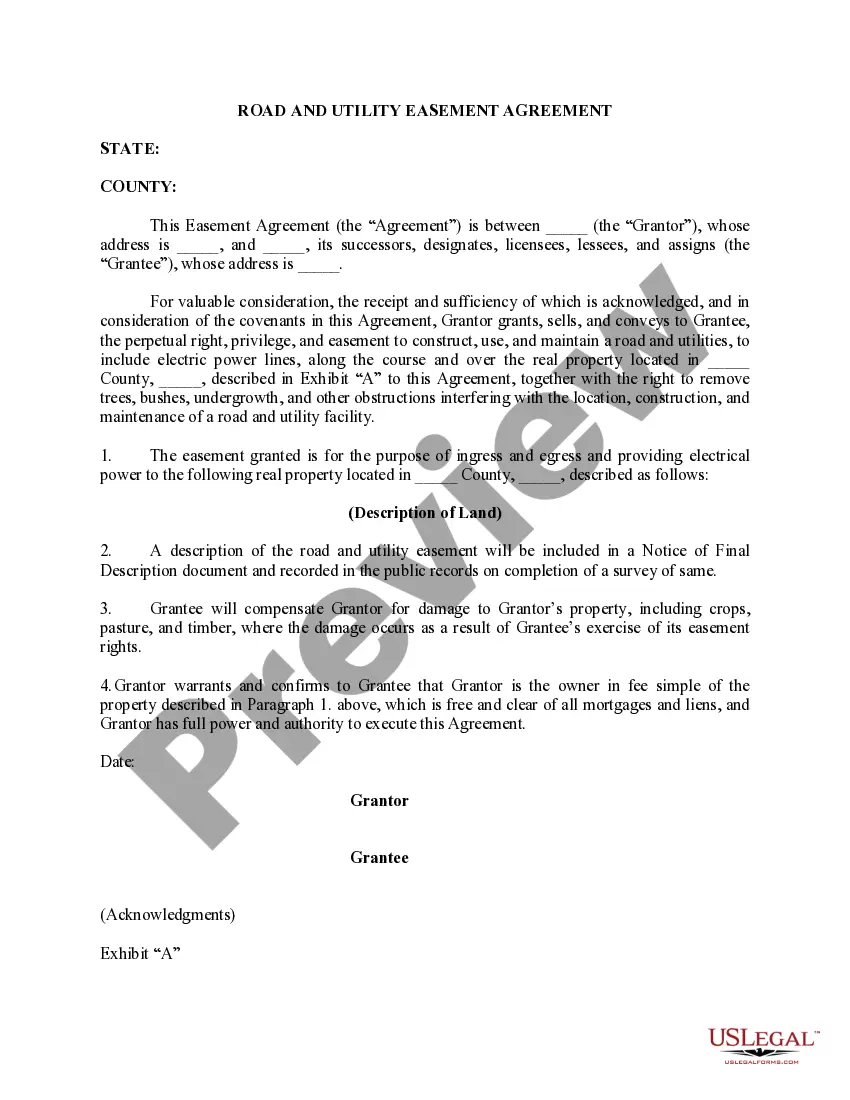
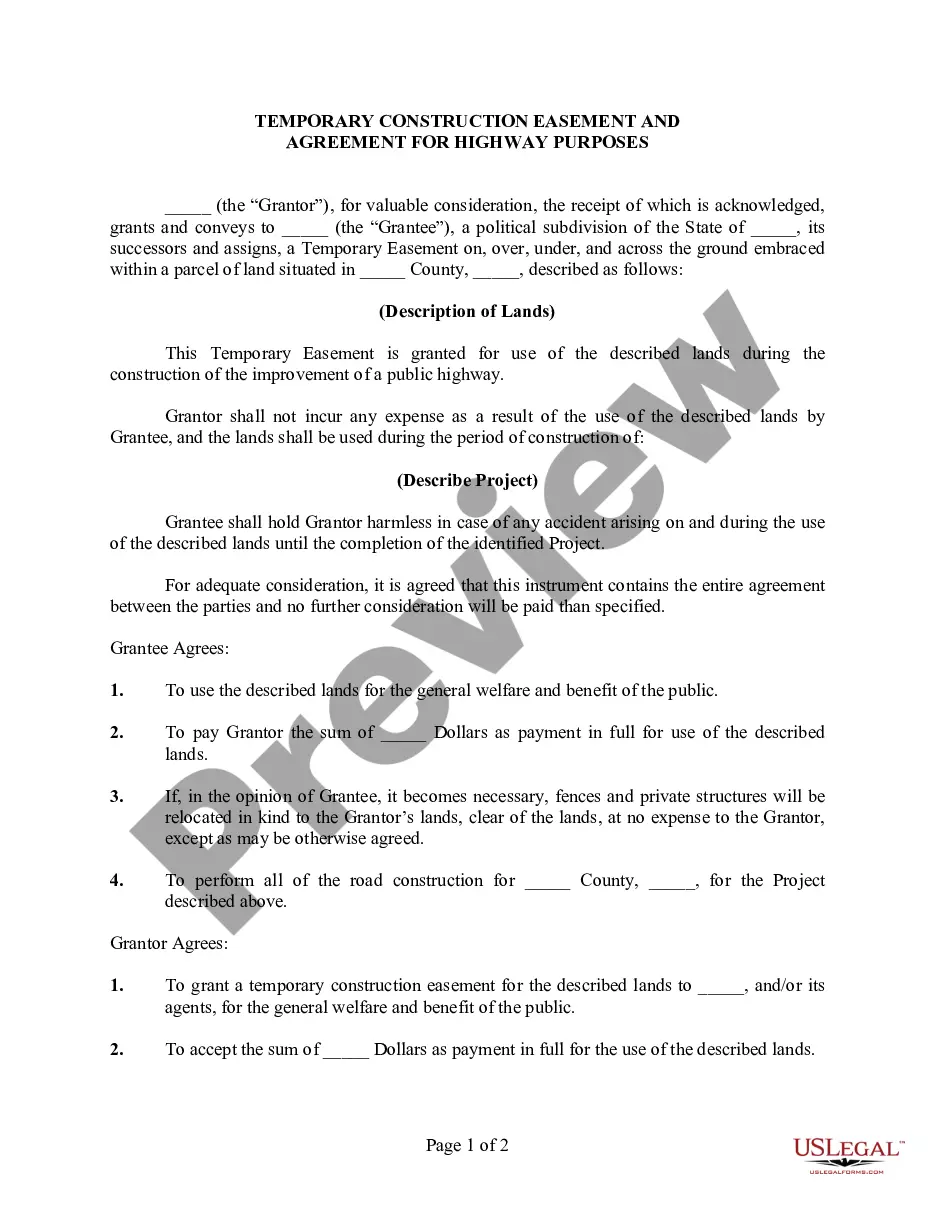
The Easement and Agreement for Highway Purposes is a legal document that establishes a permanent easement and right-of-way on a property for the construction and maintenance of a highway. This form is specifically designed for use between private landowners (Grantors) and government entities or political subdivisions (Grantees). It facilitates the legal process of granting access to land for public roadway use, differentiating it from other property agreements.
Key components of this form
- Identification of the Grantors and Grantee, including their legal status.
- Payment terms, documenting the consideration provided for the easement.
- Detailed description of the property affected by the easement.
- Rights of the Grantee, including construction, maintenance, and utility access.
- Obligations of the Grantors regarding the easement and property rights.
- Clauses addressing the abandonment of the easement and reversion of rights.

When to use this document
This form is necessary when a government entity wishes to acquire access to private land for the construction or improvement of a highway. It may be used during urban planning, road construction, or when establishing access routes for public utilities that run across private property. This agreement ensures that the government has legal rights for the ongoing maintenance and operation of the highway.
Intended users of this form
This form is appropriate for:
- Private landowners who are granting an easement for highway purposes.
- Government entities or political subdivisions seeking to establish public highways.
- Real estate developers coordinating with governmental agencies on property development.
How to complete this form
- Identify the Grantors (landowners) and the Grantee (government entity) clearly at the beginning of the form.
- Specify the correct payment amount and type of consideration involved in the easement.
- Provide a detailed description of the property that will be subject to the easement, including any necessary maps or exhibits.
- Include the rights that the Grantee will have regarding construction and maintenance on the land.
- Sign and date the form in the appropriate sections to make it legally binding.
Does this document require notarization?
To make this form legally binding, it must be notarized. Our online notarization service, powered by Notarize, lets you verify and sign documents remotely through an encrypted video session.
Get your form ready online
Our built-in tools help you complete, sign, share, and store your documents in one place.
Make edits, fill in missing information, and update formatting in US Legal Forms—just like you would in MS Word.
Download a copy, print it, send it by email, or mail it via USPS—whatever works best for your next step.
Sign and collect signatures with our SignNow integration. Send to multiple recipients, set reminders, and more. Go Premium to unlock E-Sign.
If this form requires notarization, complete it online through a secure video call—no need to meet a notary in person or wait for an appointment.
We protect your documents and personal data by following strict security and privacy standards.

Make edits, fill in missing information, and update formatting in US Legal Forms—just like you would in MS Word.

Download a copy, print it, send it by email, or mail it via USPS—whatever works best for your next step.

Sign and collect signatures with our SignNow integration. Send to multiple recipients, set reminders, and more. Go Premium to unlock E-Sign.

If this form requires notarization, complete it online through a secure video call—no need to meet a notary in person or wait for an appointment.

We protect your documents and personal data by following strict security and privacy standards.
Avoid these common issues
- Failing to include a clear and accurate description of the property involved.
- Not specifying the payment terms correctly, which may lead to disputes.
- Signing the agreement without proper legal counsel or understanding its implications.
Why use this form online
- Quick access to legally drafted templates created by licensed attorneys.
- Convenient downloading and easy editing capabilities allow for customization based on specific needs.
- Reduction of errors through guided steps and structured format.
Looking for another form?
Form popularity
FAQ
An easement is a limited right to use another person's land for a stated purpose. Examples of easements include the use of private roads and paths, or the use of a landowner's property to lay railroad tracks or electrical wires.
An easement is created by necessity when a single lot has been divided and one lot is left with no reasonable access to a main road or utilities without use of the other lot.
An easement is a nonpossessory right to use and/or enter onto the real property of another without possessing it. It is "best typified in the right of way which one landowner, A, may enjoy over the land of another, B".
Give the document a simple title: Grant of Easement is sufficient. Identify the parties. You need to explain who the parties are to the agreement. The person granting the easement to his property is the Grantor and the person gaining access to the property is the Grantee.
Easements can be created in a variety of ways. They can be created by an express grant, by implication, by necessity, and by adverse possession.
An easement deed allows a party that is not the owner to use a portion of the land. It is a written agreement between two parties that spells out what part of the property is available for access and how it may be used. Since you are granting an easement to your land, you can set any terms and conditions you like.
Easements are usually created by a transfer in a deed or some other written document such as a will or contract. Creating an easement requires the same formalities as the transferring or creating of other interests in land. It typically requires a written document, a signature, and proper delivery of the document.
Generally speaking, an easement is a more serious property right; it is the legal right to use someone else's land for a particular purpose. Easements are often recorded at the county clerk's office and encumber your property's title.Here, however, you probably do not need to take the step of granting an easement.
Nine Essential Property Easement Agreement Considerations. Legal Description of Properties. Depiction of the Easement Area. Covenant Not to Disturb the Use of the Easement. Determination of Maintenance Obligations. Payment of Property Taxes.