Correction to Mistakes in Prior Conveyance
Overview of this form
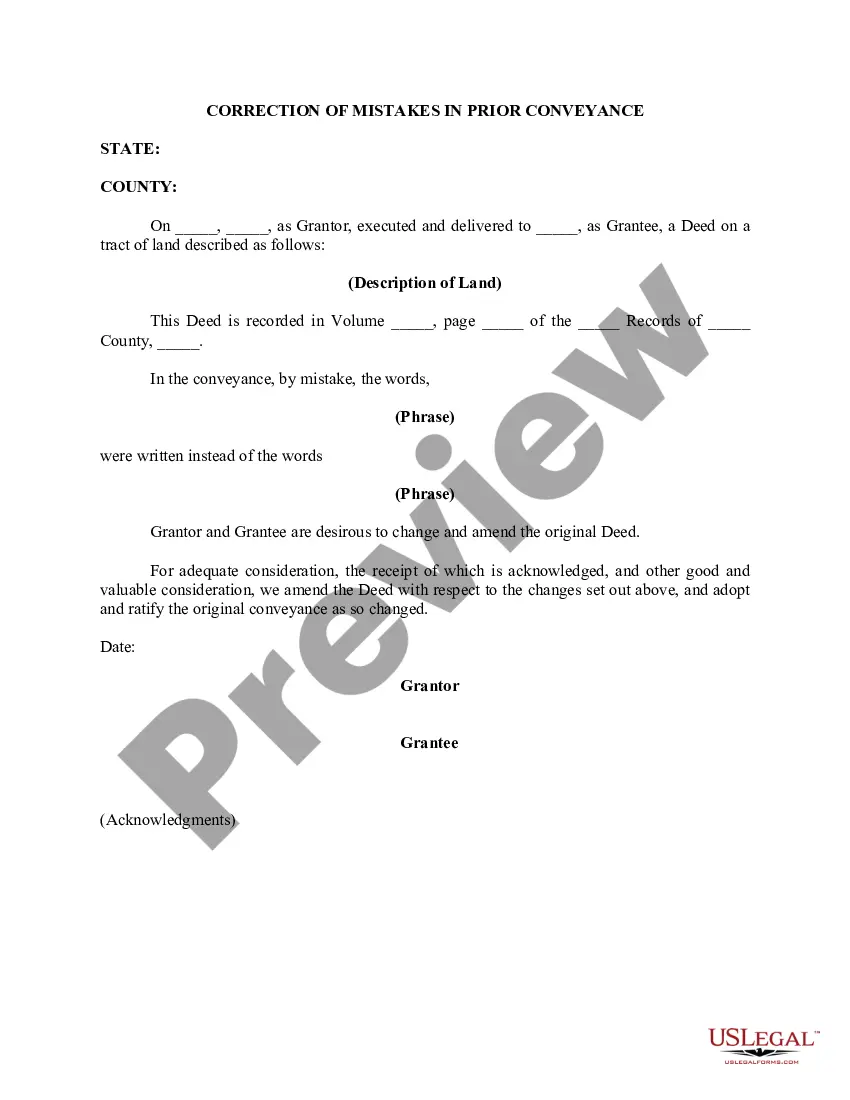
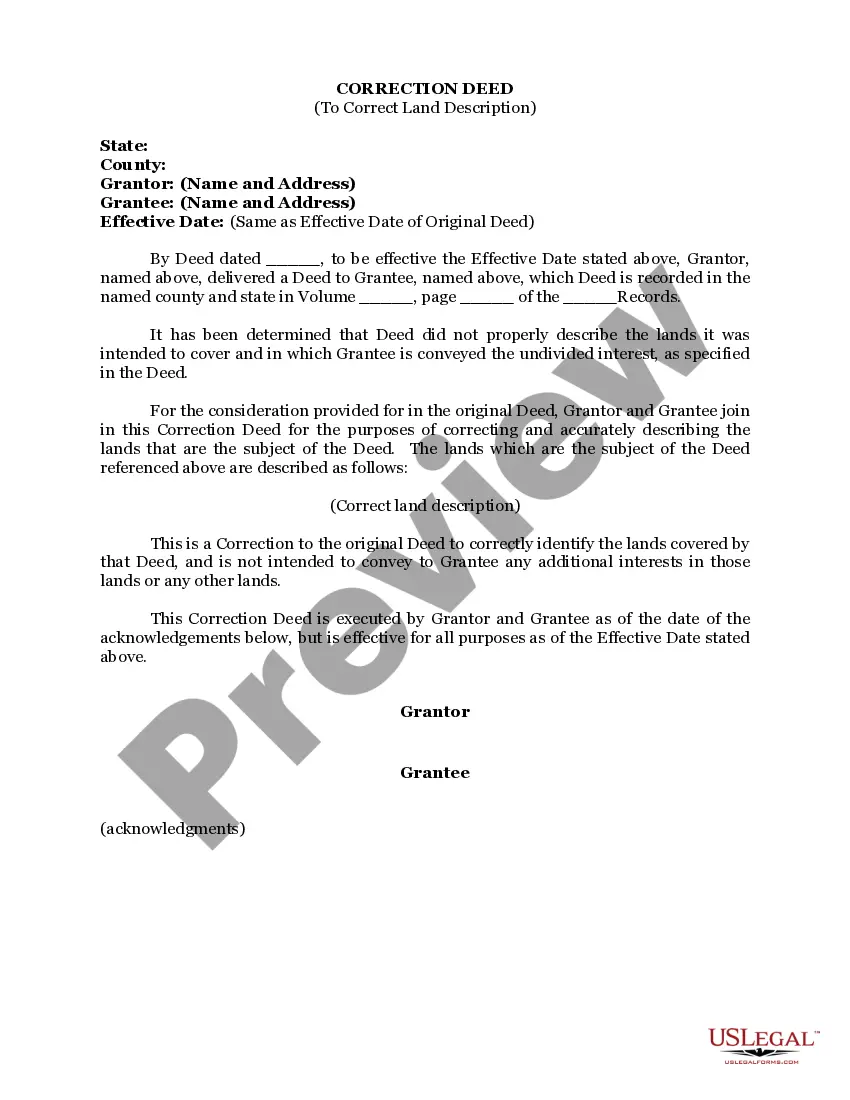
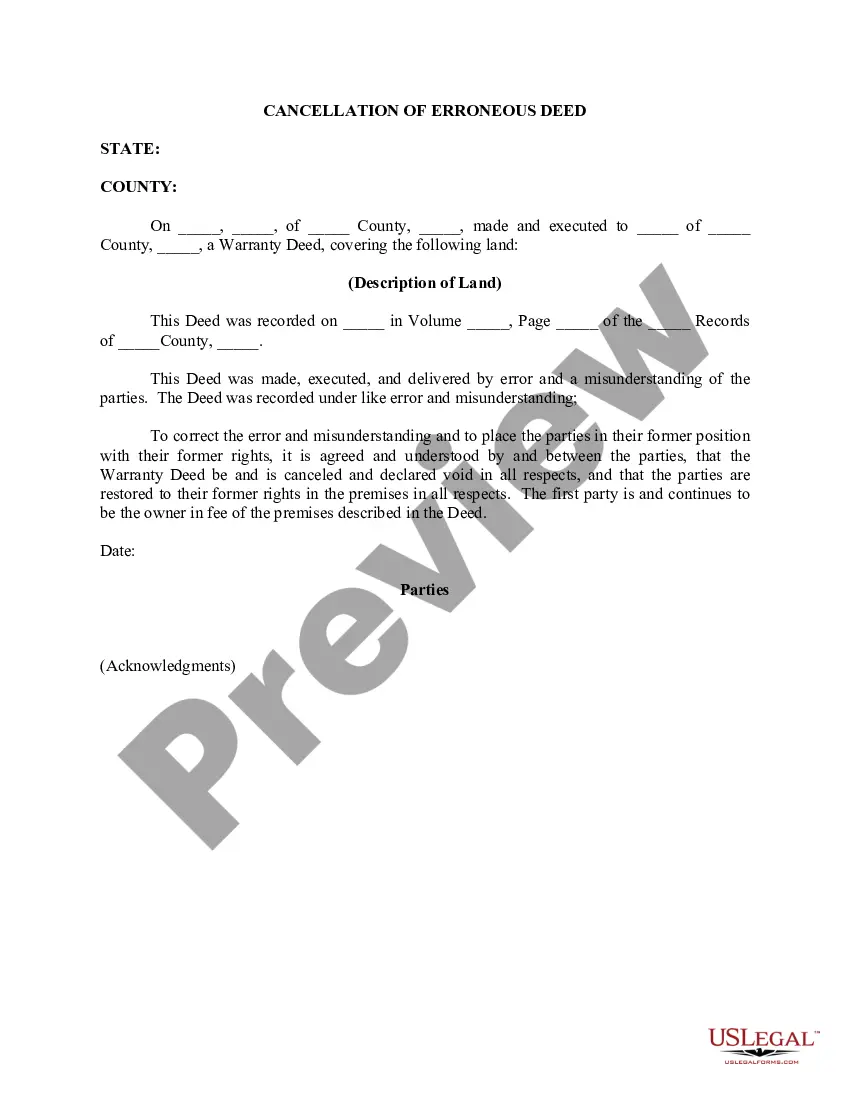
The Correction to Mistakes in Prior Conveyance form is a legal document used to amend and correct errors in a previous property transfer. Unlike other conveyance forms, this specific form addresses inaccuracies in the language used in earlier documents, ensuring that both the grantor and grantee clearly understand and agree to the corrections. This form is important for maintaining accurate ownership records and preventing potential disputes regarding property rights.
Key components of this form
- Identification of the parties involved in the original conveyance, including grantor and grantee.
- Description of the property being corrected, which needs to be clearly defined.
- Reference to the original conveyance's recording, specifying the volume and page number.
- Explicit statement of the mistakes made in the original text, along with the corrections.
- A declaration of acknowledgment of consideration (payment) for the amendments made.
- Signatures of both parties, with a space for notarization if required.

When to use this form
This form should be used when there are significant errors in a previously recorded property conveyance. For instance, if the names of parties are misspelled, property descriptions are incorrect, or key terminology is mistakenly included, this form allows the parties to officially correct those errors. It is essential in maintaining the integrity of property records and ensuring clear communication between involved parties.
Who this form is for
This form is suitable for:
- Property owners who need to amend errors in a past conveyance.
- Grantors and grantees wishing to clarify the terms of their property agreement.
- Real estate professionals or attorneys assisting clients with property transactions.
How to complete this form
- Identify and list the names of the grantor and grantee involved in the original conveyance.
- Provide a complete and precise description of the property that is being corrected.
- Reference the previous conveyance by including the exact volume and page number of the recording.
- Clearly state the errors that occurred in the original document, specifying what was incorrect.
- Include accurate corrections for the mistaken phrases or terms.
- Have both parties sign the document and, if necessary, provide notarization for legal validation.
Does this document require notarization?
Notarization is required for this form to take effect. Our online notarization service, powered by Notarize, lets you verify and sign documents remotely through an encrypted video session, available 24/7.
Get your form ready online
Our built-in tools help you complete, sign, share, and store your documents in one place.
Make edits, fill in missing information, and update formatting in US Legal Forms—just like you would in MS Word.
Download a copy, print it, send it by email, or mail it via USPS—whatever works best for your next step.
Sign and collect signatures with our SignNow integration. Send to multiple recipients, set reminders, and more. Go Premium to unlock E-Sign.
If this form requires notarization, complete it online through a secure video call—no need to meet a notary in person or wait for an appointment.
We protect your documents and personal data by following strict security and privacy standards.

Make edits, fill in missing information, and update formatting in US Legal Forms—just like you would in MS Word.

Download a copy, print it, send it by email, or mail it via USPS—whatever works best for your next step.

Sign and collect signatures with our SignNow integration. Send to multiple recipients, set reminders, and more. Go Premium to unlock E-Sign.

If this form requires notarization, complete it online through a secure video call—no need to meet a notary in person or wait for an appointment.

We protect your documents and personal data by following strict security and privacy standards.
Typical mistakes to avoid
- Failing to accurately describe the property or including incorrect property details.
- Not referencing the correct recording information from the previous conveyance.
- Omitting the signatures of both parties, which invalidates the document.
- Neglecting to clearly state the corrections, leading to confusion about the changes made.
Benefits of completing this form online
- Convenient access to a legally vetted document that saves time.
- Easy to fill out and edit according to your specific needs.
- Reliable templates drafted by licensed attorneys ensure legal compliance.
Quick recap
- The Correction to Mistakes in Prior Conveyance form is essential for amending errors in property documents.
- Accurate filling out of this form helps avoid future disputes regarding property ownership.
- Ensure compliance with state-specific requirements to maintain legality.
Looking for another form?
Form popularity
FAQ
Re-recording of the original document. With corrections made in the body of the original document. A cover sheet detailing the changes. Must be re-signed and re-acknowledged. Correction Deed. A new deed reflecting the corrections/changes. Must meet all recording requirements of a deed.
Although it's possible to change the names on title deeds yourself, we recommend that you seek professional help from a solicitor. The value of property is sufficiently high to make it worthwhile getting the transfer right.
Determine if the error is harmless or fatal to the transfer of title. Decide what instrument is best suited to the error. Draft a corrective deed, affidavit, or new deed. Obtain the original signature(s) of the Grantor(s). Re-execute the deed with proper notarization and witnessing.
The doctrine of a "scrivener's error" is the legal principle that a map-drafting or typographical error in a written contract may be corrected by oral evidence if the evidence is clear, convincing, and precise.
Agreements are often deeds, and a document that amends an operative part of another document required by law to be a deed must also be a deed. However, a deed can be amended by a simple agreement so long as there is consideration for the amendment and the deed itself does not require the amendment to be made by deed.
Once a deed has been recorded, it is part of the public record and cannot be changed. It is possible, however, to amend that record by adding a newly executed deed, usually called correction or corrective deed, deed of correction or, in some states, deed of confirmation.
Retrieve your original deed. Get the appropriate deed form. Draft the deed. Sign the deed before a notary. Record the deed with the county recorder. Obtain the new original deed.
First, if the scrivener's error is apparent on the face of the policy, a court may correct that error by applying the general rules of contract interpretation. Second, if a scrivener's error is not apparent on the face of the policy, a court may reform the contract to correct the error if the error is a mutual mistake.
Determine if the error is harmless or fatal to the transfer of title. Decide what instrument is best suited to the error. Draft a corrective deed, affidavit, or new deed. Obtain the original signature(s) of the Grantor(s). Re-execute the deed with proper notarization and witnessing.