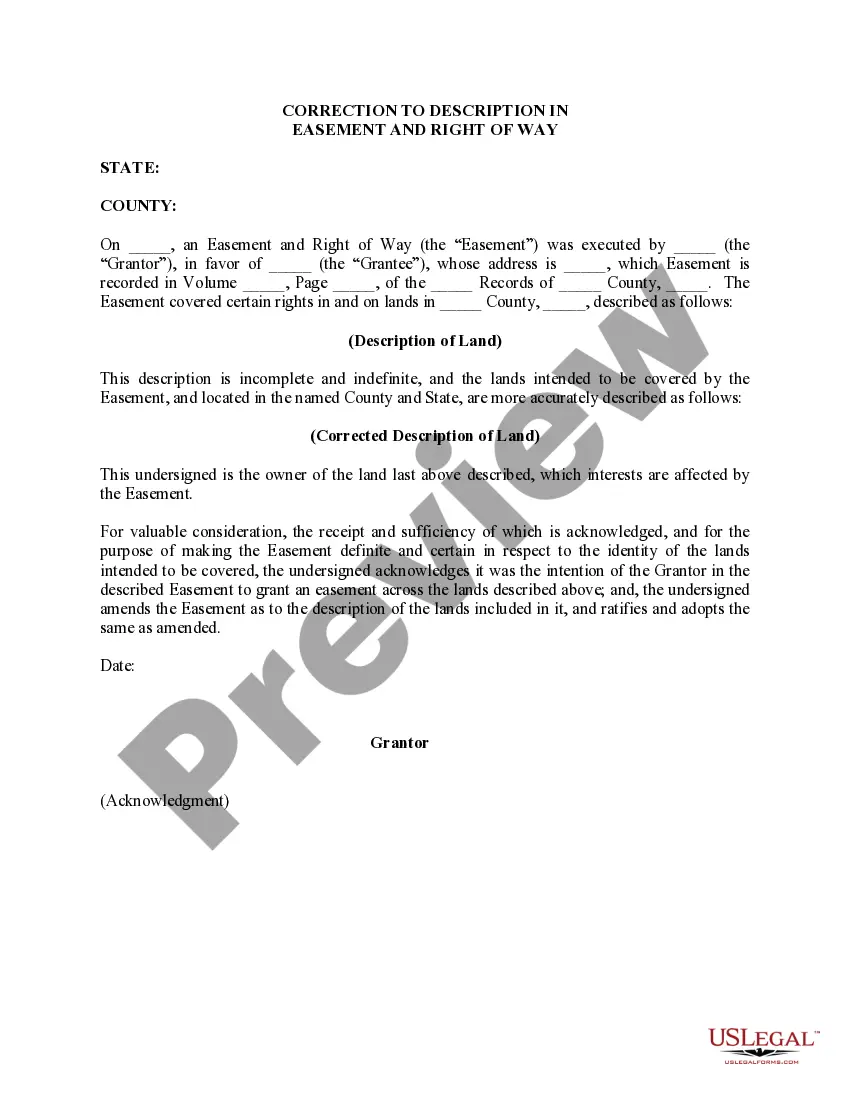
Correction to Description in Easement and Right of Way
What this document covers
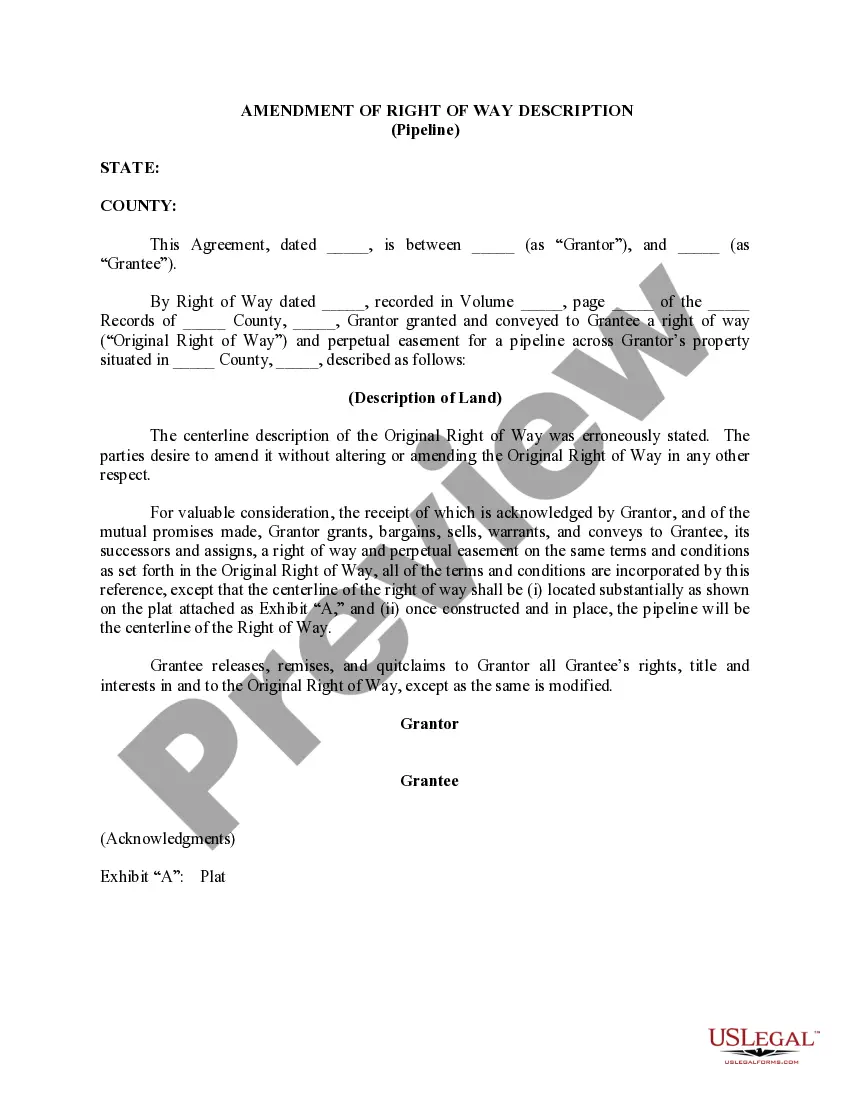
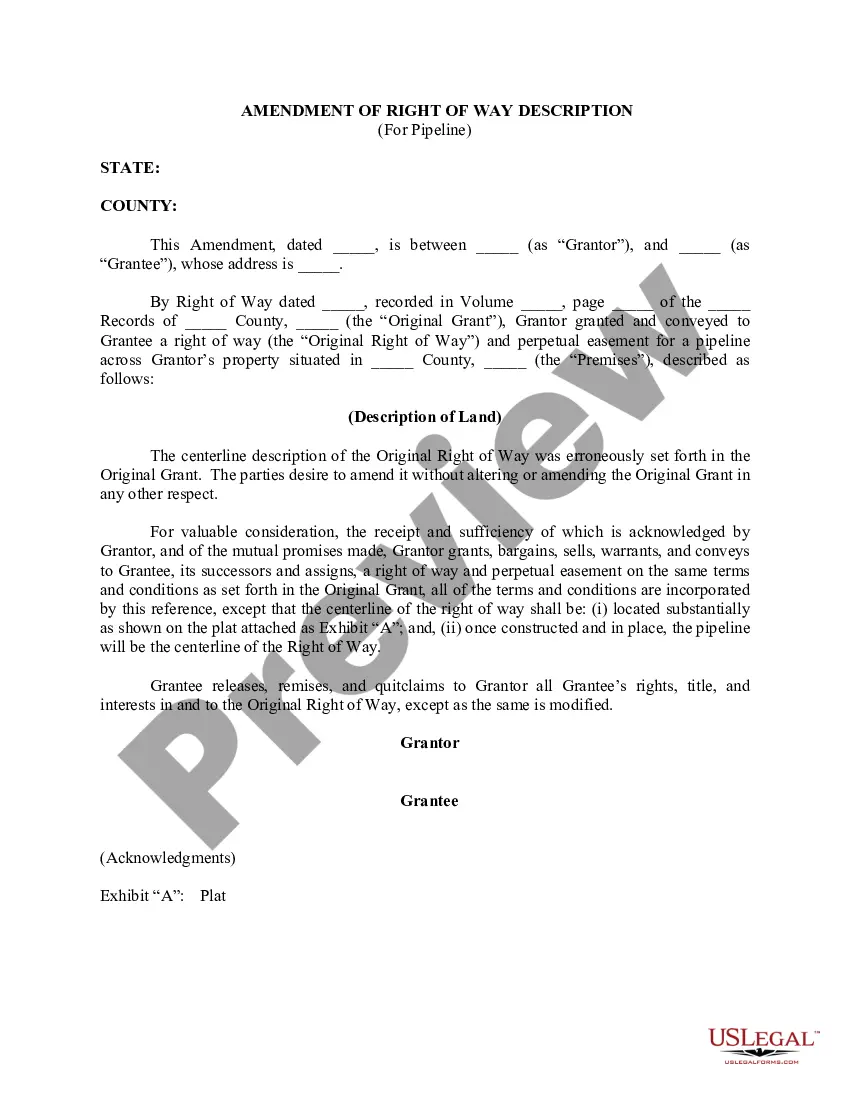
The Correction to Description in Easement and Right of Way is a legal document used to amend and clarify the boundaries or properties covered by an existing easement. This form ensures that any vague or incomplete descriptions are rectified, making the easement enforceable and precise. Unlike standard easement agreements, this correction specifically targets the accuracy of property descriptions, helping prevent disputes related to property rights and access.
Form components explained
- Date of the original easement execution.
- Names and addresses of the Grantor and Grantee.
- Volume and page number of recorded easement.
- Initial vague description of the land covered by the easement.
- Corrected, precise description of the property intended to be covered by the easement.
- Signature and acknowledgment of the Grantor and any relevant parties.
When this form is needed
This form should be used when there is a need to correct or clarify the description within an existing easement or right of way. Such situations may arise when a property has been subdivided or if the original description was ambiguous. Using this form helps clear up any misunderstandings about property boundaries and ensures that all parties involved have an accurate understanding of the easement's limits.
Who can use this document
This form is suitable for:
- Property owners (Grantors) who have previously granted an easement.
- Individuals or entities (Grantees) that intend to use the easement.
- Real estate professionals seeking to clarify property rights.
- Attorneys assisting clients with property and easement-related issues.
How to prepare this document
- Identify the date of the original easement execution.
- Fill in the names and addresses of the Grantor and Grantee.
- Specify the volume and page number where the easement is recorded.
- Clearly describe the original and corrected property boundaries.
- Have all parties sign and date the correction form.
Notarization requirements for this form
This form needs to be notarized to ensure legal validity. US Legal Forms provides secure online notarization powered by Notarize, allowing you to complete the process through a verified video call, available anytime.
Get your form ready online
Our built-in tools help you complete, sign, share, and store your documents in one place.
Make edits, fill in missing information, and update formatting in US Legal Forms—just like you would in MS Word.
Download a copy, print it, send it by email, or mail it via USPS—whatever works best for your next step.
Sign and collect signatures with our SignNow integration. Send to multiple recipients, set reminders, and more. Go Premium to unlock E-Sign.
If this form requires notarization, complete it online through a secure video call—no need to meet a notary in person or wait for an appointment.
We protect your documents and personal data by following strict security and privacy standards.

Make edits, fill in missing information, and update formatting in US Legal Forms—just like you would in MS Word.

Download a copy, print it, send it by email, or mail it via USPS—whatever works best for your next step.

Sign and collect signatures with our SignNow integration. Send to multiple recipients, set reminders, and more. Go Premium to unlock E-Sign.

If this form requires notarization, complete it online through a secure video call—no need to meet a notary in person or wait for an appointment.

We protect your documents and personal data by following strict security and privacy standards.
Mistakes to watch out for
- Failing to clearly delineate corrected property boundaries.
- Omitting important details such as the recording information.
- Not obtaining the necessary signatures from all parties involved.
- Neglecting to consult local laws which may affect the easement.
Advantages of online completion
- Convenient downloads save time, allowing you to complete your corrections promptly.
- Edit and customize the form easily to fit your specific needs.
- Access to professionally drafted templates ensures legal accuracy.
- Available anytime, allowing you to complete necessary documentation at your convenience.
Looking for another form?
Form popularity
FAQ
Determine if the error is harmless or fatal to the transfer of title. Decide what instrument is best suited to the error. Draft a corrective deed, affidavit, or new deed. Obtain the original signature(s) of the Grantor(s). Re-execute the deed with proper notarization and witnessing.
Enter into an agreement with the easement holder to terminate the easement. Buy the adjoining property. Explore legal remedies to limit or terminate the easement.
Resolving Small Ambiguities: The Scrivener Affidavit. Sometimes an omission attracts attention just after recording. The Correction Deed: Stronger Than a Scrivener's Affidavit. Obtain your correction deed form. Execute the correction deed. Record the correction deed.
When one of the owners of either the dominant estate which an easement benefits or the servient estate over which the easement runs becomes the owner of both properties, then there is a unity of the two titles, and since an owner does not need an easement over the owner's own property, according to Florida law, the
An easement is a nonpossessory right to use and/or enter onto the real property of another without possessing it. It is "best typified in the right of way which one landowner, A, may enjoy over the land of another, B".
You can correct an error on a California deed through a Correction Deed or Corrective Deed. Usually deed errors are as a result of someone attempting to prepare a deed without proper knowledge or professional help.
If a deed is to have any validity, it must be made voluntarily.If FRAUD is committed by either the grantor or grantee, a deed can be declared invalid. For example, a deed that is a forgery is completely ineffective. The exercise of UNDUE INFLUENCE also ordinarily serves to invalidate a deed.
Re-recording of the original document. With corrections made in the body of the original document. A cover sheet detailing the changes. Must be re-signed and re-acknowledged. Correction Deed. A new deed reflecting the corrections/changes. Must meet all recording requirements of a deed.
A corrective affidavit is a statutory device under Cal.Gov. Code 27201, used to correct a minor error in a document that has been recorded at an earlier date. Minor errors are those that, when corrected, cause no actual change in the substance of the document.