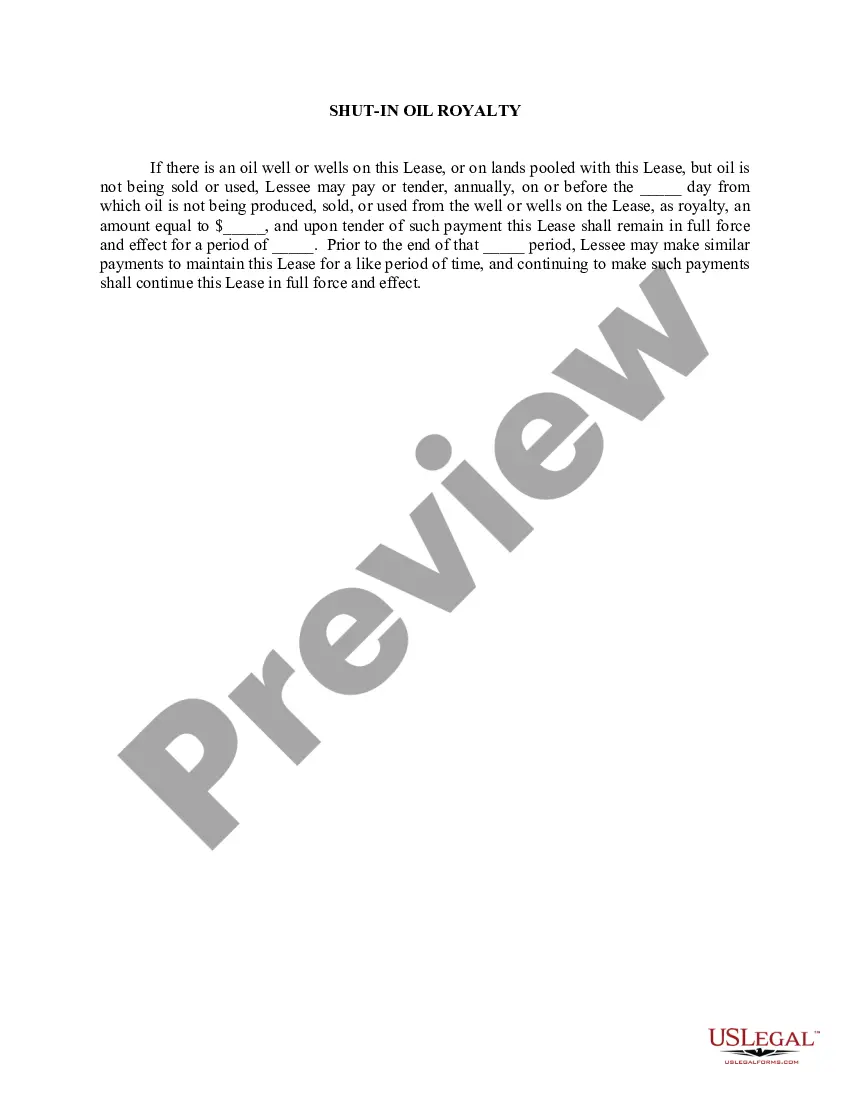
Shut-In Oil Royalty
What is this form?
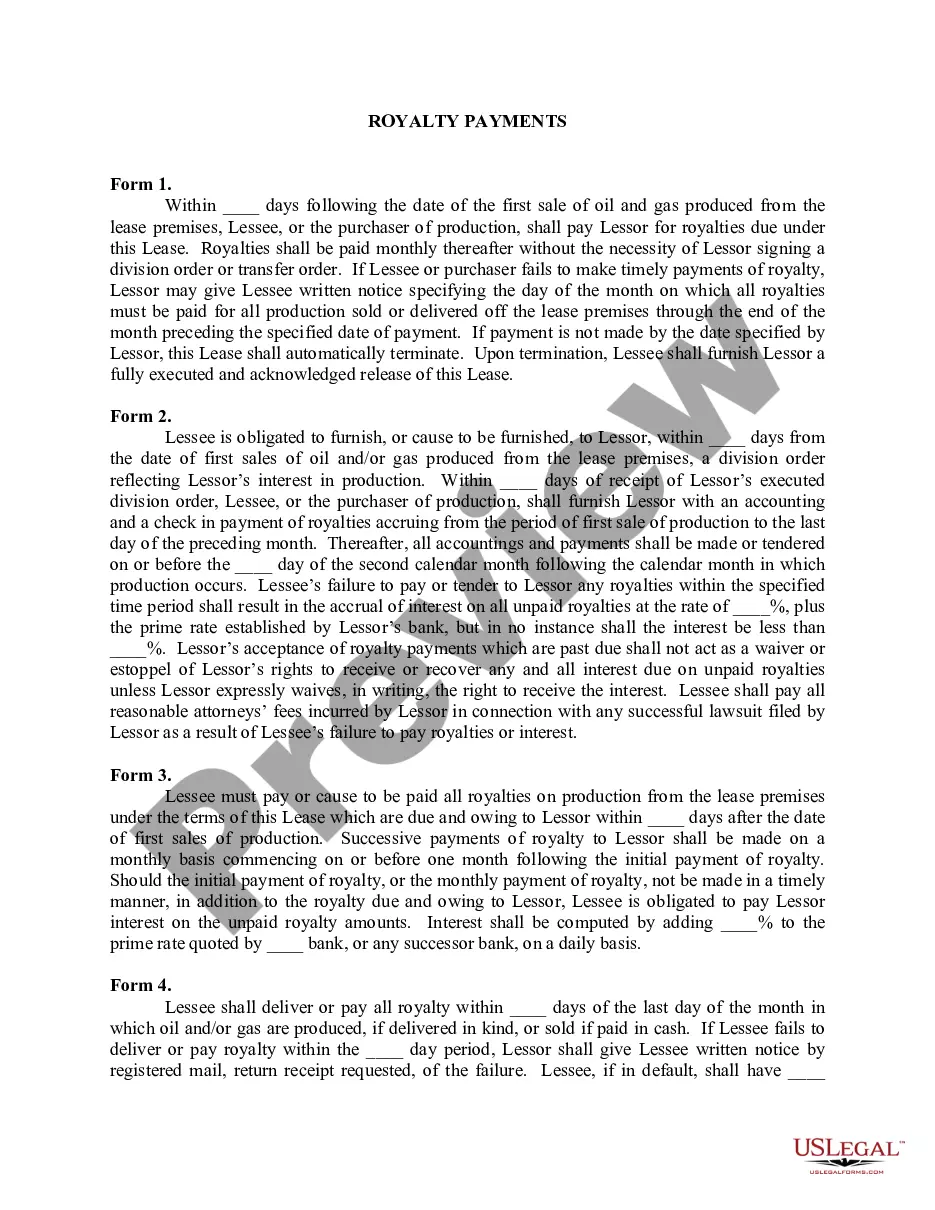
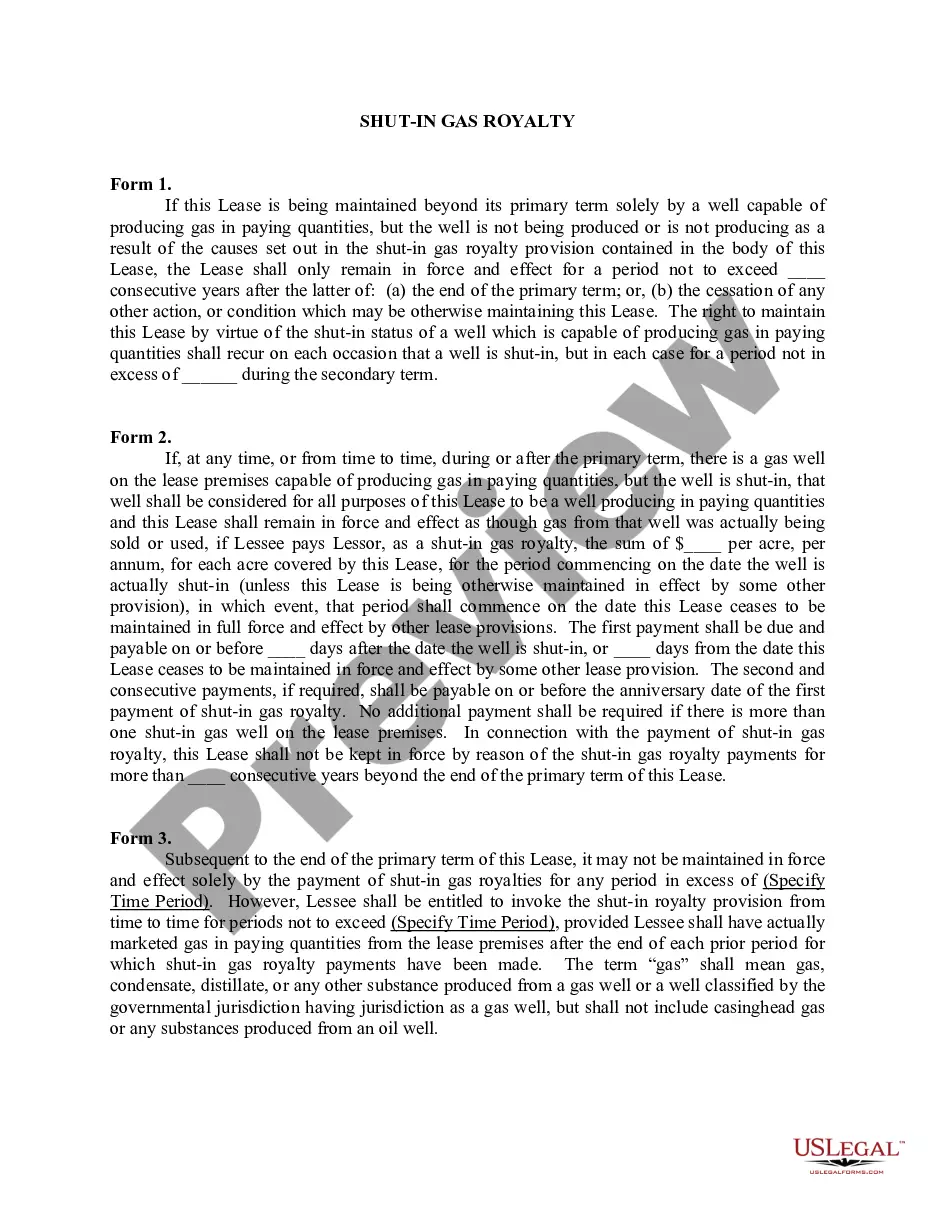
The Shut-In Oil Royalty form is a lease rider that allows you to modify an oil and gas lease. This form is specifically designed for situations where an oil well exists on the leased land but is not producing oil for sale or use. By using this form, you can establish specific conditions and limitations on the rights granted to the lessee, ensuring your concerns are addressed in the lease agreement.
What’s included in this form
- Royalty payment amount: Specified amount that the lessee must pay when oil is not being produced.
- Payment due date: The deadline for the lessee to make the royalty payment.
- Lease maintenance period: Duration for which the lease remains in effect upon payment.
- Renewal provisions: Terms for continuing the lease with subsequent payments.
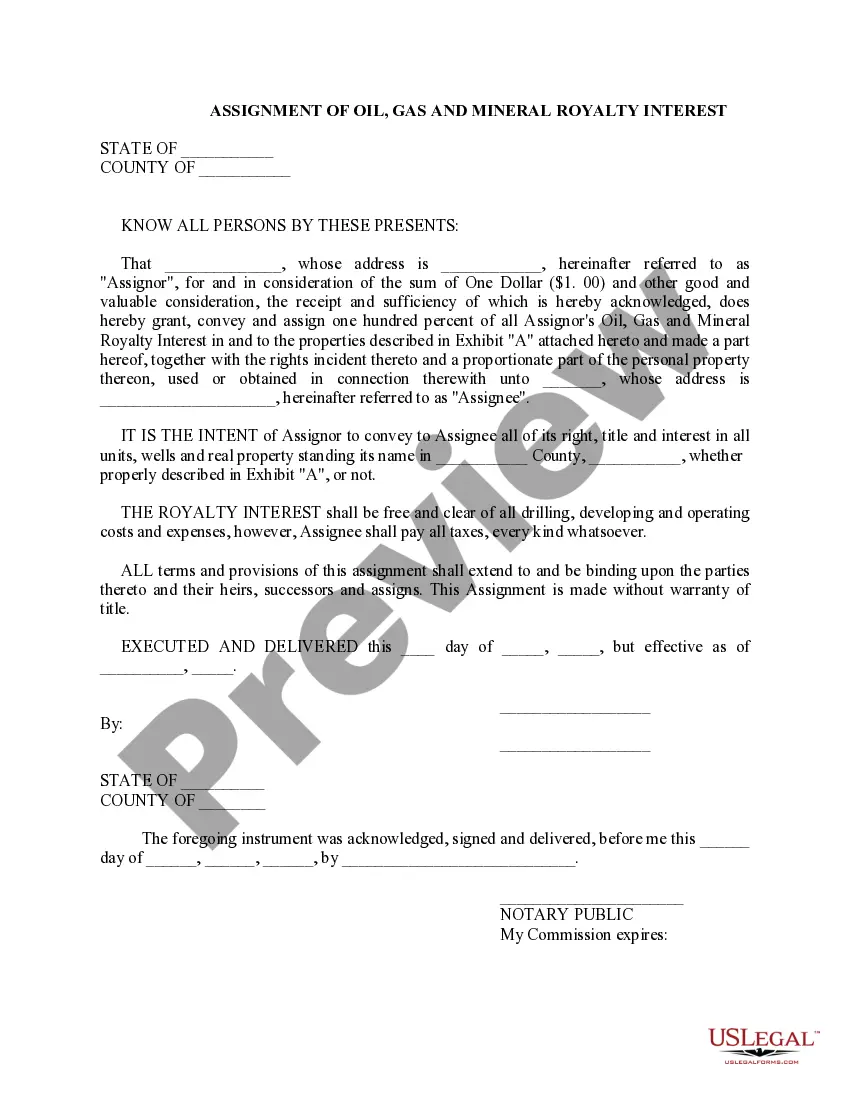
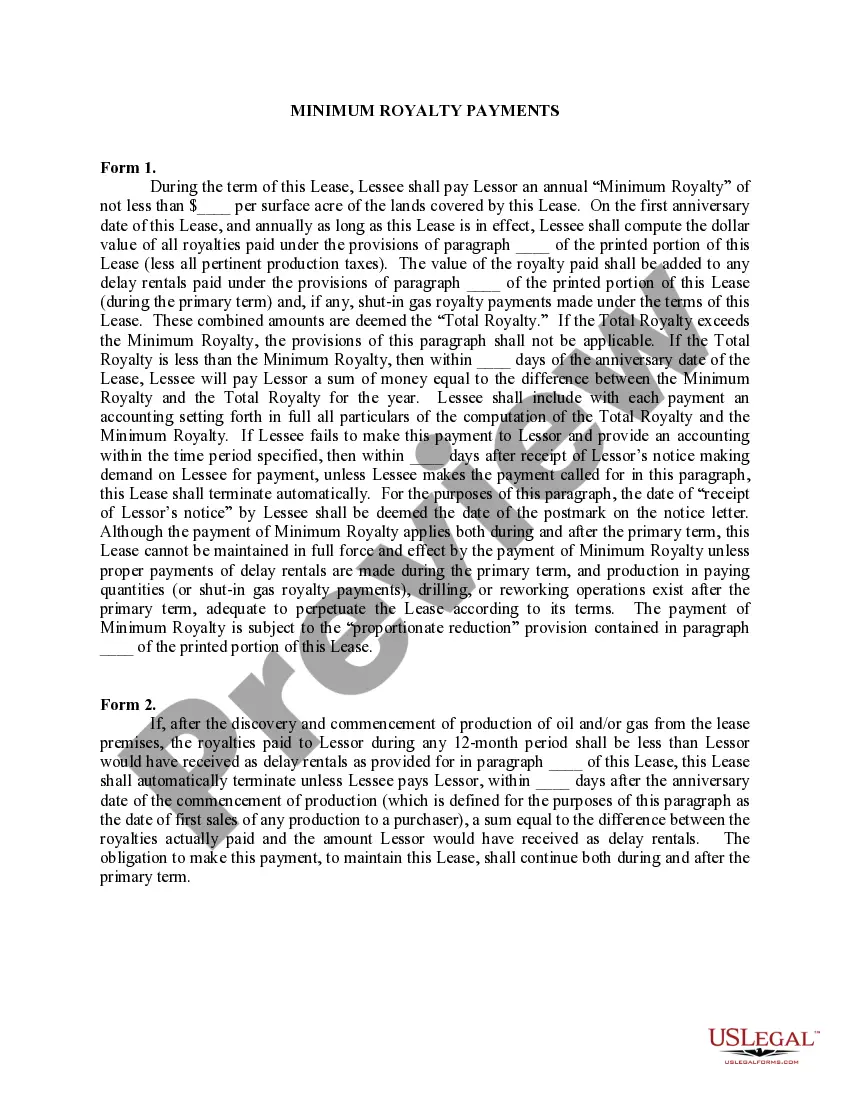
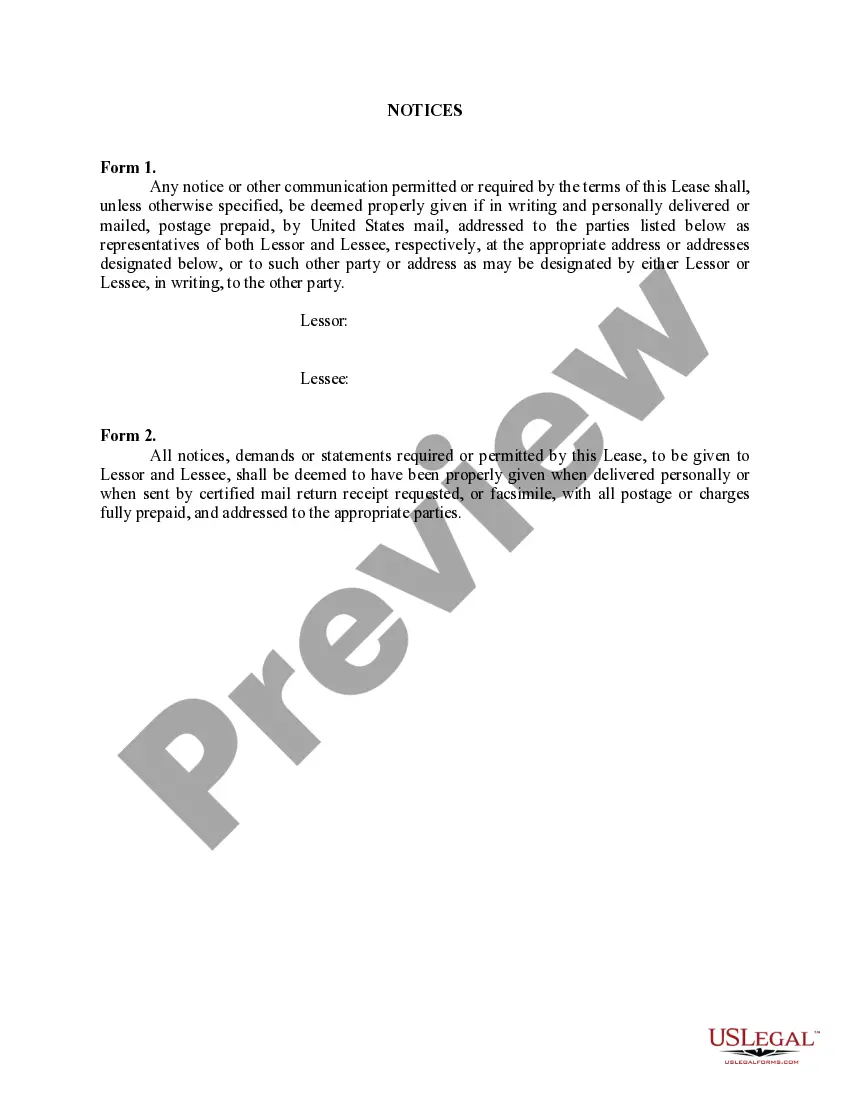
When to use this document
This form should be used when entering into an oil and gas lease and it has been decided that the lease will include additional provisions related to shut-in oil wells. It is particularly useful when an oil well exists but is temporarily not producing oil, allowing the lessee to maintain the lease through payment of royalties without producing the oil.
Who needs this form
- Landowners looking to lease oil and gas rights while protecting their interests.
- Lessee companies that need to address specific concerns of landowners in lease agreements.
- Anyone involved in oil and gas transactions requiring customized lease provisions.
How to prepare this document
- Identify the parties involved, including the lessor and lessee.
- Specify the payment amount for the royalty in the relevant field.
- Enter the due date for the royalty payment in the designated section.
- Complete the lease maintenance period duration in the form.
- Review all terms and sign the document to finalize it.
Is notarization required?
This form does not typically require notarization to be legally valid. However, some jurisdictions or document types may still require it. US Legal Forms provides secure online notarization powered by Notarize, available 24/7 for added convenience.
Get your form ready online
Our built-in tools help you complete, sign, share, and store your documents in one place.
Make edits, fill in missing information, and update formatting in US Legal Forms—just like you would in MS Word.
Download a copy, print it, send it by email, or mail it via USPS—whatever works best for your next step.
Sign and collect signatures with our SignNow integration. Send to multiple recipients, set reminders, and more. Go Premium to unlock E-Sign.
If this form requires notarization, complete it online through a secure video call—no need to meet a notary in person or wait for an appointment.
We protect your documents and personal data by following strict security and privacy standards.

Make edits, fill in missing information, and update formatting in US Legal Forms—just like you would in MS Word.

Download a copy, print it, send it by email, or mail it via USPS—whatever works best for your next step.

Sign and collect signatures with our SignNow integration. Send to multiple recipients, set reminders, and more. Go Premium to unlock E-Sign.

If this form requires notarization, complete it online through a secure video call—no need to meet a notary in person or wait for an appointment.

We protect your documents and personal data by following strict security and privacy standards.
Common mistakes
- Omitting the specific payment amount can lead to disputes.
- Failing to accurately enter the payment due date can result in lease termination.
- Not specifying the maintenance period may leave the lease vulnerable to expiration.
Benefits of completing this form online
- Convenience: Downloadable and accessible anytime, anywhere.
- Editability: Allows you to customize the form to meet specific needs.
- Reliability: Templates drafted by licensed attorneys ensure legal validity.
Looking for another form?

Form popularity
FAQ
In the petroleum industry, shutting-in is the implementation of a production cap set lower than the available output of a specific site. This may be part of an attempt to constrict the oil supply or a necessary precaution when crews are evacuated ahead of a natural disaster.
For many years, almost all oil and gas leases reserved a 1/8th royalty. Today, the royalty fraction is negotiable, and is usually between 1/8th and 1/4th. Bonus. The bonus is the amount paid to the Lessor as consideration for his/her execution of the lease.
In the event oil and gas were found and the wells produce, then the royalties kick in. So if the oil well produce 100 barrels a day, and the price of oil is $80 per barrel that month, then the cash flow is 100x$80 = $8,000/day The royalty owner, who agreed to 15% royalty, would receive $8,000 x 0.15 = $1,200/day.
Oil & gas royalties are paid monthly, consistent with the normal accounting cycle of the producer, unless the obligation does not meet the minimum check requirement for that particular state. These laws are generally known as aggregate pay laws, usually set at either $25 or $100.
In the petroleum industry, shutting-in is the implementation of a production cap set lower than the available output of a specific site.In April 2020, as a result of oil futures trading negative, Oklahoma and New Mexico voted to allow wells to shut-in in order to reduce production to combat oversupply.
Essentially, the shut-in royalty provision allows a lessee to temporarily cease production (i.e., shut-in a well) and pay a shut-in royalty to the lessor in place of the royalty on production that is not occurring during the shut-in period.
To calculate your oil and gas royalties, you would first divide 50 by 1,000, and then multiply this number by . 20, then by $5,004,000 for a gross royalty of $50,040. Once you calculate your gross royalty amount, compare it to the number you see on your royalty check stubs.
Traditionally 12.5%, but more recently around 18% 25%. The percentage varies upon how well the landowner negotiated and how expensive the oil company expects the extraction of oil and gas to be.
Raise the kelly until a tool joint is above the rotary table. Stop the mud pumps. Close the annular preventer. Notify company personnel. Read and record the shut-in drillpipe pressure, the shut-in casing pressure, and the pit gain.