Minimum Royalty Payments
What is this form?
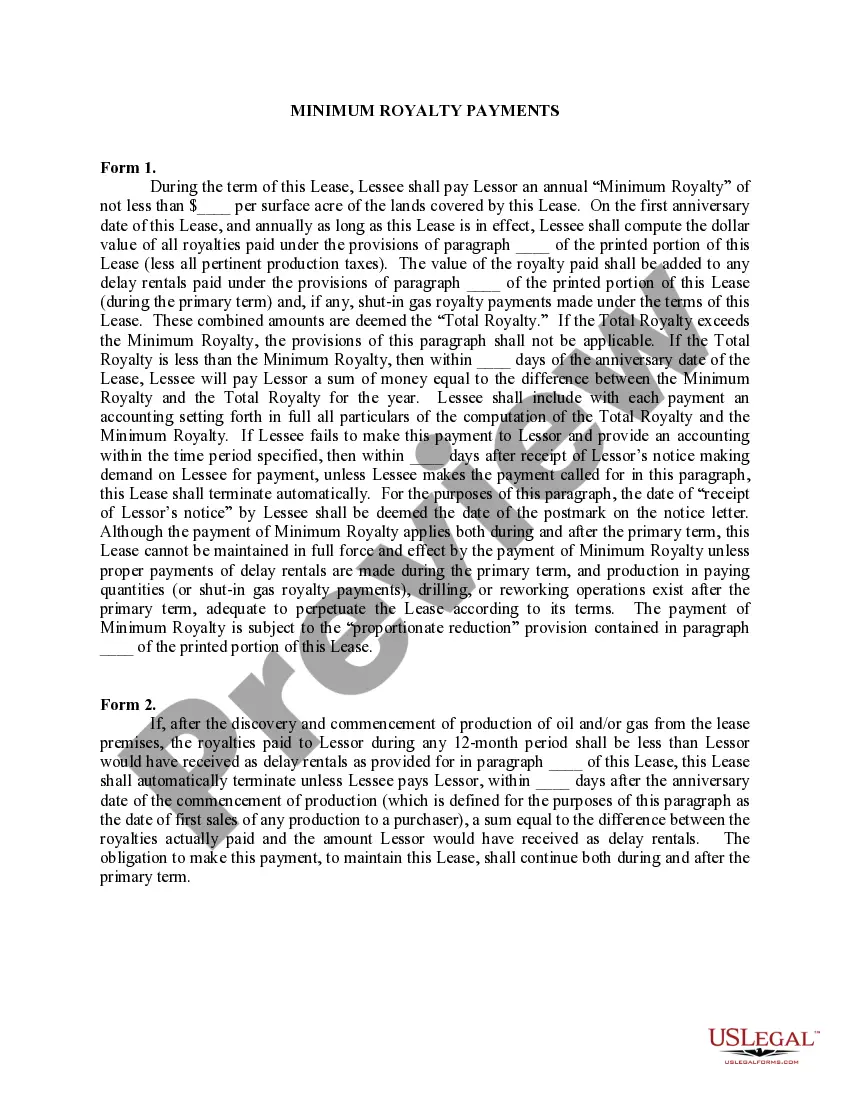
The Minimum Royalty Payments form is a lease rider that outlines the terms for minimum royalty payments in an oil and gas lease. This legal document allows you to specify additional provisions or limitations related to royalty payments, distinguishing it from standard lease forms. By using this form, lessors can ensure they receive a guaranteed income from their leased land, even if the production of oil and gas is below expectations.
Main sections of this form
- Annual Minimum Royalty: Specifies the guaranteed amount per surface acre that the lessee must pay the lessor.
- Total Royalty Calculation: Details how to compute the total royalties paid against the minimum royalty.
- Payment Notice Requirement: Outlines the procedures for payment discrepancies and consequences for non-payment.
- Proportionate Reduction Clause: Addresses circumstances under which minimum royalty payments may be reduced.
- Termination Clause: States conditions under which the lease automatically terminates due to inadequate royalty payments.
When this form is needed
This form is useful in scenarios where a property owner (lessor) is entering into an oil and gas lease and wants to ensure that they receive a minimum guaranteed payment regardless of the lessee's production levels. It is typically used when negotiating lease agreements to protect against low production and thus low royalty payments.
Who this form is for
- Lessors looking to secure their financial interests in an oil and gas lease.
- Property owners negotiating terms with lessees.
- Individuals or entities unfamiliar with standard lease agreements who need additional protection.
Instructions for completing this form
- Identify the parties involved: Enter the names and contact information for both the lessor and lessee.
- Specify the property: Include the legal description of the property being leased.
- Set the annual minimum royalty amount: Fill in the agreed amount per surface acre.
- Enter relevant lease provisions: Complete the fields for the paragraphs referenced in the form.
- Sign and date: Have all parties sign and date the form to make it legally binding.
Does this document require notarization?
This form usually doesn’t need to be notarized. However, local laws or specific transactions may require it. Our online notarization service, powered by Notarize, lets you complete it remotely through a secure video session, available 24/7.
Get your form ready online
Our built-in tools help you complete, sign, share, and store your documents in one place.
Make edits, fill in missing information, and update formatting in US Legal Forms—just like you would in MS Word.
Download a copy, print it, send it by email, or mail it via USPS—whatever works best for your next step.
Sign and collect signatures with our SignNow integration. Send to multiple recipients, set reminders, and more. Go Premium to unlock E-Sign.
If this form requires notarization, complete it online through a secure video call—no need to meet a notary in person or wait for an appointment.
We protect your documents and personal data by following strict security and privacy standards.

Make edits, fill in missing information, and update formatting in US Legal Forms—just like you would in MS Word.

Download a copy, print it, send it by email, or mail it via USPS—whatever works best for your next step.

Sign and collect signatures with our SignNow integration. Send to multiple recipients, set reminders, and more. Go Premium to unlock E-Sign.

If this form requires notarization, complete it online through a secure video call—no need to meet a notary in person or wait for an appointment.

We protect your documents and personal data by following strict security and privacy standards.
Common mistakes to avoid
- Failing to specify the annual minimum royalty amount, which can lead to confusion.
- Not providing complete information for the total royalty calculation.
- Overlooking the termination clauses, which may impact lease enforceability.
Benefits of completing this form online
- Convenient access: Download and complete the form at your convenience.
- Editability: Make adjustments as needed before finalizing the agreement.
- Secure: Ensure that you have the latest legal templates drafted by licensed attorneys.
Looking for another form?

Form popularity
FAQ
A 'reasonable royalty rate' is an estimation of damages in patent infringement cases. It is often referred to as established royalty that a licensee would pay for the rights to the patented invention in a hypothetical negotiation.
How long do music royalties last? Royalties last their entire life of the songwriter and another 70 years after they have passed away. This can result in well over 100 years of royalties.
The average royalty percentage applied to licensed services varies between 2%-15% of the media buy, depending on the attractiveness of the property. Another (much simpler) method of dealing with licensed service deals is to charge an annual fee for the licensee's right to use intellectual property.
Mechanical Royalties These royalties are paid by record companies or companies responsible for the manufacturing. In the U.S., the amount owed to the songwriter is $0.091 per reproduction of a song. Outside the U.S. the royalty rate is around 8 percent to 10 percent, but varies by country.
A royalty is an amount paid by a third party to an owner of a product or patent for the use of that product or patent. The terms of royalty payments are laid out in a licensing agreement.
Performance royalties: musicians produce copyrighted music, and anyone who wants to play the song in public or for commercial use must pay royalties. Book royalties: publishers pay authors for the right to sell and distribute their books.
A Royalty Agreement is a document used by a person, known as the Grantor, who owns the property interest in intellectual property, such as copyrighted works or patented inventions, to give permission to someone, known as the Grantee who would like to use the property to make a profit.
First, applying the 25 percent rule to the average operating profit margins would imply a royalty rate of 3.3 percent to 4.7 percent, while the average rate reported by RoyaltySource is 7 percent.