Assignment of A Reversionary Working Interest
Understanding this form
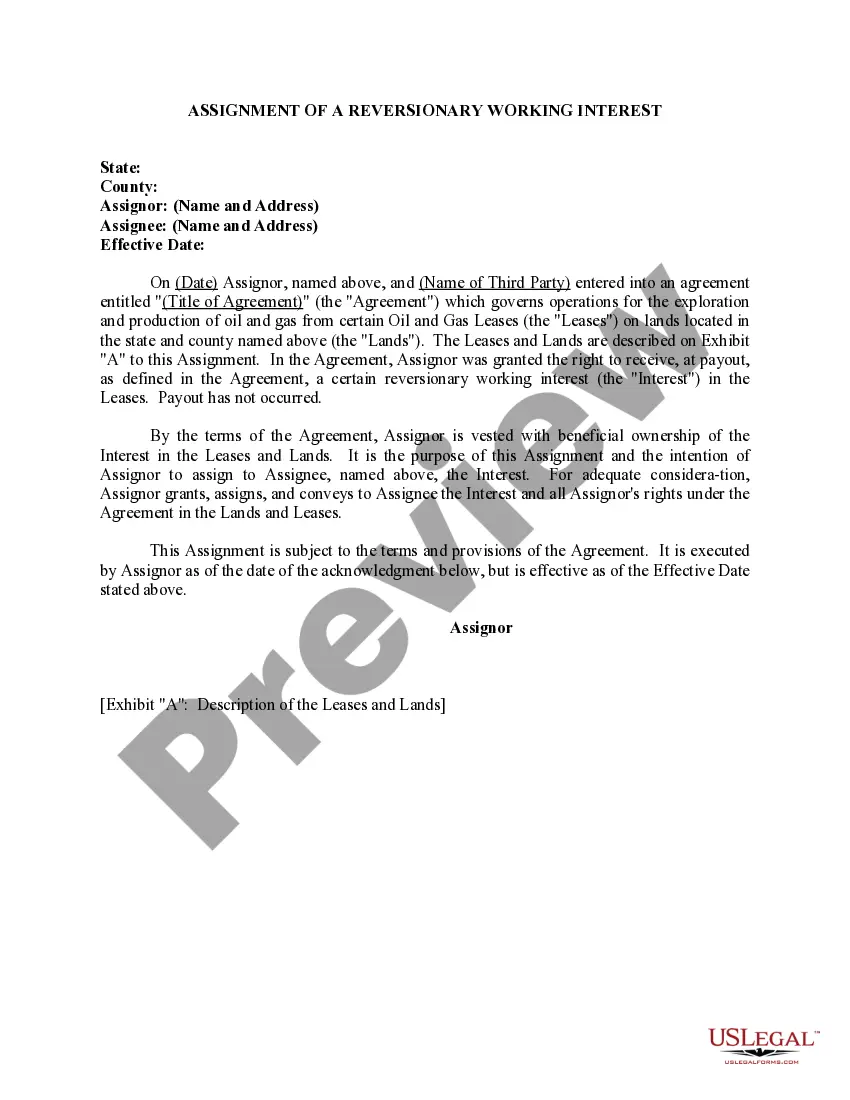
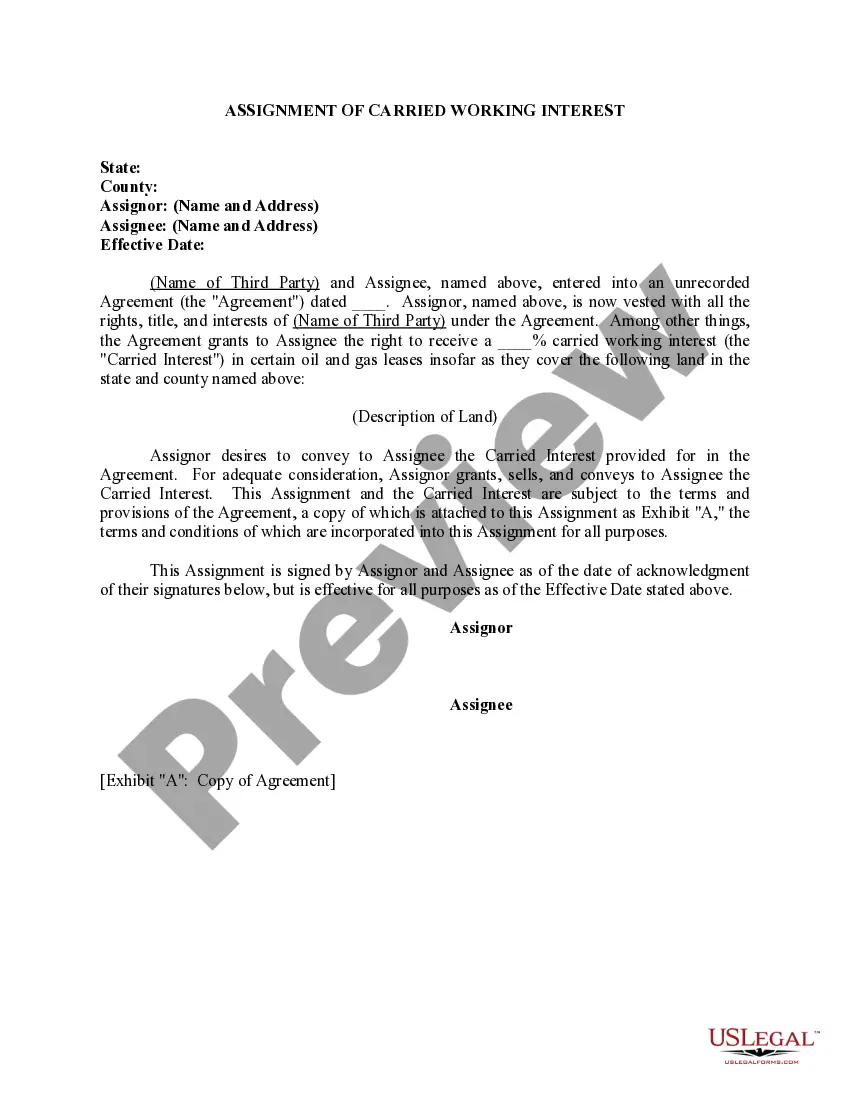
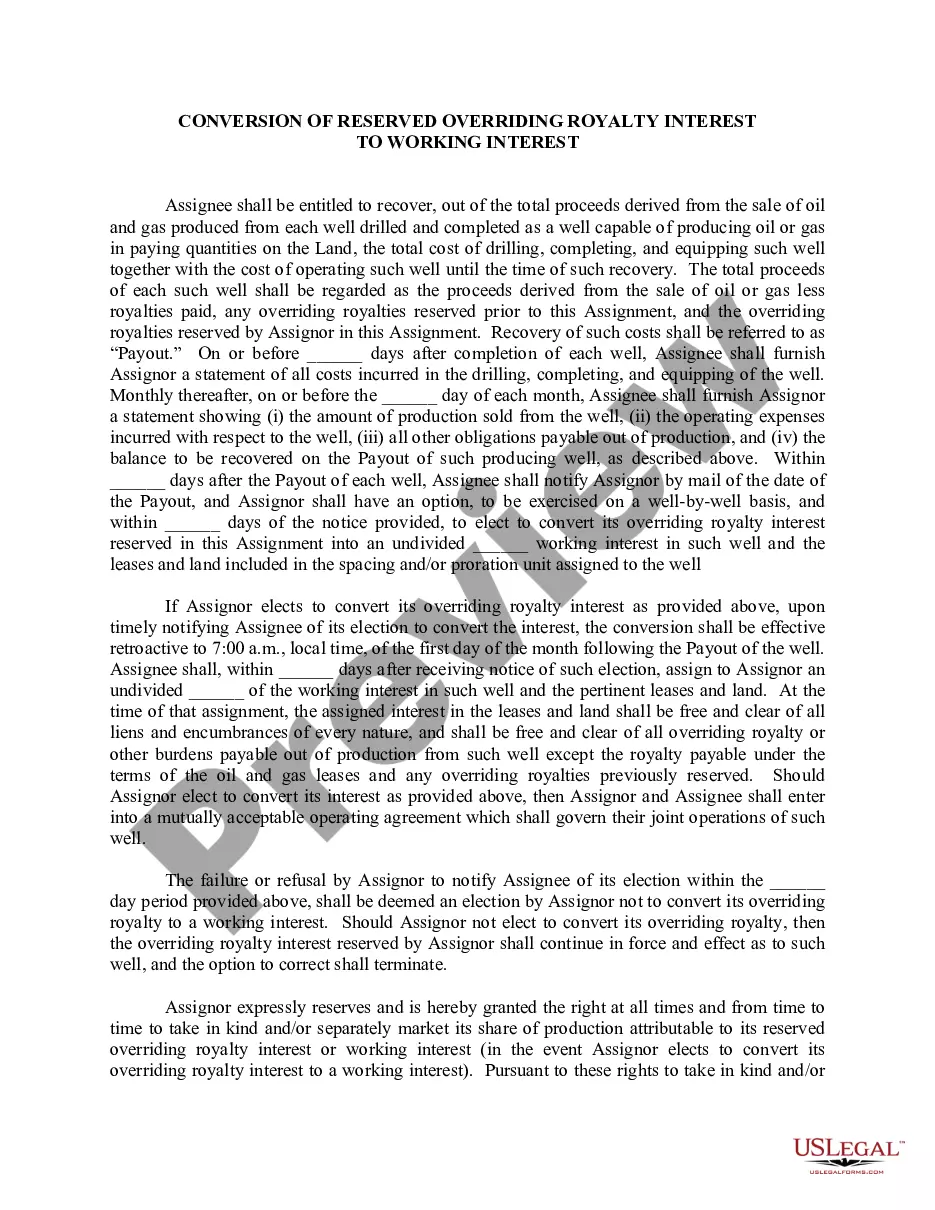
The Assignment of a Reversionary Working Interest is a legal document used to transfer a future interest in an oil and gas lease from one party (the Assignor) to another (the Assignee). This form is specifically designed for situations where the Assignor has a vested right to receive a reversionary working interest but the payout has not yet occurred. Unlike other assignments, it focuses on interests that will return to the Assignor after certain conditions are met, underscoring its unique purpose in managing future interests in lease agreements.
Form components explained
- Assignor and Assignee details: Names and addresses of both parties.
- Effective date: The date when the assignment becomes effective.
- Description of agreement: Overview of the initial agreement governing the leases.
- Beneficial ownership details: Clarification that the Assignor holds beneficial ownership of the working interest.
- Exhibit A: Specific details of the leases and lands involved.
- Terms of assignment: Conditions and provisions under which the interest is assigned.
Situations where this form applies
This form is useful in scenarios where an Assignor has been granted a reversionary working interest in an oil and gas lease but has not yet received payout. For example, if a landowner has entered into an agreement regarding the exploration of oil and gas resources and wishes to transfer their future interest to another party before payout occurs, they would utilize this assignment. It ensures clear documentation of rights and interests while abiding by the original agreement's terms.
Who can use this document
- Landowners looking to assign a reversionary working interest in oil and gas leases.
- Investors interested in acquiring future benefits from oil and gas leases.
- Legal representatives of parties involved in oil and gas lease agreements.
- Anyone with beneficial ownership seeking to formally transfer their rights.
How to prepare this document
- Identify the parties: Enter the names and addresses of the Assignor and Assignee.
- Specify the effective date: Indicate the date on which the assignment will take effect.
- Detail the original agreement: Provide information about the agreement that granted the right to the reversionary working interest.
- Include descriptions: Attach Exhibit A with specific details about the leases and lands involved.
- Sign the document: Ensure the Assignor signs the assignment to validate the transfer.
Does this form need to be notarized?
In most cases, this form does not require notarization. However, some jurisdictions or signing circumstances might. US Legal Forms offers online notarization powered by Notarize, accessible 24/7 for a quick, remote process.
Get your form ready online
Our built-in tools help you complete, sign, share, and store your documents in one place.
Make edits, fill in missing information, and update formatting in US Legal Forms—just like you would in MS Word.
Download a copy, print it, send it by email, or mail it via USPS—whatever works best for your next step.
Sign and collect signatures with our SignNow integration. Send to multiple recipients, set reminders, and more. Go Premium to unlock E-Sign.
If this form requires notarization, complete it online through a secure video call—no need to meet a notary in person or wait for an appointment.
We protect your documents and personal data by following strict security and privacy standards.

Make edits, fill in missing information, and update formatting in US Legal Forms—just like you would in MS Word.

Download a copy, print it, send it by email, or mail it via USPS—whatever works best for your next step.

Sign and collect signatures with our SignNow integration. Send to multiple recipients, set reminders, and more. Go Premium to unlock E-Sign.

If this form requires notarization, complete it online through a secure video call—no need to meet a notary in person or wait for an appointment.

We protect your documents and personal data by following strict security and privacy standards.
Common mistakes
- Not clearly identifying all parties involved in the transaction.
- Failing to provide accurate descriptions of the leases and lands in Exhibit A.
- Inaccurately stating the effective date, leading to confusion about when the assignment takes effect.
- Neglecting to sign the form, which renders the assignment invalid.
Advantages of online completion
- Easy access: Download and complete the form from the convenience of your home or office.
- Editable: Customize the form to meet your specific needs without hassle.
- Reliable: The forms are drafted by licensed attorneys, ensuring legal compliance.
- Time-saving: Rapidly generate necessary documents with minimal effort.
Summary of main points
- The Assignment of a Reversionary Working Interest is key for transferring future interests in lease agreements.
- Clearly outline the rights being assigned to avoid disputes.
- Complete all sections meticulously to ensure the form is legally binding.
- Consider the potential need for notarization based on local laws.
Looking for another form?

Form popularity
FAQ
Reversionary Interest is an amount of money that is calculated, which reflects what a Freeholder should receive now, rather than having to wait until a lease expires to have the property (and ALL its value) returned to his ownership.
: of, relating to, constituting, or involving especially a legal reversion.
Reversion, in Anglo-American law, interest held by a prior owner in property given to another, which, upon the happening of some future event, will return to that prior owner. A reversion is itself specific property, and it can be sold or disposed of as property by the reversion owner.
In property law, the term 'reversion' (returning or reverting something to its previous state) refers to the interest a party to whom a property will revert at the expiry of an agreement has in that property.When a leasehold expires, legal title to the property reverts back to the freeholder.
In trust law terms, a reversionary interest is an interest that reverts back to the settlor of a trust once a beneficiary's interest has come to an end. For example, Bob gives a life interest in Rose Cottage to his mother Judy, and on Judy's death the cottage is to revert back to Bob.
A landowner who is concerned about the future use of his land can donate or sell the land on a conditional rather than absolute basis. A reversionary interest is created by a deed that reserves to the grantor a future ownership right upon the occurrence of some condition.
A reversionary right is a registered condition embodied in a Deed of Transfer that on the happening of a particular event, or the non-happening thereof, ownership of the property concerned reverts to the enforcer.
A landowner who is concerned about the future use of his land can donate or sell the land on a conditional rather than absolute basis. A reversionary interest is created by a deed that reserves to the grantor a future ownership right upon the occurrence of some condition.
In property law, the term 'reversion' (returning or reverting something to its previous state) refers to the interest a party to whom a property will revert at the expiry of an agreement has in that property.When a property is rented from a landlord, the property will revert to the landlord at the end of the lease.