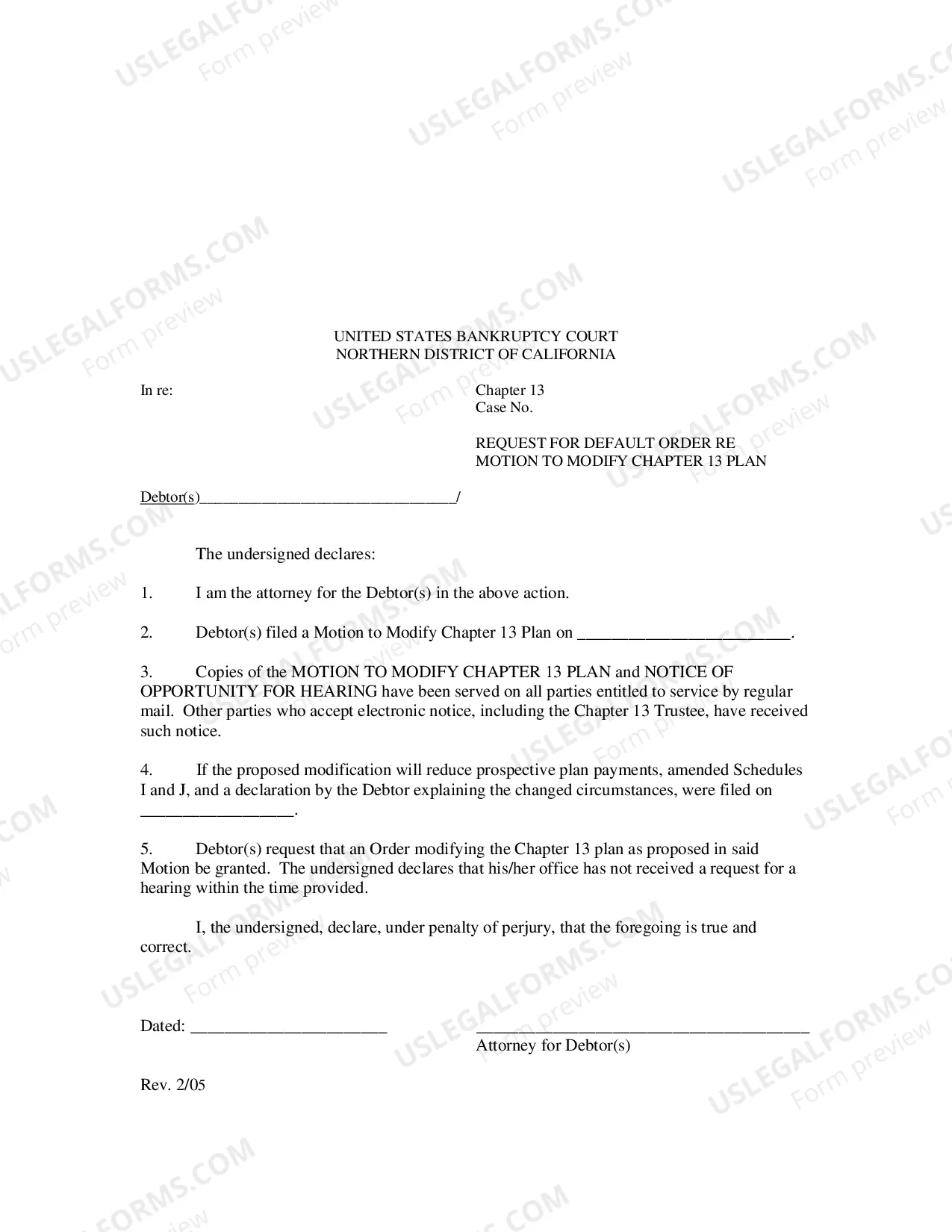
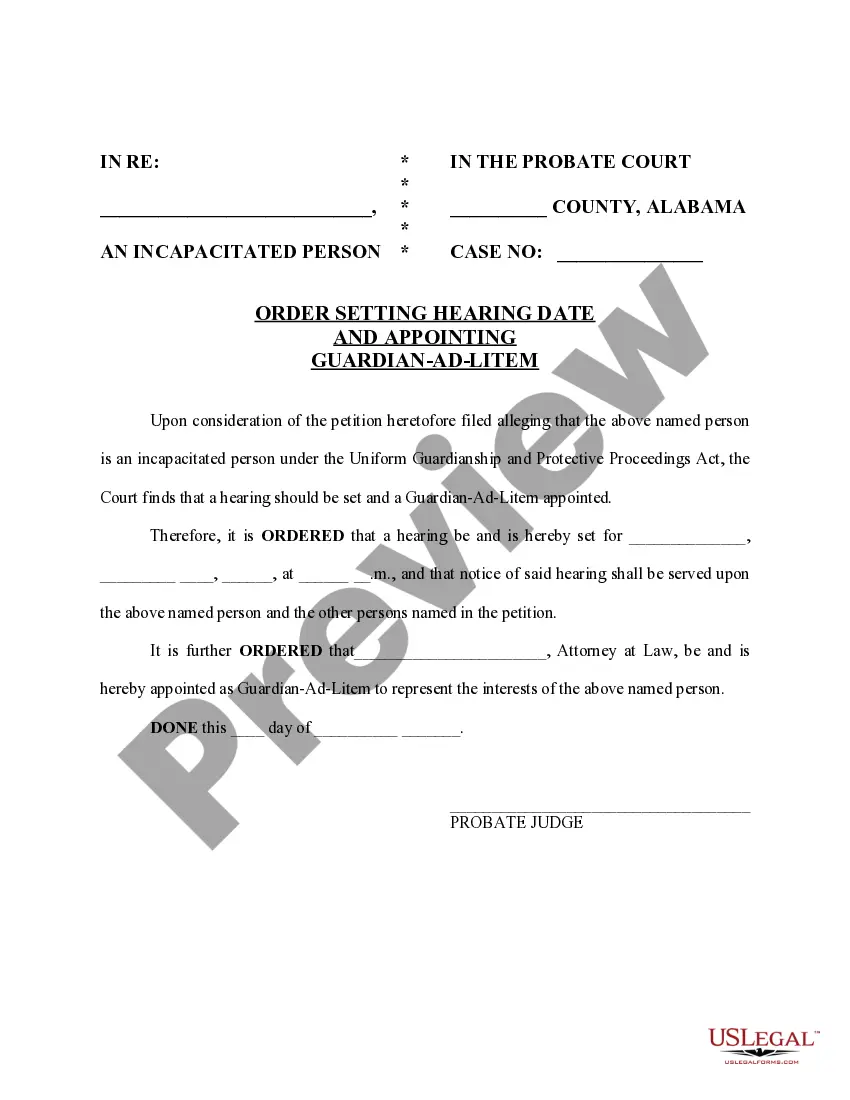
Alabama Order Setting Date and Appointing Guardian Ad Litem
Understanding this form
The Order Setting Date and Appointing Guardian Ad Litem is a legal document that establishes a hearing date to evaluate whether an individual is incapacitated. This form also appoints a Guardian Ad Litem, an attorney responsible for representing the interests of the incapacitated person during the process. Unlike other legal forms, this document specifically addresses guardianship proceedings under the Uniform Guardianship and Protective Proceedings Act, ensuring that the individual's rights and preferences are considered.
Key components of this form
- Case number to identify the court proceeding.
- Details of the individual alleged to be incapacitated.
- Date and time set for the hearing.
- Name of the appointed Guardian Ad Litem.
- Signature of the Probate Judge confirming the order.





Common use cases
This form should be used when a petition has been filed to declare someone as incapacitated. It is necessary when there is a need to appoint a Guardian Ad Litem to ensure that the rights and interests of the incapacitated person are protected during court proceedings.
Who should use this form
This form is intended for:
- Individuals who believe a family member or loved one may be incapacitated.
- Attorneys representing clients in guardianship cases.
- Court personnel involved in guardianship proceedings.
Instructions for completing this form
To complete the Order Setting Date and Appointing Guardian Ad Litem, follow these steps:
- Fill in the case number and county where the petition is filed.
- Provide the name of the person alleged to be incapacitated.
- Enter the date and time for the scheduled hearing.
- Assign an attorneyâs name as the appointed Guardian Ad Litem.
- Obtain the signature of the Probate Judge to finalize the order.
Is notarization required?
This form does not typically require notarization unless specified by local law.
Get your form ready online
Our built-in tools help you complete, sign, share, and store your documents in one place.
Make edits, fill in missing information, and update formatting in US Legal Forms—just like you would in MS Word.
Download a copy, print it, send it by email, or mail it via USPS—whatever works best for your next step.
Sign and collect signatures with our SignNow integration. Send to multiple recipients, set reminders, and more. Go Premium to unlock E-Sign.
If this form requires notarization, complete it online through a secure video call—no need to meet a notary in person or wait for an appointment.
We protect your documents and personal data by following strict security and privacy standards.

Make edits, fill in missing information, and update formatting in US Legal Forms—just like you would in MS Word.

Download a copy, print it, send it by email, or mail it via USPS—whatever works best for your next step.

Sign and collect signatures with our SignNow integration. Send to multiple recipients, set reminders, and more. Go Premium to unlock E-Sign.

If this form requires notarization, complete it online through a secure video call—no need to meet a notary in person or wait for an appointment.

We protect your documents and personal data by following strict security and privacy standards.
Mistakes to watch out for
- Forgetting to include the date and time of the hearing.
- Neglecting to specify the name of the appointed Guardian Ad Litem.
- Failing to provide accurate case numbers or details about the incapacitated person.
Advantages of online completion
- Convenience of downloading the form instantly from a trusted source.
- Editable format allows for easy customization to fit individual circumstances.
- Reliability associated with forms drafted by licensed attorneys.
- The form is used in legal proceedings to evaluate a person's capacity.
- It ensures representation for individuals who may not be able to advocate for themselves.
- File this order in accordance with local court rules to ensure enforceability.
Looking for another form?



Form popularity
FAQ
When should a guardian be appointed? A child guardian will be appointed when the family court requires an independent view of what has been happening in the concerned child's life and what should happen in their life. The court will appoint a children guardian in child proceedings under the Children Act 1989.
This will involve factors such as stability in the child's upbringing, the child's stated preference, the ability of the proposed guardian to provide the child with proper care, the relationship between the parents and the proposed guardian, and any information regarding the moral character of the proposed guardian.
EXPLANATION OF A PETITION FOR APPOINTMENT OF GUARDIAN(S) A guardianship may be needed if someone cannot take care of him/herself and/or his/her property. The person who needs assistance is the proposed ward. If guardianship is granted, that person will be the ward.
A legal guardian is a person who has been appointed by a court or otherwise has the legal authority (and the corresponding duty) to care for the personal and property interests of another person, called a ward.A parent of a child is normally not considered a guardian, though the responsibilities may be similar.
A. A guardian can be appointed by court (in case of parents death or parents have abandoned their child) after following proper procedure in court of law or by way of will (testamentary guardian) where parents want someone to act as guardian of their children after their death.
A Guardian is appointed when the court wants an independent view of what has been happening and Page 2 what should happen in the child's life. A Children's Guardian will normally be appointed in certain court proceedings under The Children Act 1989. Children's Guardians are also involved in adoption proceedings.
While Simply Hired reported an average salary of 200b$76,349200b per year for guardian ad litems in 2021, the average salary for child and family social workers was 200b$51,030200b a year, as of May 2019, according to the Bureau of Labor Statistics.
If child is 14 or older, child has the right to choose the custodial parent. If the child is 14 or older, child has the right to testify in court regarding the preference of custodial parent. If the child is 14 or older, the judge may consider the wishes of the child.
There are two types of guardianships, a full guardianship and a limited guardianship.