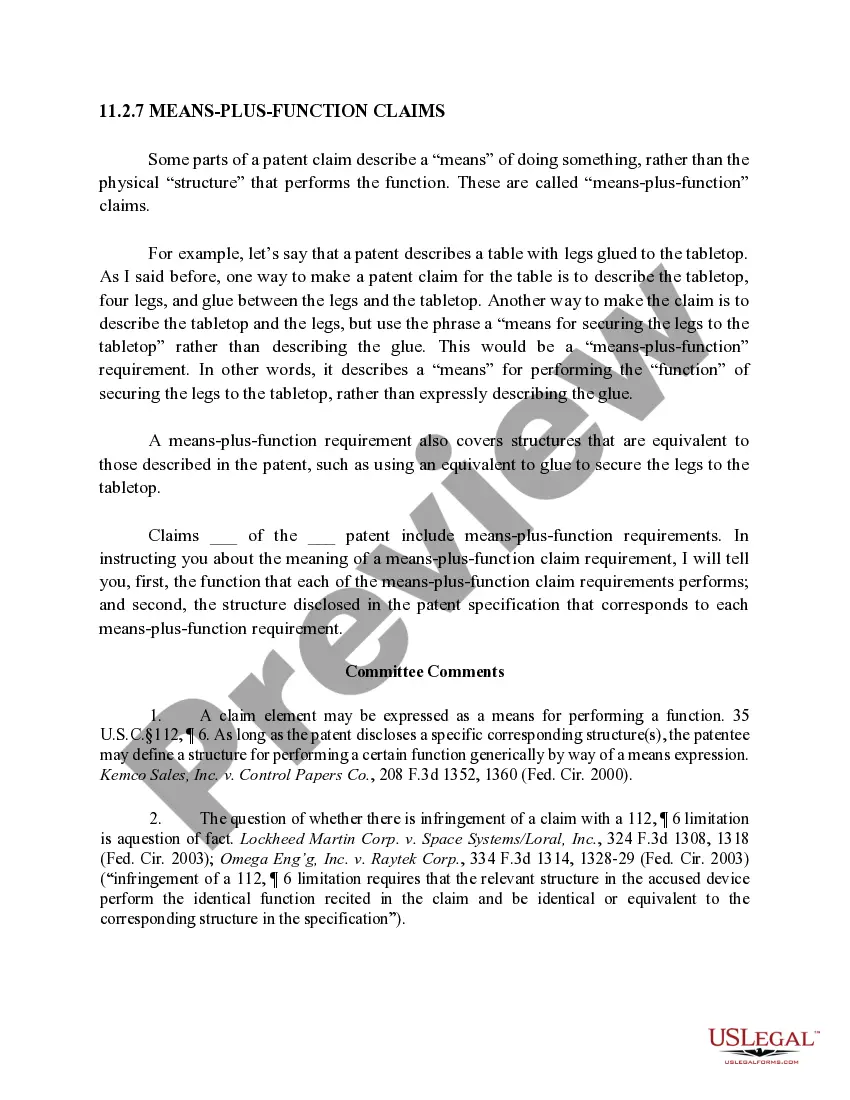
11.2.7 Means-Plus-Function Claims .
What this document covers
The 11.2.7 Means-Plus-Function Claims form is an official jury instruction used in the Federal 7th Circuit Court. This form outlines how certain patent claims can specify a function through a "means" instead of detailing the specific structure involved, allowing for broader interpretations of patent claims. It differs from other legal forms by focusing specifically on how to interpret means-plus-function claims within patent law, making it essential for addressing specific legal questions regarding patent infringement and validity.
Key parts of this document
- Definition of means-plus-function claims: Explains what constitutes a means-plus-function claim.
- Examples of application: Provides a practical example of how a means-plus-function claim may differ from a structural description.
- Legal citations: References applicable legal cases and statutes relevant to the interpretation of these claims.
- Functions and structures: Details the functions performed by means-plus-function claims and the corresponding structures disclosed in the patent specification.
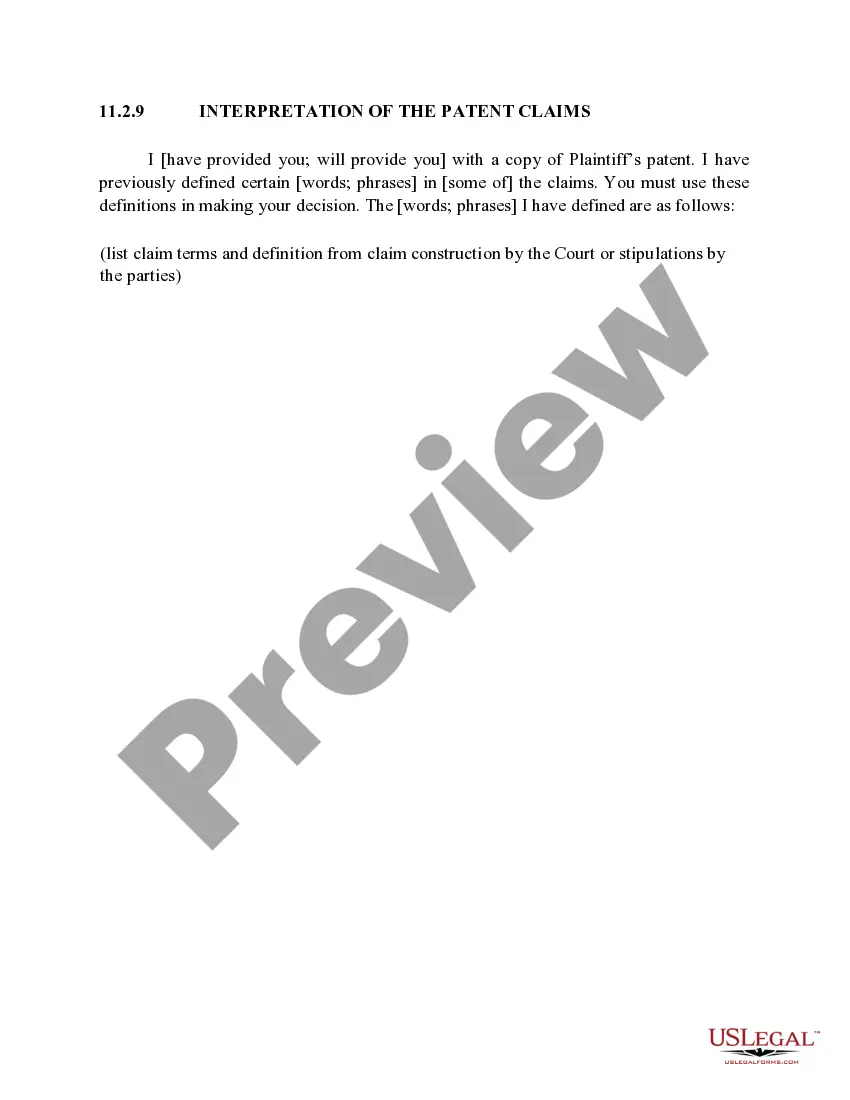
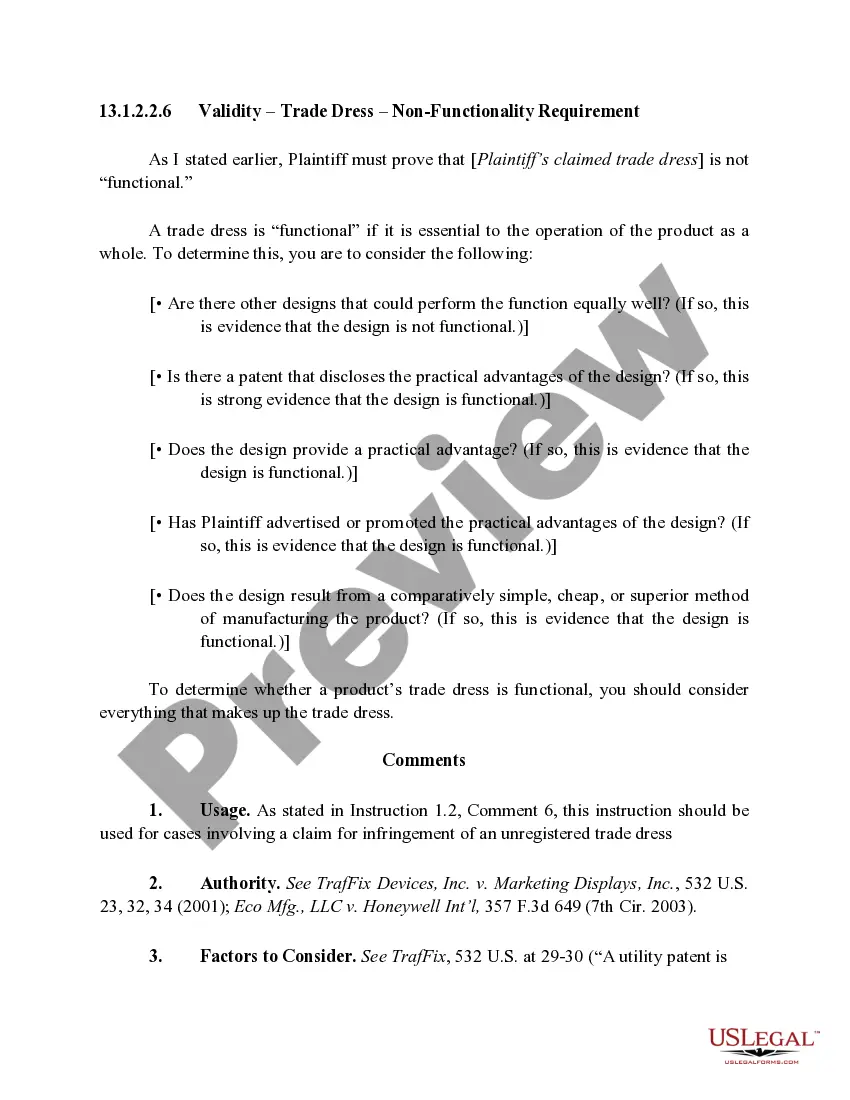
Situations where this form applies
This form is utilized in patent litigation cases where there is a dispute over the interpretation of means-plus-function claims. It is particularly relevant when a claim involves a generic description of a function and the parties need guidance on whether a specific product or method infringes on existing patents. The form serves to aid jurors in understanding complex legal definitions and interpretations relevant to patent law.
Who needs this form
- Patent attorneys representing clients in patent litigation.
- Judges presiding over cases related to patent infringement.
- Jurors needing clarification on means-plus-function patent claims during trial.
- Legal scholars and students studying patent law and litigation processes.
How to prepare this document
- Review the claims at issue in the patent to identify means-plus-function terms.
- Interpret the function associated with each means-plus-function claim from the provided examples.
- Reference specific structures described in the patent that correspond to each means of doing something.
- Consider legal precedent and statutory requirements as outlined in the related legal citations.
- Ensure the instruction clearly defines how the claims apply in the context of the case being tried.
Notarization guidance
Notarization is not commonly needed for this form. However, certain documents or local rules may make it necessary. Our notarization service, powered by Notarize, allows you to finalize it securely online anytime, day or night.
Get your form ready online
Our built-in tools help you complete, sign, share, and store your documents in one place.
Make edits, fill in missing information, and update formatting in US Legal Forms—just like you would in MS Word.
Download a copy, print it, send it by email, or mail it via USPS—whatever works best for your next step.
Sign and collect signatures with our SignNow integration. Send to multiple recipients, set reminders, and more. Go Premium to unlock E-Sign.
If this form requires notarization, complete it online through a secure video call—no need to meet a notary in person or wait for an appointment.
We protect your documents and personal data by following strict security and privacy standards.

Make edits, fill in missing information, and update formatting in US Legal Forms—just like you would in MS Word.

Download a copy, print it, send it by email, or mail it via USPS—whatever works best for your next step.

Sign and collect signatures with our SignNow integration. Send to multiple recipients, set reminders, and more. Go Premium to unlock E-Sign.

If this form requires notarization, complete it online through a secure video call—no need to meet a notary in person or wait for an appointment.

We protect your documents and personal data by following strict security and privacy standards.
Mistakes to watch out for
- Failing to clearly distinguish between means-plus-function claims and structural claims.
- Omitting relevant legal citations that clarify the interpretation of claims.
- Incorrectly assuming that all means-plus-function claims are treated the same in all jurisdictions.
- Neglecting to specify the functions associated with each claim accurately.
Benefits of completing this form online
- Accessibility: Downloadable format allows for easy access and review anywhere.
- Time-saving: Quickly generate specific legal instructions without needing extensive legal research.
- Convenience: Easily editable for specific cases and tailored to the needs of the users.
- Reliability: Utilizes established legal standards adopted by the Federal 7th Circuit Court.
Legal use & context
- The form is based on established patent law and is relevant for cases involving the interpretation of means-plus-function claims.
- Proper use of this form can clarify complex legal concepts for jurors, aiding in informed decision-making.
- Understanding the nuances of means-plus-function claims can impact patent rights and infringement litigation outcomes.
Looking for another form?


Form popularity
FAQ
112(f) interpretation. Every case will turn on its own unique set of facts. The standard is whether the words of the claim are understood by persons of ordinary skill in the art to have a sufficiently definite meaning as the name for structure.? Williamson v.
For example, an inventor could claim an electronic or electromechanical device by describing circuits performing specific functions, as opposed to the circuitry of the actual device.
§112(f), ?an element in a claim for a combination may be expressed as a means or step for performing a specified function without the recital of structure, material, or acts in support thereof, and such claim shall be construed to cover the corresponding structure, material, or acts described in the specification and
A form of patent claim that both: Expresses an element by its function rather than by any structure, material, or acts. Covers the structure, material, or acts, and any equivalents, which the patent's specification describes as corresponding to the function.
Citing more than two decades of precedent, the Court emphasized that infringement of means-plus-function claims requires proof of three things: That the accused structure performs the (1) identical function, (2) in substantially the same way (3) with substantially the same result, as the disclosed structure.
§ 112(f) Language ? A claim limitation that does not use the term ?means? or. ?step? creates a rebuttable presumption that the claim. limitation is not interpreted under § 112(f) ? This presumption is rebutted when the claim limitation recites. function without reciting sufficient structure, material or acts to.
112, first paragraph require that the specification include the following: (A) A written description of the invention; (B) The manner and process of making and using the invention (the enablement requirement); and. (C) The best mode contemplated by the inventor of carrying out his invention.
Claim interpretation is important in determining the scope of your patent rights and in determining whether anyone else has a patent that would prevent you from making, using, selling or importing an apparatus or method. must possess each claimed element, or something equivalent to the element.