Nevada Acknowledgment for Verification upon Oath
What this document covers
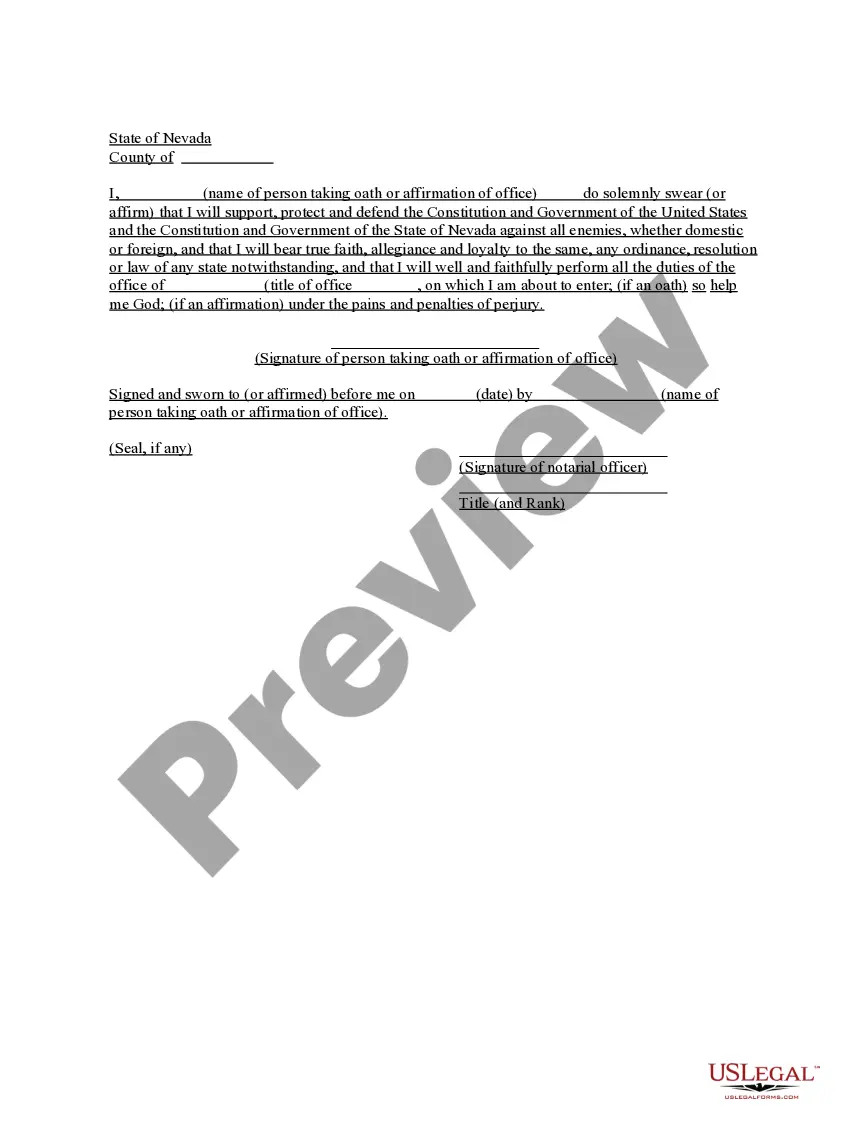
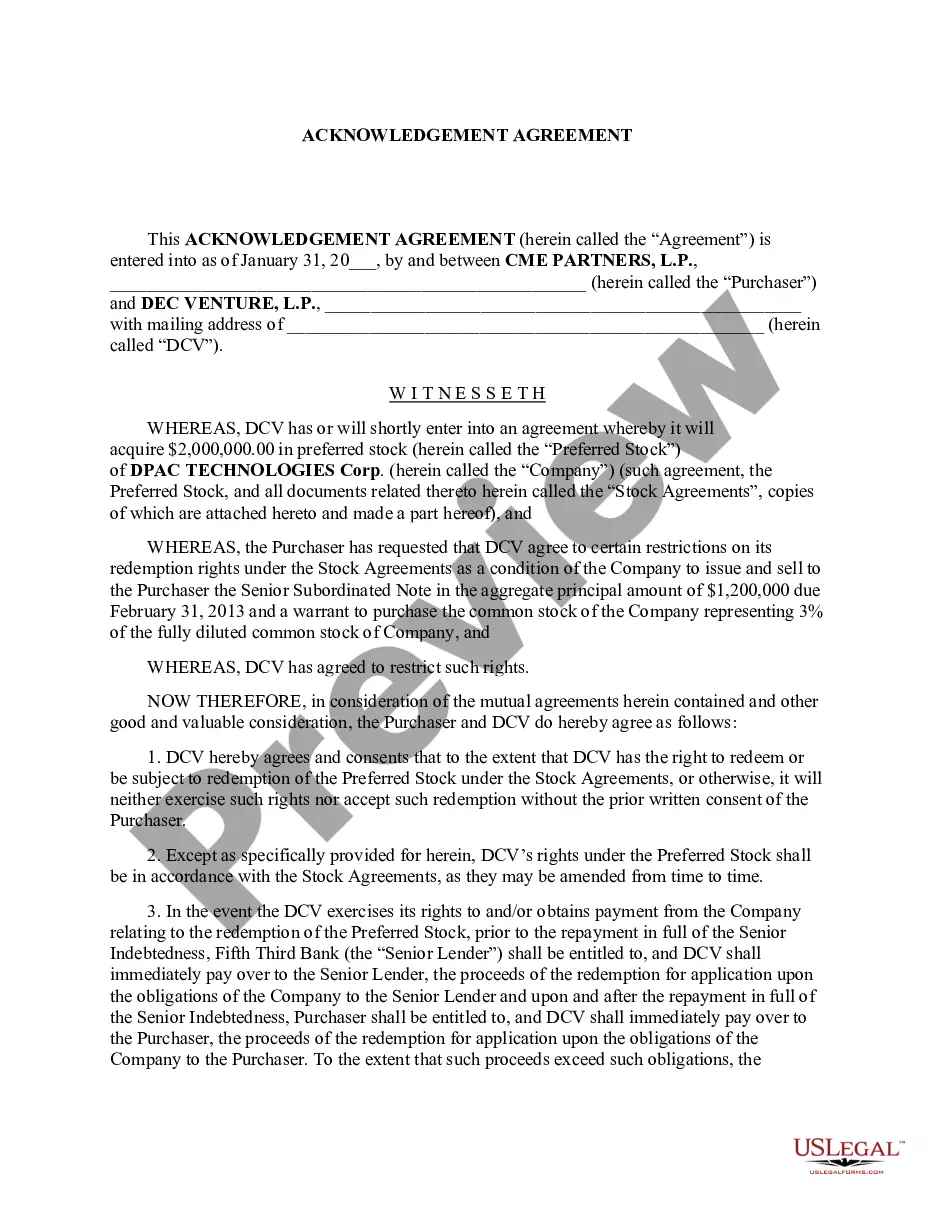
The Acknowledgment for Verification upon Oath is a legal document used to confirm that an individual has taken an oath or affirmation. This form is essential for individuals entering into certain public offices or positions that require a formal declaration of loyalty and adherence to the laws of the United States and the State of Nevada. It differs from other acknowledgment forms as it specifically pertains to the affirmation of duty in a sworn capacity.
Main sections of this form
- Name of the person taking the oath.
- Title of office being affirmed.
- Statement of loyalty to the Constitution and the laws.
- Date of the oath or affirmation.
- Signature of the person taking the oath.
- Signature of the notarial officer, if required.

When this form is needed
This form is used when an individual is required to affirm their allegiance to the laws of the United States and the State of Nevada while assuming a public office. Scenarios include government positions, law enforcement roles, or any position where a formal oath is necessary to uphold the duties of that office.
Who can use this document
- Individuals entering public office in Nevada.
- Government employees required to take an oath.
- Anyone affirming their loyalty and duty under the Constitution.
How to complete this form
- Begin by entering the name of the individual taking the oath.
- Specify the title of the office they are assuming.
- Complete the affirmation statement regarding loyalty to the Constitution.
- Sign and date the form in the designated areas.
- If applicable, obtain the signature of the notarial officer.
Does this form need to be notarized?
This document requires notarization to meet legal standards. US Legal Forms provides secure online notarization powered by Notarize, allowing you to complete the process through a verified video call, available 24/7.
Get your form ready online
Our built-in tools help you complete, sign, share, and store your documents in one place.
Make edits, fill in missing information, and update formatting in US Legal Forms—just like you would in MS Word.
Download a copy, print it, send it by email, or mail it via USPS—whatever works best for your next step.
Sign and collect signatures with our SignNow integration. Send to multiple recipients, set reminders, and more. Go Premium to unlock E-Sign.
If this form requires notarization, complete it online through a secure video call—no need to meet a notary in person or wait for an appointment.
We protect your documents and personal data by following strict security and privacy standards.

Make edits, fill in missing information, and update formatting in US Legal Forms—just like you would in MS Word.

Download a copy, print it, send it by email, or mail it via USPS—whatever works best for your next step.

Sign and collect signatures with our SignNow integration. Send to multiple recipients, set reminders, and more. Go Premium to unlock E-Sign.

If this form requires notarization, complete it online through a secure video call—no need to meet a notary in person or wait for an appointment.

We protect your documents and personal data by following strict security and privacy standards.
Common mistakes to avoid
- Failing to include the correct title of the office.
- Not signing the form in the appropriate section.
- Omitting the date when signing the acknowledgment.
- Using incorrect wording in the affirmation statement.
Main things to remember
- The Acknowledgment for Verification upon Oath is essential for individuals assuming public office in Nevada.
- This form formally affirms loyalty to the Constitution and public duties.
- Ensuring accuracy in completing this form is crucial to avoid common mistakes.
- Notarization is a requirement for this document to be legally effective.
Looking for another form?
Form popularity
FAQ
They key difference is that for a signature witnessing, the signer must always sign the document in the Notary's presence.An acknowledgment, on the other hand, does not require the Notary to witness the signature in most states (one exception is Maryland).
For an acknowledgment, the signer must always: Be positively identified by the Notary. The Notary must always identify the signer for an acknowledgement; whether the signer personally knows the Notary, presents an ID document, or is identified by a credible witness depends on the circumstances.
Acknowledgee. An acknowledgee is a family member, friend, associate, or honoree that should be notified or thanked when a gift is donated to honor, memorialize, or celebrate an honor/memorial constituent. For example, you create a tribute honoring William Smith on his 50th birthday.
An acknowledgment is a formal declaration before an authorized official such as a notary, by a person who has signed a document, that the document is his or her act. Acknowledgments are governed by the Uniform Acknowledgment Act. The person acknowledging the document must personally appear before the notary.
For an acknowledgment, the signer must always: Be positively identified by the Notary. The Notary must always identify the signer for an acknowledgement; whether the signer personally knows the Notary, presents an ID document, or is identified by a credible witness depends on the circumstances.
A notary acknowledgement ensures that the signer of the document is indeed the person named in the document.On the other hand, a notary is asked to perform a Jurat, when the signer takes an oath or makes an affirmation. The function of the notary in this case is to administer of oath or affirmation.
What Is An Acknowledgment? The purpose of an acknowledgment is for a signer, whose identity has been verified, to declare to a Notary or notarial officer that he or she has willingly signed a document.The signer may either sign the document before appearing before you, or in your presence.
What is notarisation? Notarisation is the first step, in which a notary will certify the document in a certain way, depending what is required. They may, for example, certify a person's signature on the document to prove that the person signing is the person named in the document.
Respect individual beliefs and choices. Do not joke or behave frivolously during the procedure. Use appropriate ceremonial gestures. Other State Requirements.