Salt Water Disposal Well Agreement Between Surface Owner and off Premises Operator
About this form
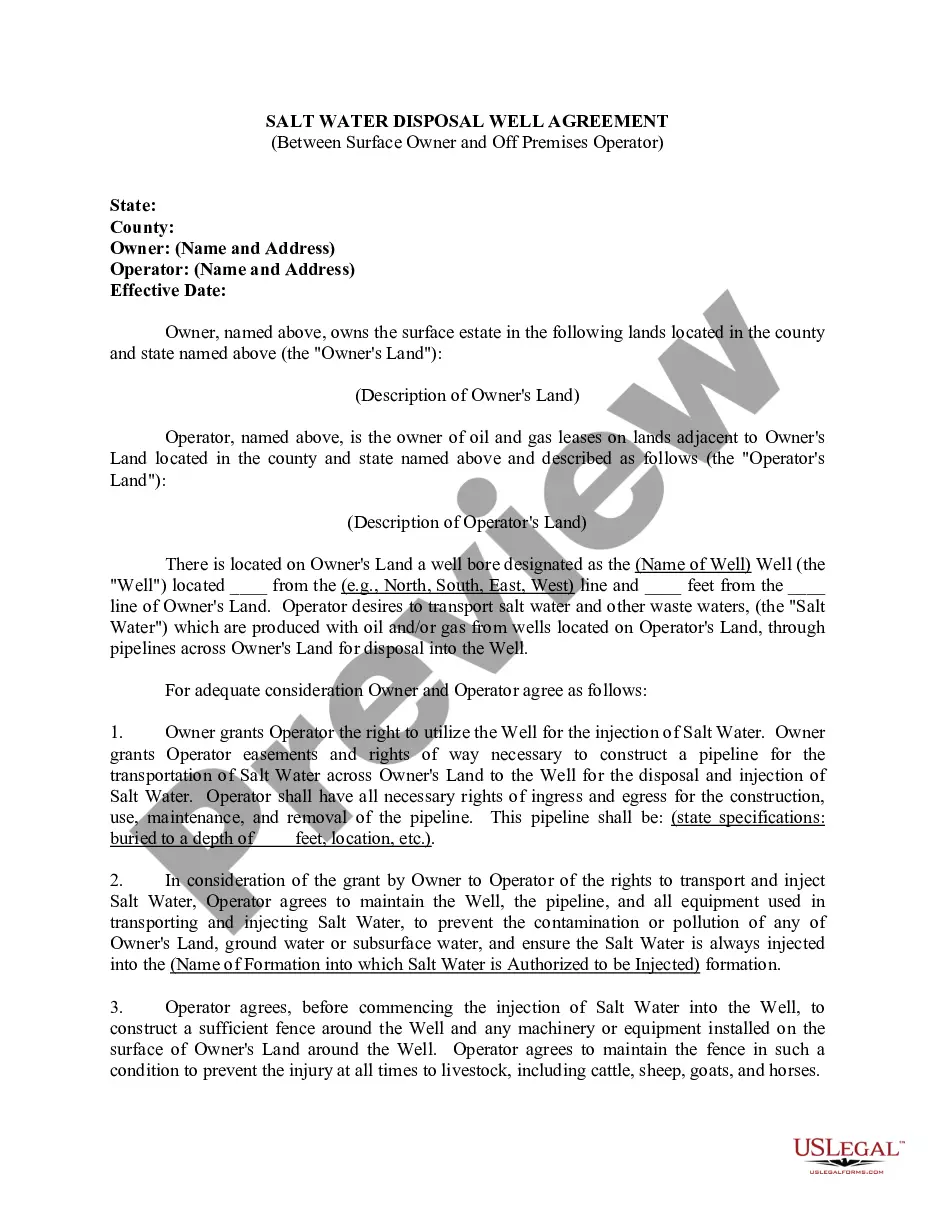
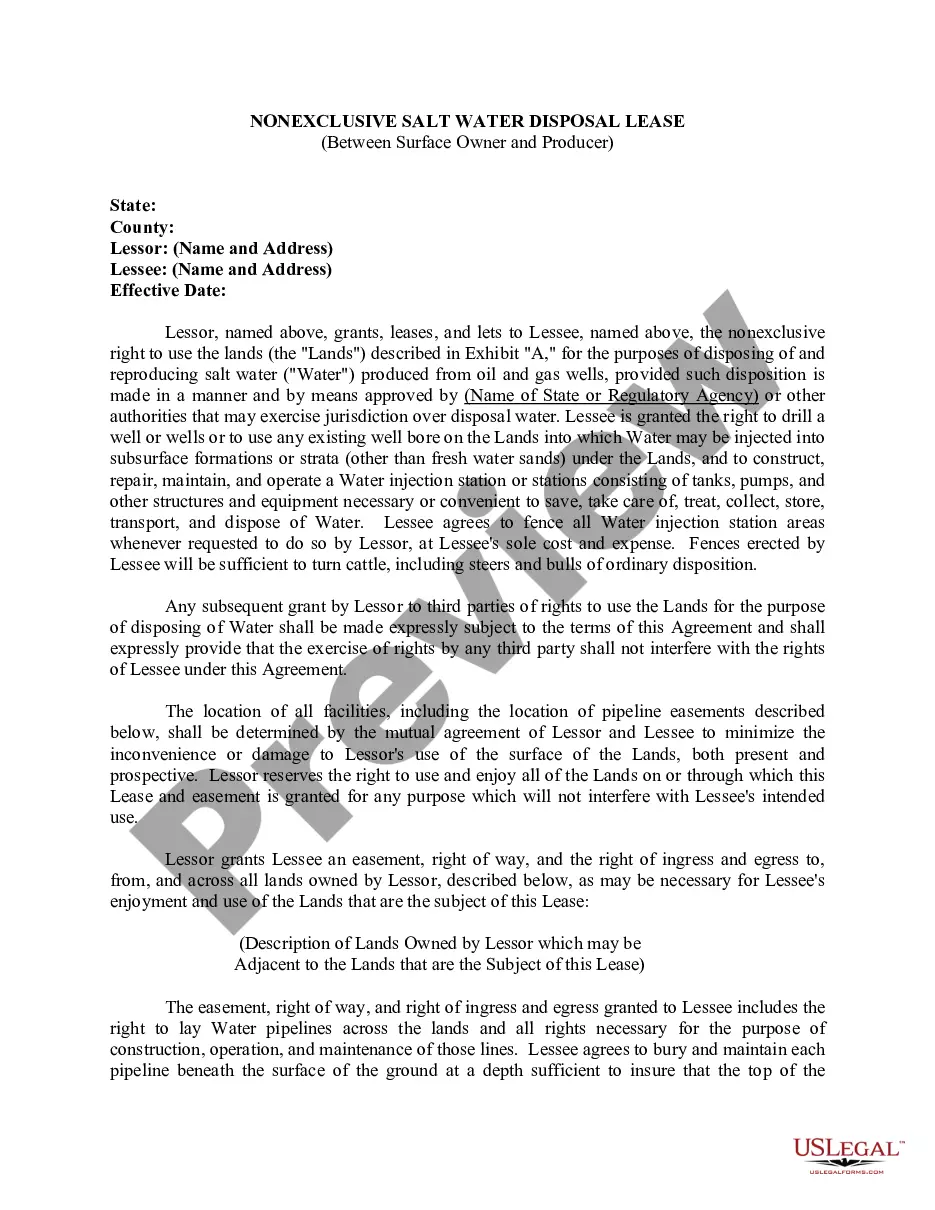
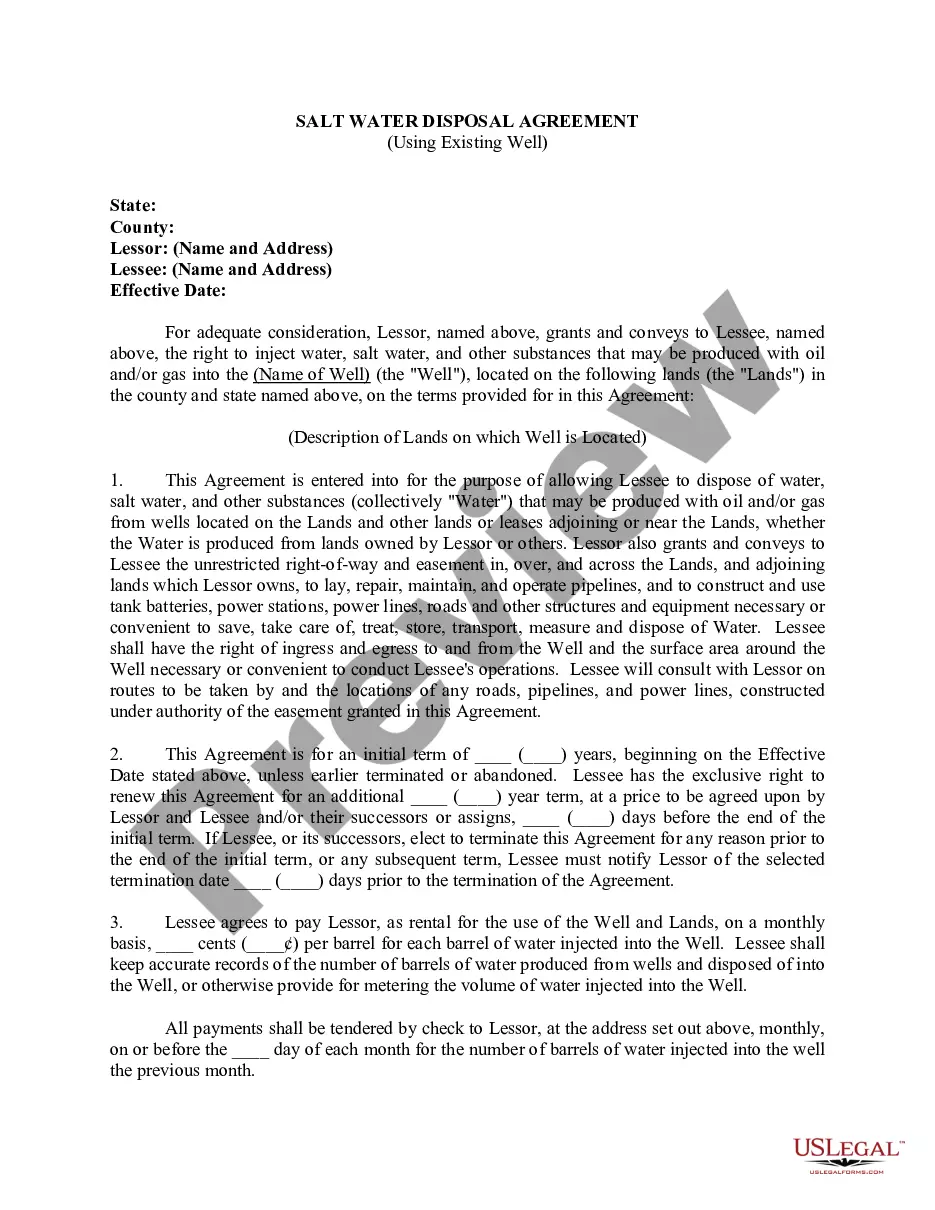
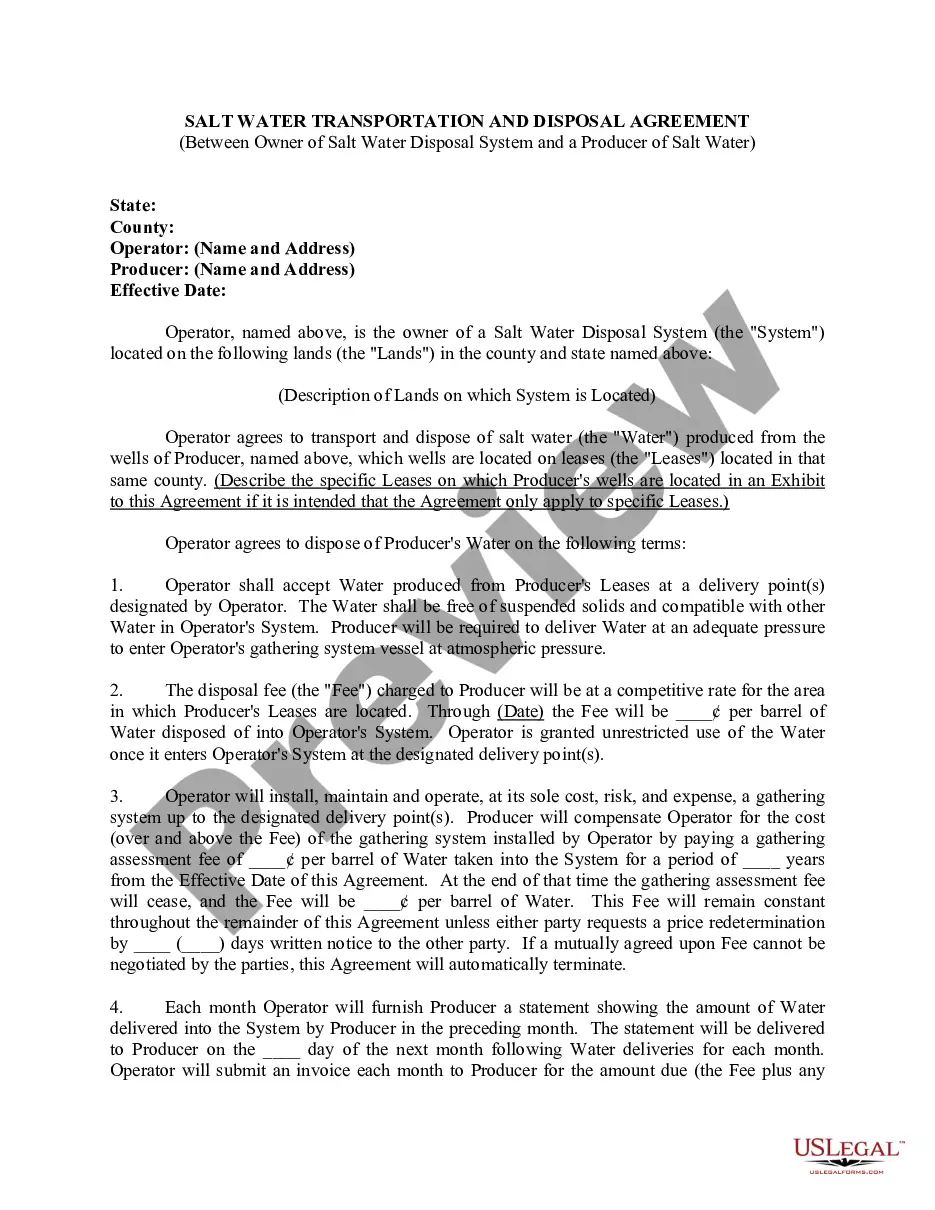
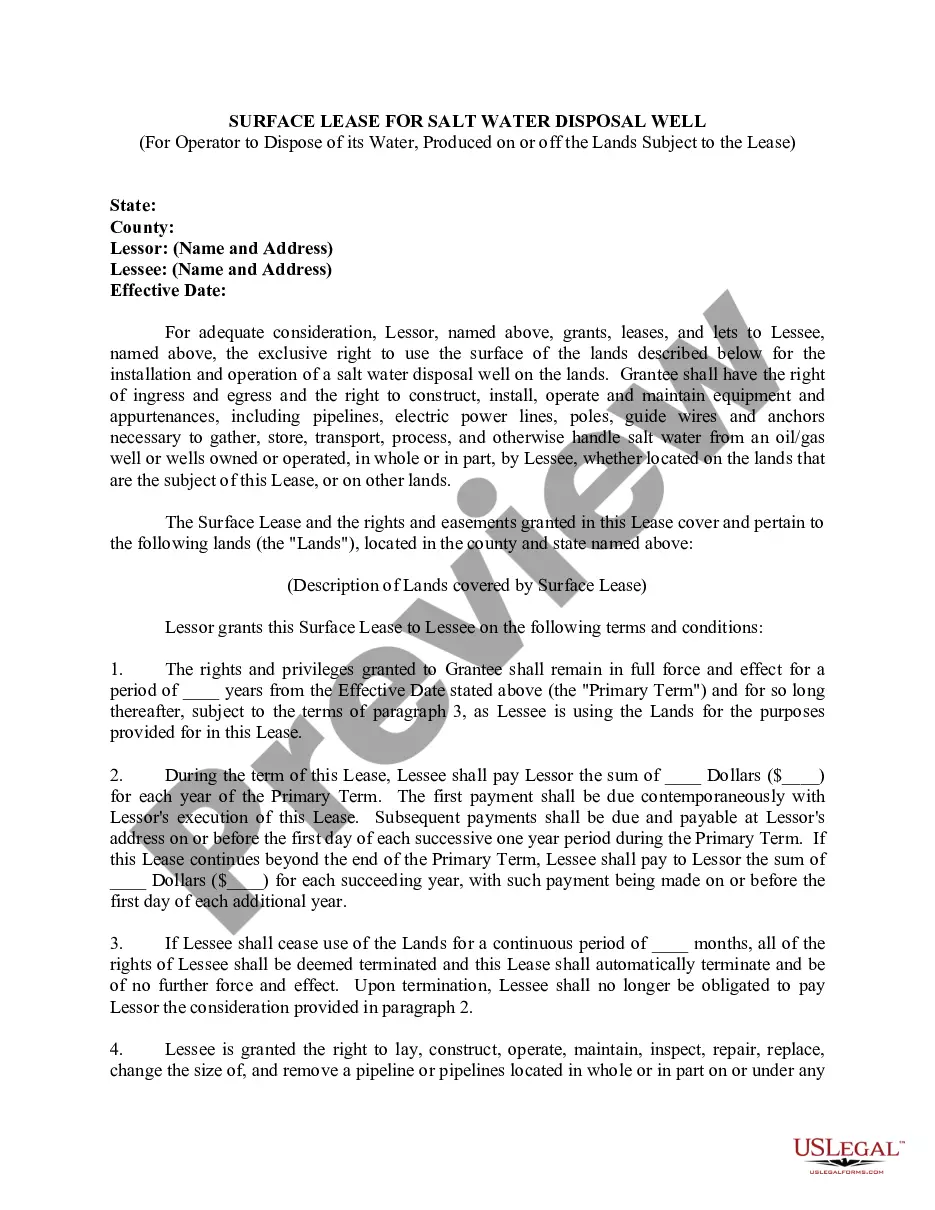
The Salt Water Disposal Well Agreement is a legal document that establishes a contractual relationship between a surface owner and an off-premises operator. This agreement allows the operator to dispose of salt water and other waste waters beneath the surface ownerâs land. Unlike other land use agreements, this form specifically outlines the rights to use a designated well for the injection of waste produced from oil and gas operations located on the operator's land.
Key components of this form
- Details of the surface owner and off-premises operator, including addresses.
- Description of the land owned by the owner and the adjacent properties owned by the operator.
- Specifications for the salt water well and pipeline easement.
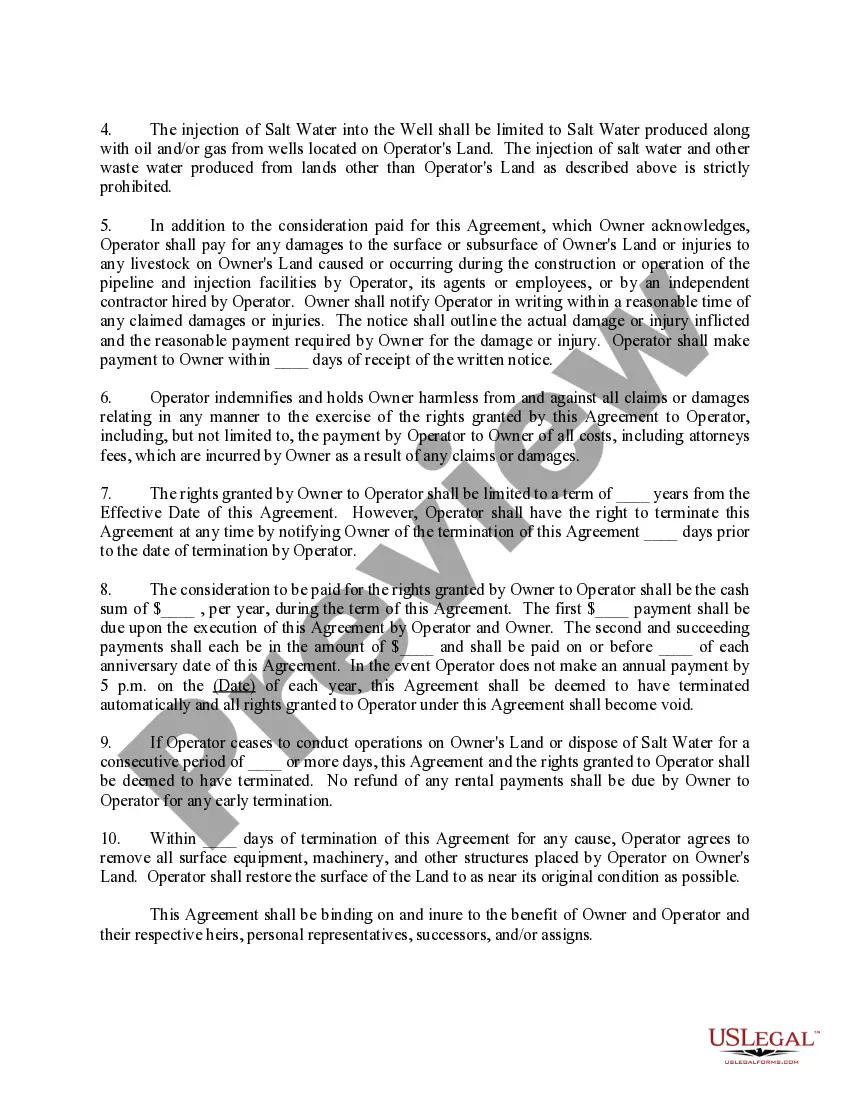
- Obligations of the operator to maintain the well and prevent contamination.
- Financial terms including rental payments and liability for damages.
- Terms for termination of the agreement and removal of equipment upon termination.

When to use this form
This agreement should be used when a surface owner allows an off-premises operator to use their land for the disposal of salt water from nearby oil and gas operations. It is essential in situations where the operator requires a legal basis to transport saline byproducts through the land for disposal, ensuring both parties understand their rights and responsibilities.
Intended users of this form
- Surface owners who receive requests from operators wishing to dispose of salt water on their property.
- Off-premises operators looking to formalize rights and responsibilities regarding salt water disposal.
- Legal representatives assisting either party in drafting or reviewing the agreement.
How to complete this form
- Identify the parties involved: enter the names and addresses of the surface owner and operator.
- Describe the lands involved: provide accurate details of the ownerâs and operatorâs properties.
- Specify the well location and any easement specifics related to pipeline construction.
- Fill in the financial details including payment terms and conditions of termination.
- Review and ensure all provisions are complete before both parties sign the agreement.
Does this form need to be notarized?
This form does not typically require notarization unless specified by local law. However, it is recommended to consult with a legal professional regarding the need for notarization based on specific circumstances.
Get your form ready online
Our built-in tools help you complete, sign, share, and store your documents in one place.
Make edits, fill in missing information, and update formatting in US Legal Forms—just like you would in MS Word.
Download a copy, print it, send it by email, or mail it via USPS—whatever works best for your next step.
Sign and collect signatures with our SignNow integration. Send to multiple recipients, set reminders, and more. Go Premium to unlock E-Sign.
If this form requires notarization, complete it online through a secure video call—no need to meet a notary in person or wait for an appointment.
We protect your documents and personal data by following strict security and privacy standards.

Make edits, fill in missing information, and update formatting in US Legal Forms—just like you would in MS Word.

Download a copy, print it, send it by email, or mail it via USPS—whatever works best for your next step.

Sign and collect signatures with our SignNow integration. Send to multiple recipients, set reminders, and more. Go Premium to unlock E-Sign.

If this form requires notarization, complete it online through a secure video call—no need to meet a notary in person or wait for an appointment.

We protect your documents and personal data by following strict security and privacy standards.
Avoid these common issues
- Failing to provide complete descriptions of the properties involved.
- Omitting specific maintenance responsibilities from the operator.
- Neglecting to define the financial terms clearly, leading to misunderstandings.
- Not considering local regulations that may affect the agreement.
Why use this form online
- Convenience of accessing and downloading the form from anywhere at any time.
- Editability allows users to customize the agreement to fit their specific needs.
- Reliability of legally drafted templates crafted by licensed attorneys.
Legal use & context
- This agreement is legally enforceable as long as it meets the requirements of state law.
- Be aware that the environmental regulations can vary significantly by jurisdiction, affecting compliance obligations.
- Consulting with a legal expert is advisable to ensure that all local laws are observed.
Looking for another form?
Form popularity
FAQ
(Oil & Gas Exploration and Production) An oil, natural gas, and mineral lease gives the lessee rights to exploit minerals beneath the surface of the property.It also grants the lessee the right to utilize the surface of the property to access those minerals.
Surface rights are, as the name implies, the rights to the surface area of a piece of land. This includes any structures on the property, as well as the rights to farm the land or exploit aboveground resources such as trees, plants, or water according to local laws and ordinances.
How far down the mineral rights go depends on the mineral and technology used. The average depth of open-pit mining a surface mining technique used to extract metals such as nickel, copper, uranium, and coal is between 100500 meters. For deep mining, the average depth is 2.83.4 kilometers.
Not owning the mineral rights to a parcel of land doesn't mean your property is worthless. If someone else owns the mineral rights and they sell those rights to an individual or corporation, you can still make a profit as the surface rights owner.
A: Mineral rights are the legal rights to the minerals in a property. Whoever owns a property's mineral rights has full legal rights to mine for and profit from those minerals.
Surface rights are subservient to mineral rights, which means the owner of a mineral servitude will be able to access and use the surface to extract the minerals from underneath.
Surface rights. Ownership rights in real property that include the right to occupy the land, develop it with buildings and fixtures and even to destroy its resources such as timber and water. air space rights.
Surface rights mean that you own the top of the land. Essentially, you'll own the grass, trees and any structures that are part of the land itself. All of the rights to these essential parts of the land will be owned once the title of the land has been transferred to your name.
A mineral owner's rights typically include the right to use the surface of the land to access and mine the minerals owned. This might mean the mineral owner has the right to drill an oil or natural gas well, or excavate a mine on your property.