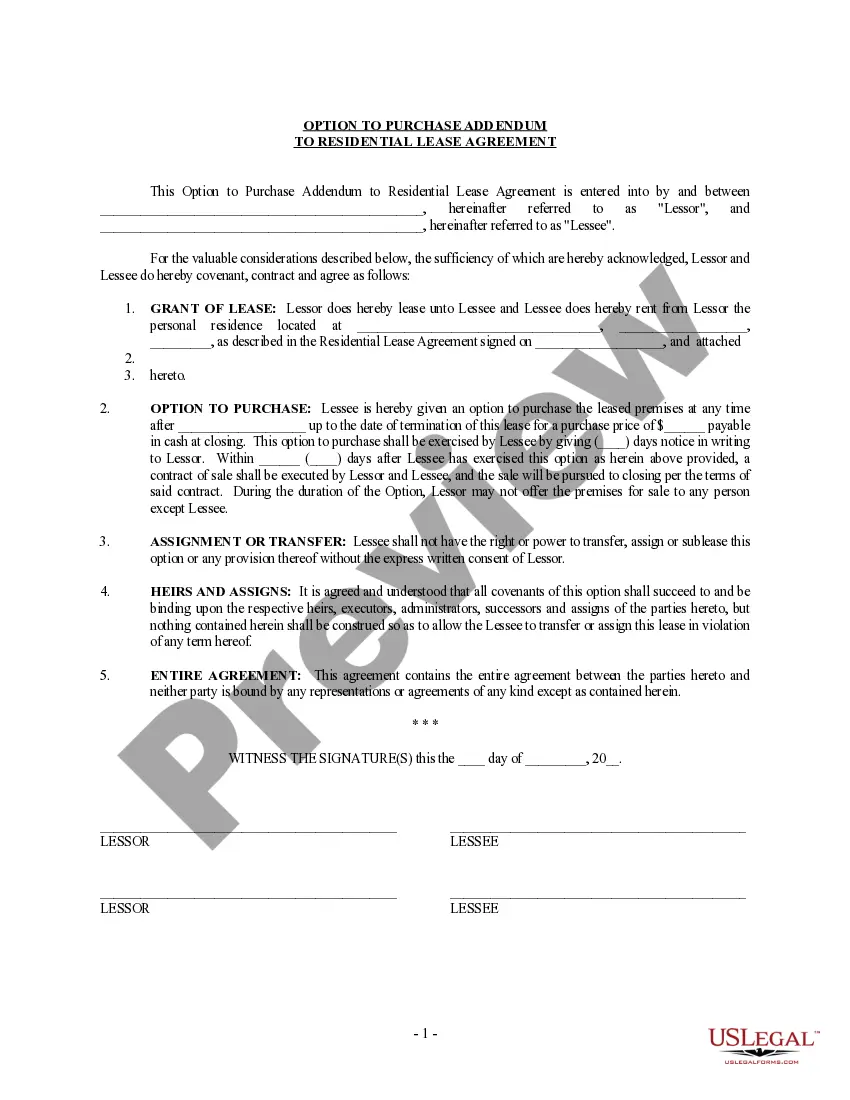
Salt Water Disposal Lease and Agreement Using Existing Well Bore
What this document covers
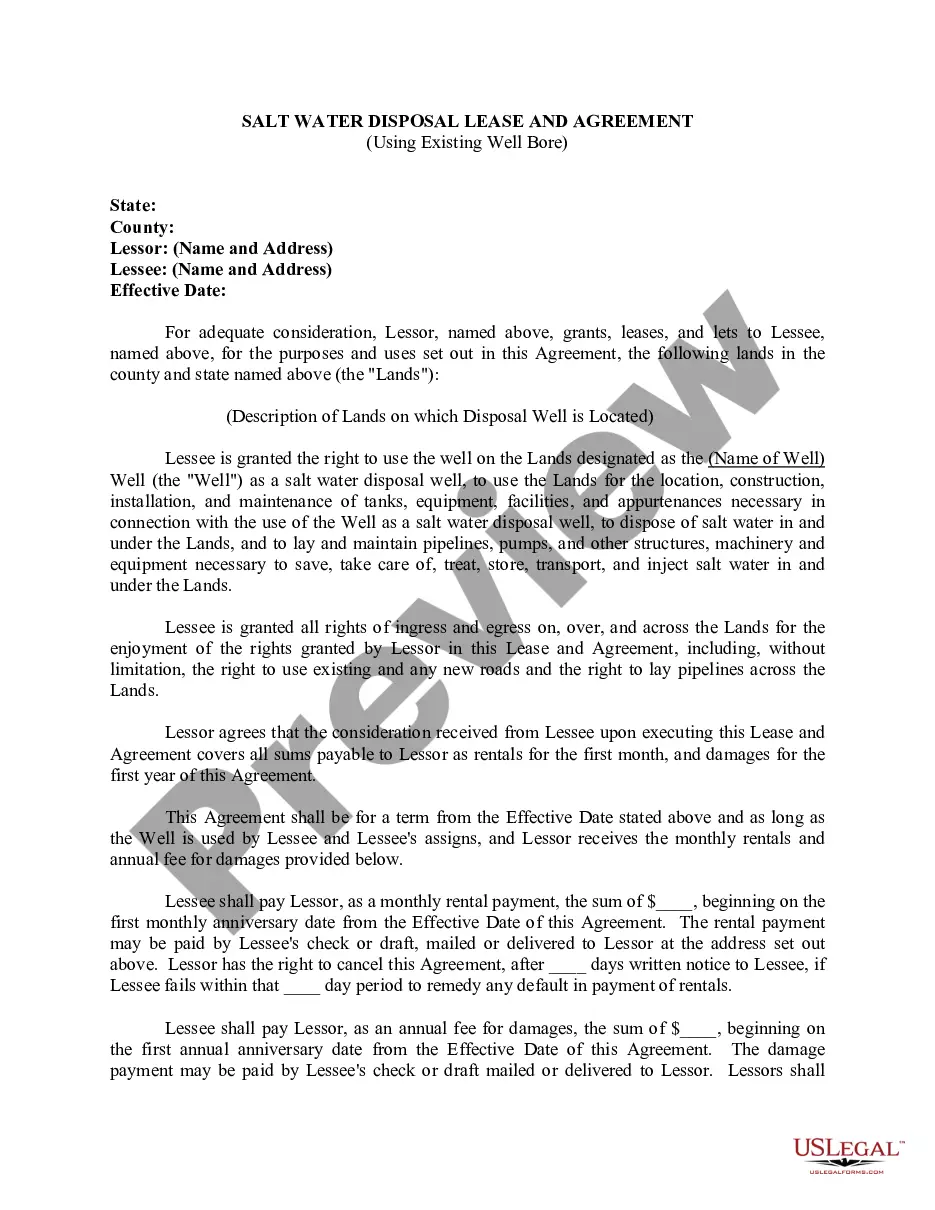
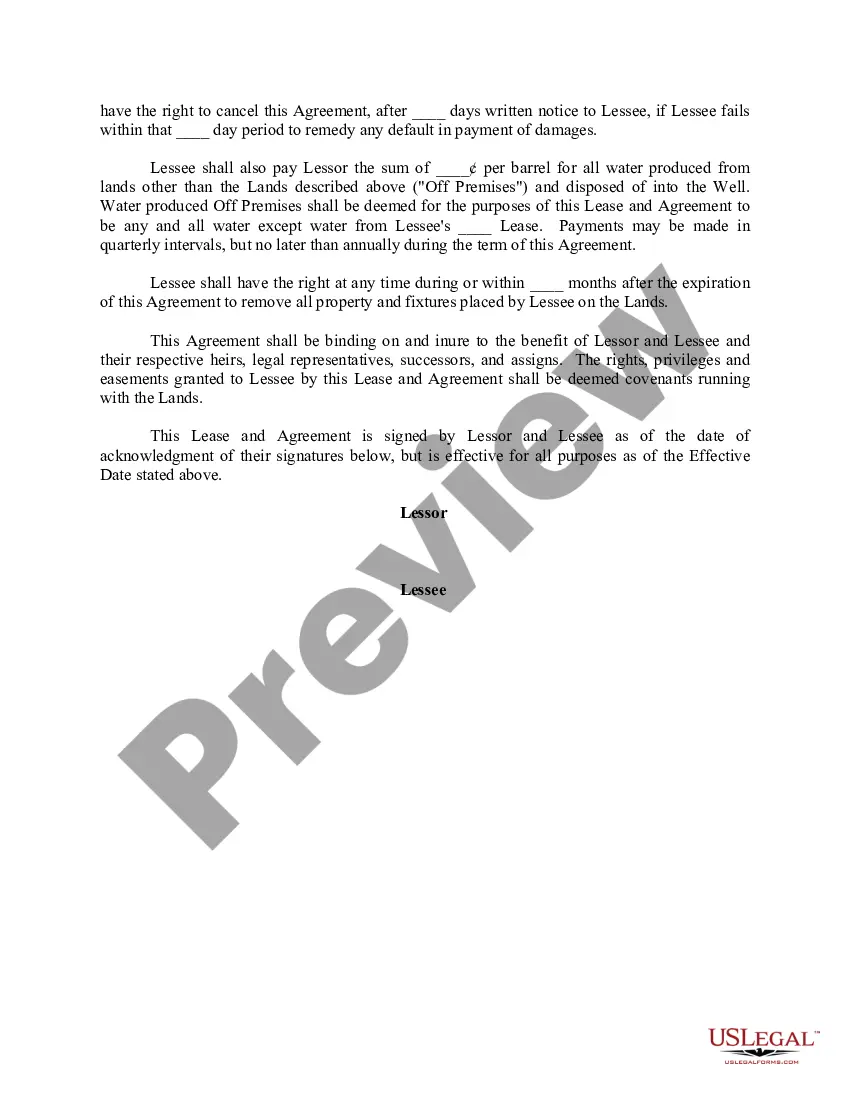
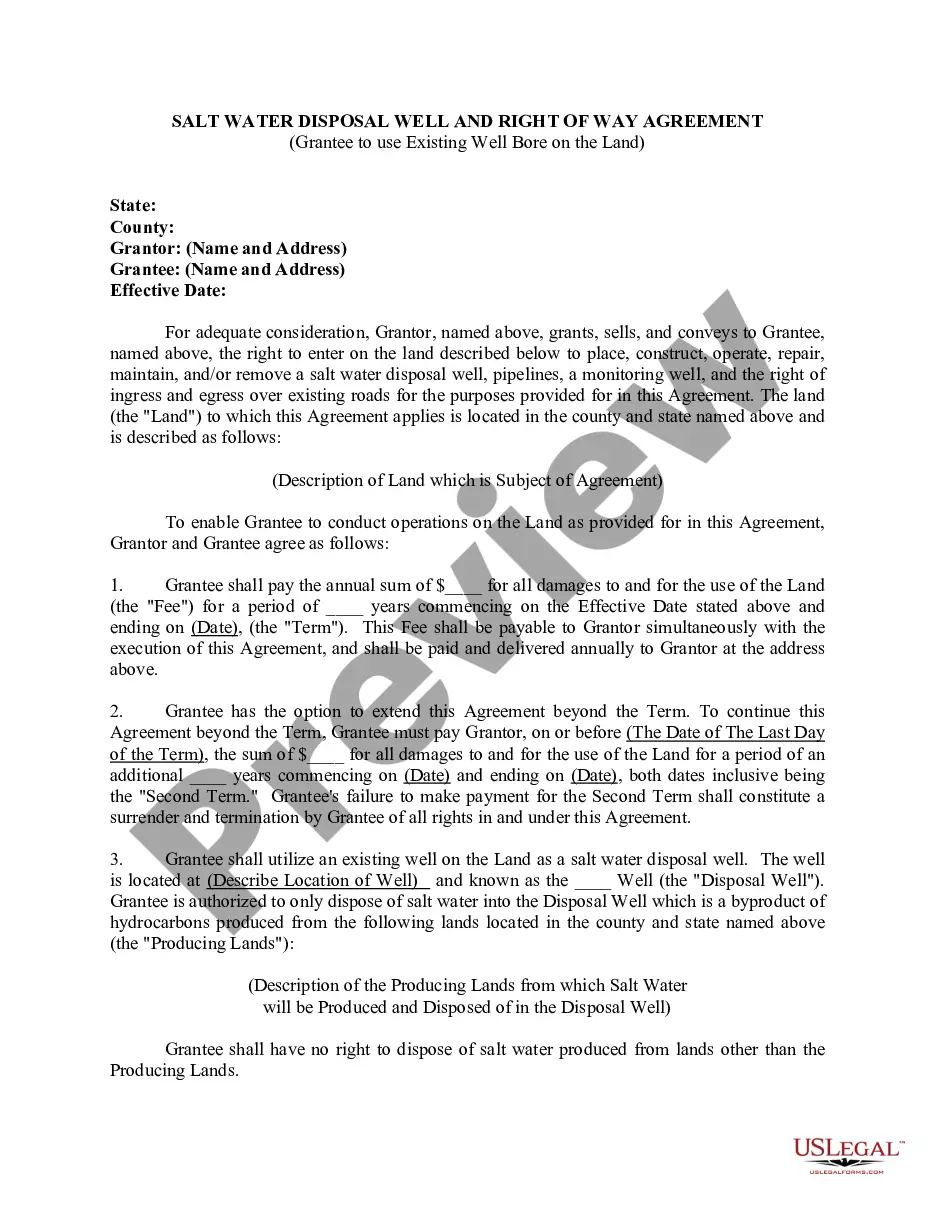
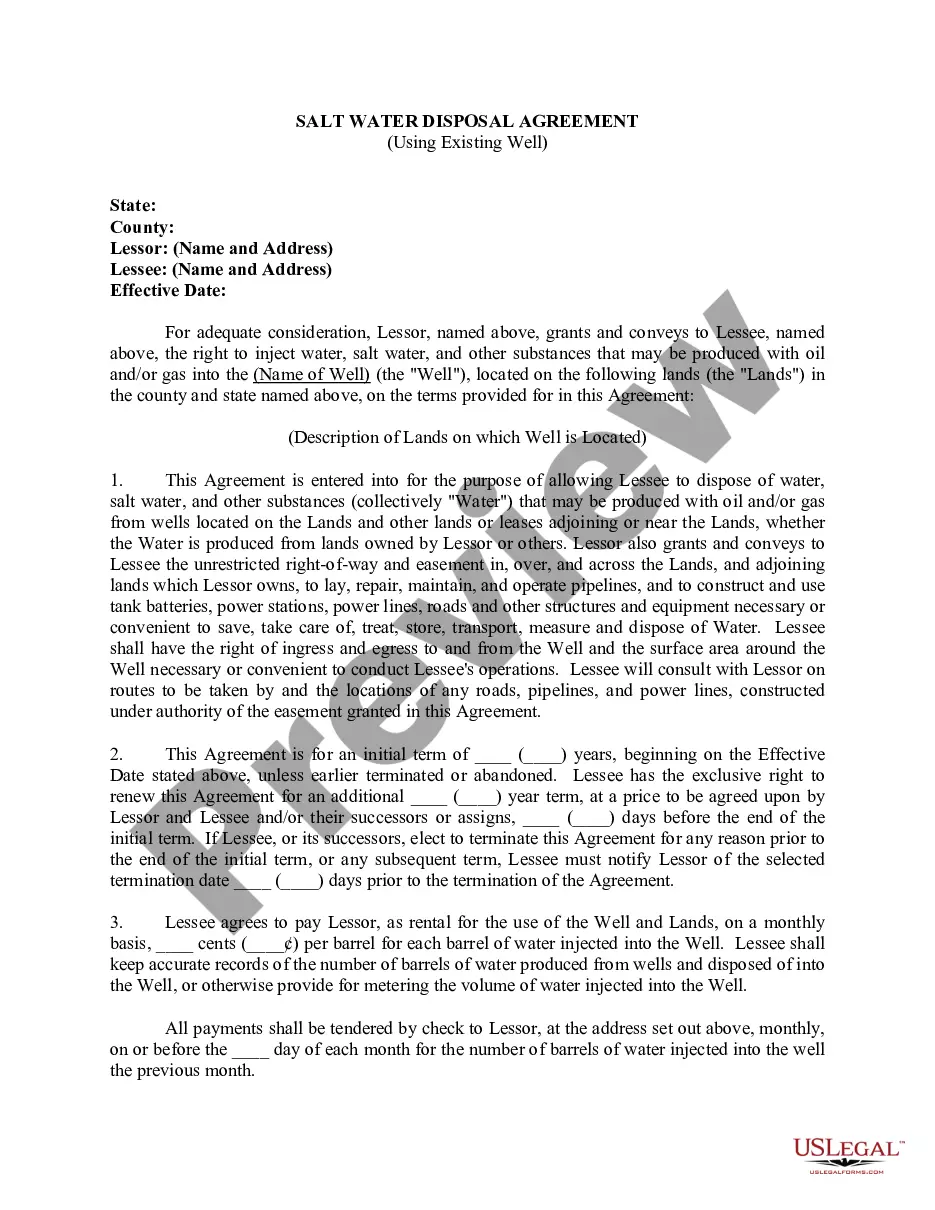
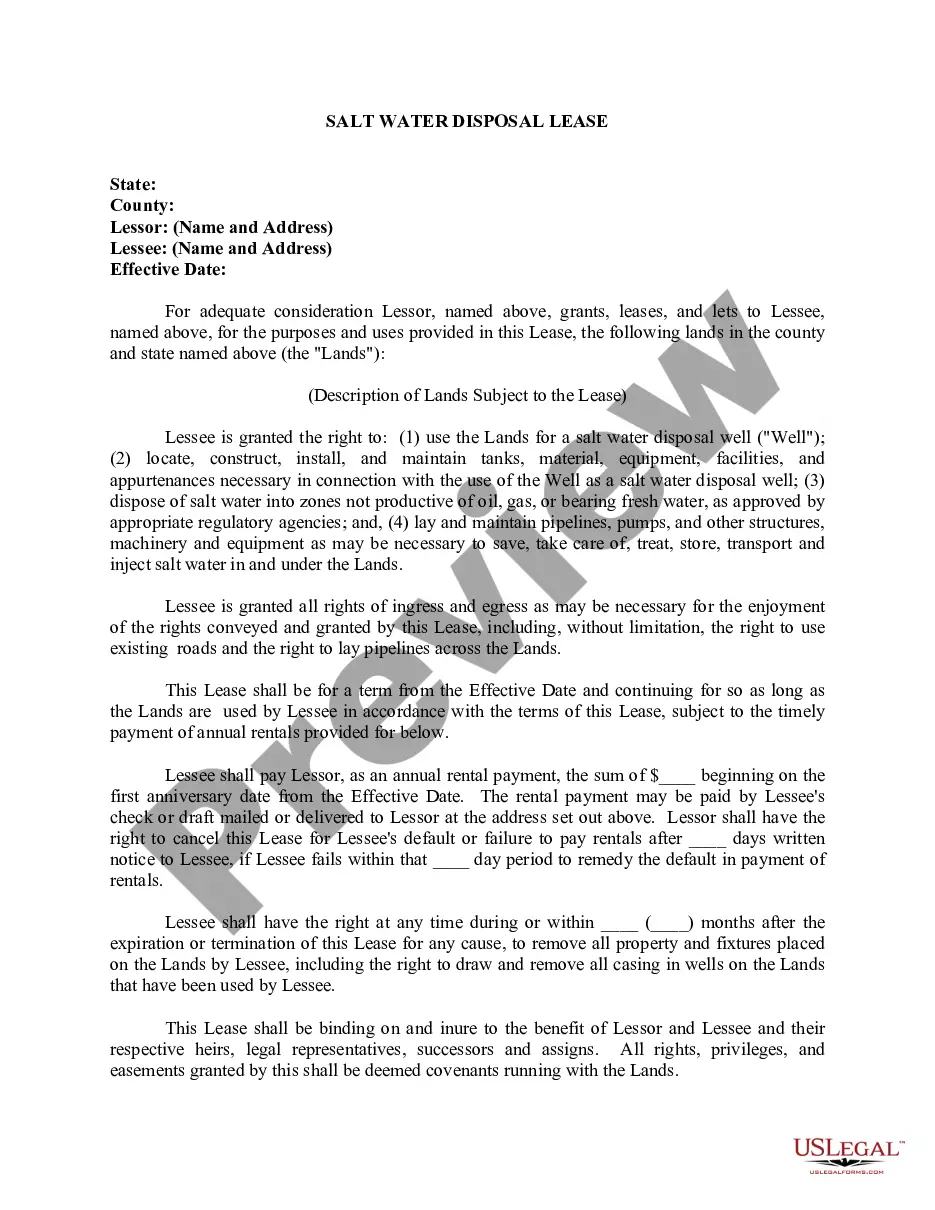
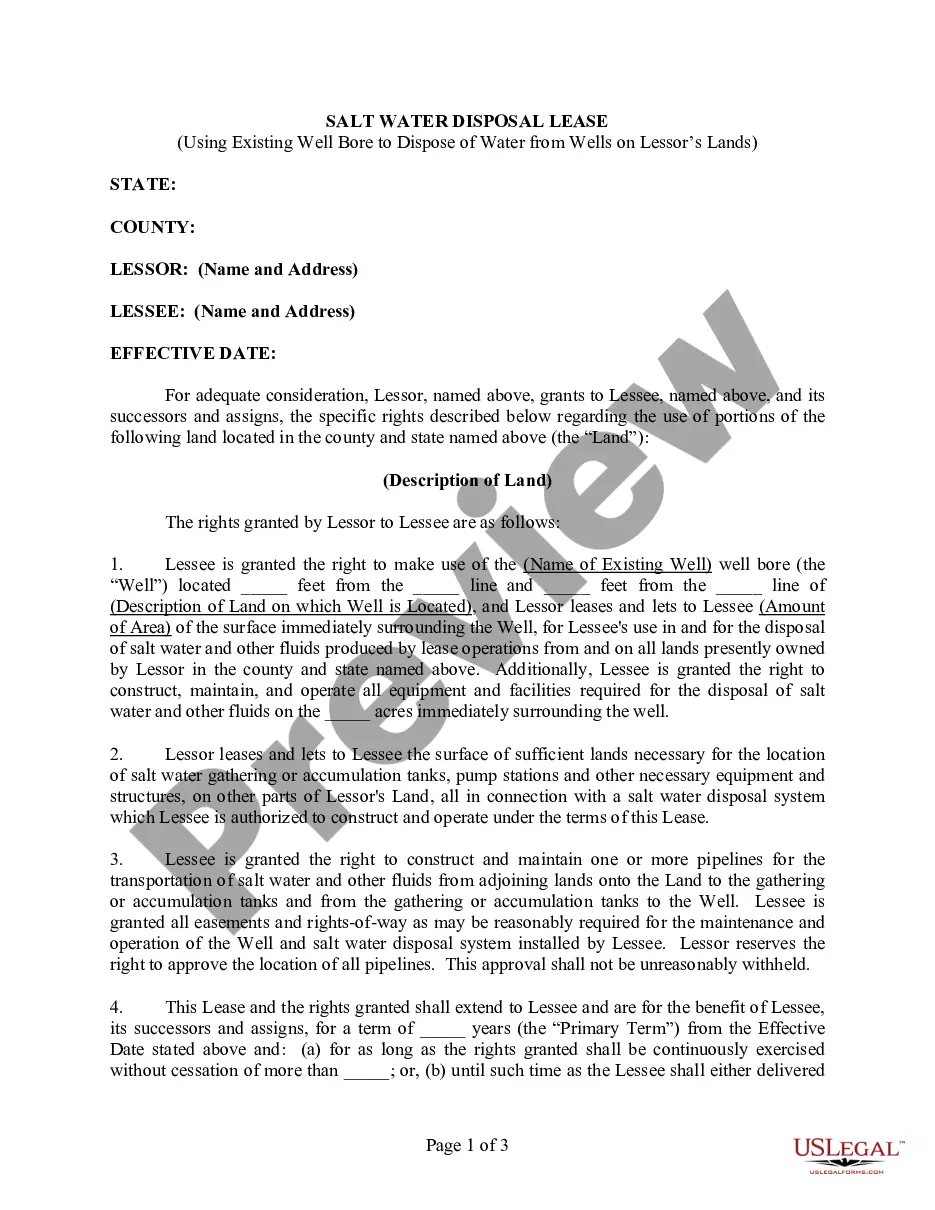
The Salt Water Disposal Lease and Agreement Using Existing Well Bore is a legal contract allowing a surface owner to permit another party to use their land for the disposal of salt water through an existing well. This form is specifically designed for properties not under an oil and gas lease, differentiating it from other leasing agreements in the oil and gas sector. It clearly outlines the rights and responsibilities of both the lessor and the lessee regarding the disposal of salt water and related activities.
Main sections of this form
- Identification of the parties involved: lessor and lessee, including their contact information.
- Description of the property: detailed description of the land where the disposal well is located.
- Grant of rights: specifies rights granted to the lessee for using the well and maintaining the necessary facilities.
- Payment terms: outlines monthly rental payments and annual fees for damages.
- Termination conditions: explains the process for cancellation of the agreement due to non-payment.
- Rights to remove property: stipulates the lessee's rights to remove their equipment after the lease ends.
Common use cases
This form should be used when a surface owner wants to allow another party to use an existing well on their land for the disposal of salt water. It is essential in situations where the land is not leased for oil and gas operations, ensuring that both parties have clear terms regarding the usage, payment, and obligations associated with the lease.
Who this form is for
- Landowners or surface owners seeking to lease their land for salt water disposal.
- Companies or individuals involved in oil and gas operations who need to dispose of salt water.
- Legal representatives advising clients on land lease agreements and property rights.
Completing this form step by step
- Identify the parties: Fill in the names and addresses of the lessor and lessee.
- Specify the property: Provide a detailed description of the land where the disposal well is located.
- Enter the effective date: Indicate the starting date of the agreement.
- Outline payment terms: Fill in the rental fee and damages payment amounts.
- Clarify rights and access: Ensure that the rights to ingress and egress are clearly stated.
- Sign and date the agreement: Both parties should sign and date the form to acknowledge their acceptance of the terms.
Notarization requirements for this form
Notarization is generally not required for this form. However, certain states or situations might demand it. You can complete notarization online through US Legal Forms, powered by Notarize, using a verified video call available anytime.
Get your form ready online
Our built-in tools help you complete, sign, share, and store your documents in one place.
Make edits, fill in missing information, and update formatting in US Legal Forms—just like you would in MS Word.
Download a copy, print it, send it by email, or mail it via USPS—whatever works best for your next step.
Sign and collect signatures with our SignNow integration. Send to multiple recipients, set reminders, and more. Go Premium to unlock E-Sign.
If this form requires notarization, complete it online through a secure video call—no need to meet a notary in person or wait for an appointment.
We protect your documents and personal data by following strict security and privacy standards.

Make edits, fill in missing information, and update formatting in US Legal Forms—just like you would in MS Word.

Download a copy, print it, send it by email, or mail it via USPS—whatever works best for your next step.

Sign and collect signatures with our SignNow integration. Send to multiple recipients, set reminders, and more. Go Premium to unlock E-Sign.

If this form requires notarization, complete it online through a secure video call—no need to meet a notary in person or wait for an appointment.

We protect your documents and personal data by following strict security and privacy standards.
Typical mistakes to avoid
- Failing to provide a clear description of the land.
- Not specifying the effective date of the lease.
- Omitting or incorrectly stating the payment amounts.
- Not signing the form or lacking the necessary signatures.
Advantages of online completion
- Convenience of downloading and completing the form at your own pace.
- Editability allows for easy customization to fit specific needs.
- Reliability with attorney-reviewed templates ensuring legal compliance.
Legal use & context
- The lease grants specific rights for the disposal of salt water, which may vary by jurisdiction.
- Both parties should understand their legal obligations and rights under the agreement.
- Ensuring compliance with local environmental laws and regulations is crucial for enforceability.
Quick recap
- The form is essential for establishing a legal framework for salt water disposal on private land.
- Clear terms regarding payment and obligations protect both parties and prevent disputes.
- Proper completion and understanding of the form can facilitate smooth operations and compliance with legal standards.
Looking for another form?
Form popularity
FAQ
SWD uses an ARM CPU standard bi-directional wire protocol, defined in the ARM Debug Interface v5. This enables the debugger to become another AMBA bus master for access to system memory and peripheral or debug registers. The Debug Access Port (DAP) is split into two main control units.
1. n. Well Completions A well, often a depleted oil or gas well, into which waste fluids can be injected for safe disposal. Disposal wells typically are subject to regulatory requirements to avoid the contamination of freshwater aquifers.
Disposal wells inject saltwater into underground formations, often over a mile in depth, into sub-surface zones that already contain naturally occurring saltwater. In contrast, wells that supply fresh water can vary in depth throughout the state, but generally range from no deeper than a few hundred to a thousand feet.
How Saltwater Disposal Works. Saltwater is typically ejected from the wells into natural underground formations sealed within an impenetrable rock to prevent the saltwater from escaping into surrounding soil and groundwater.
An injection well is used to place fluid underground into porous geologic formations. These underground formations may range from deep sandstone or limestone, to a shallow soil layer. Injected fluids may include water, wastewater, brine (salt water), or water mixed with chemicals.
A salt water disposal (SWD) well is a disposal site for water produced as a result of the oil and gas extraction process. Produced water, also referred to as salt water, contains particulate which can cause problems for the pump bringing water into the well.
While drilling costs can vary markedly based on the site geology, the target zone, and well depth, the total facility cost can easily reach $3 million to $4 million even if the facility offers no produced water transportation via pipeline.