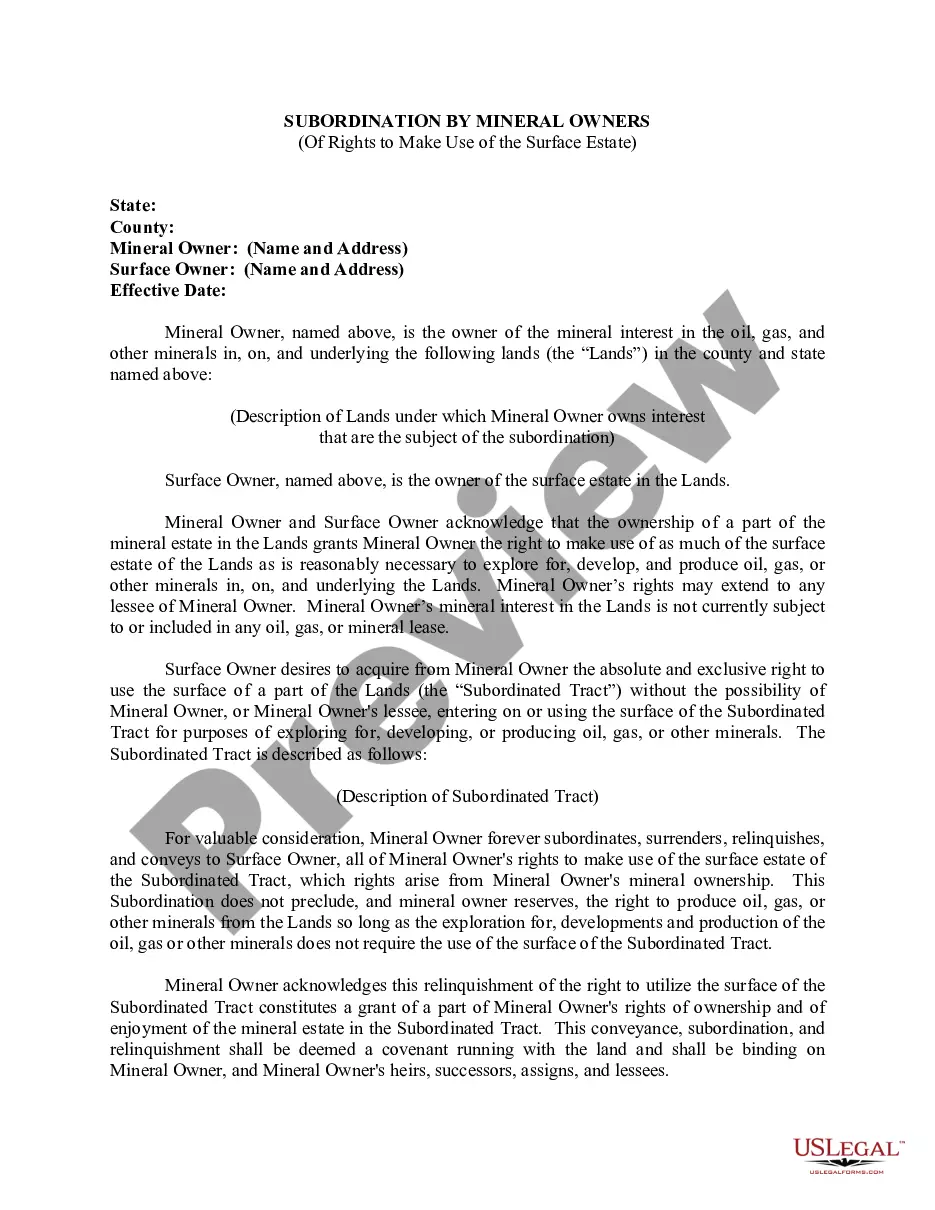
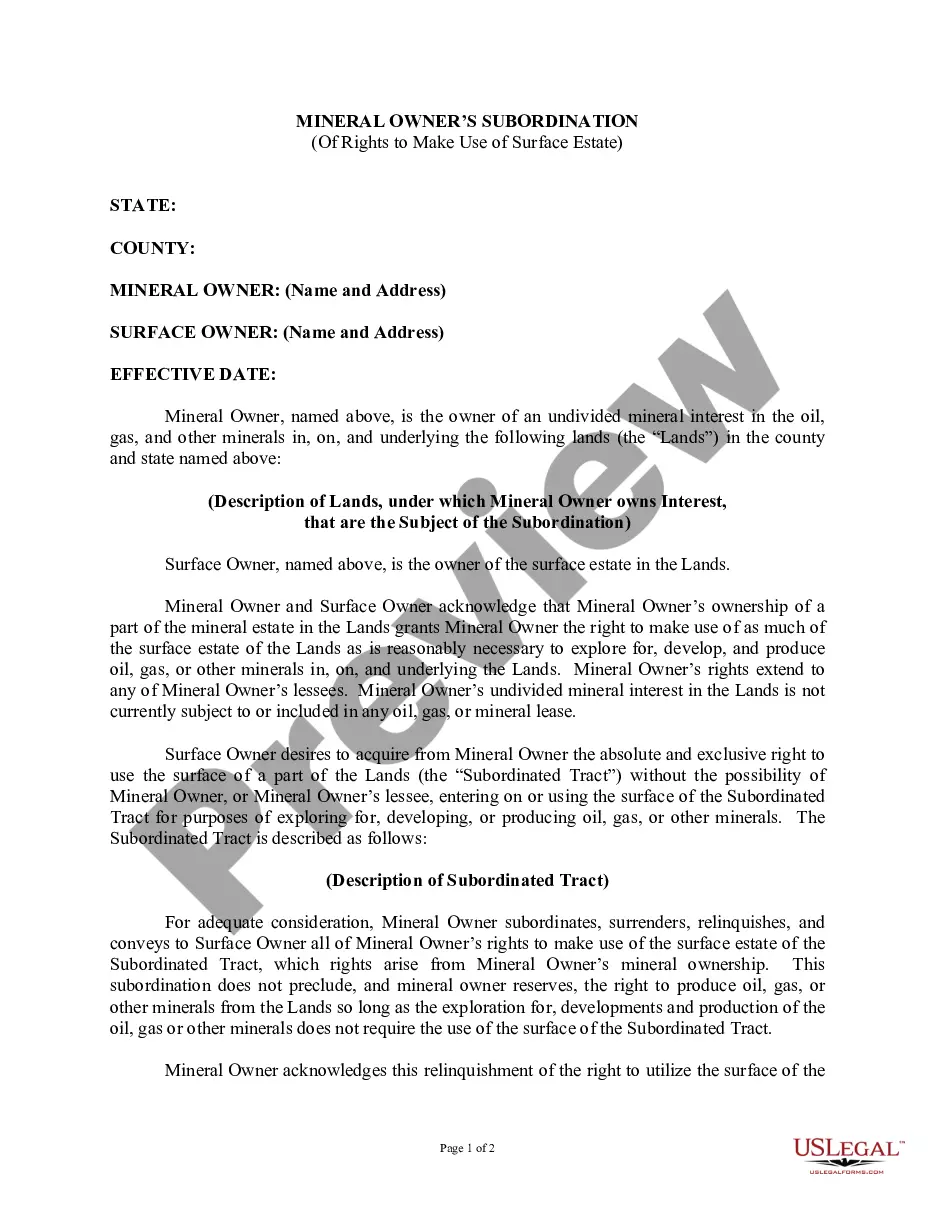
Subordination by Mineral Owners of Rights to Make Use of the Surface Estate - Transfer
Description

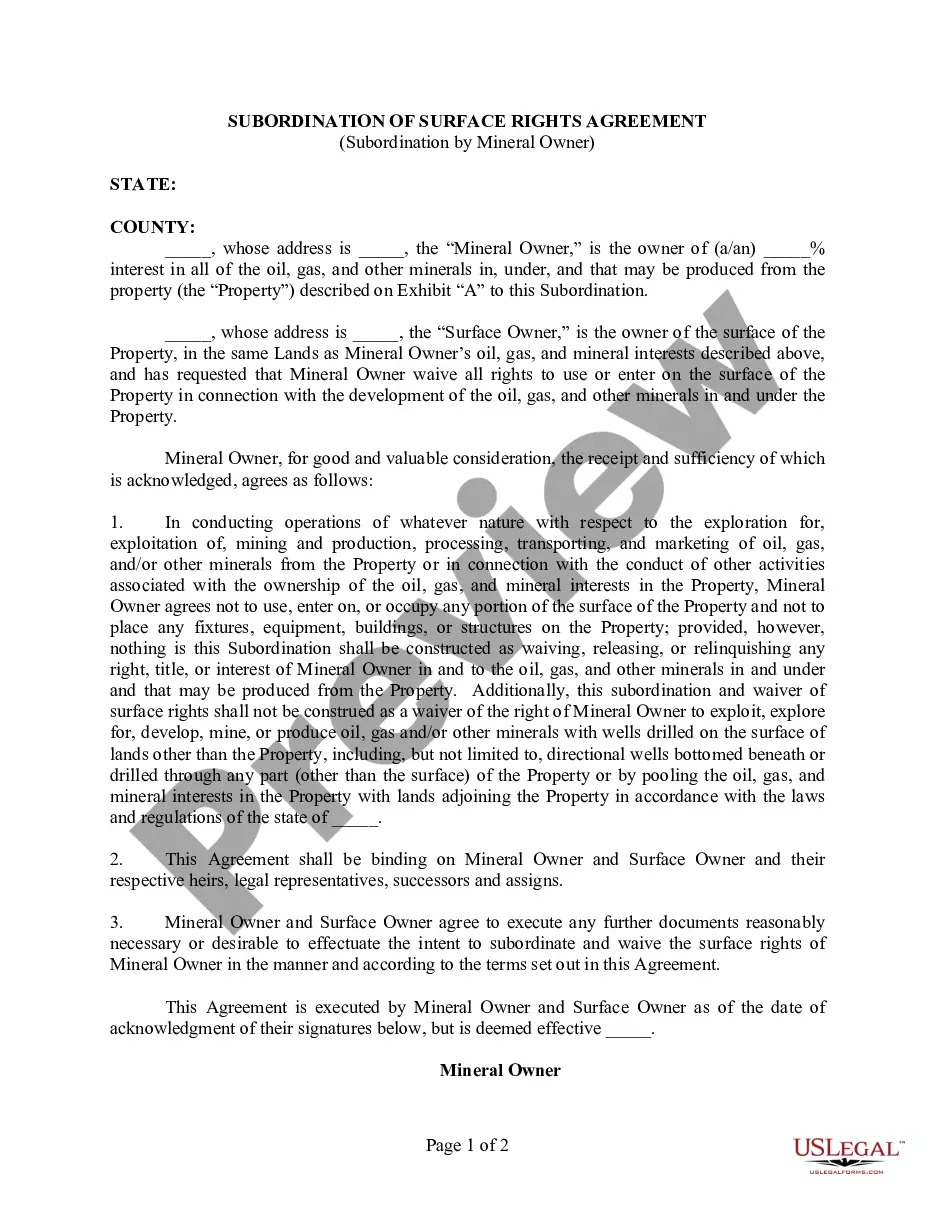
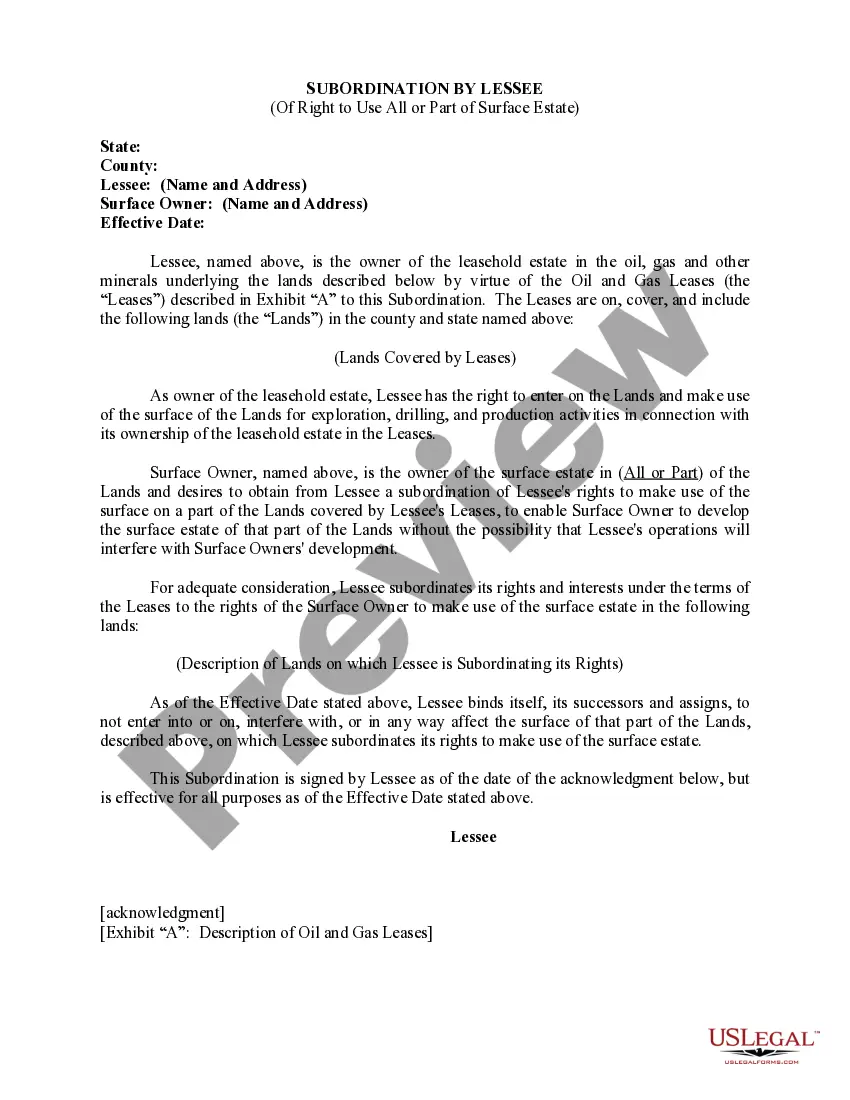

How to fill out Subordination By Mineral Owners Of Rights To Make Use Of The Surface Estate - Transfer?
When it comes to drafting a legal form, it is better to leave it to the experts. However, that doesn't mean you yourself can not find a template to use. That doesn't mean you yourself can’t get a sample to use, however. Download Subordination by Mineral Owners of Rights to Make Use of the Surface Estate - Transfer from the US Legal Forms website. It gives you numerous professionally drafted and lawyer-approved forms and templates.
For full access to 85,000 legal and tax forms, customers simply have to sign up and select a subscription. When you are registered with an account, log in, search for a certain document template, and save it to My Forms or download it to your gadget.
To make things easier, we’ve included an 8-step how-to guide for finding and downloading Subordination by Mineral Owners of Rights to Make Use of the Surface Estate - Transfer fast:
- Make sure the document meets all the necessary state requirements.
- If possible preview it and read the description before buying it.
- Press Buy Now.
- Choose the appropriate subscription for your needs.
- Create your account.
- Pay via PayPal or by debit/bank card.
- Choose a needed format if a few options are available (e.g., PDF or Word).
- Download the file.
As soon as the Subordination by Mineral Owners of Rights to Make Use of the Surface Estate - Transfer is downloaded you are able to fill out, print and sign it in any editor or by hand. Get professionally drafted state-relevant papers within a matter of seconds in a preferable format with US Legal Forms!
Form popularity
FAQ
Mineral rights are ownership claims against the natural resources located beneath a plot of land. In the United States, mineral rights are separate from surface rights. 1feff Mineral rights are often "severed" from surface rights in states such as Texas, Oklahoma, Pennsylvania, Louisiana, Colorado, and New Mexico.
As a mineral rights value rule of thumb, the 3X cash flow method is often used. To calculate mineral rights value, multiply the 12-month trailing cash flow by 3. For a property with royalty rights, a 5X multiple provides a more accurate valuation (stout.com).
(Oil & Gas Exploration and Production) An oil, natural gas, and mineral lease gives the lessee rights to exploit minerals beneath the surface of the property.It also grants the lessee the right to utilize the surface of the property to access those minerals.
An owner can separate the mineral rights from his or her land by: Conveying (selling or otherwise transferring) the land but retaining the mineral rights. (This is accomplished by including a statement in the deed conveying the land that reserves all rights to the minerals to the seller.)
Are inherited mineral rights taxable? The federal government does not consider inherited mineral rights taxable. Still, any income you accumulate from those rights does have to be reported on your tax return.
As a mineral rights value rule of thumb, the 3X cash flow method is often used. To calculate mineral rights value, multiply the 12-month trailing cash flow by 3. For a property with royalty rights, a 5X multiple provides a more accurate valuation (stout.com).
The IRS classifies the sale of mineral rights as a capital gain event, which is one of the most favorable tax treatments in the U.S. tax code.Cost basis is the original value of an asset for tax purposes, usually the purchase price.
Mineral rights are often sold separately from the land they are on. You may have title to the mineral rights on a property you own, or a previous owner may have sold or leased them in which case, they may not be yours to sell. But there is no need to abandon the idea of monetizing your mineral reserves!
Surface rights are subservient to mineral rights, which means the owner of a mineral servitude will be able to access and use the surface to extract the minerals from underneath.