Subordination of Surface Rights Agreement (Subordination by Mineral Owner)
Overview of this form
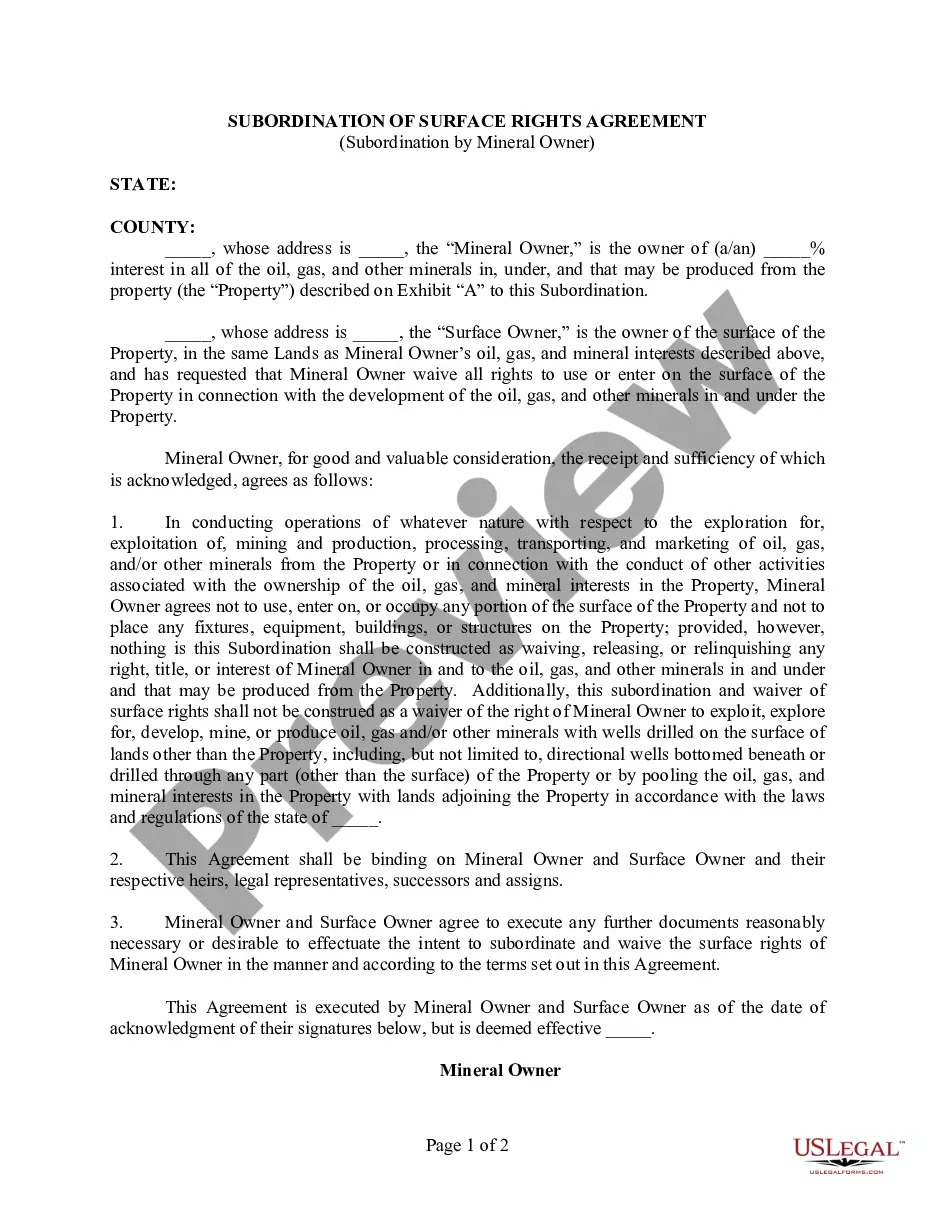
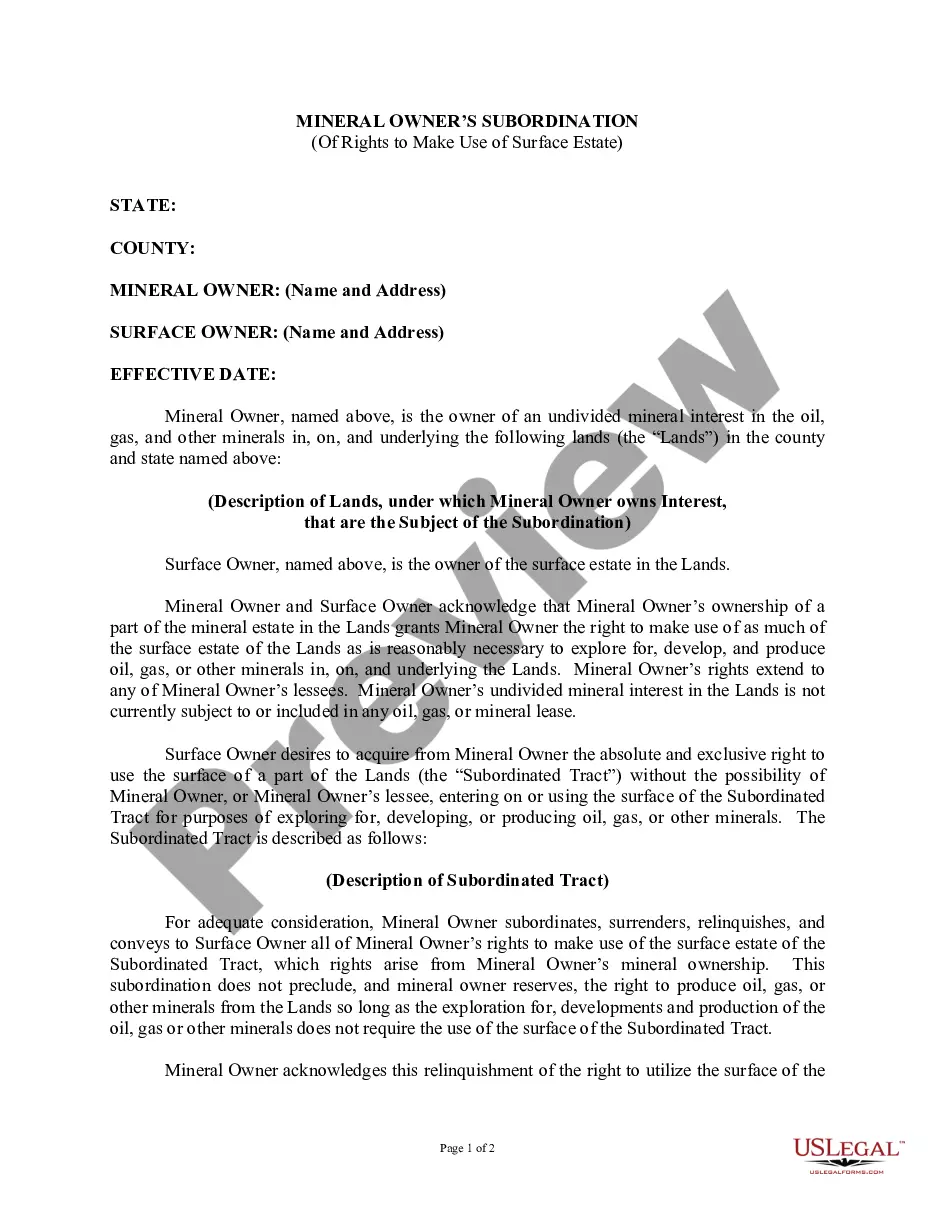
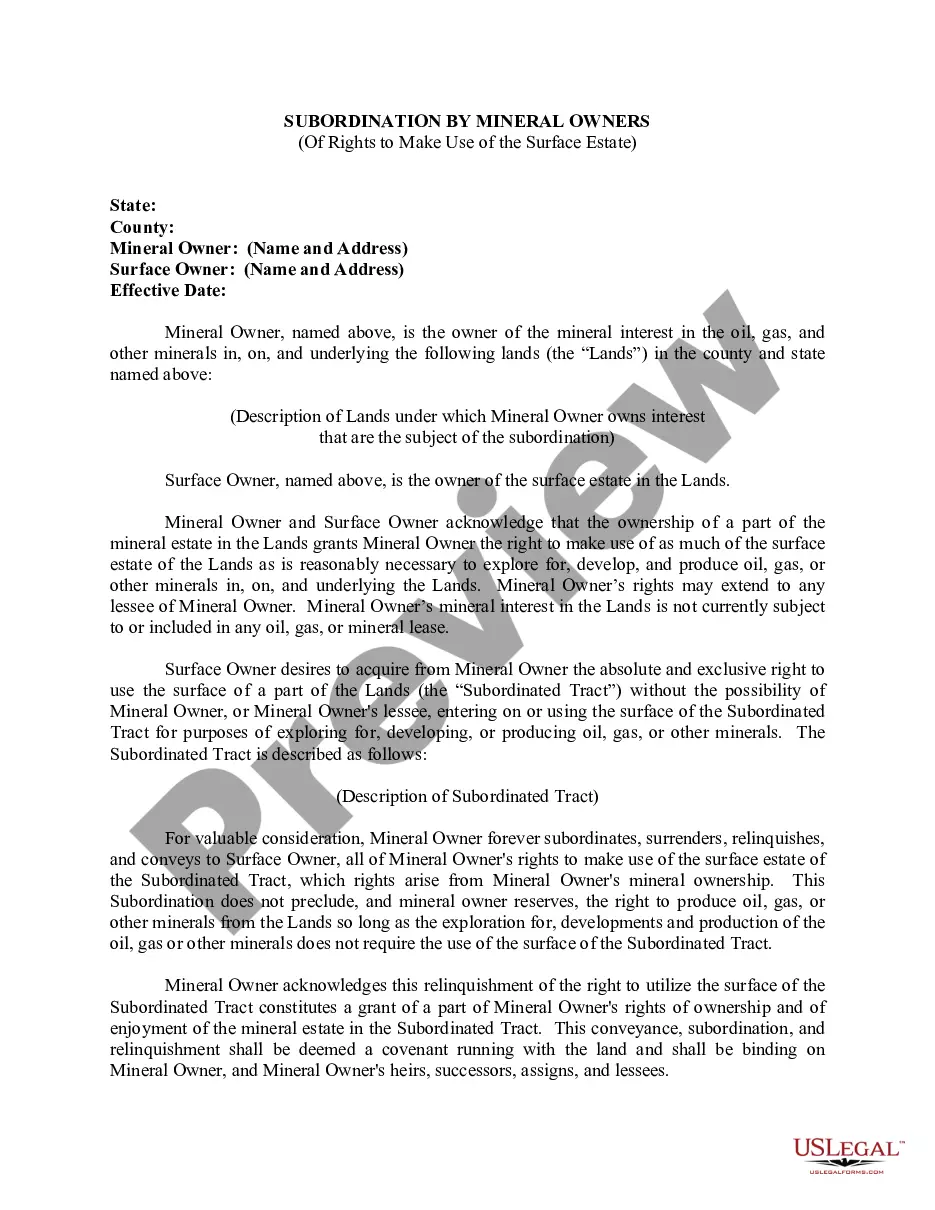
The Subordination of Surface Rights Agreement (Subordination by Mineral Owner) is a legal document that allows a mineral owner to waive their rights to use the surface of a property for mineral extraction activities. This agreement is essential for protecting the interests of the surface owner, ensuring that any exploration and production of oil, gas, or minerals occurs without interfering with surface rights. Unlike other agreements, this document specifically addresses the subordination of surface rights by the mineral owner, providing clarity on the use of land for mineral activities while preserving their rights below the surface.
Key components of this form
- Identification of the Mineral Owner and Surface Owner, including their addresses.
- Description of the mineral interests and the property involved, detailed in Exhibit A.
- Agreement that the Mineral Owner will not enter or use the surface of the property for any extraction activities.
- Statement that this agreement does not waive the Mineral Owner's rights to explore or produce minerals from other nearby properties.
- Clauses on binding terms for heirs, successors, and the need for additional documentation, if required.
When this form is needed
This form is typically used when a surface owner wants to ensure their land remains undisturbed while allowing mineral extraction rights to exist below them. Situations may include residential development where drilling and extraction are planned nearby, or negotiations between landowners and mineral companies regarding exploration rights. It is a crucial tool to clarify responsibilities and rights in cases where mineral interests may impact surface activities.
Who can use this document
- Surface Owners seeking to protect their land from disturbance by mineral extraction activities.
- Mineral Owners wishing to formalize their rights while agreeing to not utilize the land's surface.
- Land development companies involved in negotiations with mineral owners for construction projects.
Instructions for completing this form
- Identify the Mineral Owner and Surface Owner, entering their full names and addresses.
- Clearly describe the property involved, referencing Exhibit A for detailed location information.
- Enter the specific agreement terms regarding surface and mineral rights, ensuring all clauses are accurate.
- Add the effective date of the agreement to clarify when the subordination takes effect.
- Ensure both parties sign the document to validate the agreement and consider notarization.
Does this form need to be notarized?
This form needs to be notarized to ensure legal validity. US Legal Forms provides secure online notarization powered by Notarize, allowing you to complete the process through a verified video call, available anytime.
Get your form ready online
Our built-in tools help you complete, sign, share, and store your documents in one place.
Make edits, fill in missing information, and update formatting in US Legal Forms—just like you would in MS Word.
Download a copy, print it, send it by email, or mail it via USPS—whatever works best for your next step.
Sign and collect signatures with our SignNow integration. Send to multiple recipients, set reminders, and more. Go Premium to unlock E-Sign.
If this form requires notarization, complete it online through a secure video call—no need to meet a notary in person or wait for an appointment.
We protect your documents and personal data by following strict security and privacy standards.

Make edits, fill in missing information, and update formatting in US Legal Forms—just like you would in MS Word.

Download a copy, print it, send it by email, or mail it via USPS—whatever works best for your next step.

Sign and collect signatures with our SignNow integration. Send to multiple recipients, set reminders, and more. Go Premium to unlock E-Sign.

If this form requires notarization, complete it online through a secure video call—no need to meet a notary in person or wait for an appointment.

We protect your documents and personal data by following strict security and privacy standards.
Common mistakes
- Failing to accurately describe the property in Exhibit A.
- Not obtaining signatures from both Mineral and Surface Owners.
- Overlooking clauses that may limit mineral rights outside of the property area.
- Neglecting to specify the effective date of the agreement.
Why use this form online
- Convenient access to a professionally drafted document, saving time and reducing legal costs.
- Editable format allows for customization to fit specific needs of both parties.
- Reliable legal framework ensures enforceability in case of disputes.
Legal use & context
- This form is legally binding and enforces the agreement between both parties regarding surface rights.
- It allows surface owners to proceed with their intended use of the property while protecting their interests.
- Mineral owners maintain their rights to the minerals beneath the surface but agree not to interfere with surface activities.
What to keep in mind
- The Subordination of Surface Rights Agreement clarifies the relationship between mineral and surface rights.
- This form ensures surface owners can develop their land without mineral extraction interruptions.
- It is essential for both parties to understand their rights and obligations under this agreement.
Looking for another form?
Form popularity
FAQ
If you have mineral rights, you have several options available to help you profit from them. These include: 1) leasing the minerals; 2) selling all or a portion of the minerals; and 3) participating in development of the minerals.
Mineral rights don't come into effect until you begin to dig below the surface of the property. But the bottom line is: if you do not have the mineral rights to a parcel of land, then you do not have the legal ability to explore, extract, or sell the naturally occurring deposits below.
One important factor you must keep in mind is that if real estate contains mineral rights, simply buying the property doesn't make you the owner of them. Since mineral rights can be sold separately from the land itself, even if you own the land, someone else may hold ownership of what's below it.
Like land, mineral rights are conveyed through a deed transferring ownership to the buyer. While the property deed will reference the mineral rights transfer at the time of the separation of land and mineral rights, subsequent sales of the land will not.
Investing in mineral rights is a complex investment strategy but can be a profitable real estate venture.Then investing in mineral rights may be a great fit for your next real estate venture. Investing in mineral rights has the potential to provide big returns.
Mineral rights have sold for as high as $40,000 per acre, and usually, the average price can be between $250 and $9,000. If mineral rights buyers and sellers conduct proper due diligence, both parties can negotiate the best mining rights deal and avoid future legal quagmires.
If you sell your mineral rights, you are gambling that the one-time payment you receive is worth more than the potential future value of the minerals. When you sell your rights, you lose all opportunity to benefit from the future exploration and excavation or extraction of those minerals.
The price of mineral rights per acre ranges from under $500 to over $5,000.
Mineral rights are automatically included as a part of the land in a property conveyance, unless and until the ownership gets separated at some point by an owner/seller.Conveying (selling or otherwise transferring) the land but retaining the mineral rights.