Tenant's Consent (Pipeline Easement)
Overview of this form
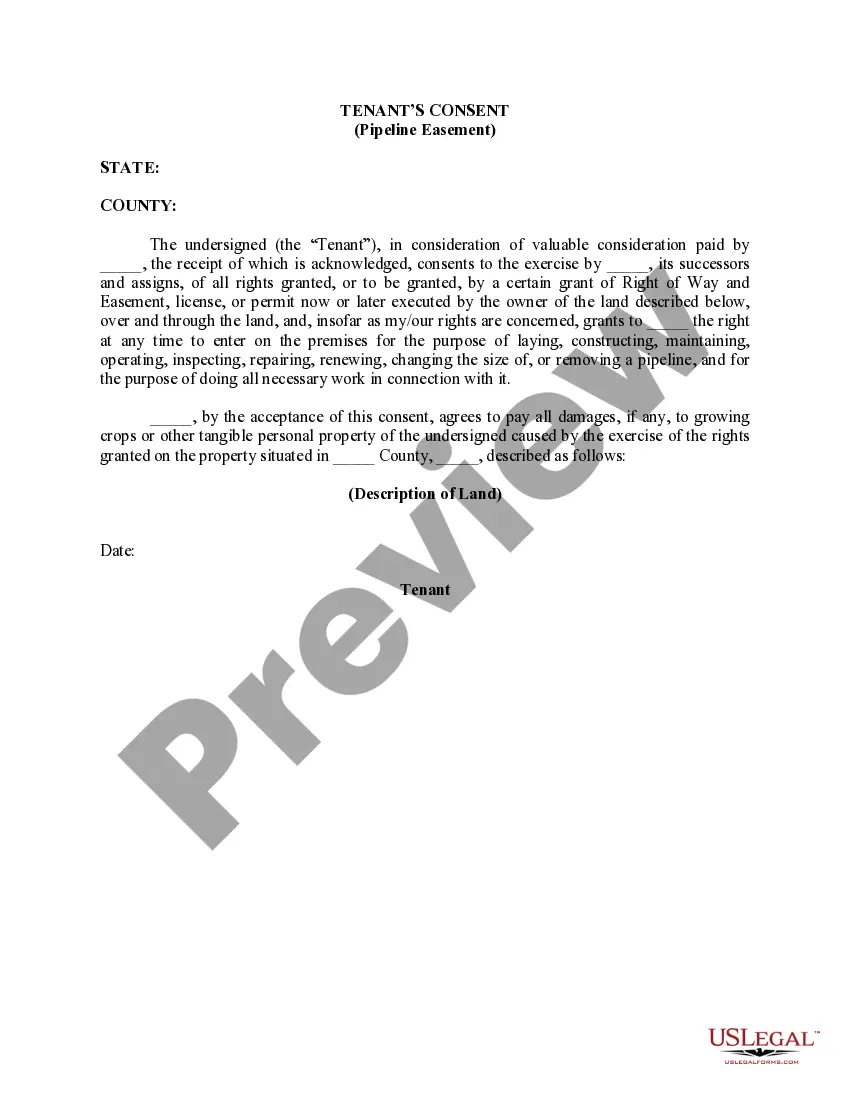
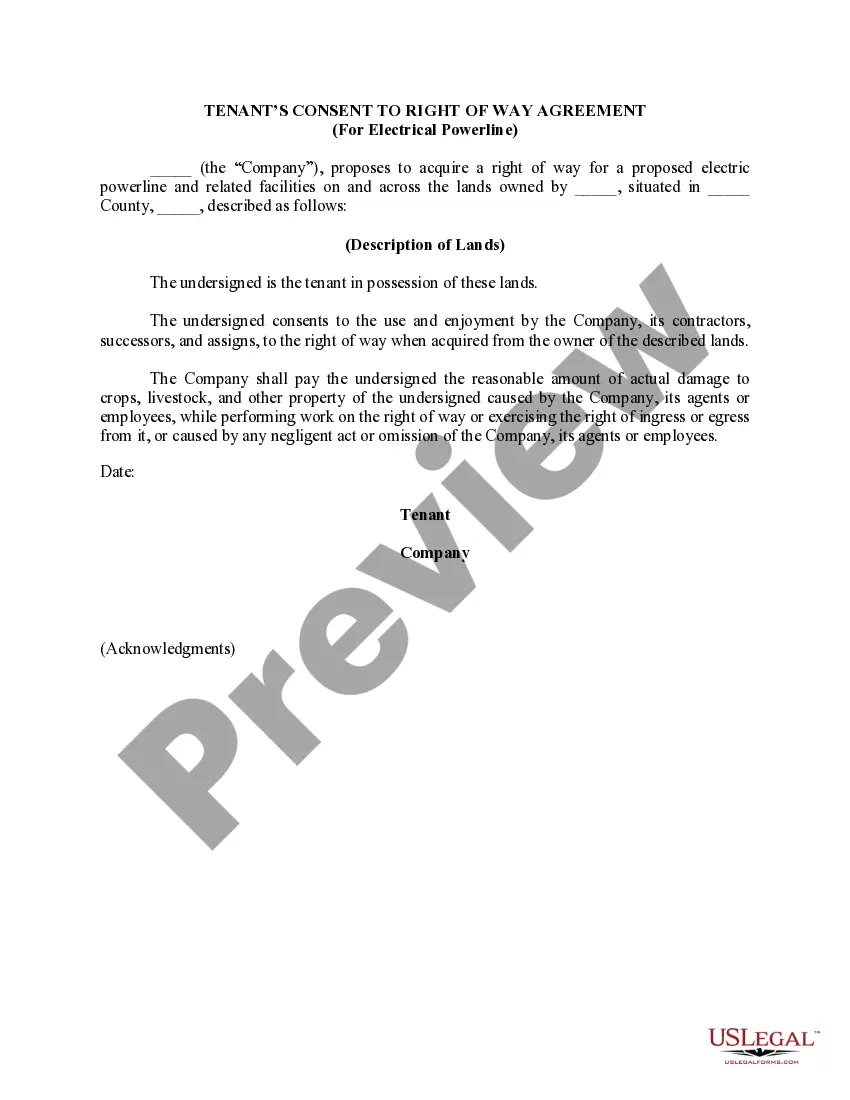
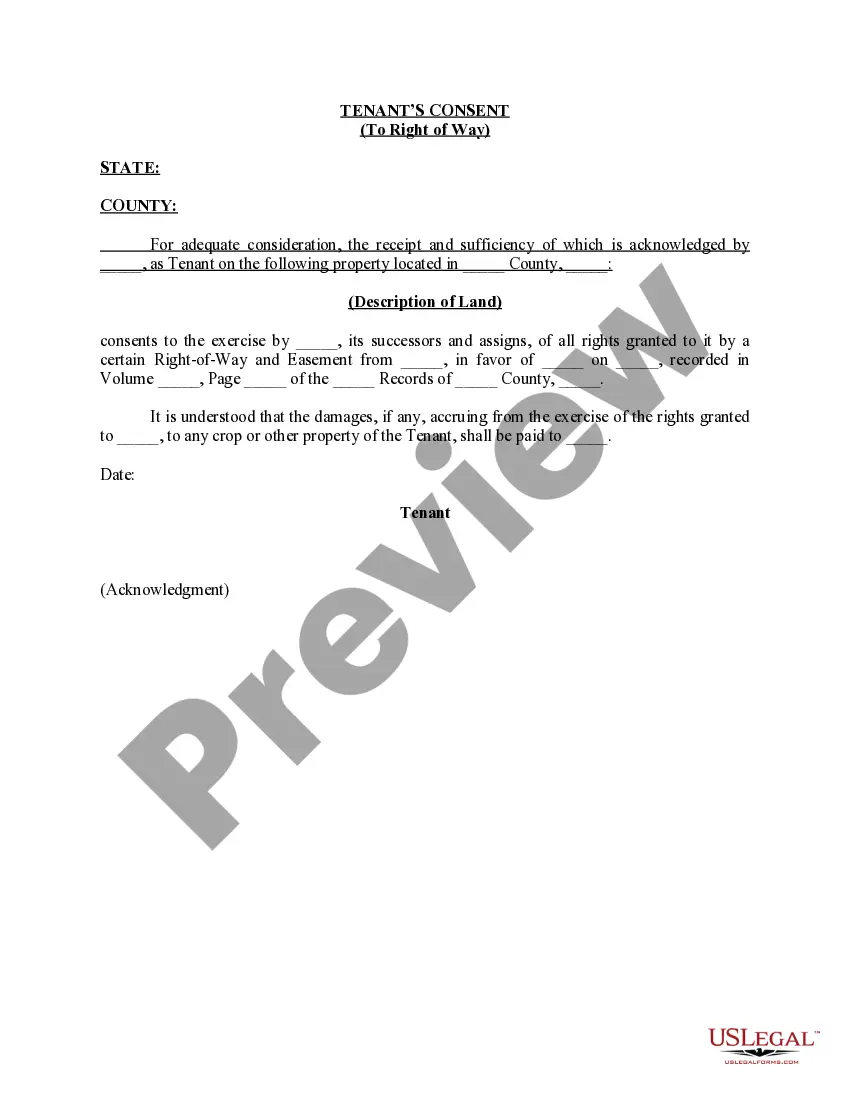
The Tenant's Consent for Pipeline Easement form is a legal document that allows a tenant to grant consent for the installation and maintenance of a pipeline on their leased property. This form differs from other easement agreements as it specifically pertains to the tenant's rights and obligations regarding pipeline access and property use. This document is essential for ensuring both parties have a clear understanding of the terms of access and use of the tenant's property for pipeline-related activities.
Form components explained
- Identification of the tenant and the party seeking the easement.
- Acknowledgment of consideration received, typically a nominal fee.
- Description of the property where the pipeline will be located.
- Granting permission to enter the property for construction and maintenance of the pipeline.
- Agreement to compensate for any damages to property or crops.
When to use this document
This form should be used when a tenant is approached by a pipeline company or another entity seeking to install or maintain a pipeline on the tenant's leased land. It is particularly necessary if the lease does not already address such easement rights. Using this form helps formalize the tenant's consent and clarifies the obligations of both parties regarding access and potential damages during the easement period.
Who this form is for
- Tenants leasing property near existing or proposed pipelines.
- Landowners who are renting their property and need to give consent for pipeline access.
- Pipeline companies seeking legal permission to operate on rented land.
- Real estate professionals managing leased properties with potential pipeline easements.
Steps to complete this form
- Identify the tenant and the party seeking the easement by filling in their full names.
- Specify the exact amount of consideration being provided in exchange for the easement.
- Describe the property where the pipeline will be installed including the county and any identifying features.
- Enter the date of signing to validate the document.
- Ensure both parties sign the document to make it legally binding.
Notarization requirements for this form
This form does not typically require notarization to be legally valid. However, some jurisdictions or document types may still require it. US Legal Forms provides secure online notarization powered by Notarize, available 24/7 for added convenience.
Get your form ready online
Our built-in tools help you complete, sign, share, and store your documents in one place.
Make edits, fill in missing information, and update formatting in US Legal Forms—just like you would in MS Word.
Download a copy, print it, send it by email, or mail it via USPS—whatever works best for your next step.
Sign and collect signatures with our SignNow integration. Send to multiple recipients, set reminders, and more. Go Premium to unlock E-Sign.
If this form requires notarization, complete it online through a secure video call—no need to meet a notary in person or wait for an appointment.
We protect your documents and personal data by following strict security and privacy standards.

Make edits, fill in missing information, and update formatting in US Legal Forms—just like you would in MS Word.

Download a copy, print it, send it by email, or mail it via USPS—whatever works best for your next step.

Sign and collect signatures with our SignNow integration. Send to multiple recipients, set reminders, and more. Go Premium to unlock E-Sign.

If this form requires notarization, complete it online through a secure video call—no need to meet a notary in person or wait for an appointment.

We protect your documents and personal data by following strict security and privacy standards.
Common mistakes
- Failing to accurately describe the property which can lead to disputes.
- Not including a date, which can complicate legal enforcement.
- Neglecting to retain a copy of the signed form for personal records.
Why complete this form online
- Convenient access to the form from any location, allowing for quick completion.
- Easy to edit for specific needs without the hassle of printing and mailing.
- Reliable templates drafted by licensed attorneys, ensuring legal validity.
Looking for another form?

Form popularity
FAQ
How much money should landowners get when an oil or gas pipeline crosses their land? As it stands, landowners receive a one-time payment roughly based on the length of the pipeline, with rates varying from $5 to $50 per foot or more for a Marcellus or Utica shale pipeline right-of-way agreement.
An easement is a nonpossessory right to use and/or enter onto the real property of another without possessing it. It is "best typified in the right of way which one landowner, A, may enjoy over the land of another, B".
Generally speaking, an easement is a more serious property right; it is the legal right to use someone else's land for a particular purpose. Easements are often recorded at the county clerk's office and encumber your property's title.Here, however, you probably do not need to take the step of granting an easement.
An easement is a limited right to use another person's land for a stated purpose. Examples of easements include the use of private roads and paths, or the use of a landowner's property to lay railroad tracks or electrical wires.
Easements are treated as a recovery of the basis of the property first, with any excess proceeds treated as capital gain, which is taxed at a lower rate than ordinary income. The basis of property that offsets an easement is limited to the basis of the affected acres or square footage.
Rights of way (similar to the driveway example, but also including walkways or pathways); Public utilities, such as gas, electricity or water and sewer mains; Parking areas; Access to light and air; and. Shared walls.
If an easement is 50 rods long, that is almost an acre. In a recent case, a pipeline company paid some owners $180 per rod and others $767 per rod for the same project.
Give the document a simple title: Grant of Easement is sufficient. Identify the parties. You need to explain who the parties are to the agreement. The person granting the easement to his property is the Grantor and the person gaining access to the property is the Grantee.
An easement deed allows a party that is not the owner to use a portion of the land. It is a written agreement between two parties that spells out what part of the property is available for access and how it may be used. Since you are granting an easement to your land, you can set any terms and conditions you like.