Commingling Agreement Among Working Owners As to Production from Different Formations Out of the Same Well Bore, Where Leasehold Ownership Varies As to Depth
Overview of this form
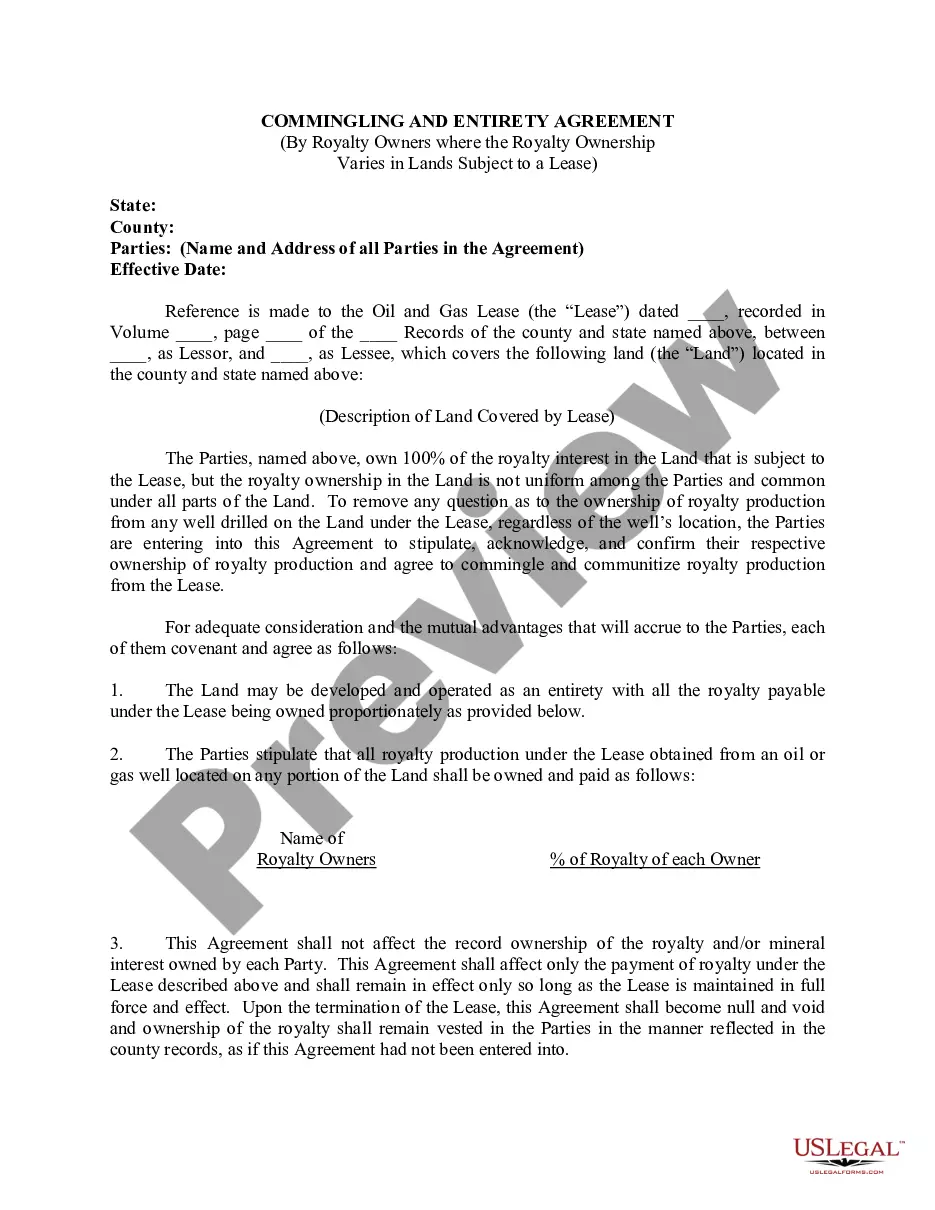
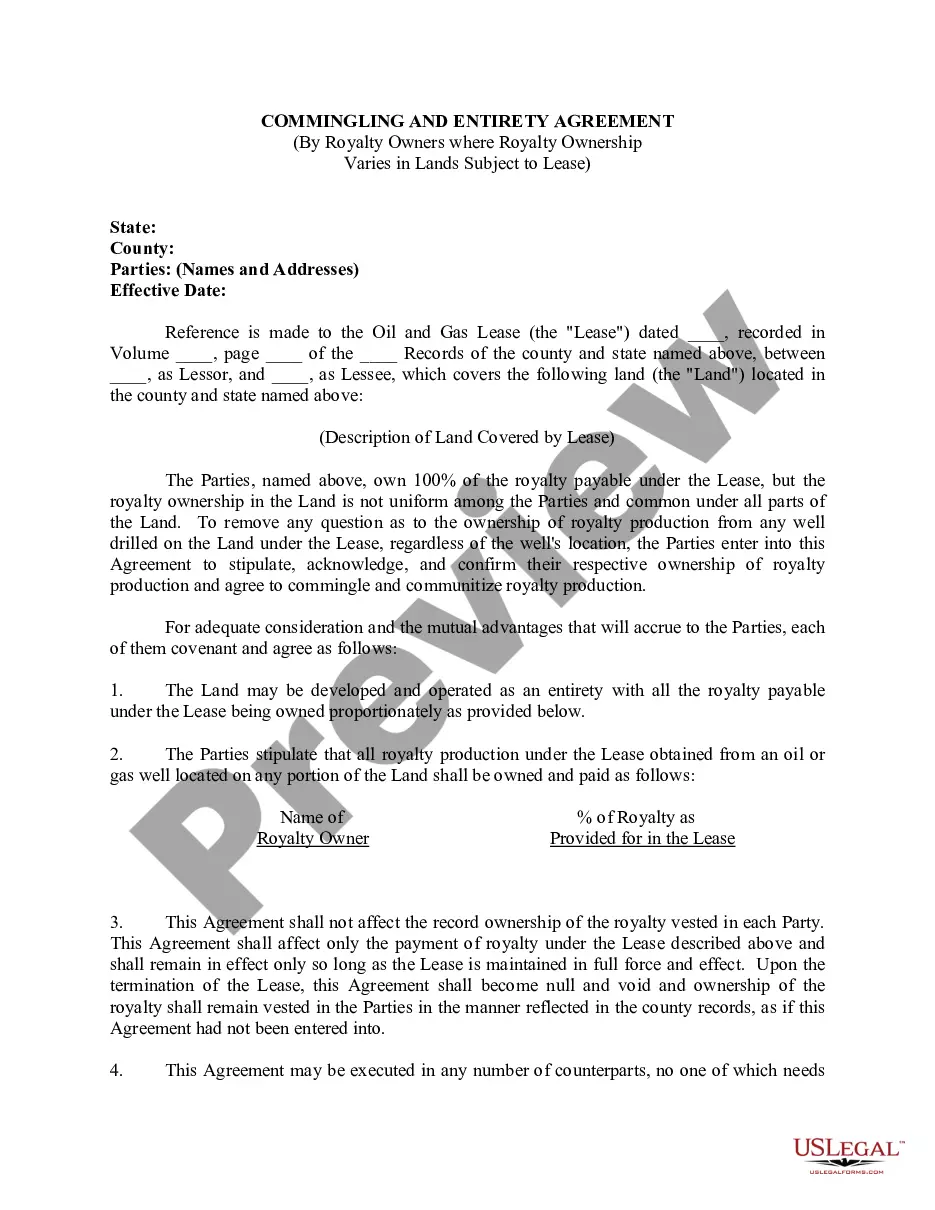
This Commingling Agreement Among Working Owners is a legal document used by parties who hold undivided leasehold interests in different depths of the same well. It ensures that production from various geological formations within the same well bore, where ownership rights differ, is accurately accounted for and compensated. This agreement is essential for enabling the parties to receive their proportional share of commingled production based on their specific depth ownership, distinguishing it from standard lease agreements or surface rights agreements.
Key components of this form
- Identification of the parties involved, including names and addresses.
- Effective date of the agreement.
- Details of the oil and gas lease and the lands covered.
- Specification of the depth interests owned by each party.
- Agreement terms for sharing costs and revenues from produced oil and gas.
- Termination conditions for the agreement based on production feasibility.
When to use this form
This form should be used when multiple parties own various leasehold interests in different geological depths of the same well and need a structured agreement to share production revenues. It is particularly relevant in situations where the ownership is not uniform, and the parties require clarity on how the commingled resources will be divided among them, ensuring fair compensation as production continues.
Who this form is for
- Working owners of leasehold interests in oil and gas wells.
- Owners with different rights and interests pertaining to specific subsurface depths.
- Parties collaborating on oil and gas production from the same well bore.
Instructions for completing this form
- Identify all parties involved and provide their names and addresses.
- Specify the effective date of the agreement.
- Detail the oil and gas lease, including the recording information and land description.
- Outline each party's ownership interests in relation to the depths specified.
- Enter the agreed-upon production shares and cost responsibilities for each party.
- Ensure all parties sign the agreement, indicating their consent to the terms.
Does this form need to be notarized?
Notarization is generally not required for this form. However, certain states or situations might demand it. You can complete notarization online through US Legal Forms, powered by Notarize, using a verified video call available anytime.
Get your form ready online
Our built-in tools help you complete, sign, share, and store your documents in one place.
Make edits, fill in missing information, and update formatting in US Legal Forms—just like you would in MS Word.
Download a copy, print it, send it by email, or mail it via USPS—whatever works best for your next step.
Sign and collect signatures with our SignNow integration. Send to multiple recipients, set reminders, and more. Go Premium to unlock E-Sign.
If this form requires notarization, complete it online through a secure video call—no need to meet a notary in person or wait for an appointment.
We protect your documents and personal data by following strict security and privacy standards.

Make edits, fill in missing information, and update formatting in US Legal Forms—just like you would in MS Word.

Download a copy, print it, send it by email, or mail it via USPS—whatever works best for your next step.

Sign and collect signatures with our SignNow integration. Send to multiple recipients, set reminders, and more. Go Premium to unlock E-Sign.

If this form requires notarization, complete it online through a secure video call—no need to meet a notary in person or wait for an appointment.

We protect your documents and personal data by following strict security and privacy standards.
Common mistakes to avoid
- Failing to accurately specify the depths of ownership.
- Not clearly outlining the revenue sharing percentages.
- Neglecting to include all relevant parties in the agreement.
- Overlooking the need for all parties' signatures.
Why use this form online
- Convenience of immediate access and download.
- Ability to edit and customize the agreement to fit specific circumstances.
- Reliable templates drafted by licensed attorneys for legal accuracy.
Main things to remember
- This Commingling Agreement is essential for parties with varying leasehold interests in an oil and gas well.
- It helps clarify revenue sharing and responsibilities linked to production from different depths.
- Accurate completion and appropriate signatures are vital for the agreement's validity.
Looking for another form?
Form popularity
FAQ
A Shared Well Agreement is a contract regarding the drilling, maintenance, and use of a well. As a contract, the Agreement's core provisions must properly identify the parties, properties, well and water distribution system, maintenance liabilities, easements, and registered water rights, if any.
Wells are built by drilling into the ground and accessing an underground aquifer. That water is then pumped into the house. A house with a well can either be connected to the city's sewer system or use a septic system.
It doesn't affect value. I ask for a copy of the water sharing agreement.
Name and address of the supplying party. Name and address of the supplied party. Address of the property with the well. Legal description of the property (Parcel 1) Legal description of the Parcel 2. Conditions of the agreement.
By definition, a shared well is a well that services more than one home whether its for residential or irrigation purposes. They can service up to two or more homes, and if there were more than four, then it would be classified as a community well.
By definition, a shared well is a well that services more than one home whether its for residential or irrigation purposes.They can service up to two or more homes, and if there were more than four, then it would be classified as a community well.
Homeowners that share a groundwater well system usually have a shared well agreement. If no legal agreement is in place, get one. A shared well agreement should specify cost sharing for powering, maintaining and repairing the groundwater system. In addition, the document should limit water use to domestic purposes.
By definition, a shared well is a well that services more than one home whether its for residential or irrigation purposes. They can service up to two or more homes, and if there were more than four, then it would be classified as a community well.