Commingling and Entirety Agreement by Royalty Owners Where the Royalty Ownership Is Not Common
About this form
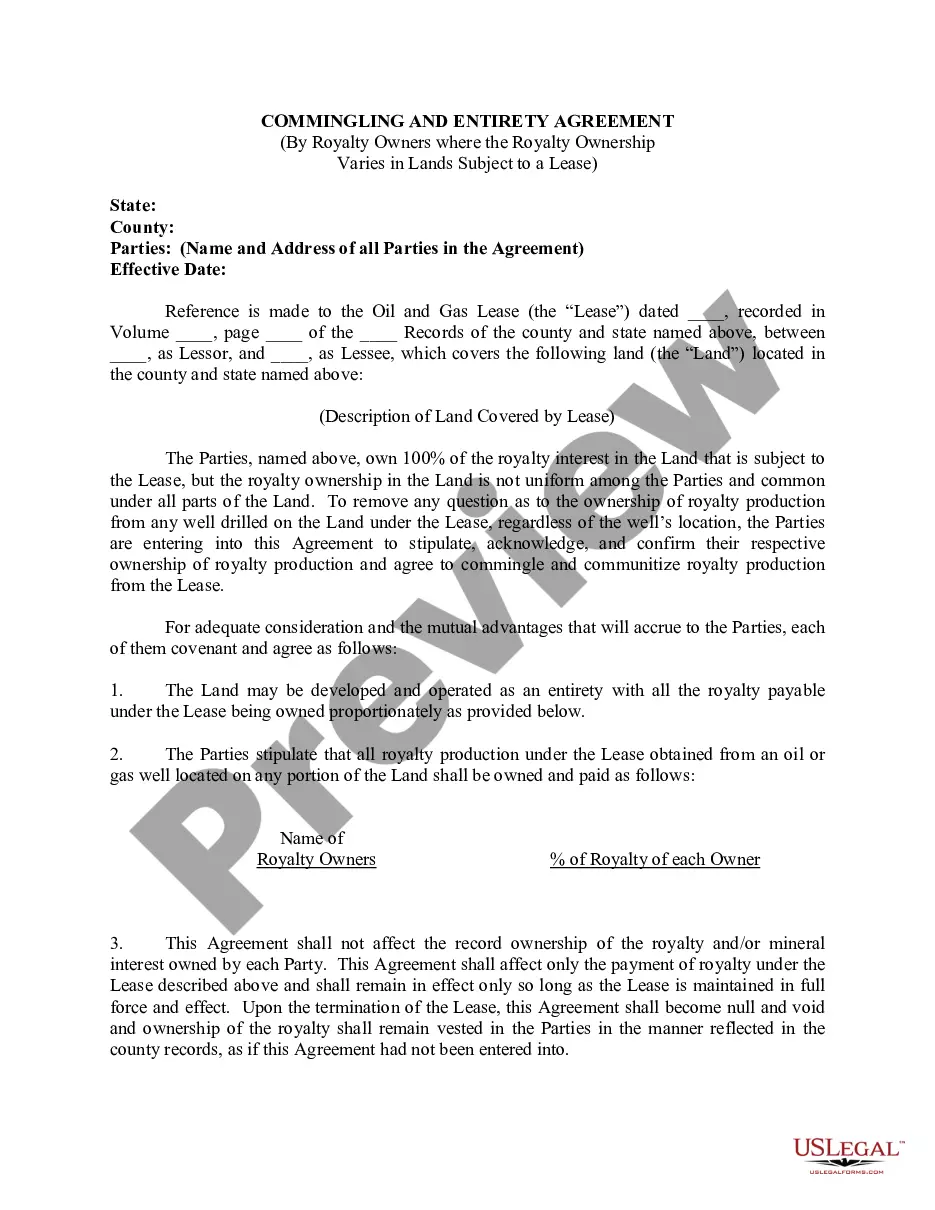
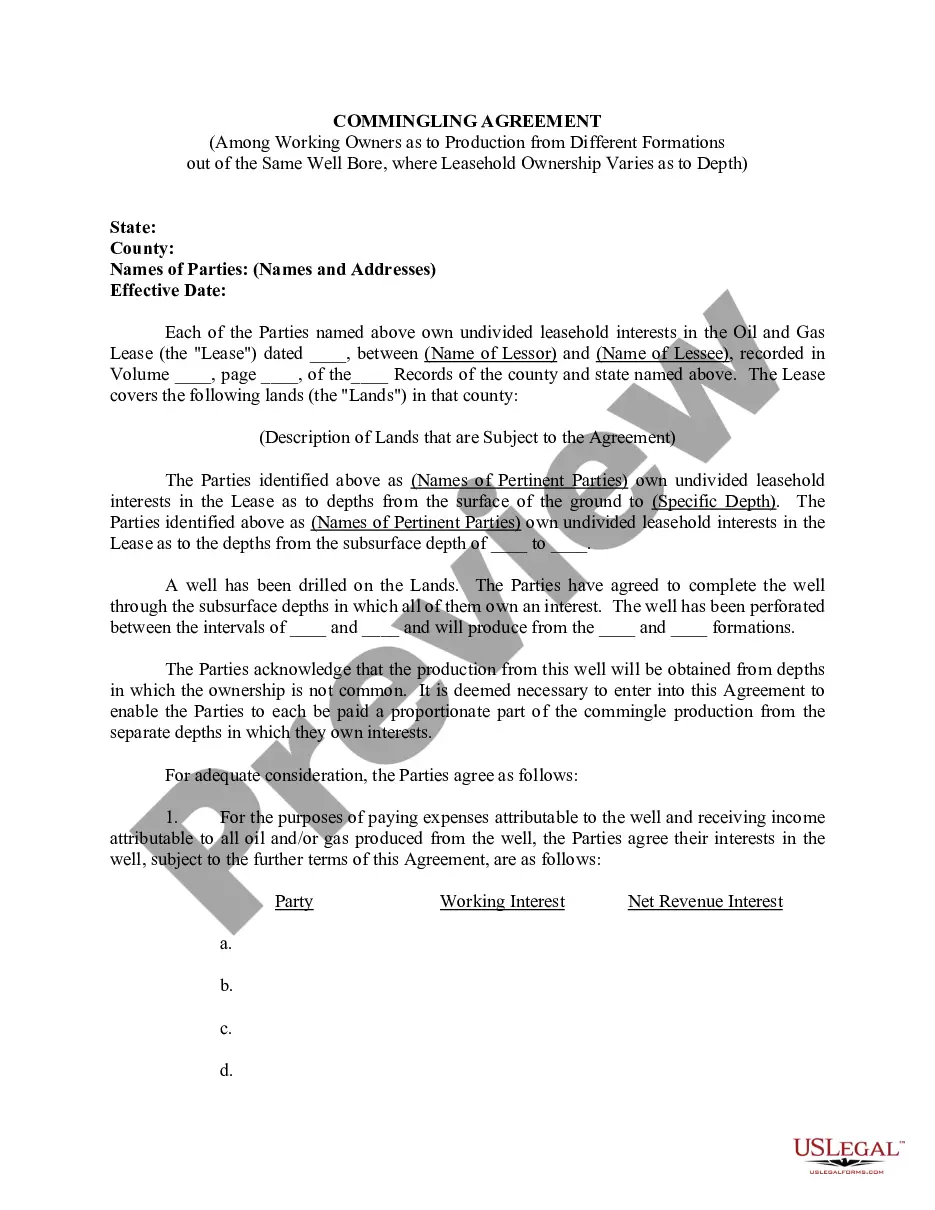
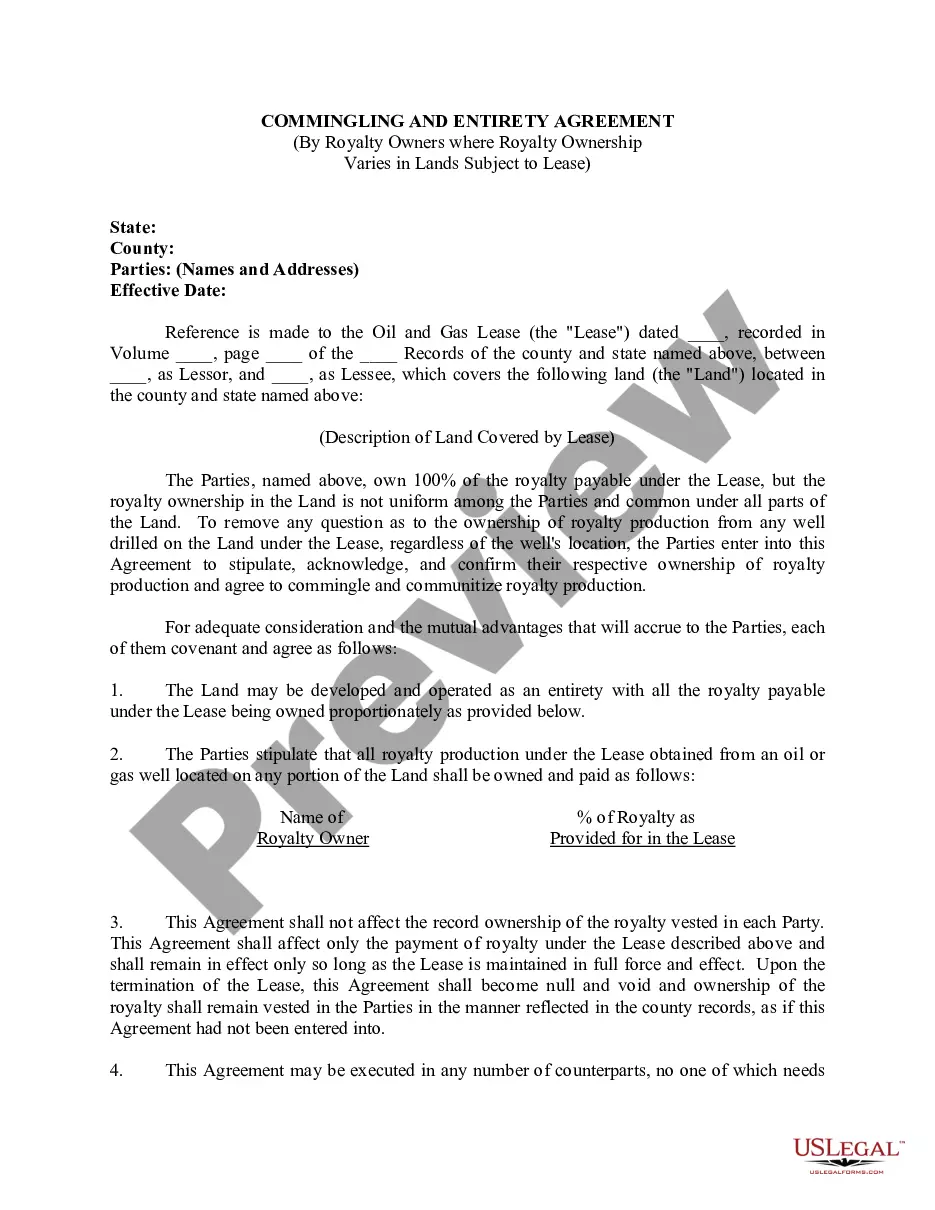
The Commingling and Entirety Agreement by Royalty Owners is a legal document that allows multiple royalty owners of a mineral lease to agree on how to distribute royalties from oil and gas production across a tract of land. This agreement is particularly useful when royalty ownership is divided among different parties, ensuring that all owners can participate in production royalties irrespective of the precise location of extraction within the tract. This form differs from other agreements as it specifically addresses the complexities arising from non-uniform royalty ownership, making it essential for managing shared interests effectively.
Main sections of this form
Identification of parties involved, including their names and addresses.
A description of the land covered by the mineral lease.
Stipulation of royalty ownership percentages for each party, regardless of well location.
Agreement terms regarding the payment and ownership of royalties.
Provisions for the agreement's validity and termination upon lease expiration.
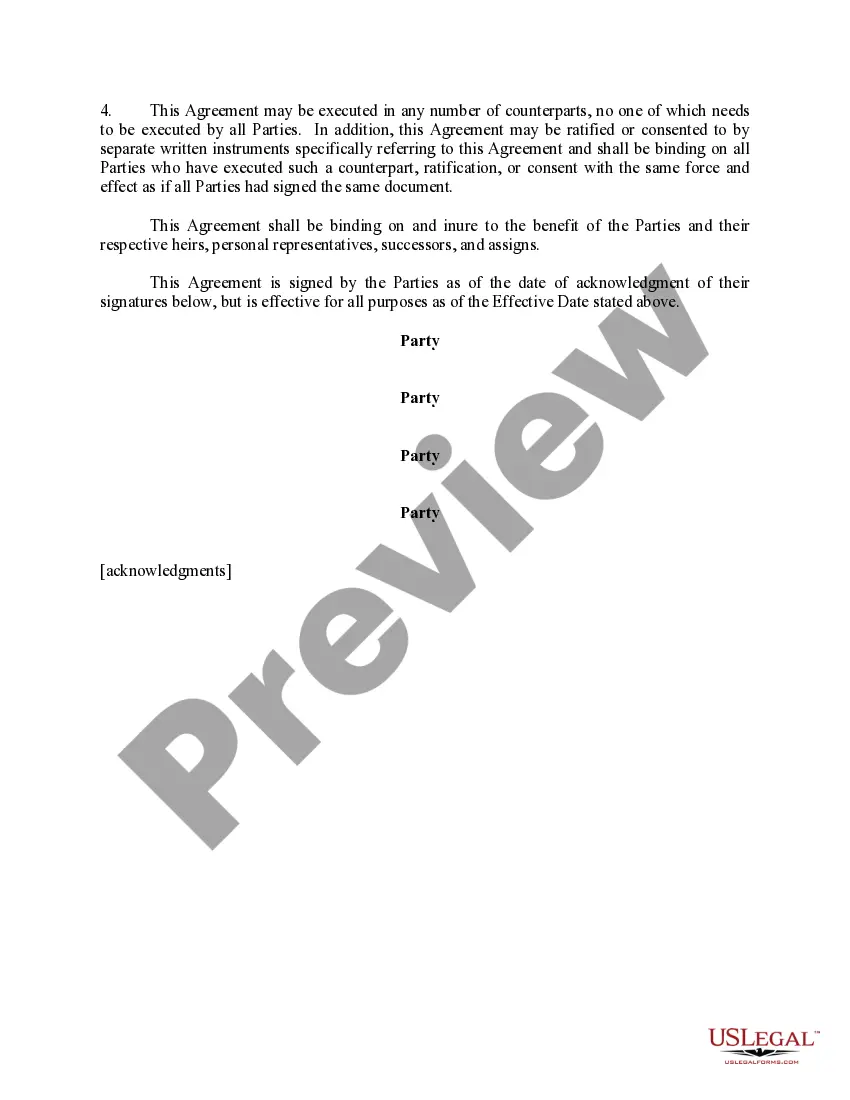
Execution details, including potential counterparts and binding nature.
When to use this document
You should use the Commingling and Entirety Agreement when multiple parties own royalty interests in a mineral estate but the ownership is not common. This scenario often arises when one mineral owner leases the entire tract but there are various parties entitled to royalties. This agreement ensures that all royalty owners can participate in production earnings regardless of the location of oil or gas wells drilled on the land.
Intended users of this form
Royalty owners who have divided interests in a mineral lease.
Landowners looking to formalize royalty distribution agreements.
Lessee or mineral owners seeking to clarify royalty payments under a lease.
Parties involved in oil and gas production where royalty interests are not uniform.
How to prepare this document
Identify all parties involved and provide their names and addresses.
Specify the effective date of the agreement.
Describe the land covered by the existing oil and gas lease.
Outline the agreed-upon royalty ownership percentages for each party.
Ensure all parties sign the agreement, acknowledging their consent.
Does this form need to be notarized?
This form does not typically require notarization to be legally valid. However, some jurisdictions or document types may still require it. US Legal Forms provides secure online notarization powered by Notarize, available 24/7 for added convenience.
Get your form ready online
Our built-in tools help you complete, sign, share, and store your documents in one place.
Make edits, fill in missing information, and update formatting in US Legal Forms—just like you would in MS Word.
Download a copy, print it, send it by email, or mail it via USPS—whatever works best for your next step.
Sign and collect signatures with our SignNow integration. Send to multiple recipients, set reminders, and more. Go Premium to unlock E-Sign.
If this form requires notarization, complete it online through a secure video call—no need to meet a notary in person or wait for an appointment.
We protect your documents and personal data by following strict security and privacy standards.

Make edits, fill in missing information, and update formatting in US Legal Forms—just like you would in MS Word.

Download a copy, print it, send it by email, or mail it via USPS—whatever works best for your next step.

Sign and collect signatures with our SignNow integration. Send to multiple recipients, set reminders, and more. Go Premium to unlock E-Sign.

If this form requires notarization, complete it online through a secure video call—no need to meet a notary in person or wait for an appointment.

We protect your documents and personal data by following strict security and privacy standards.
Typical mistakes to avoid
Failing to list all royalty owners participating in the agreement.
Not providing accurate descriptions of the land included in the lease.
Overlooking to specify effective dates or payment terms.
Neglecting to obtain signatures from all parties involved.
Benefits of using this form online
Convenient access to download and complete the form at your own pace.
Editability allows for customization to match specific agreements.
Reliability, as the forms are drafted by licensed attorneys and updated to comply with current laws.
Quick recap
- The Commingling and Entirety Agreement helps manage complex royalty ownership structures.
- This form is essential for equitable distribution of royalties among divided interests.
- Accurate completion and understanding of terms are crucial to avoid disputes.
Looking for another form?
Form popularity
FAQ
A Non-Participating Royalty Interest (NPRI) is an interest in oil and gas production which is created from the mineral estate. Like the plain royalty interest it is expense-free, bearing no operational costs of production.
A mineral owner's rights typically include the right to use the surface of the land to access and mine the minerals owned. This might mean the mineral owner has the right to drill an oil or natural gas well, or excavate a mine on your property.
Royalties are a form of real property ownership as defined by the IRS. As property owners, royalty investments could provide a complement to existing real estate portfolios offering similar benefits to REIT's including passive-cash flow and upside participation from any recovery in energy prices.
If you want to sell the mineral rights to another person, you can transfer them by deed. You will need to create a mineral deed and have it recorded. You should check with the county Recorder of Deeds in the county where the land is located and ask if a printed mineral deed form is available to use.
A royalty interest is a non-possessory real property interest in oil and gas production free of production and operating expenses, which may be created by grant or by reservation or exception.
A: Mineral rights are the legal rights to the minerals in a property. Whoever owns a property's mineral rights has full legal rights to mine for and profit from those minerals.
As a mineral rights value rule of thumb, the 3X cash flow method is often used. To calculate mineral rights value, multiply the 12-month trailing cash flow by 3. For a property with royalty rights, a 5X multiple provides a more accurate valuation (stout.com).
A deed that names the seller/donor and the purchaser/donee. It states and describes the rights being sold or given. Filing of the notarized conveyance in the county government office which is generally the county clerk's office.
After a divorce, mineral rights can be transferred by submitting the divorce decree and conveyances to the county (where the minerals are located) for recording. They usually go to the same agency that records titles and property deeds. The county will return the recorded original documents to the new owner.