Telecommunications Systems Easement
About this form
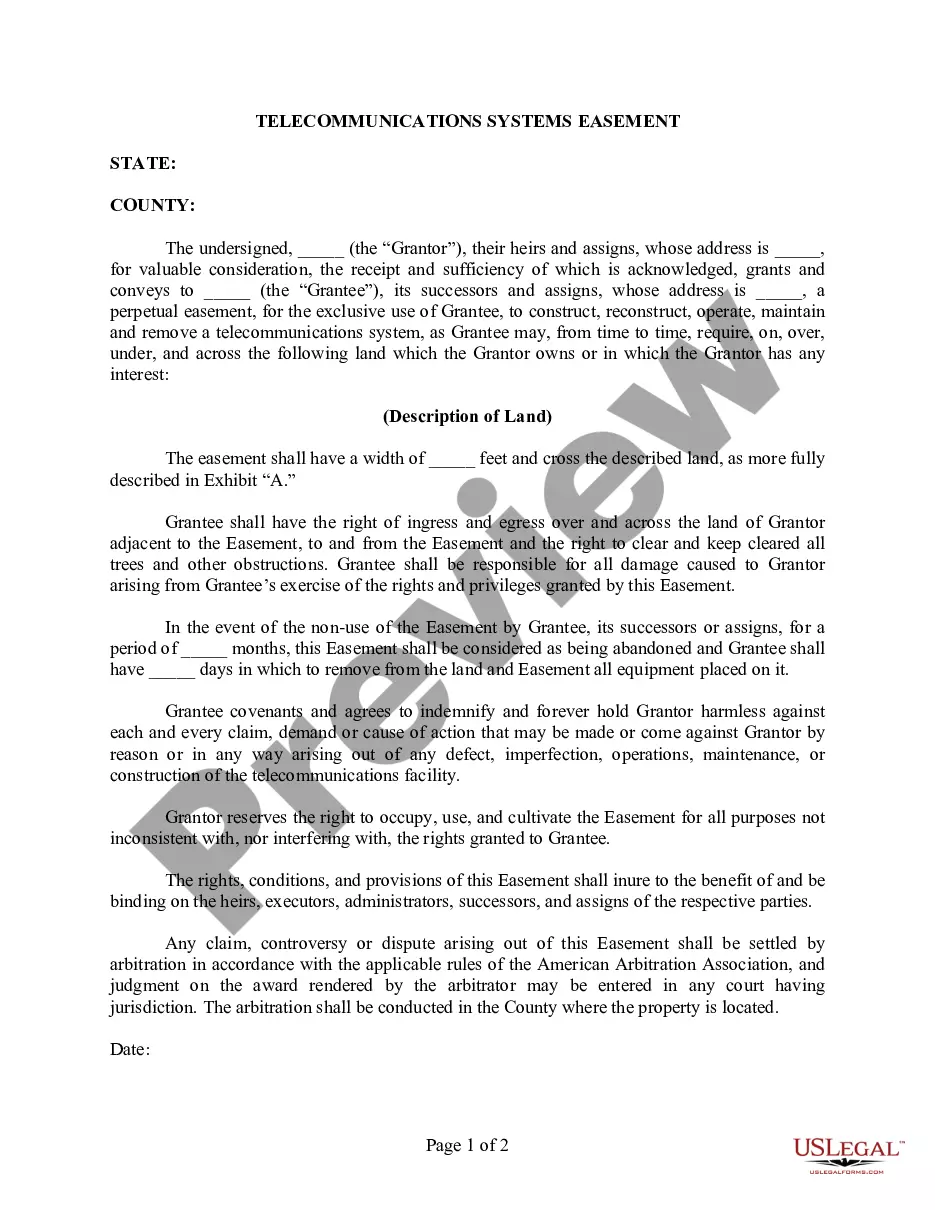
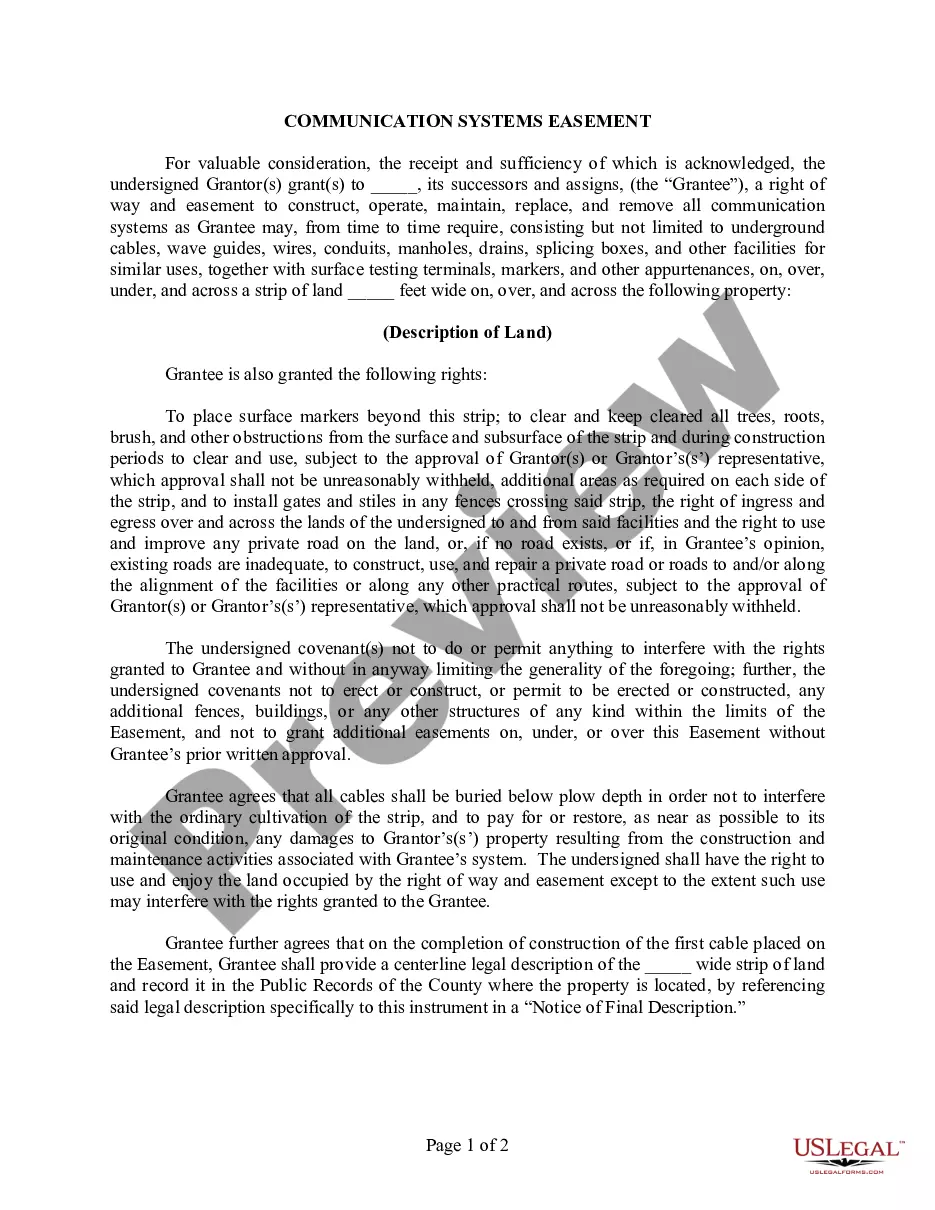
The Telecommunications Systems Easement form is a legal document that grants a specific right to a telecommunications company (the Grantee) to use a portion of a property for the installation and operation of telecommunications systems. This easement allows the Grantee to access and maintain these systems while the property owner (the Grantor) retains the rights to use the land for other purposes, provided those do not interfere with the easement rights. It is essential to differentiate this form from other property easements as it specifically pertains to telecommunications-related installations.
Form components explained
- Grantor and Grantee Information: Fields for identifying the parties involved and their addresses.
- Description of Land: Specific description of the land where the easement will be applied.
- Easement Details: Width of the easement and rights granted to the Grantee regarding access and maintenance.
- Indemnification Clause: Provisions that protect the Grantor from claims related to the telecommunications facility.
- Abandonment Clause: Conditions under which the easement can be considered abandoned if not used for a specified time.


When to use this form
This form is typically used when a telecommunications company seeks to install or operate its systems on a property owned by another party. It is necessary in situations where access to the property is required for the construction, operation, maintenance, or removal of telecommunications infrastructure. The easement clarifies the rights of the telecommunications company while protecting the interests of the property owner.
Who this form is for
- Property owners (Grantors) who are approached by a telecommunications company for installation rights.
- Telecommunications companies (Grantees) looking to secure access to land for their services.
- Real estate professionals managing properties where telecommunications easements may be applicable.
Completing this form step by step
- Identify the parties by entering the names and addresses of the Grantor and Grantee.
- Provide a detailed description of the land where the easement will be granted.
- Specify the width of the easement and any restrictions or conditions related to its use.
- Include the duration of time that must pass before the easement can be considered abandoned.
- Ensure both parties sign and date the document to validate the agreement.
Notarization requirements for this form
To make this form legally binding, it must be notarized. Our online notarization service, powered by Notarize, lets you verify and sign documents remotely through an encrypted video session.
Get your form ready online
Our built-in tools help you complete, sign, share, and store your documents in one place.
Make edits, fill in missing information, and update formatting in US Legal Forms—just like you would in MS Word.
Download a copy, print it, send it by email, or mail it via USPS—whatever works best for your next step.
Sign and collect signatures with our SignNow integration. Send to multiple recipients, set reminders, and more. Go Premium to unlock E-Sign.
If this form requires notarization, complete it online through a secure video call—no need to meet a notary in person or wait for an appointment.
We protect your documents and personal data by following strict security and privacy standards.

Make edits, fill in missing information, and update formatting in US Legal Forms—just like you would in MS Word.

Download a copy, print it, send it by email, or mail it via USPS—whatever works best for your next step.

Sign and collect signatures with our SignNow integration. Send to multiple recipients, set reminders, and more. Go Premium to unlock E-Sign.

If this form requires notarization, complete it online through a secure video call—no need to meet a notary in person or wait for an appointment.

We protect your documents and personal data by following strict security and privacy standards.
Common mistakes
- Failing to provide an accurate description of the land, which can lead to disputes later.
- Not clearly defining the rights and responsibilities of both parties, leading to misunderstandings.
- Overlooking the need for signatures or not dating the document, which can make it unenforceable.
Benefits of using this form online
- Convenience: Download and complete the form from anywhere, at any time.
- Editability: Make necessary changes before finalizing, ensuring all information is accurate.
- Reliability: Access forms drafted by licensed attorneys, offering peace of mind regarding legal compliance.
Looking for another form?

Form popularity
FAQ
Right of Way charge is a levy paid by telecommunication companies to state governments, permitting telecommunication companies to dig up the roads and install telecommunications hardware such as optic fibre cables that carry internet traffic.
The short answer is NO. It may be considered trespass.
Simply put, an easement is a legal right given to cross or use another person's land for a specific purpose.Easements are more commonly granted to utility companies, such as telephone or electrical companies to run cable and power lines.
When termed as a utility easement, it means a utility company's right to access and control the portion of another person's land that is located near utility facilities and structures (i.e. utility poles, transformers, overhead or underground electrical lines).
If an authority has an easement registered over your land, they have the right to access the easement to maintain or repair the easement land or their equipment on the land.
There are four types of easement Section. 5 of Easement Act deals with the types of easement. It provides that the easements are either continuous or discontinuous ,apparent or non apparent. A continuous easement is one whose enjoyment is, or may be, continual without the act of man.
An easement is a right which the owner or occupier of certain land possesses, as such, for the beneficial enjoyment of that land, to do and continue to do something, or to prevent and continue to prevent something being done, in or upon, or in respect of certain other land not his own. Kinds/ Types of Easement -
When one of the owners of either the dominant estate which an easement benefits or the servient estate over which the easement runs becomes the owner of both properties, then there is a unity of the two titles, and since an owner does not need an easement over the owner's own property, according to Florida law, the
Types of Easements An easement may be classified as either an easement appurtenant or an easement in gross. Easement Appurtenant. An easement appurtenant is an easement that benefits one parcel of land, known as the dominant tenement, to the detriment of another parcel of land, known as the servient tenement.