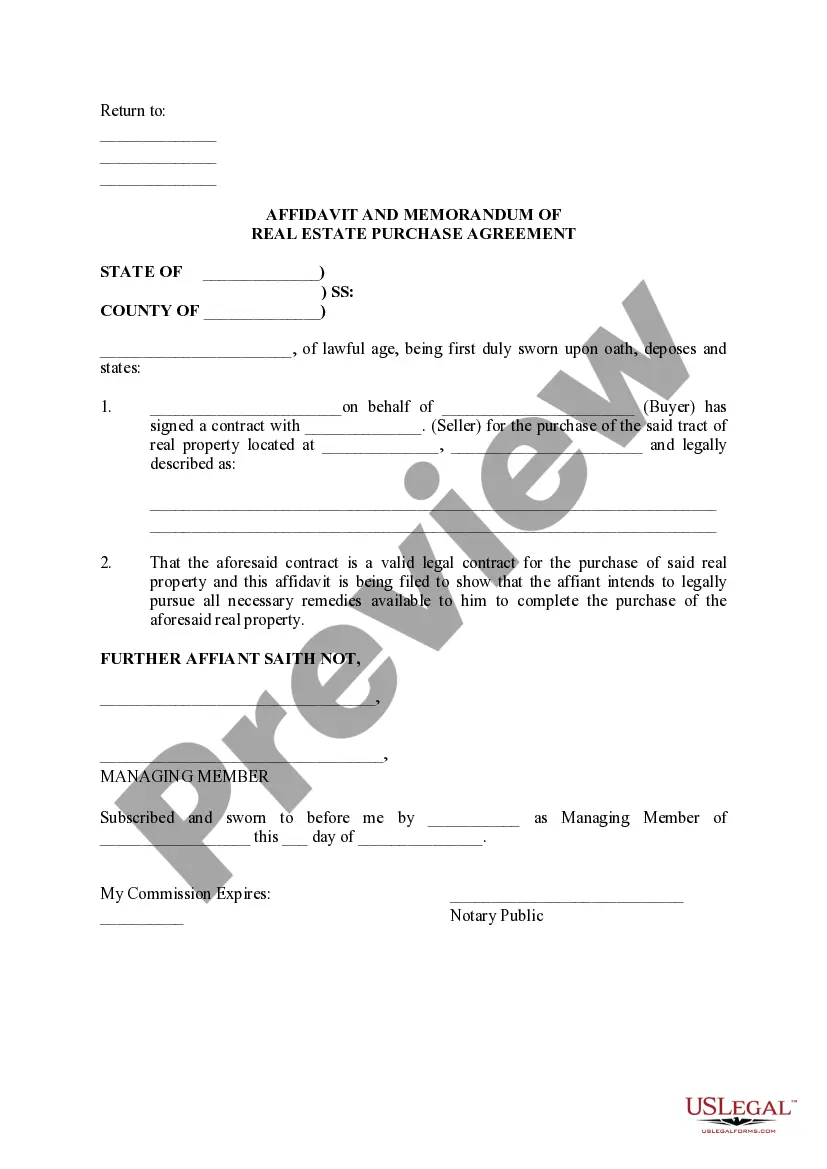
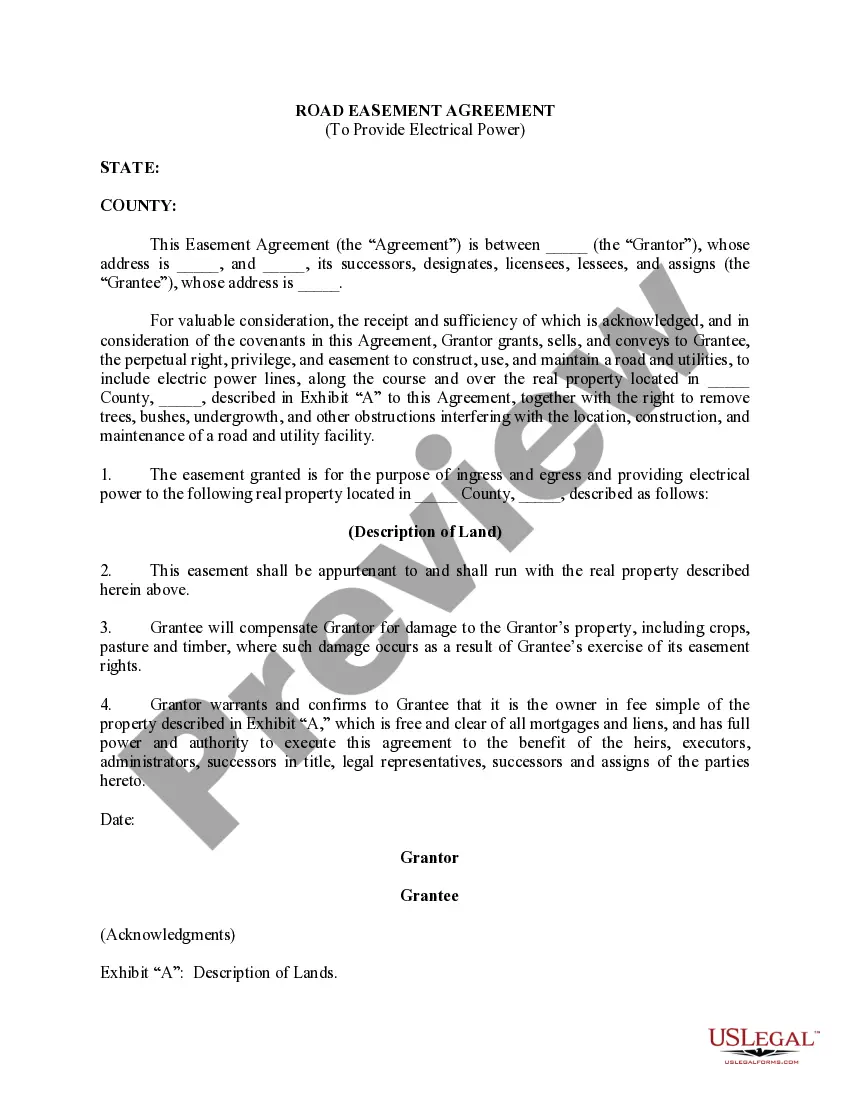
Road Easement Agreement (To Provide Electrical Power)
Understanding this form
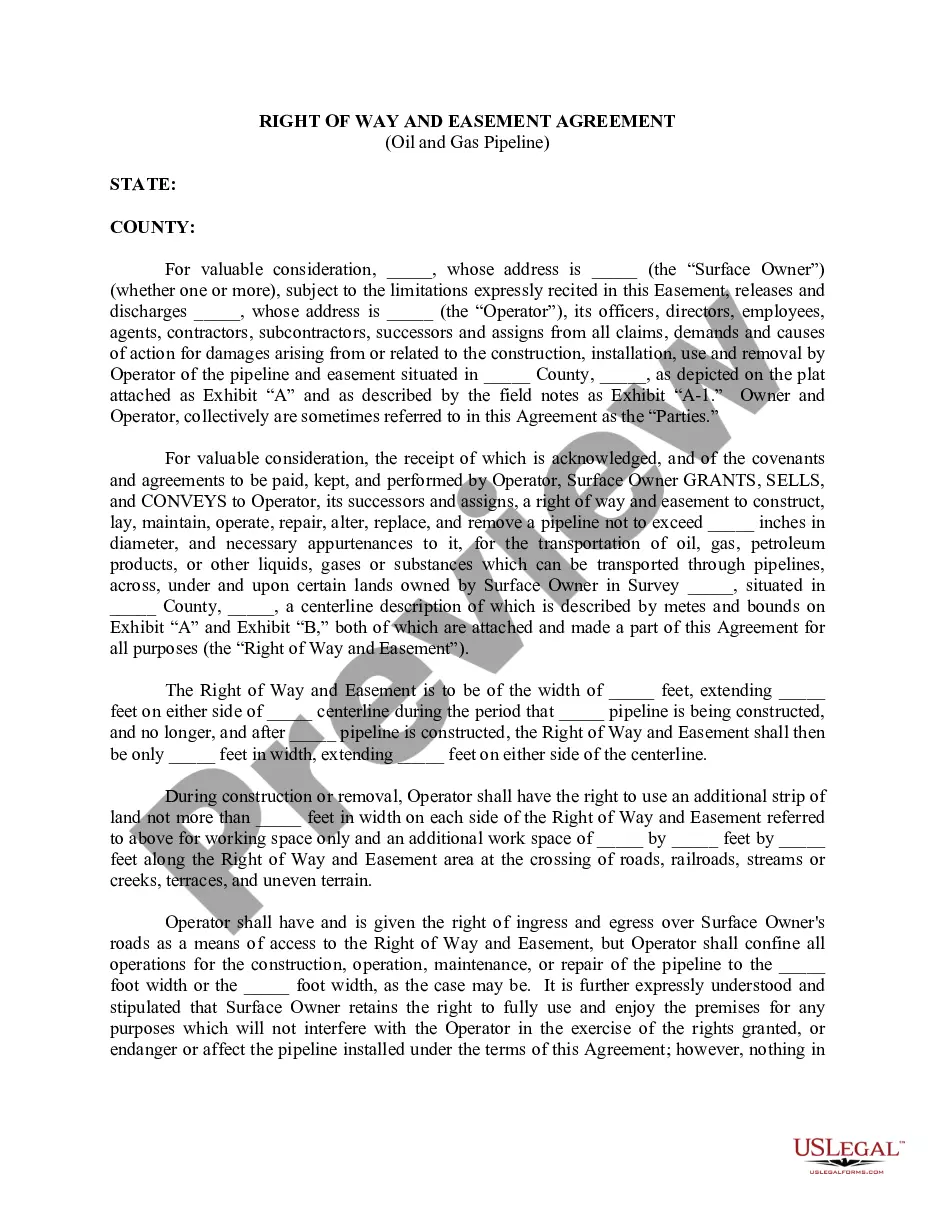
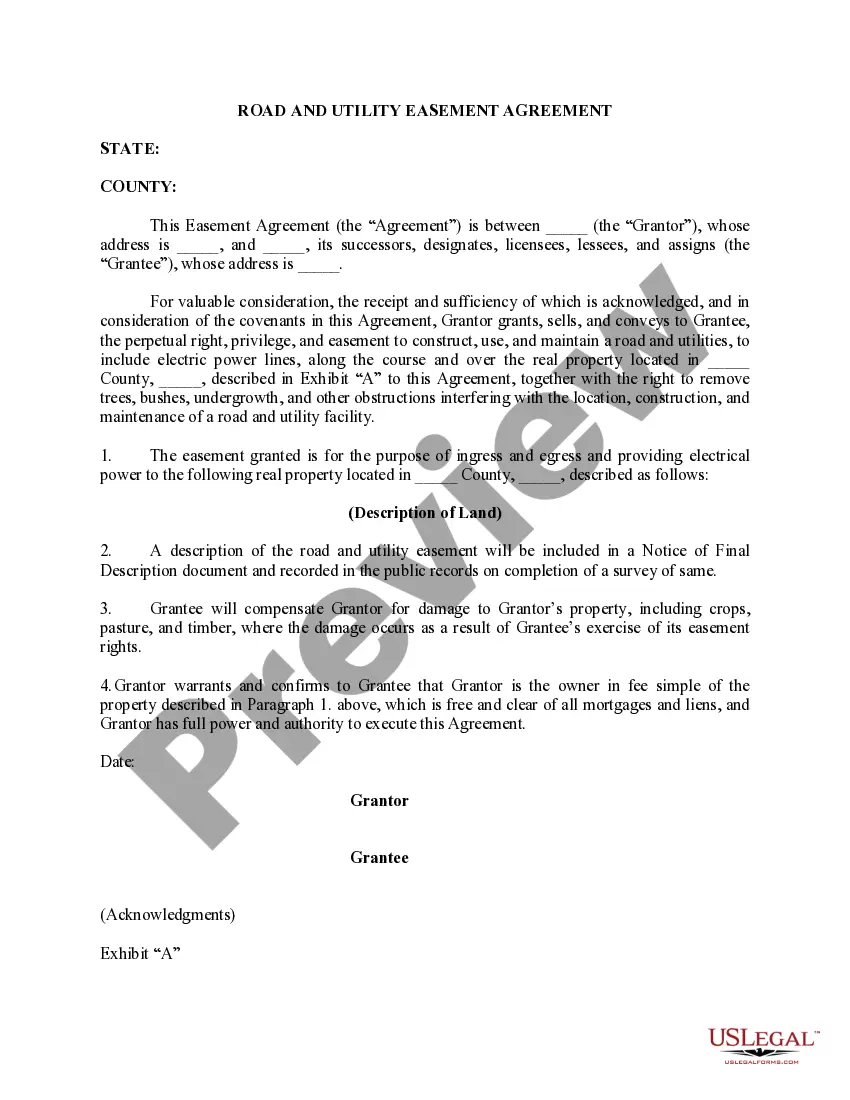
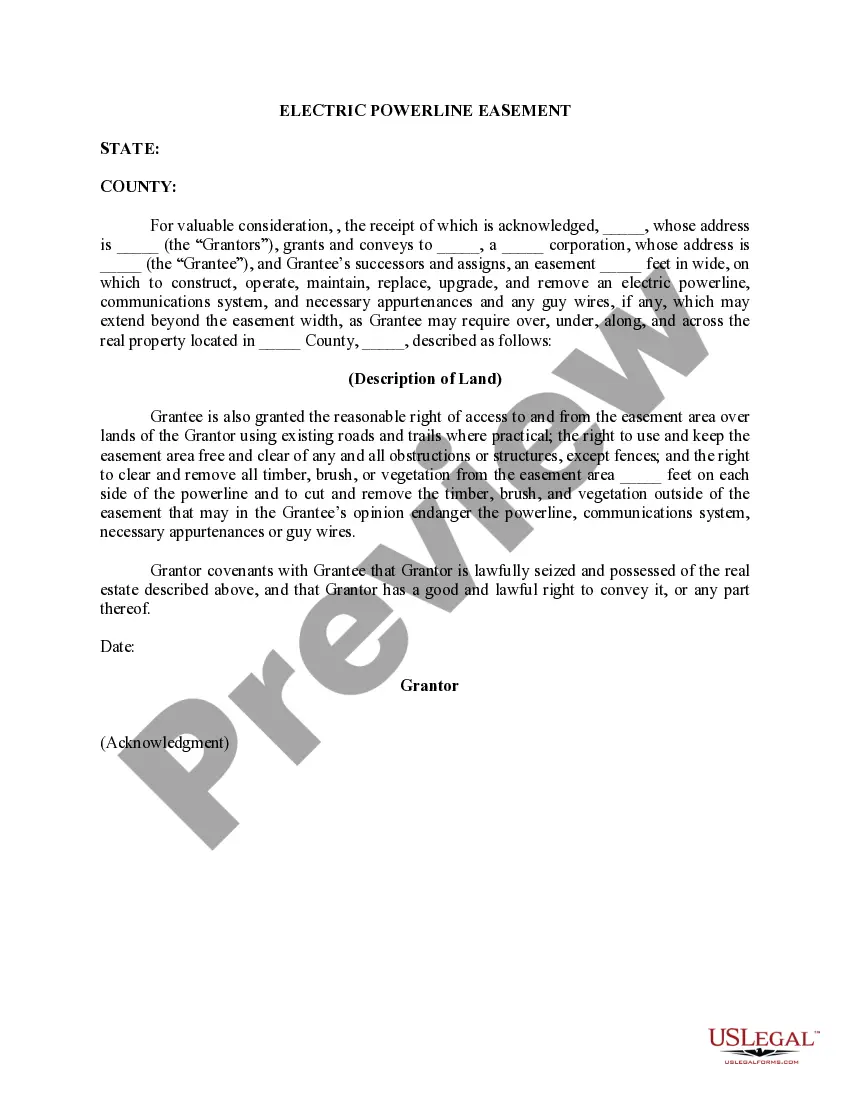
The Road Easement Agreement (To Provide Electrical Power) is a legal document that grants a party (the Grantee) the right to construct, use, and maintain a road and utilities, specifically for electric power lines, on another party's property (the Grantor). This form differs from other easement agreements by focusing specifically on the creation and maintenance of electrical power infrastructure. It establishes rights to access and use a specified piece of land, ensuring that both the Grantor and Grantee understand their rights and responsibilities involved in such arrangements.
What’s included in this form
- Identification of the Grantor and Grantee, including their addresses.
- Details of the real property affected, including a description and location.
- Specifications of the easement for constructing and maintaining roads and utilities.
- Terms regarding compensation for any damage to the Grantorâs property.
- Warranties by the Grantor regarding property ownership and authority to grant the easement.
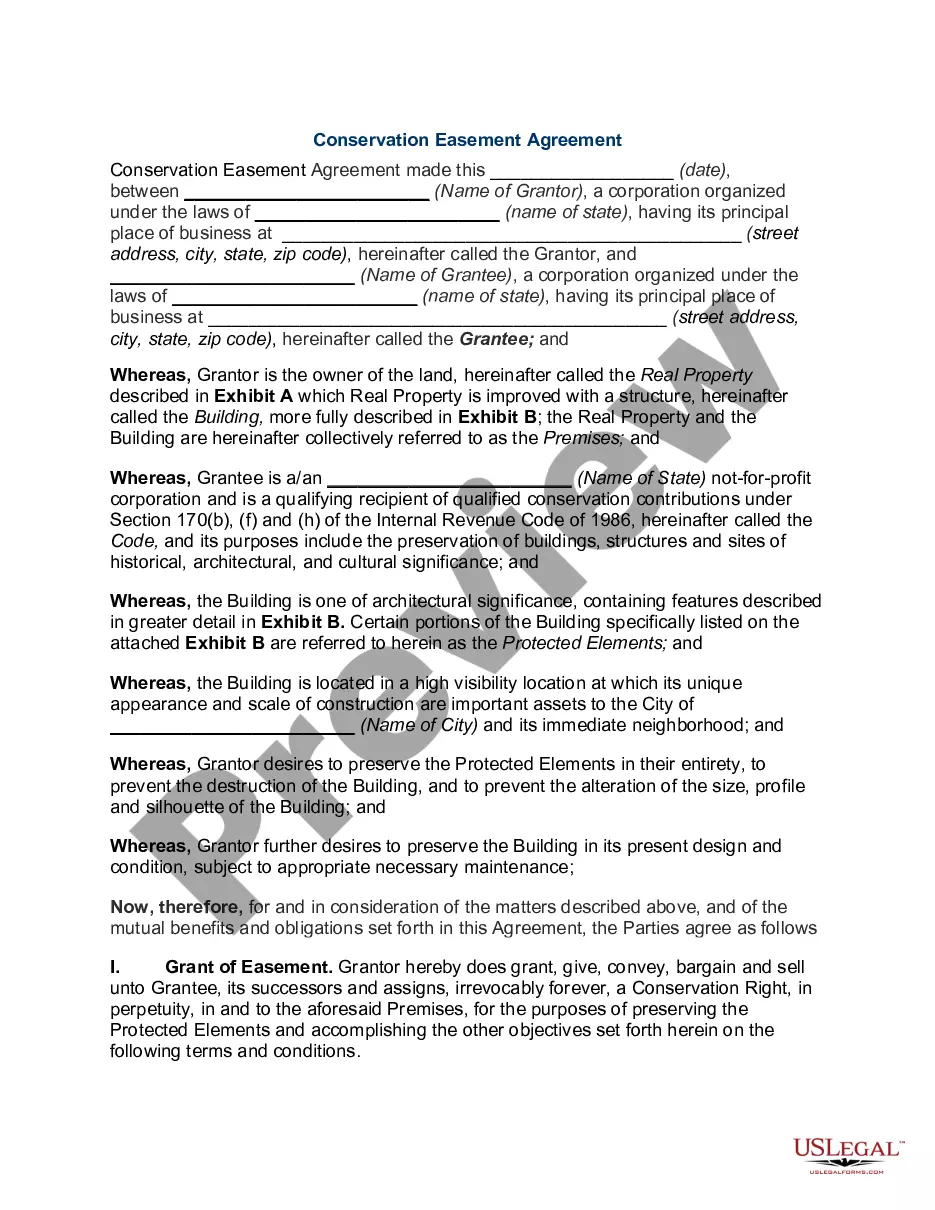
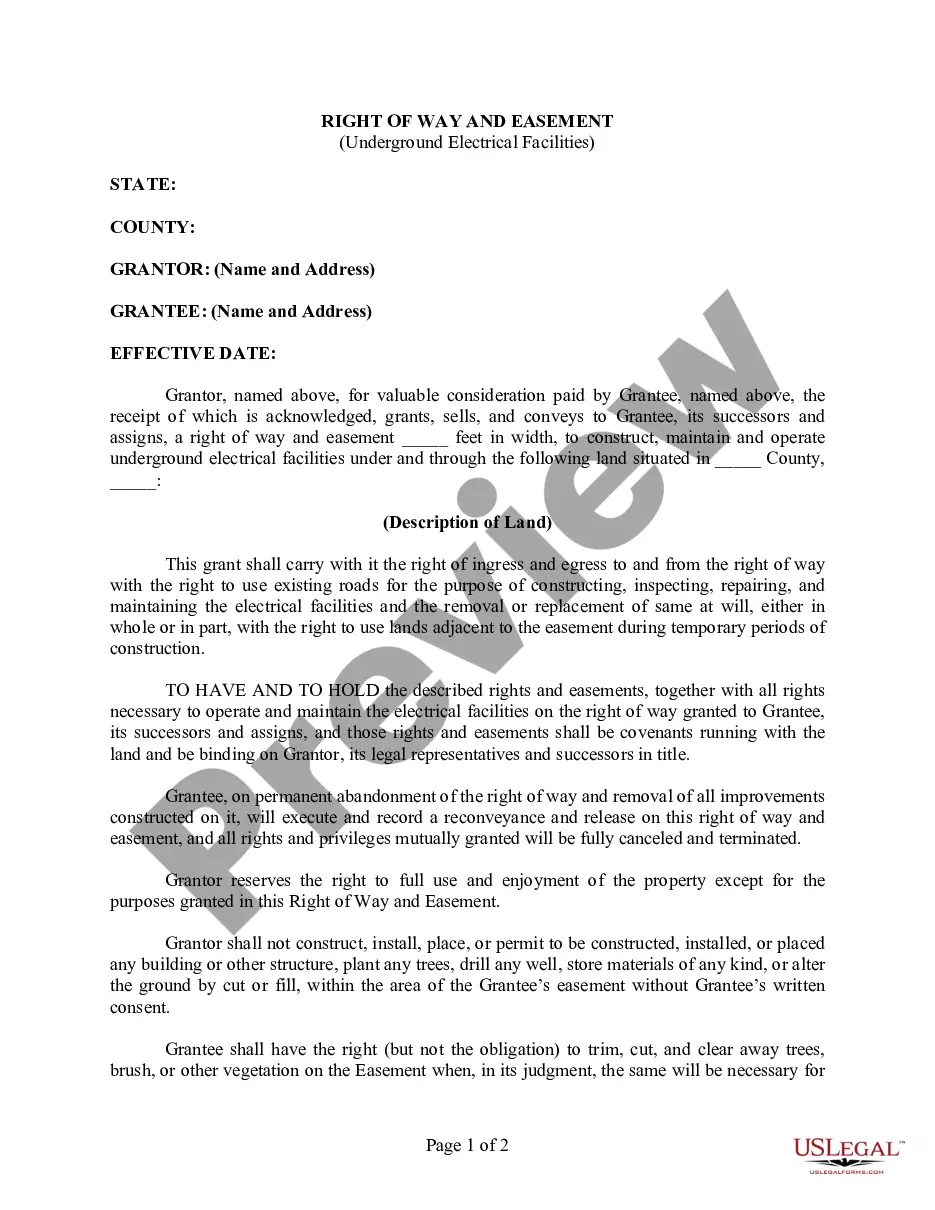
Situations where this form applies
This form should be used when a property owner (Grantor) wishes to grant access to another party (Grantee) to install and maintain electrical power lines over their land. Scenarios may include agreements with utility companies, developers, or individuals seeking to establish an electrical supply line, ensuring that all parties have clear guidelines and understand their rights to the property involved.
Who needs this form
- Property owners (Grantors) who need to allow utility access for electrical power lines.
- Utility companies or contractors (Grantees) seeking to install power lines over private property.
- Individuals or businesses requiring electrical service expansion to new or existing structures.
Steps to complete this form
- Identify and enter the names and addresses of both the Grantor and Grantee.
- Provide a detailed description of the real property involved, usually including a reference to an attached Exhibit.
- Specify the scope of the easement, focusing on access and maintenance of the electric power lines.
- Enter terms for compensation for any potential damages to the Grantorâs property.
- Ensure that both parties sign and date the agreement to make it legally binding.
Does this form need to be notarized?
This form does not typically require notarization unless specified by local law. However, it is always advisable to verify jurisdictional requirements to ensure the form's enforceability.
Get your form ready online
Our built-in tools help you complete, sign, share, and store your documents in one place.
Make edits, fill in missing information, and update formatting in US Legal Forms—just like you would in MS Word.
Download a copy, print it, send it by email, or mail it via USPS—whatever works best for your next step.
Sign and collect signatures with our SignNow integration. Send to multiple recipients, set reminders, and more. Go Premium to unlock E-Sign.
If this form requires notarization, complete it online through a secure video call—no need to meet a notary in person or wait for an appointment.
We protect your documents and personal data by following strict security and privacy standards.

Make edits, fill in missing information, and update formatting in US Legal Forms—just like you would in MS Word.

Download a copy, print it, send it by email, or mail it via USPS—whatever works best for your next step.

Sign and collect signatures with our SignNow integration. Send to multiple recipients, set reminders, and more. Go Premium to unlock E-Sign.

If this form requires notarization, complete it online through a secure video call—no need to meet a notary in person or wait for an appointment.

We protect your documents and personal data by following strict security and privacy standards.
Common mistakes
- Failing to accurately describe the property in Exhibit A.
- Not including clear terms for compensation for property damage.
- Omitting signatures and dates, making the document unenforceable.
Benefits of using this form online
- Easy access to legal templates that are drafted by licensed attorneys.
- Ability to download and customize the form to meet specific needs.
- Secure storage and retrieval of your completed legal documents.
Looking for another form?

Form popularity
FAQ
An easement held by an electricity provider allows it to erect and maintain electric power equipment on your land. The easement gives the electric power company the right to use a property for this specific purpose only.
Express Grant by Instrument. An express grant by written instrument is the most common source of an easement. Implied. The owner of a large tract of land splits up the land with one or more parcels that do not abut a public highway or road. Necessity. Dedication.
An easement is a limited right to use another person's land for a stated purpose. Examples of easements include the use of private roads and paths, or the use of a landowner's property to lay railroad tracks or electrical wires.
When termed as a utility easement, it means a utility company's right to access and control the portion of another person's land that is located near utility facilities and structures (i.e. utility poles, transformers, overhead or underground electrical lines).
Utility easements are one of the most common types of easements for private property, which generally allow public utility companies access to the property for the purpose of installing, repairing and maintaining utility lines.
The bottom line is that developers and builders who are presented with utility company easement forms should not just sign them, but think about the kinds of issues they can present. It is easier to negotiate these concessions up front before the lines go in, than to ask the utility company to amend its easement later.