License Agreement (For Natural Gas Pipeline)
Understanding this form
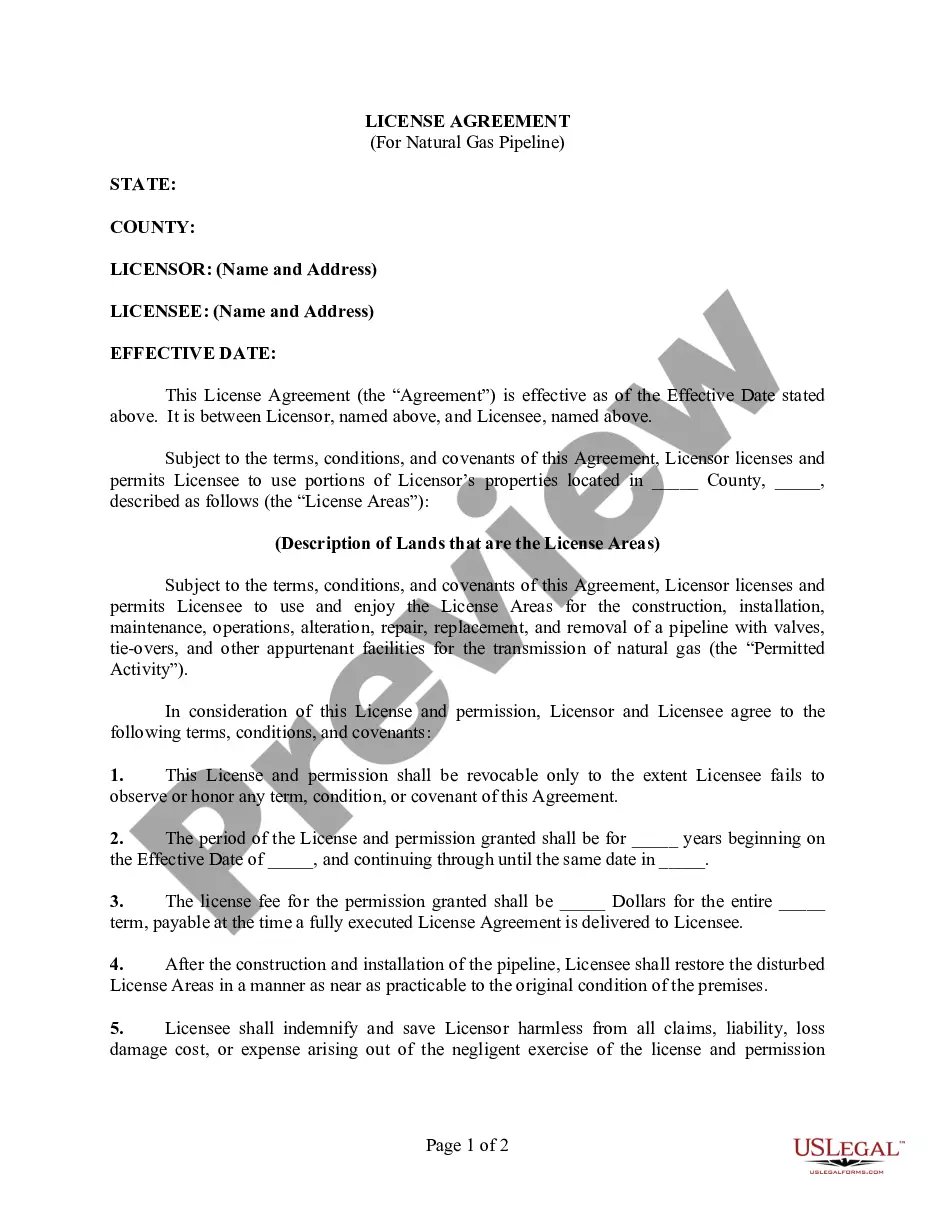
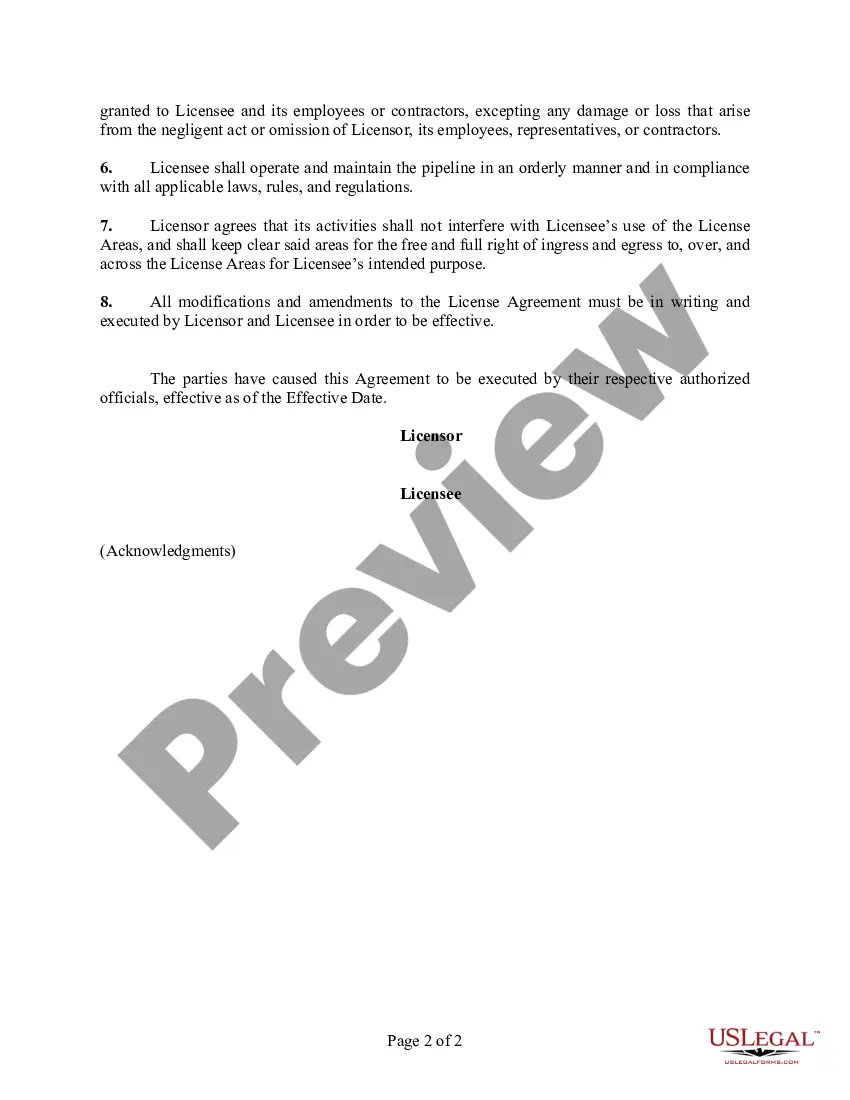
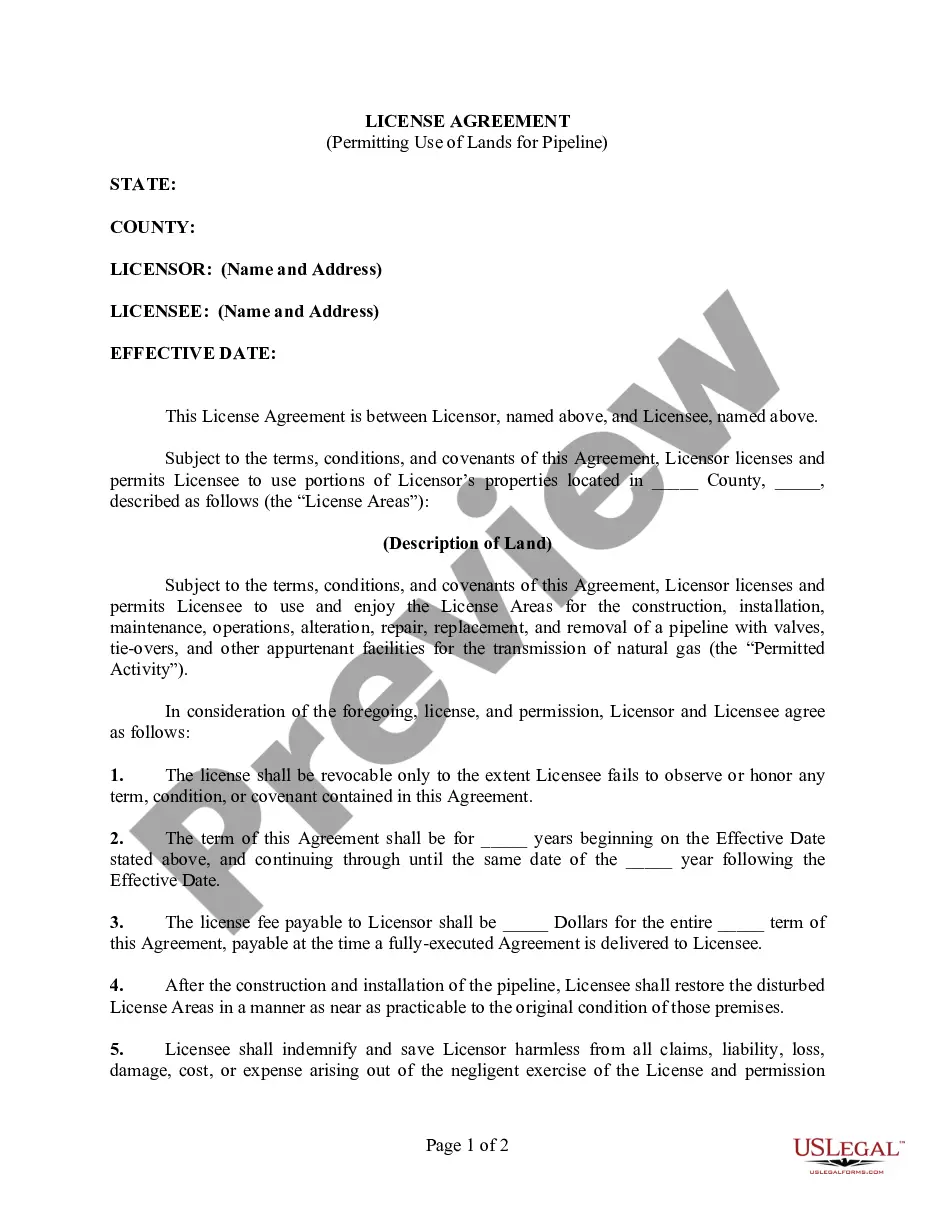
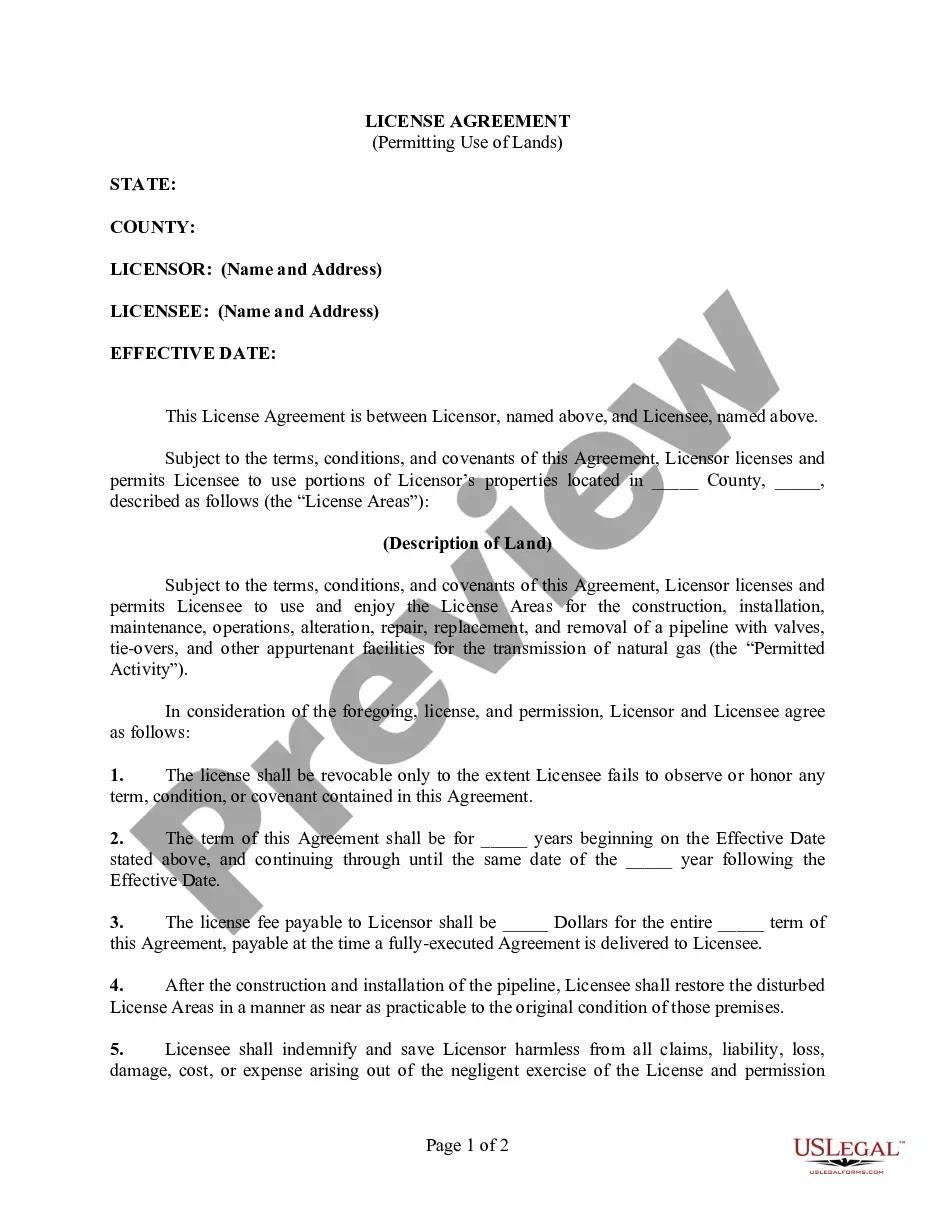
The License Agreement for Natural Gas Pipeline is a legal document that allows a licensee to use specific portions of a licensor's property for constructing and maintaining a natural gas pipeline. Unlike other agreements, this form specifically addresses the terms of use related to natural gas pipelines and includes clauses on restoration, indemnification, and compliance with laws.
Main sections of this form
- Identification of the licensor and licensee, including names and addresses.
- Effective date of the agreement.
- Description of the property areas licensed for the pipeline.
- License duration and fee structure.
- Indemnification clauses protecting the licensor from liabilities.
- Conditions for operation, maintenance, and restoration of the property.
- Agreement modifications and amendments requirements.
When this form is needed
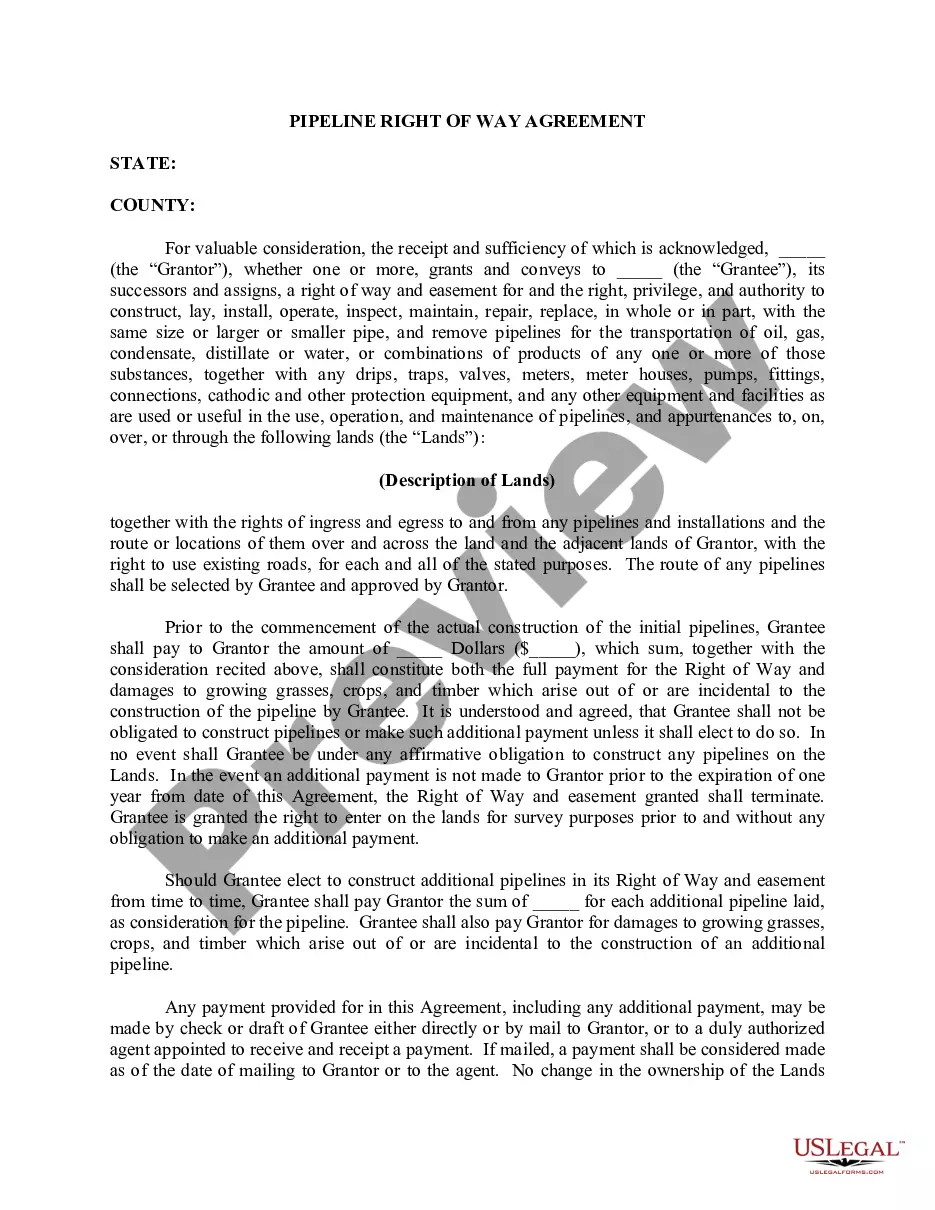
This form should be used when a party (licensee) seeks permission from a property owner (licensor) to install and operate a natural gas pipeline on their land. It is particularly relevant in situations where gas distribution infrastructure is needed, such as extending service to new areas or upgrading existing pipelines.
Intended users of this form
- Natural gas companies needing access to land for pipeline projects.
- Landowners who want to formalize the terms of pipeline usage on their property.
- Legal professionals drafting agreements for gas distribution infrastructure.
How to complete this form
- Identify the parties involved by filling in the names and addresses of the licensor and licensee.
- Specify the effective date of the agreement.
- Detail the license areas to be used for the pipeline, including descriptions of the property.
- Enter the duration of the license and the associated fee for the agreement.
- Have both parties sign and date the agreement to finalize the document.
Notarization requirements for this form
This form does not typically require notarization to be legally valid. However, some jurisdictions or document types may still require it. US Legal Forms provides secure online notarization powered by Notarize, available 24/7 for added convenience.
Get your form ready online
Our built-in tools help you complete, sign, share, and store your documents in one place.
Make edits, fill in missing information, and update formatting in US Legal Forms—just like you would in MS Word.
Download a copy, print it, send it by email, or mail it via USPS—whatever works best for your next step.
Sign and collect signatures with our SignNow integration. Send to multiple recipients, set reminders, and more. Go Premium to unlock E-Sign.
If this form requires notarization, complete it online through a secure video call—no need to meet a notary in person or wait for an appointment.
We protect your documents and personal data by following strict security and privacy standards.

Make edits, fill in missing information, and update formatting in US Legal Forms—just like you would in MS Word.

Download a copy, print it, send it by email, or mail it via USPS—whatever works best for your next step.

Sign and collect signatures with our SignNow integration. Send to multiple recipients, set reminders, and more. Go Premium to unlock E-Sign.

If this form requires notarization, complete it online through a secure video call—no need to meet a notary in person or wait for an appointment.

We protect your documents and personal data by following strict security and privacy standards.
Mistakes to watch out for
- Failing to provide a clear description of the licensed areas.
- Omitting critical terms related to restoration and indemnification.
- Not specifying the effective date or duration of the license.
- Neglecting to sign the agreement by both parties.
Why use this form online
- Convenience of downloading the form and filling it out at your own pace.
- Editable fields allow for customization to meet specific needs.
- Access to forms drafted by licensed attorneys, ensuring legal compliance.
Legal use & context
- This license agreement is enforceable under contract law, provided all parties agree to the terms.
- It limits the licensor's liability, protecting them from claims related to the licensee's actions.
- The agreement should comply with state-specific regulations regarding property use and pipeline operations.
What to keep in mind
- The License Agreement for Natural Gas Pipeline establishes the terms for using property for gas pipeline activities.
- Completing the form accurately can prevent legal disputes and ensure compliance with regulations.
- Understanding key components can help in negotiating terms favorable to all parties involved.
Looking for another form?


Form popularity
FAQ
Download a template for a licensing agreement. Choose your role as the licensor or licensee. Define the license(s) in the agreement. Decide whether the license is exclusive or not. Settle the matter of fees and payment schedule. Add a renewal date and rules.
A license agreement is a business contract between two parties. The licensor (the seller of the license) owns the asset being licensed and the licensee (the buyer) pays for the right to use the license. The licensee pays royalties to the owner in exchange for the right to sell the product or use the technology.
Breach of Licensing Agreement If the material is used after the licensee has been notified of the contract cancellation, this constitutes infringement. Using the work in an unauthorized manner, such as adapting it into another language, is also considered infringement.
A license agreement must spell out what constitutes an improvement and who owns such improvement and all IP that vests in the same. The license agreement also needs to provide for ownership of IP if there is any joint development.
An example of a licensing agreement is a contract between the copyright holders of software and another company, allowing the latter to use the computer software for their daily business operations.
A contract violation is a somewhat regular occurrence in the business world, defined as a breach of any of the terms of a contract that were previously agreed upon by all parties.If one of the parties does not fulfill their duties as stated, this is considered a contract violation, or a breach of contract.
The 3 P's of collegiate licensing are protection, promotion, and profit.
Exclusive or non-exclusive. In an exclusive license, the intellectual property holder is licensing the work only to one person, for that particular use/territory. Territory. Use. Attribution. Derivative works. Confidentiality. Time frame. Termination.