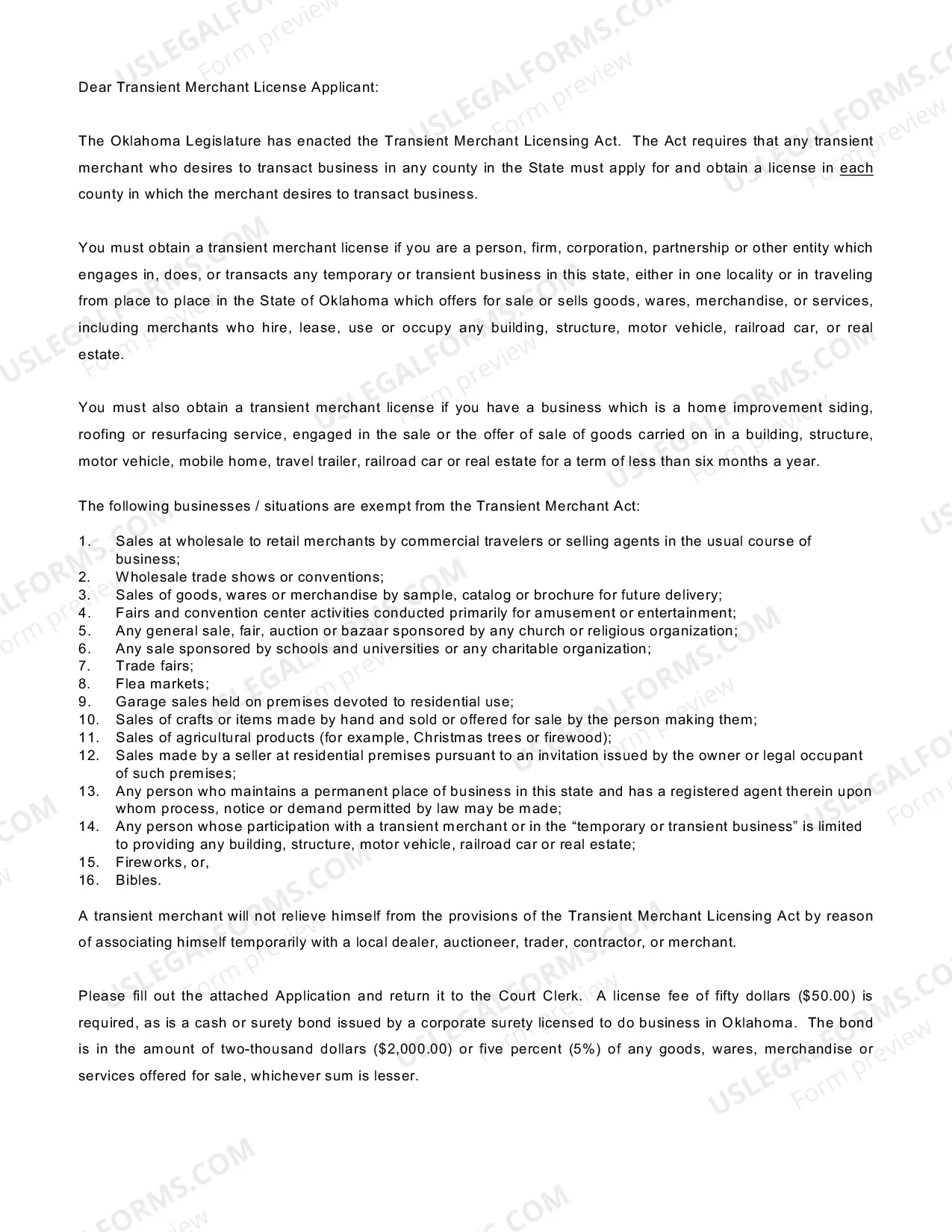
License Agreement (Permitting Use of Lands)
Understanding this form
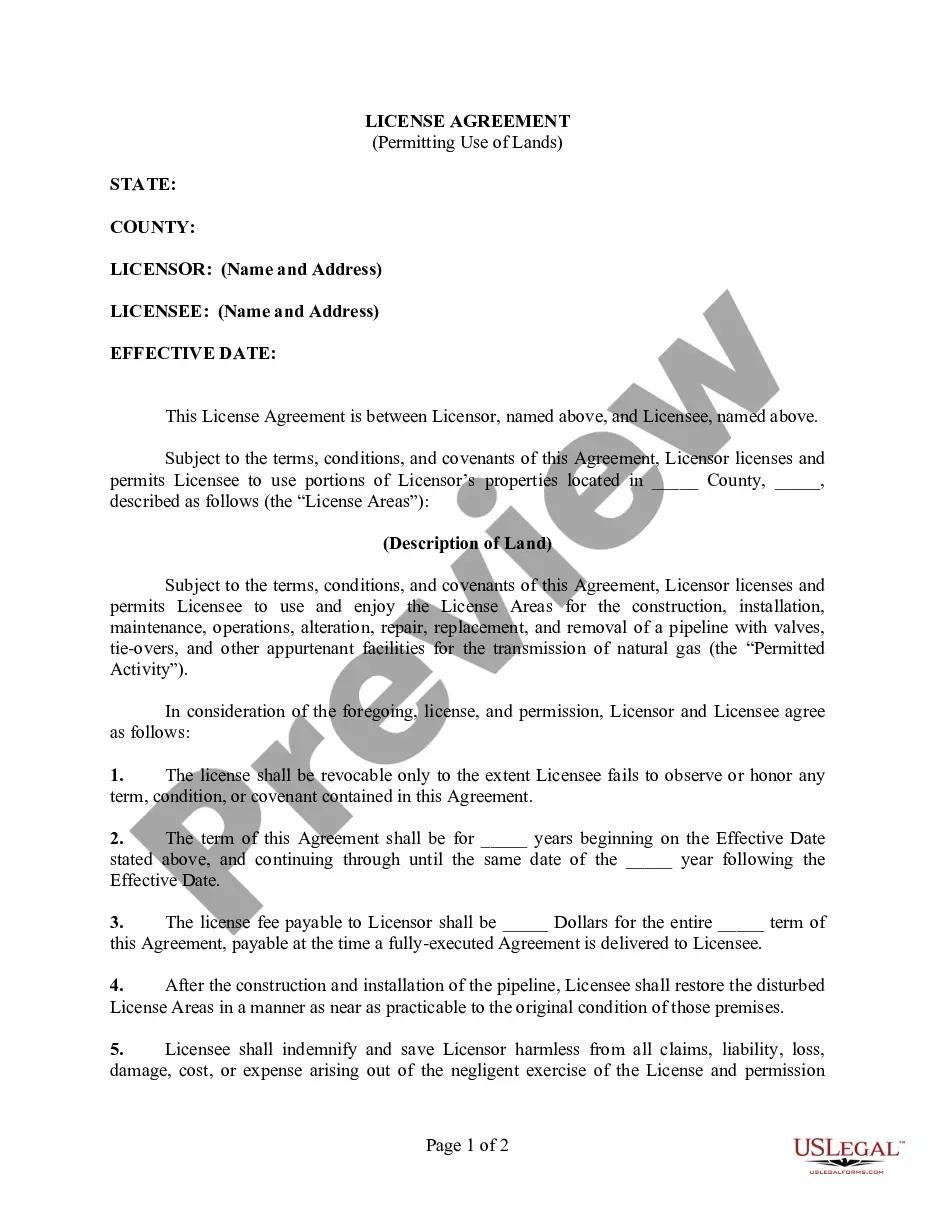
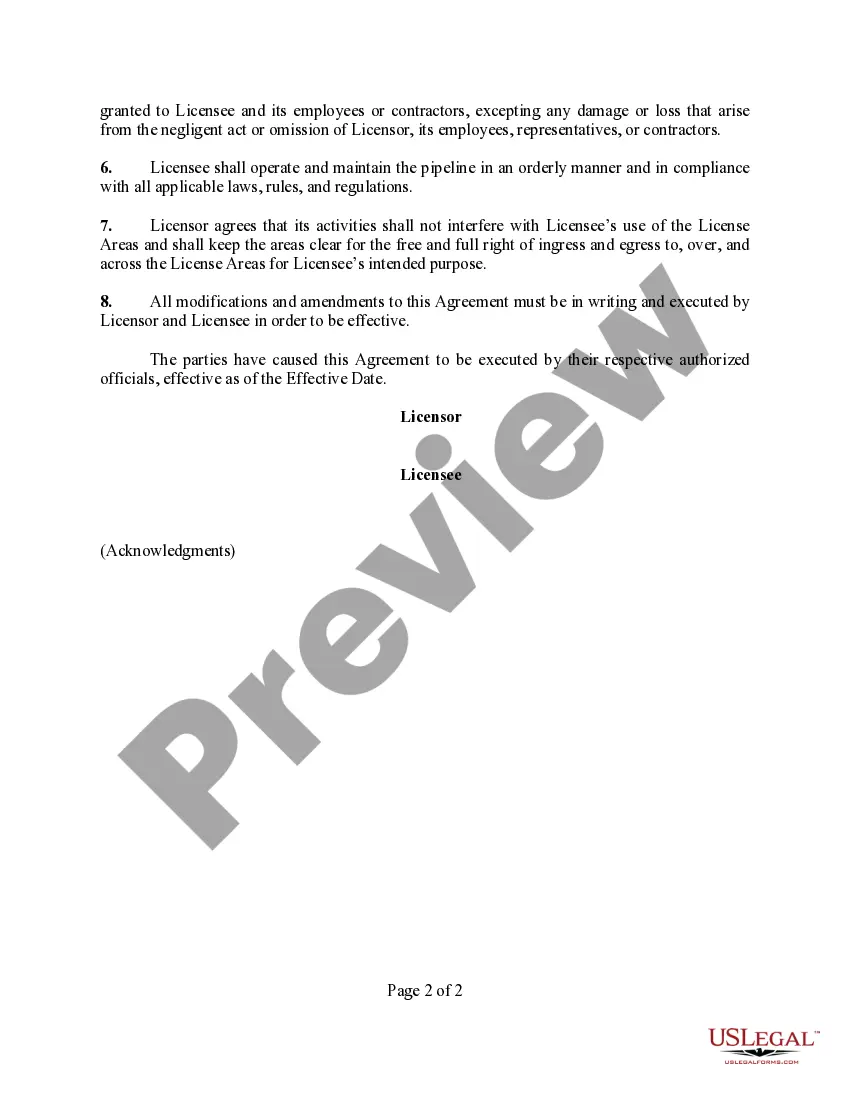
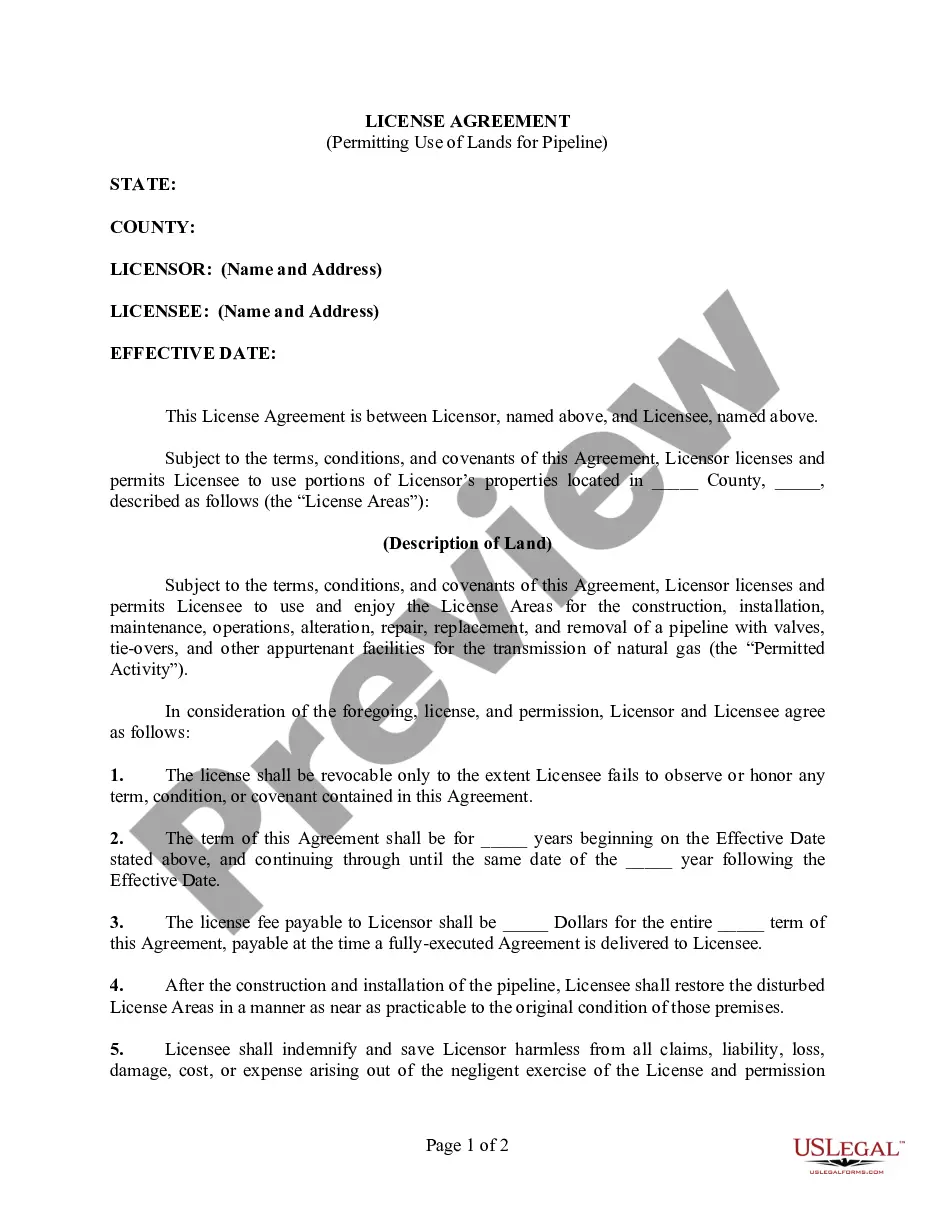
The License Agreement (Permitting Use of Lands) is a legal document that grants permission from a property owner (Licensor) to another party (Licensee) to use specific portions of land for defined activities, particularly for the installation and operation of facilities related to the transmission of natural gas. This form differs from lease agreements as it does not convey ownership rights or a long-term interest in the land, rather providing a temporary license subject to terms and conditions.
What’s included in this form
- Identification of the Licensor and Licensee, including names and addresses.
- Description of the licensed Land Areas, specifying locations and boundaries.
- Details of the Permitted Activity (e.g., construction and maintenance of a pipeline).
- Terms regarding the duration of the license and fees payable to the Licensor.
- Indemnification clause, outlining responsibilities for claims arising from Licensee's actions.
- Conditions on modifying the agreement and ensuring compliance with applicable laws.
Common use cases
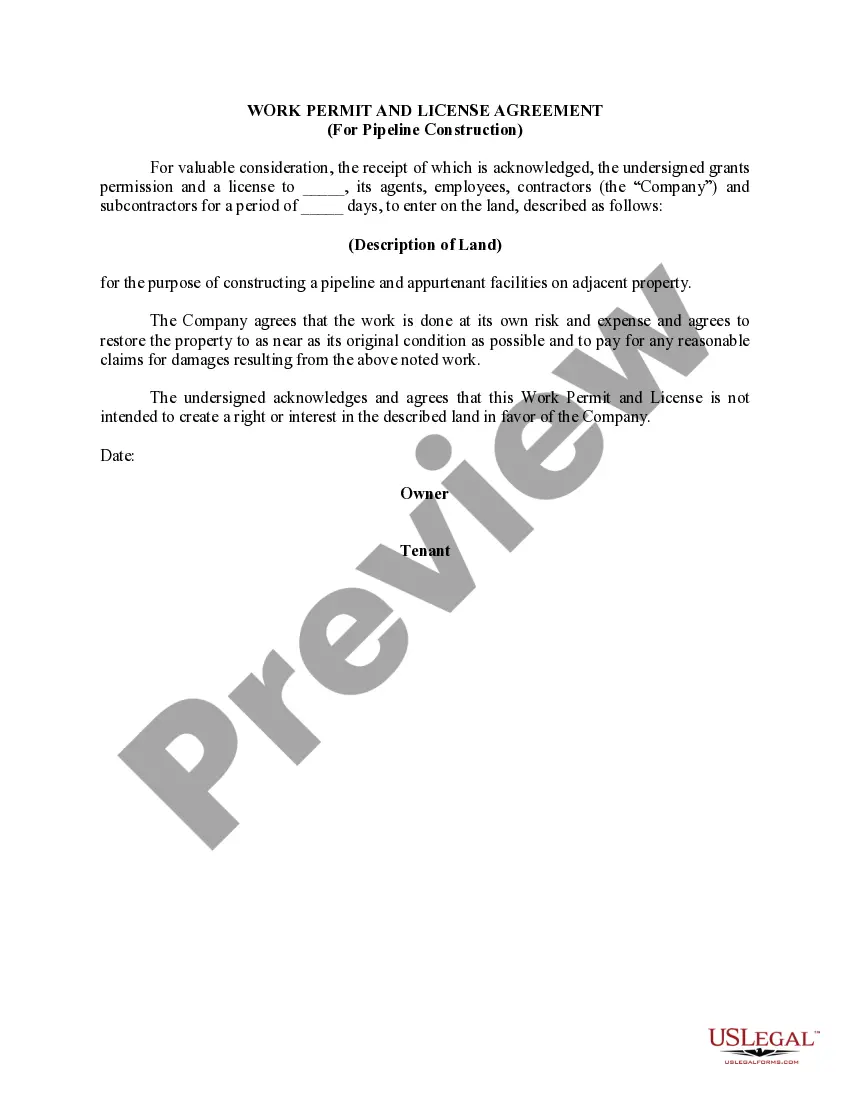
This License Agreement should be used when a property owner wants to allow another party to use their land for specific purposes, particularly for projects involving the construction and maintenance of pipelines or similar infrastructures. It is suitable when the engagement does not qualify as a lease but still requires formal consent to perform activities on the land.
Who this form is for
- Property owners (Licensors) who want to grant temporary access to their land.
- Contractors or companies (Licensees) engaged in projects that require land use for construction or maintenance.
- Legal representatives who assist clients with land use agreements.
- Businesses needing to install pipelines or conduct operations on private or commercial land.
Steps to complete this form
- Identify the parties by entering the names and addresses of both the Licensor and Licensee.
- Specify the effective date and duration of the license agreement.
- Describe the land areas being licensed, including specific locations and boundaries.
- Fill in the details of the permitted activities, focusing on construction, operation, and maintenance.
- Complete the fee section, specifying the total amount due and payment terms.
- Ensure both parties sign and date the agreement in the designated areas.
Notarization requirements for this form
Notarization is generally not required for this form. However, certain states or situations might demand it. You can complete notarization online through US Legal Forms, powered by Notarize, using a verified video call available anytime.
Get your form ready online
Our built-in tools help you complete, sign, share, and store your documents in one place.
Make edits, fill in missing information, and update formatting in US Legal Forms—just like you would in MS Word.
Download a copy, print it, send it by email, or mail it via USPS—whatever works best for your next step.
Sign and collect signatures with our SignNow integration. Send to multiple recipients, set reminders, and more. Go Premium to unlock E-Sign.
If this form requires notarization, complete it online through a secure video call—no need to meet a notary in person or wait for an appointment.
We protect your documents and personal data by following strict security and privacy standards.

Make edits, fill in missing information, and update formatting in US Legal Forms—just like you would in MS Word.

Download a copy, print it, send it by email, or mail it via USPS—whatever works best for your next step.

Sign and collect signatures with our SignNow integration. Send to multiple recipients, set reminders, and more. Go Premium to unlock E-Sign.

If this form requires notarization, complete it online through a secure video call—no need to meet a notary in person or wait for an appointment.

We protect your documents and personal data by following strict security and privacy standards.
Common mistakes to avoid
- Failing to provide a clear description of the licensed land areas.
- Omitting important terms regarding fees or duration of the agreement.
- Neglecting to have both parties sign the document.
- Not including an indemnification clause, which could protect the Licensor from liabilities.
Why complete this form online
- Convenient access to professionally drafted legal templates, ensuring compliance and clarity.
- Editability allows users to customize the agreement to suit specific needs.
- Reliability from licensed attorneys who draft the documents with up-to-date legal standards.
Legal use & context
- Enforceable in most states as a binding agreement.
- Licensor retains ownership while granting specific usage rights to the Licensee.
- Commonly used in construction, extraction, and other land-intensive activities.
Quick recap
- A License Agreement permits the use of land without transferring ownership.
- It outlines the specific terms and responsibilities of both parties.
- Clear descriptions and agreement on terms help avoid disputes.
Looking for another form?


Form popularity
FAQ
A lease is the grant of legal interest in land which gives exclusive possession for a fixed period of time. A licence is merely a personal permission granting licence to occupy or do something on someone else's property.
Download a template for a licensing agreement. Choose your role as the licensor or licensee. Define the license(s) in the agreement. Decide whether the license is exclusive or not. Settle the matter of fees and payment schedule. Add a renewal date and rules.
The 3 P's of collegiate licensing are protection, promotion, and profit.
An example of a licensing agreement is a contract between the copyright holders of software and another company, allowing the latter to use the computer software for their daily business operations.
A license agreement is a business contract between two parties. The licensor (the seller of the license) owns the asset being licensed and the licensee (the buyer) pays for the right to use the license. The licensee pays royalties to the owner in exchange for the right to sell the product or use the technology.
What is a Licensing Agreement? A licensing agreement is a contract between two parties (the licensor and licensee) in which the licensor grants the licensee the right to use the brand name, trademark, patented technology, or ability to produce and sell goods owned by the licensor.
An example of a licensing agreement is a contract between the copyright holders of software and another company, allowing the latter to use the computer software for their daily business operations.
Exclusive or non-exclusive. In an exclusive license, the intellectual property holder is licensing the work only to one person, for that particular use/territory. Territory. Use. Attribution. Derivative works. Confidentiality. Time frame. Termination.