9.08 Sample Special Verdict Form .
Understanding this form
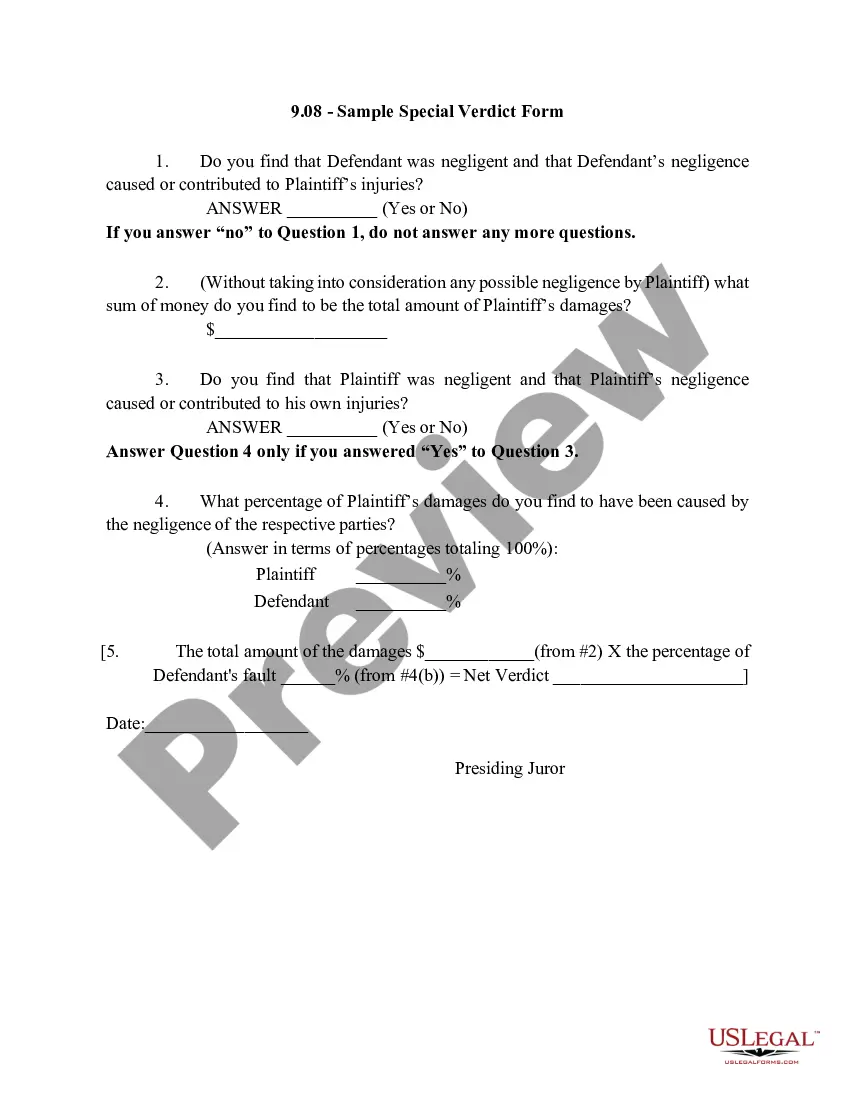
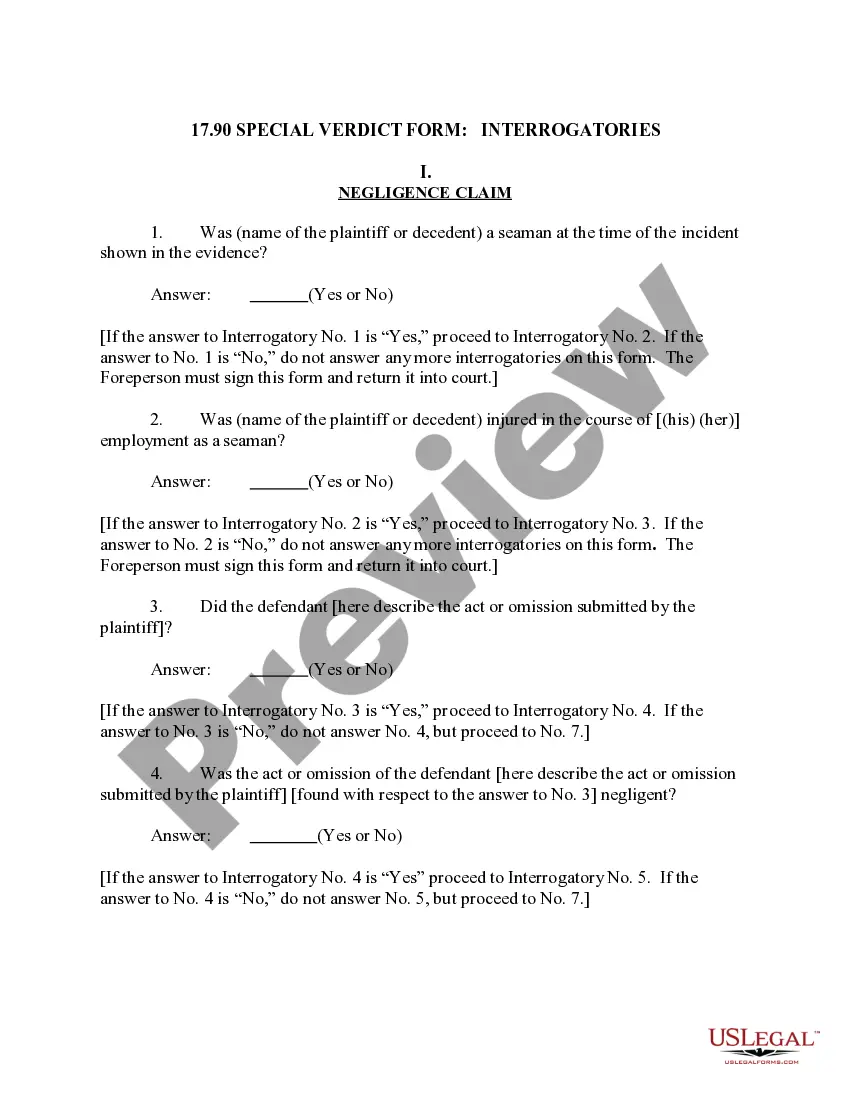
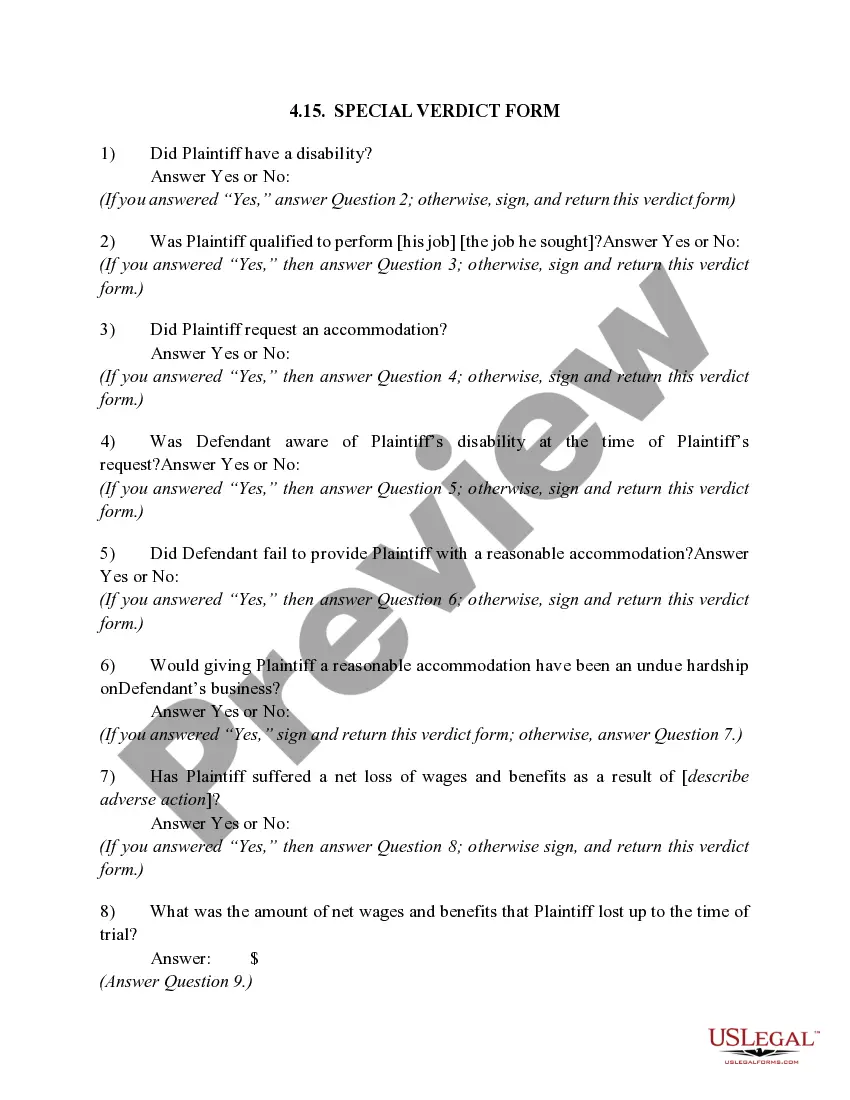
The 9.08 Sample Special Verdict Form is a legal document used in court to gather the jury's determinations on key issues in a negligence case. This form specifically aims to establish whether the defendant was negligent and if that negligence contributed to the plaintiff's injuries. It is specially designed to help juries outline their findings systematically, ensuring that all relevant questions are addressed and answered clearly. Unlike other verdict forms, which may combine multiple areas of inquiry, this form focuses specifically on establishing fault and determining damages, making it an essential tool in personal injury cases.
Key parts of this document
- Question 1: Assessment of the defendant's negligence and its connection to the plaintiff's injuries.
- Question 2: Total amount of damages incurred by the plaintiff, independent of their own conduct.
- Question 3: Evaluation of the plaintiff's own negligence and its contribution to their injuries.
- Question 4: Percentage distribution of fault between the plaintiff and defendant.
- Final computation of the net verdict based on total damages and the percentage of fault attributed to the defendant.
- Signature line for the presiding juror to validate the verdict.
When this form is needed
This form is typically used in civil court cases involving personal injury or tort claims where negligence is disputed. It helps juries articulate their decisions on liability and damage awards. If you are involved in a case that requires the jury to determine the amount of damages and the allocation of fault, this sample special verdict form provides a clear framework for those evaluations.
Who this form is for
- Juries participating in a negligence trial to deliberate on liability and damages.
- Attorneys who are involved in civil litigation to educate jurors on how to use the verdict form.
- Judges who oversee trials and require an official document for jurors' assessments.
Steps to complete this form
- Begin by determining the defendant's negligence and confidently answer the first question.
- If the answer to Question 1 is "no," you may stop; otherwise, proceed to Question 2 to assess the total damages.
- In Question 3, evaluate whether any negligence on the part of the plaintiff contributed to their injuries.
- In Question 4, allocate the percentages of fault between the plaintiff and the defendant, ensuring the total equals 100 percent.
- Calculate the net verdict based on the damages and the percentage of fault assigned to the defendant.
- Finally, sign and date the form as the presiding juror to validate your findings.
Notarization guidance
This form does not typically require notarization unless specified by local law. It is advisable to check with your local court rules to confirm any requirements related to notarization.
Get your form ready online
Our built-in tools help you complete, sign, share, and store your documents in one place.
Make edits, fill in missing information, and update formatting in US Legal Forms—just like you would in MS Word.
Download a copy, print it, send it by email, or mail it via USPS—whatever works best for your next step.
Sign and collect signatures with our SignNow integration. Send to multiple recipients, set reminders, and more. Go Premium to unlock E-Sign.
If this form requires notarization, complete it online through a secure video call—no need to meet a notary in person or wait for an appointment.
We protect your documents and personal data by following strict security and privacy standards.

Make edits, fill in missing information, and update formatting in US Legal Forms—just like you would in MS Word.

Download a copy, print it, send it by email, or mail it via USPS—whatever works best for your next step.

Sign and collect signatures with our SignNow integration. Send to multiple recipients, set reminders, and more. Go Premium to unlock E-Sign.

If this form requires notarization, complete it online through a secure video call—no need to meet a notary in person or wait for an appointment.

We protect your documents and personal data by following strict security and privacy standards.
Typical mistakes to avoid
- Failing to answer Question 1 correctly which could invalidate other answers.
- Not totaling the percentages in Question 4 to equal 100 percent.
- Neglecting to properly establish the damages before moving on to fault assessment.
- Skipping the signature line, thereby omitting the juror's validation of the verdict.
Why use this form online
- Convenient access to a standardized legal template saves time and effort.
- User-friendly format allows for easy completion and modifications.
- Reliability of using a form drafted by licensed attorneys ensures legal accuracy.
- Downloadable form allows you to save and print as needed.
Legal use & context
- This form is legally binding once completed by a jury and signed by the designated juror.
- It is intended for use in civil court trials regarding personal injury claims.
- Inaccurate or incomplete information on the form may affect the validity of the verdict.
Looking for another form?
Form popularity
FAQ
If it makes factual findings in addition to the ultimate legal conclusions, it returns a general verdict with interrogatories. (Ibid.) ?If it returns only factual findings, leaving the court to determine the ultimate legal result, it returns a special verdict.? (Ibid.)
The verdict form, in turn, formalizes the jury's decisions on the case, telling us how it will answer the claims and defenses. Its structure and language could influence the jury's ultimate answers. It may also control what issues may be raised on appeal.
A verdict in which the jury gives its findings on factual issues in the case, without necessarily stating which party should win.
The formal decision issued by a jury on the issues of fact that were presented at trial. VERDICT. The formal decision issued by a jury on the issues of fact that were presented at trial.Privy Verdict.Public Verdict.General Verdict.Partial Verdict.Special Verdict.
A general verdict is one that decides which party should win but does not make findings on any specific factual issues. A special verdict is one in which the jury provides its findings on specific factual issues.
Types of Verdicts General Verdict. Special Verdict. Directed Verdict. Judgment Notwithstanding the Verdict.
?We, the Jury, find the defendant, (guilty; not guilty; not guilty by reason of mental disease or defect; or not guilty and not guilty by reason of mental disease or defect) of , as charged in Count 1 of the Indictment/Complaint.?