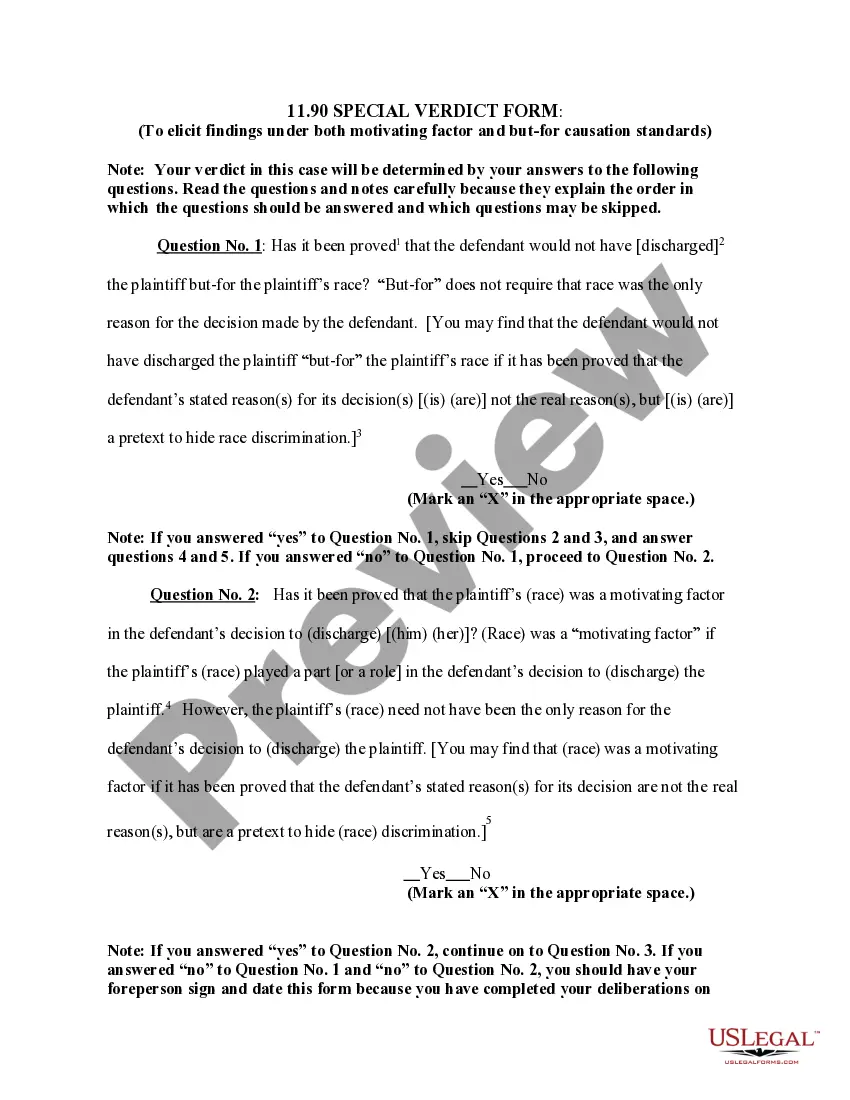
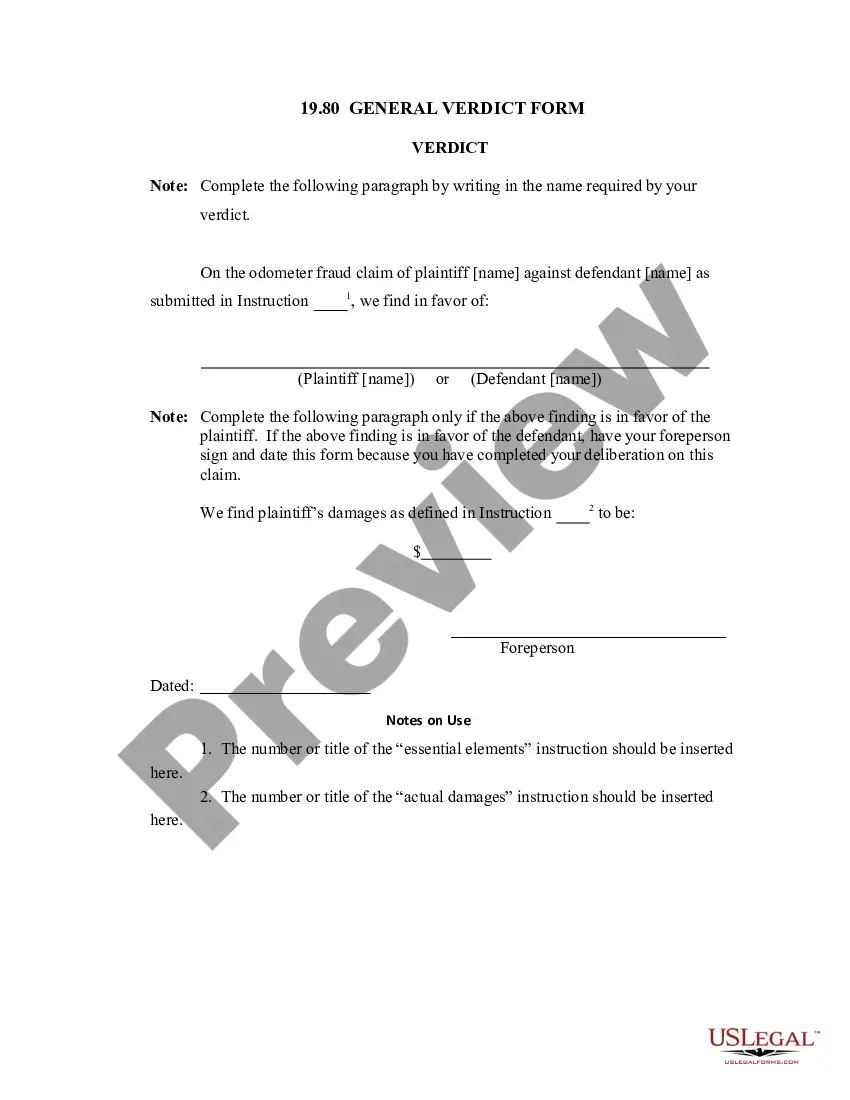
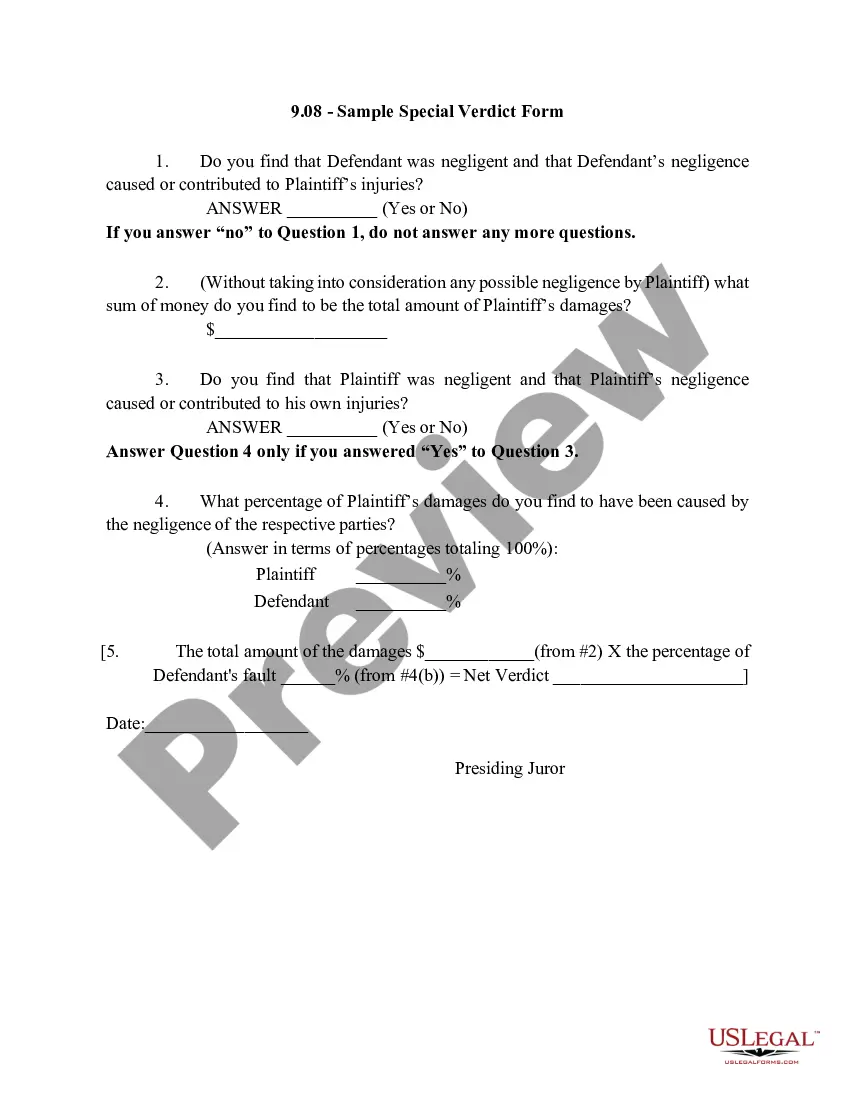
11.90 SPECIAL VERDICT FORM
What is this form?
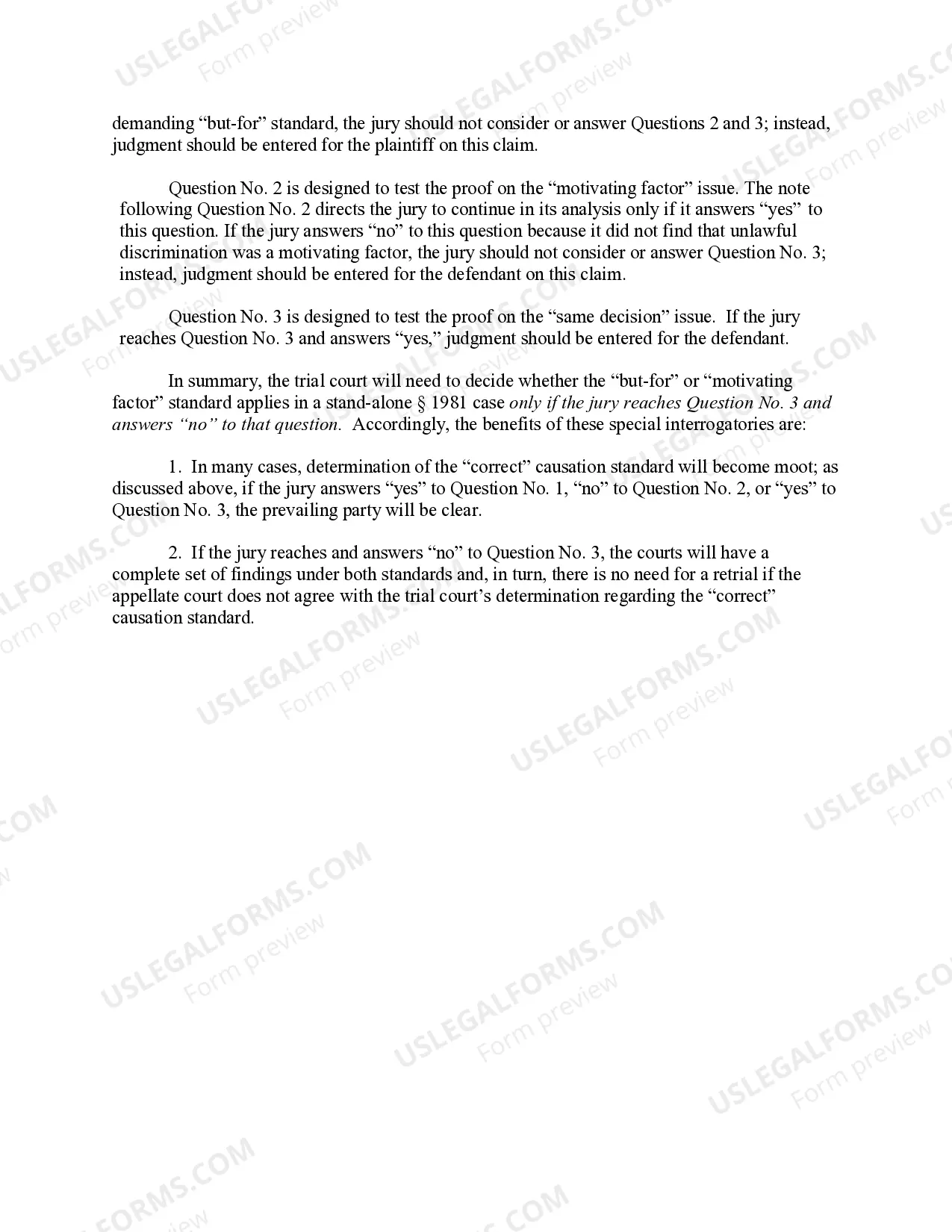
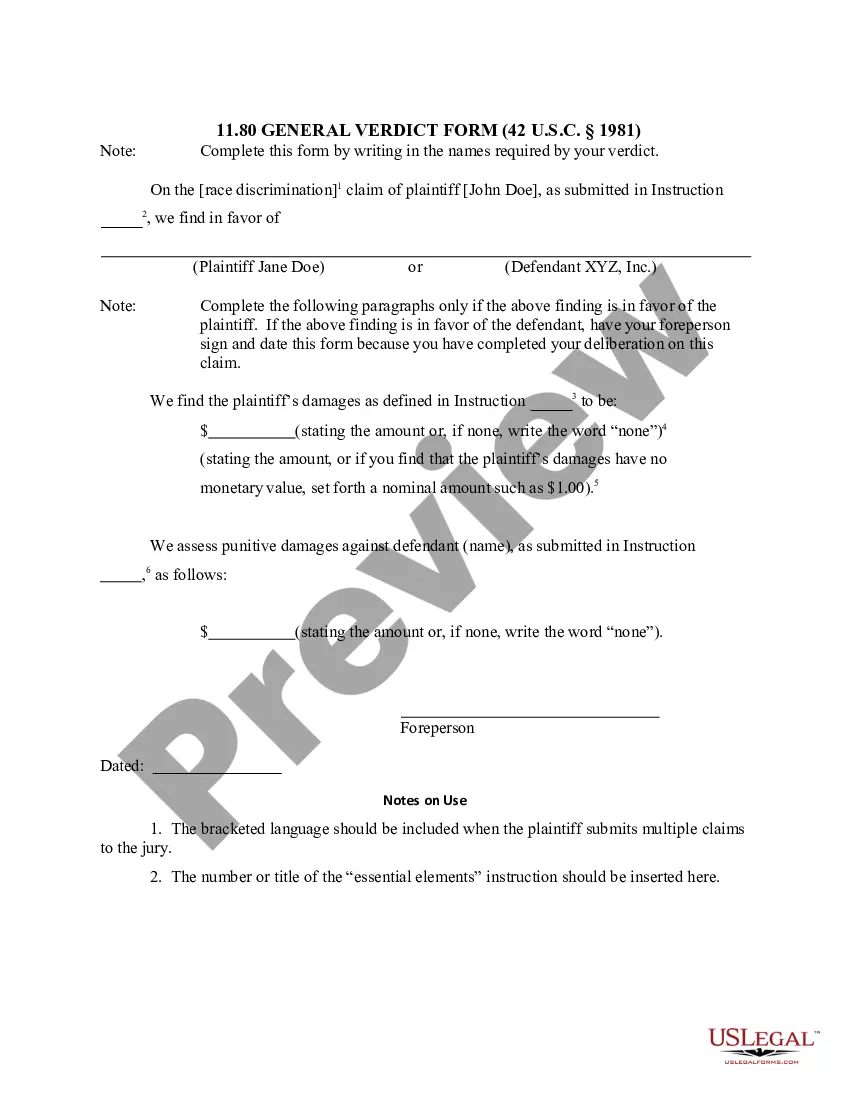
The Special Verdict Form is used to determine the findings in cases of alleged race discrimination under specific legal standards. This form is distinct because it elicits findings on both "but-for" causation and "motivating factor" standards, making it suitable for complex discrimination claims. It aims to clarify the jury's decision-making process by providing structured inquiries regarding the defendant's motives.
Key parts of this document
- Question No. 1: Establishes if the plaintiff's race was the sole reason for discharge.
- Question No. 2: Asks if the plaintiff's race was a motivating factor in the defendant's decision.
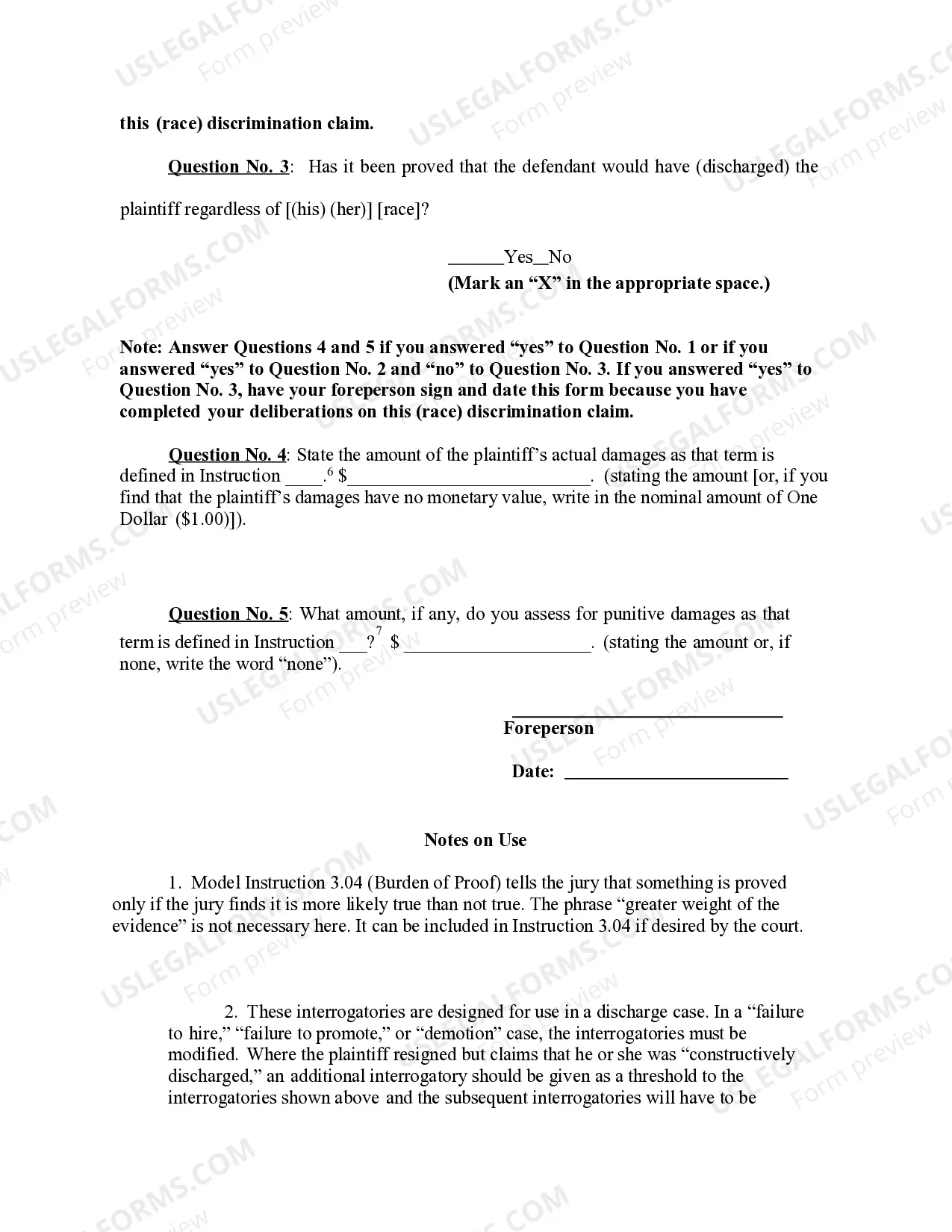
- Question No. 3: Inquires whether the defendant would have discharged the plaintiff regardless of race.
- Questions No. 4 & 5: Focus on the assessment of actual and punitive damages, respectively.
- Instructions for responding to the questions and determining the course of deliberation.
Situations where this form applies
This form should be utilized in legal scenarios involving claims of race discrimination where the plaintiff has been discharged. It is particularly relevant when there is ambiguity about whether the legal standard for liability is "but-for" causation or "motivating factor." Common contexts include employment cases where an individual contests their termination based on their race.
Who can use this document
- Juries in civil cases involving race discrimination claims.
- Legal professionals seeking to navigate causation issues in discrimination lawsuits.
- Courts that require a clear framework for jury deliberation on discrimination-related questions.
Completing this form step by step
- Read each question carefully to understand its intent.
- Mark an "X" in the appropriate box for each question based on the evidence presented.
- Follow the instructions provided after each question to determine whether to skip subsequent questions.
- For Questions 4 and 5, enter the amounts for actual and punitive damages as required.
- Ensure to have the foreperson sign and date the form upon completion of deliberations.
Does this document require notarization?
This form usually doesn’t need to be notarized. However, local laws or specific transactions may require it. Our online notarization service, powered by Notarize, lets you complete it remotely through a secure video session, available 24/7.
Get your form ready online
Our built-in tools help you complete, sign, share, and store your documents in one place.
Make edits, fill in missing information, and update formatting in US Legal Forms—just like you would in MS Word.
Download a copy, print it, send it by email, or mail it via USPS—whatever works best for your next step.
Sign and collect signatures with our SignNow integration. Send to multiple recipients, set reminders, and more. Go Premium to unlock E-Sign.
If this form requires notarization, complete it online through a secure video call—no need to meet a notary in person or wait for an appointment.
We protect your documents and personal data by following strict security and privacy standards.

Make edits, fill in missing information, and update formatting in US Legal Forms—just like you would in MS Word.

Download a copy, print it, send it by email, or mail it via USPS—whatever works best for your next step.

Sign and collect signatures with our SignNow integration. Send to multiple recipients, set reminders, and more. Go Premium to unlock E-Sign.

If this form requires notarization, complete it online through a secure video call—no need to meet a notary in person or wait for an appointment.

We protect your documents and personal data by following strict security and privacy standards.
Mistakes to watch out for
- Failing to read the questions thoroughly, which can lead to incorrect responses.
- Not marking boxes clearly, which can create ambiguity in the jury's findings.
- Overlooking the sequential nature of the questions, potentially affecting the outcome.
Why complete this form online
- Convenience of accessing and completing the form from anywhere, at any time.
- Easily editable format allows for adjustments before final submission.
- Reliability of the document being created based on professional legal standards.
Legal use & context
- This form serves as a legal tool to accurately assess jury findings in discrimination cases.
- Exclusively designed for use under federal law regarding race discrimination.
- It is important to comply with jurisdictional guidelines while using this form.
Looking for another form?
Form popularity
FAQ
A verdict in which the jury gives its findings on factual issues in the case, without necessarily stating which party should win.
624. The verdict of a jury is either general or special. A general verdict is that by which they pronounce generally upon all or any of the issues, either in favor of the plaintiff or defendant; a special verdict is that by which the jury find the facts only, leaving the judgment to the Court.
A general verdict is one that decides which party should win but does not make findings on any specific factual issues. A special verdict is one in which the jury provides its findings on specific factual issues.
A verdict in which the jury gives its findings on factual issues in the case, without necessarily stating which party should win. The judge decides what questions the jury should answer, and the judge can draw legal implications from the jury's answers.
A general verdict is one that decides which party should win but does not make findings on any specific factual issues. A special verdict is one in which the jury provides its findings on specific factual issues.
In U.S. legal nomenclature, the verdict is the finding of the jury on the questions of fact submitted to it. Once the court (the judge) receives the verdict, the judge enters judgment on the verdict. The judgment of the court is the final order in the case.
If the judge tries the case, the judge's decision is called a judgment. If a jury tries the case, the jury's decision is called a verdict.
FORMS OF VERDICT Multiple counts: A. ?We, the Jury, find the defendant, (guilty; not guilty; not guilty by reason of mental disease or defect; or not guilty and not guilty by reason of mental disease or defect) of , as charged in Count 1 of the Indictment/Complaint.?