6.06 RELIANCE ON PUBLIC AUTHORITY
What this document covers
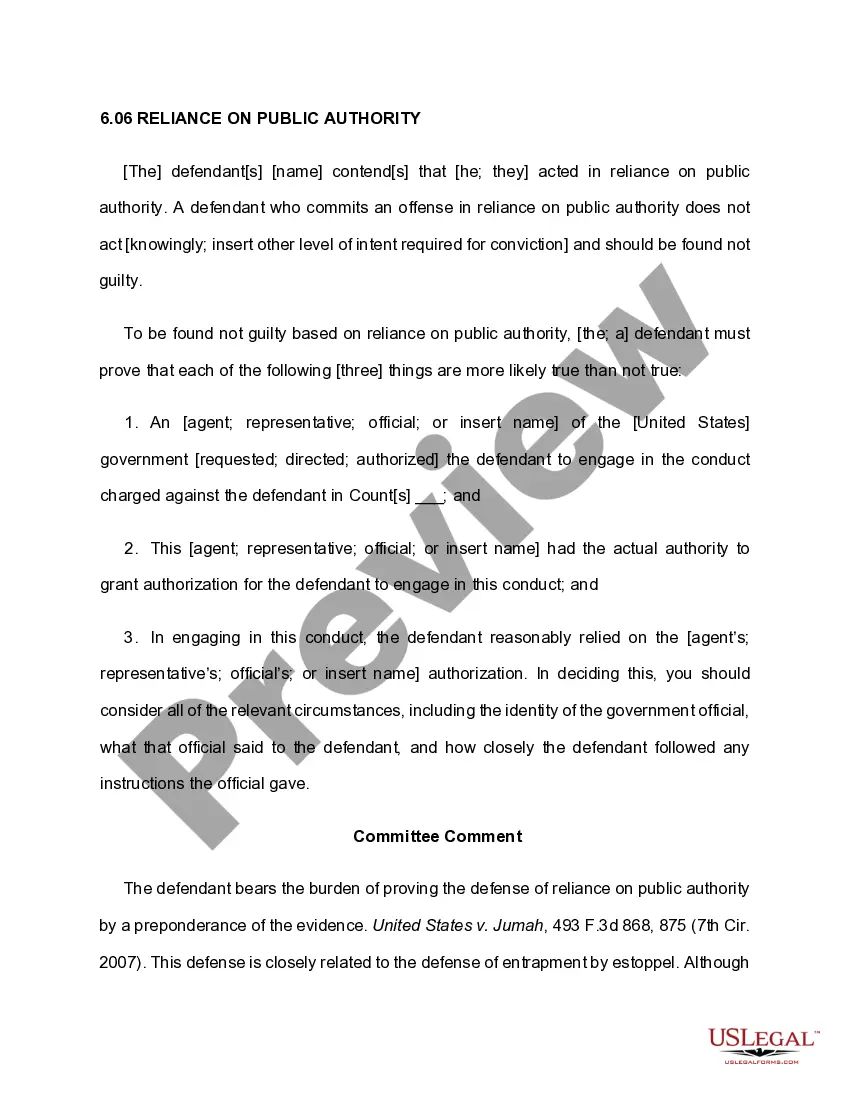
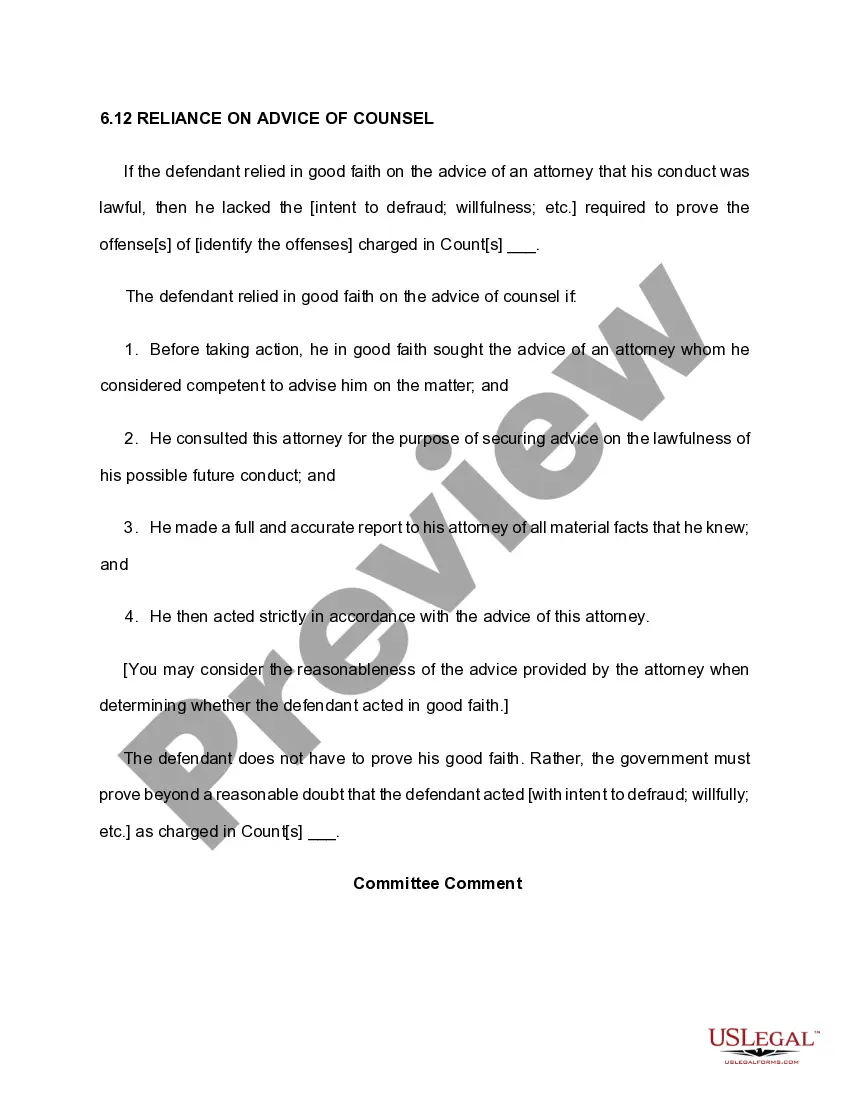
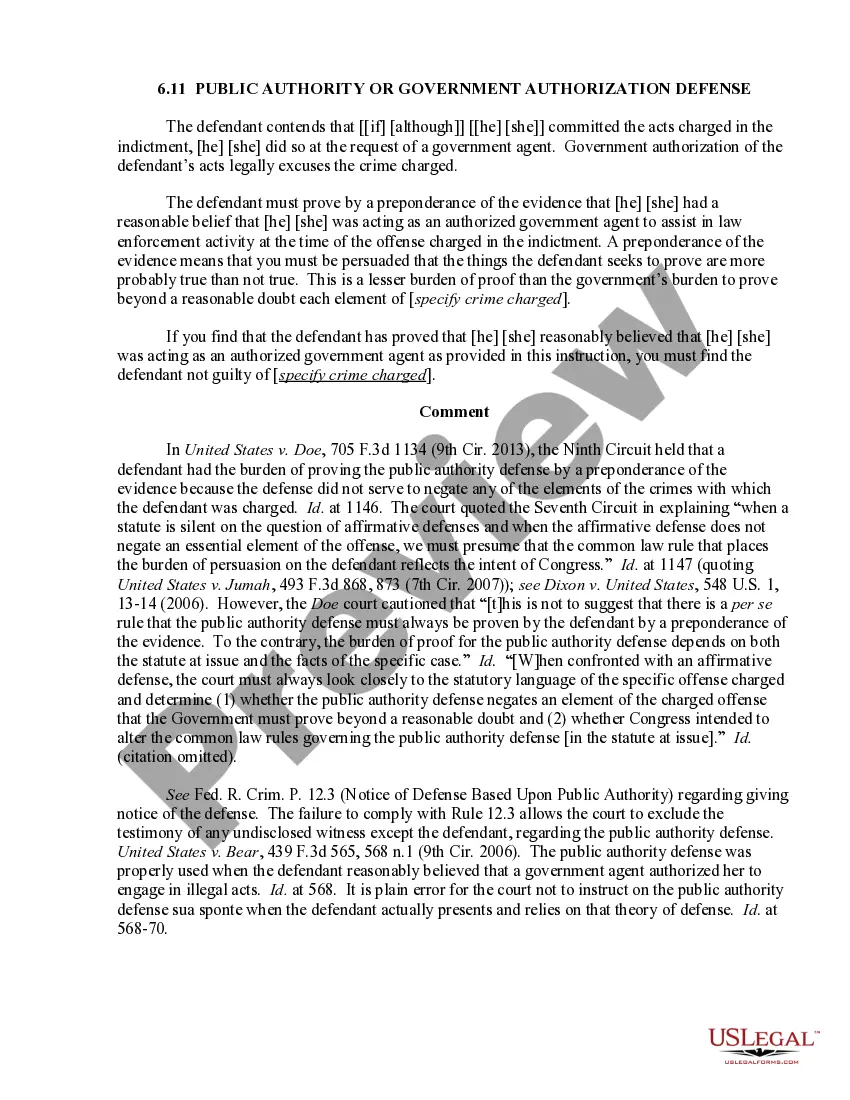
The 6.06 Reliance on Public Authority form provides a legal defense strategy for defendants who claim they acted under the authorization of a government official. This form is specifically designed for use in the context of federal cases as per the Official Pattern Jury Instructions adopted by the Federal 7th Circuit Court. It outlines the circumstances under which a defendant can argue that their actions, although illegal, were based on reasonable reliance on a directive from a public authority.
Key parts of this document
- Definition of reliance on public authority and its legal implications.
- Criteria that the defendant must prove to establish this defense.
- Consideration of the actions and instructions of the government official involved.
- Details on the burden of proof required from the defendant.
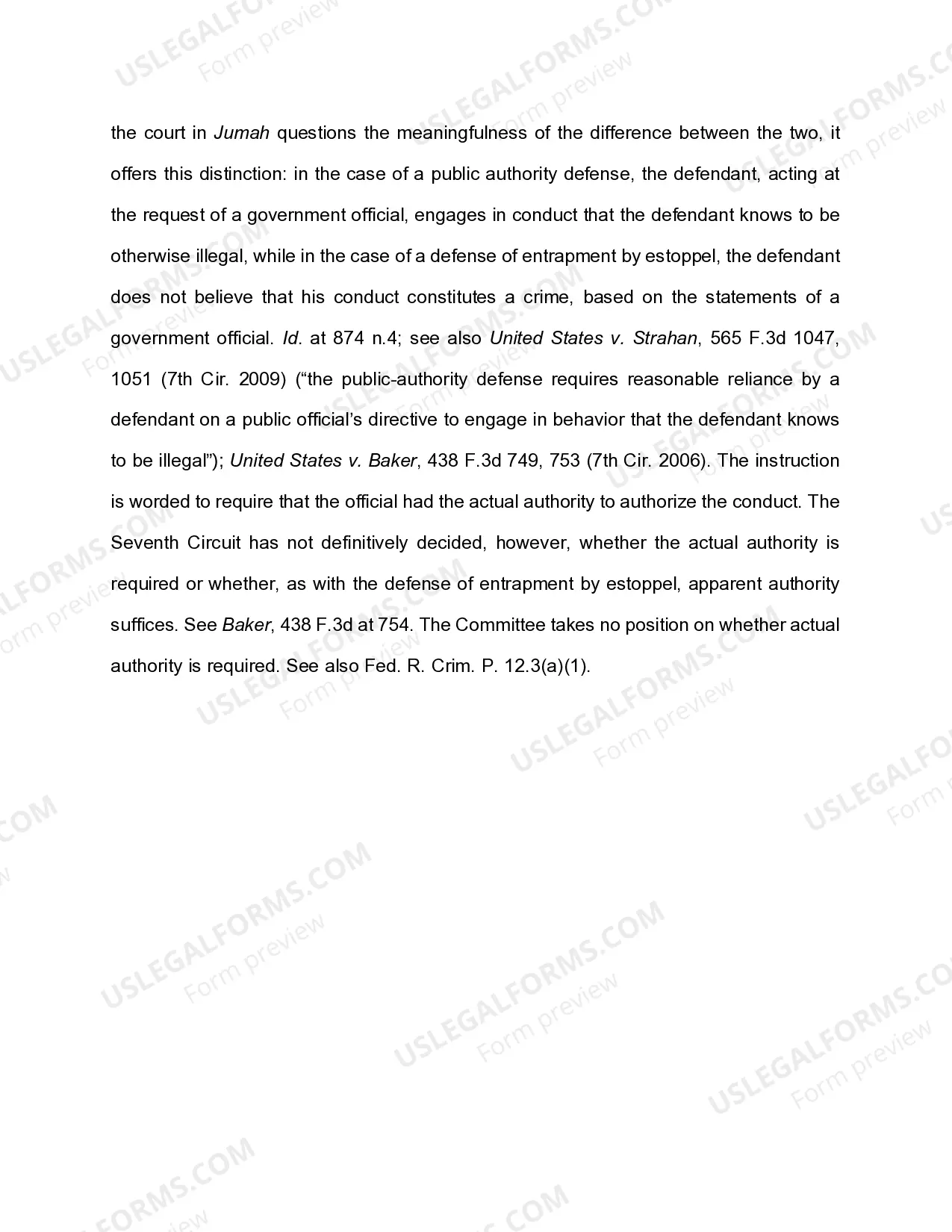
- Clarification on the difference between reliance on public authority and entrapment by estoppel.
When to use this form
This form should be used when a defendant in a federal case intends to argue that they were acting under the authority of a government official, and thus did not have the required intent for a conviction. This might be relevant in cases of alleged criminal conduct that the defendant believes was authorized by a public authority.
Who should use this form
- Defendants in federal criminal cases who believe they acted under public authority.
- Legal representatives seeking to establish a defense based on public authorization.
- Individuals involved in cases related to federal law where reliance on a government official's directive is applicable.
How to prepare this document
- Identify the defendant's name and the specific charge against them.
- Provide the details of the government official who allegedly authorized the conduct.
- State the circumstances that led to the reliance on public authority, including any communications the defendant had with the official.
- Document any evidence supporting the claim of reasonable reliance on the official's instructions.
- Ensure all statements can be substantiated to meet the burden of proof required.
Notarization guidance
This form does not typically require notarization unless specified by local law. It is essential to check any additional requirements that may apply to your specific case.
Get your form ready online
Our built-in tools help you complete, sign, share, and store your documents in one place.
Make edits, fill in missing information, and update formatting in US Legal Forms—just like you would in MS Word.
Download a copy, print it, send it by email, or mail it via USPS—whatever works best for your next step.
Sign and collect signatures with our SignNow integration. Send to multiple recipients, set reminders, and more. Go Premium to unlock E-Sign.
If this form requires notarization, complete it online through a secure video call—no need to meet a notary in person or wait for an appointment.
We protect your documents and personal data by following strict security and privacy standards.

Make edits, fill in missing information, and update formatting in US Legal Forms—just like you would in MS Word.

Download a copy, print it, send it by email, or mail it via USPS—whatever works best for your next step.

Sign and collect signatures with our SignNow integration. Send to multiple recipients, set reminders, and more. Go Premium to unlock E-Sign.

If this form requires notarization, complete it online through a secure video call—no need to meet a notary in person or wait for an appointment.

We protect your documents and personal data by following strict security and privacy standards.
Typical mistakes to avoid
- Failing to provide adequate evidence of the government's authorization.
- Misunderstanding the difference between reliance on public authority and other defenses, such as entrapment by estoppel.
- Not clearly articulating the defendant's reliance on the instructions of the government official.
Why complete this form online
- Immediate access to the form allows for timely legal action.
- Easy editability enables users to tailor the form to their specific circumstances.
- Access to professionally drafted content ensures legal accuracy and compliance.
Legal use & context
- This form aligns with the legal standards within the Federal 7th Circuit regarding public authority defense.
- Understanding the importance of reasonable belief in the authority of a government official is critical.
- When utilized, it should be supported by strong evidence to substantiate claims made during court proceedings.
Summary of main points
- The "Reliance on Public Authority" form serves as a defense for defendants who acted under government direction.
- Key elements include proving the authority of the public official and the reasonableness of reliance.
- Proper completion requires careful gathering of evidence to support the claim.
Looking for another form?
Form popularity
FAQ
In the defense of public authority, it is the defendant whose mistake leads to the commission of the crime; with "entrapment by estoppel," a government official commits an error and, in reliance thereon, the defendant thereby violates the law.
Entrapment by estoppel applies when an official tells a defendant that certain conduct is legal and the defendant believes that official. This defense applies even in cases of strict liability, because entrapment does not negate the intent element of an offense, it relies on the principle of fairness.
(the defense of duress applies when the accused's participation in the offense was caused by a reasonable apprehension that the accused or another innocent person would be immediately killed or would immediately suffer serious bodily injury if the accused did not commit the act; the apprehension must reasonably
Entrapment by estoppel applies when an official tells a defendant that certain conduct is legal and the defendant believes that official. This defense applies even in cases of strict liability, because entrapment does not negate the intent element of an offense, it relies on the principle of fairness.
"Entrapment by estoppel" is another type of "public authority defense," defined as an argument that the government made errors that convinced a defendant that they were acting within the law, assuming the defendant "was reasonable in believing that his/her conduct was sanctioned by the government."
In the defense of public authority, it is the defendant whose mistake leads to the commission of the crime; with "entrapment by estoppel," a government official commits an error and, in reliance thereon, the defendant thereby violates the law.
The defendant contends that if although he she committed the acts charged in the indictment, he she did so at the request of a government agent. Government authorization of the defendant's acts legally excuses the crime charged.