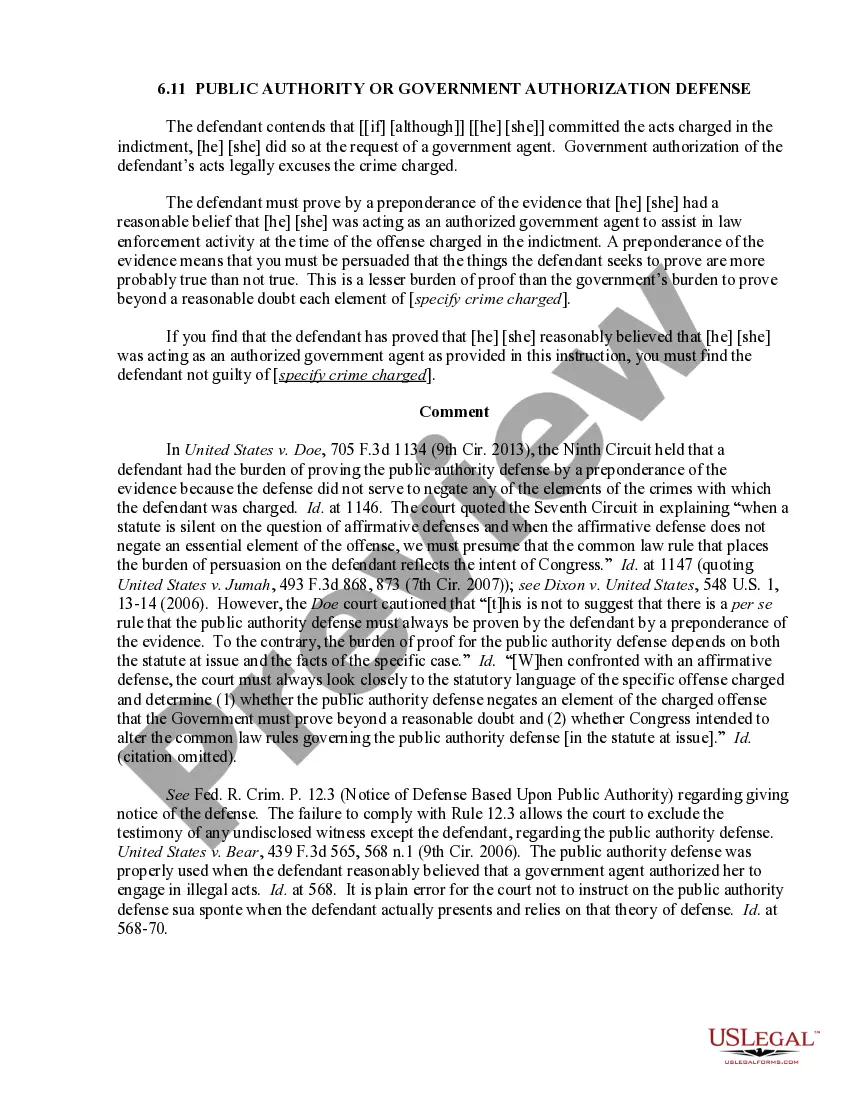
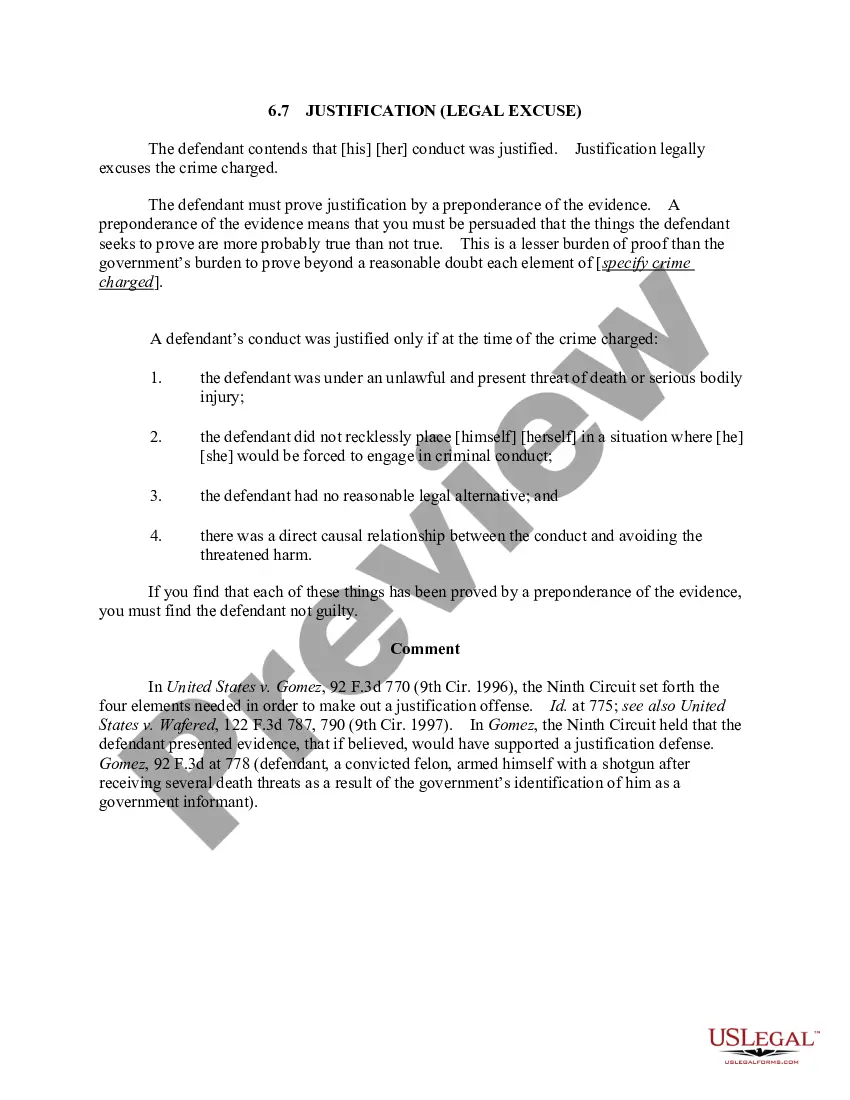
6.11 Public Authority or Government Authorization Defense

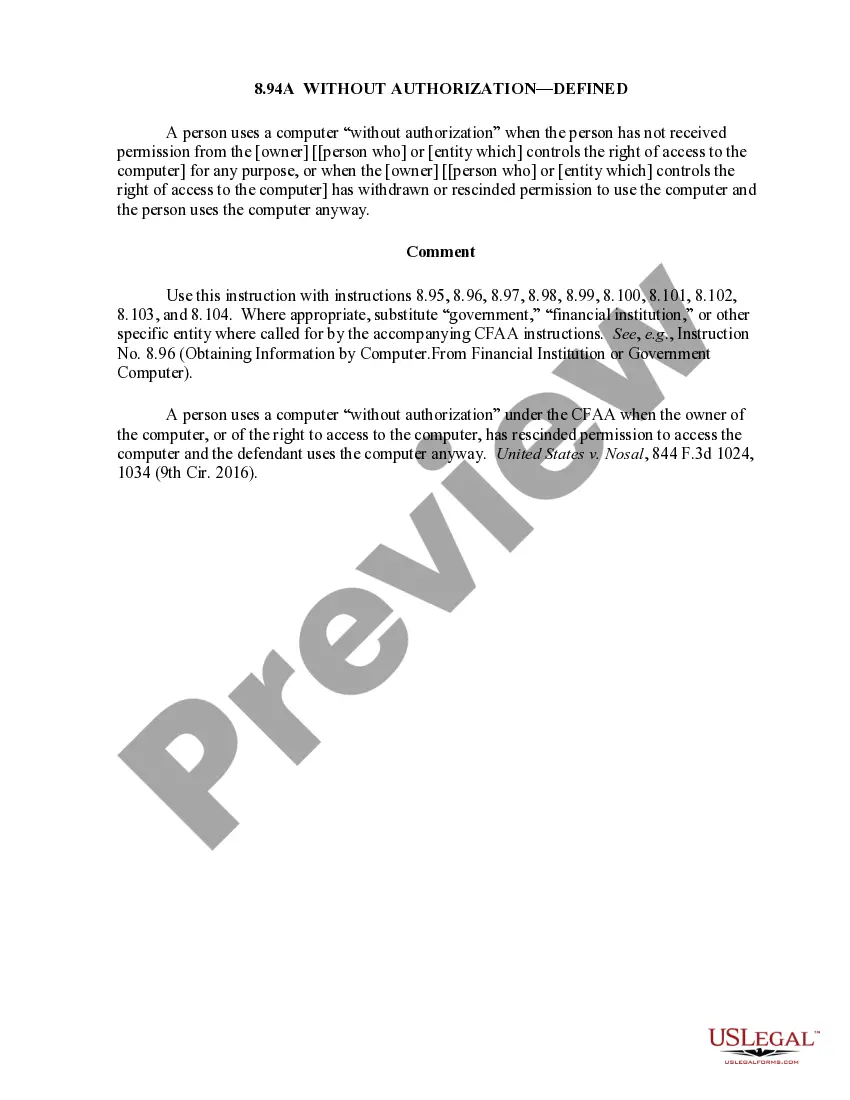
Notarization guidance
Notarization is not commonly needed for this form. However, certain documents or local rules may make it necessary. Our notarization service, powered by Notarize, allows you to finalize it securely online anytime, day or night.
Get your form ready online
Our built-in tools help you complete, sign, share, and store your documents in one place.
Make edits, fill in missing information, and update formatting in US Legal Forms—just like you would in MS Word.
Download a copy, print it, send it by email, or mail it via USPS—whatever works best for your next step.
Sign and collect signatures with our SignNow integration. Send to multiple recipients, set reminders, and more. Go Premium to unlock E-Sign.
If this form requires notarization, complete it online through a secure video call—no need to meet a notary in person or wait for an appointment.
We protect your documents and personal data by following strict security and privacy standards.

Make edits, fill in missing information, and update formatting in US Legal Forms—just like you would in MS Word.

Download a copy, print it, send it by email, or mail it via USPS—whatever works best for your next step.

Sign and collect signatures with our SignNow integration. Send to multiple recipients, set reminders, and more. Go Premium to unlock E-Sign.

If this form requires notarization, complete it online through a secure video call—no need to meet a notary in person or wait for an appointment.

We protect your documents and personal data by following strict security and privacy standards.
Looking for another form?
Form popularity
FAQ
Entrapment is a complete defense to a criminal charge, on the theory that "Government agents may not originate a criminal design, implant in an innocent person's mind the disposition to commit a criminal act, and then induce commission of the crime so that the Government may prosecute." Jacobson v.
Innocence One of the simplest defenses to criminal liability is the defense of innocence. This defense is raised when you did not commit the crime. Remember, the prosecution has to prove every element of the crime charged against you and prove it beyond a reasonable doubt.
THE ENTRAPMENT DEFENSE IS USED WHEN AN ACCUSED PERSON ALLEGES THAT HE NEVER WOULD HAVE COMMITTED A CRIME IF A LAW ENFORCEMENT OFFICER HAD NOT INSPIRED, INCITED, PERSUADED AND LURED HIM. THE VARIOUS POLICY REASONS UNDERLYING THE DEVELOPMENT OF THE DEFENSE ARE DISCUSSED.
Mere presence at the scene of a crime or mere knowledge that a crime is being committed is not sufficient to establish that the defendant committed the crime of specify crime charged. The defendant must be a participant and not merely a knowing spectator.
In California, entrapment is a defense if conducted by law enforcement agents that would likely induce a normally law-abiding person to commit a crime induced the defendant to commit a charged crime. The defendant has the burden of proving entrapment by a preponderance of the evidence.
Entrapment is a legal defense used in criminal cases where the defendant argues that they were induced by law enforcement to commit a crime that they otherwise would not have committed.
The Criminal Defense of Entrapment Entrapment is a defense to criminal charges on the basis that the defendant only committed the crime because of harassment or coercion by a government official. Without such coercion, the crime would never have been committed.
In the defense of public authority, it is the defendant whose mistake leads to the commission of the crime; with "entrapment by estoppel," a government official commits an error and, in reliance thereon, the defendant thereby violates the law.