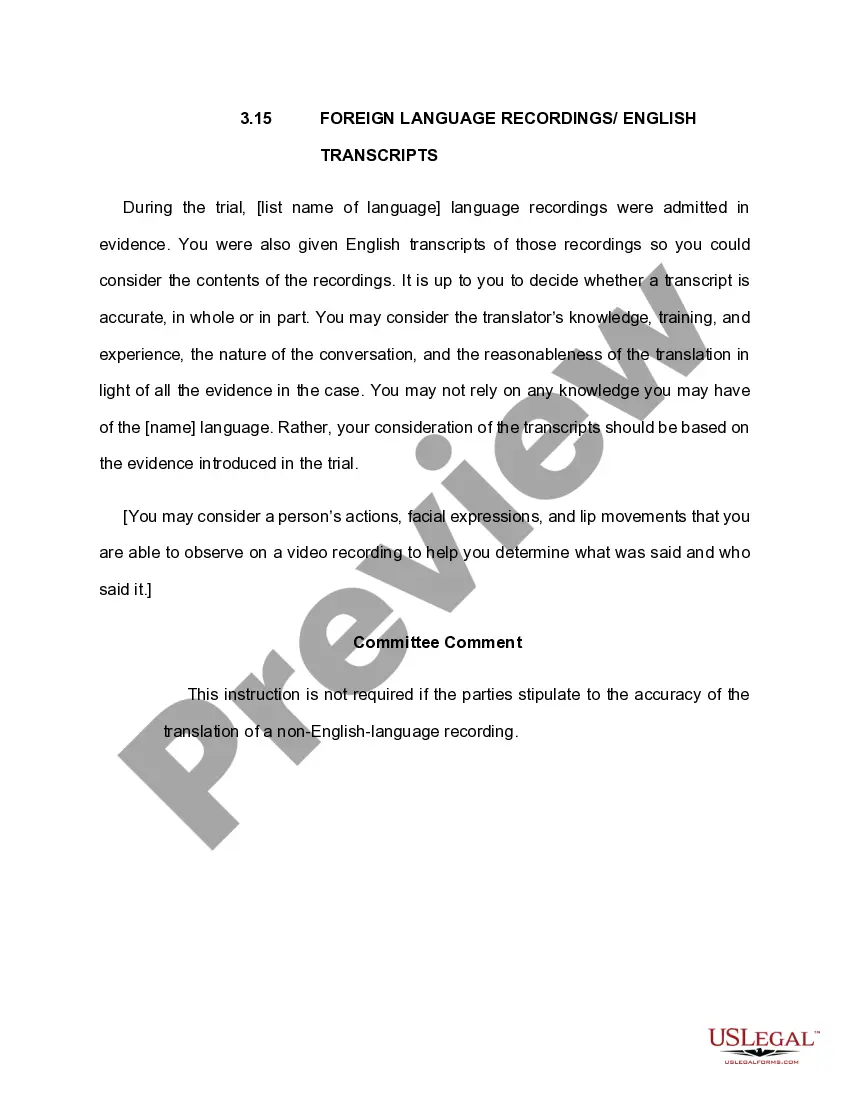
3.15 FOREIGN LANGUAGE RECORDINGS/ ENGLISH TRANSCRIPTS
Overview of this form
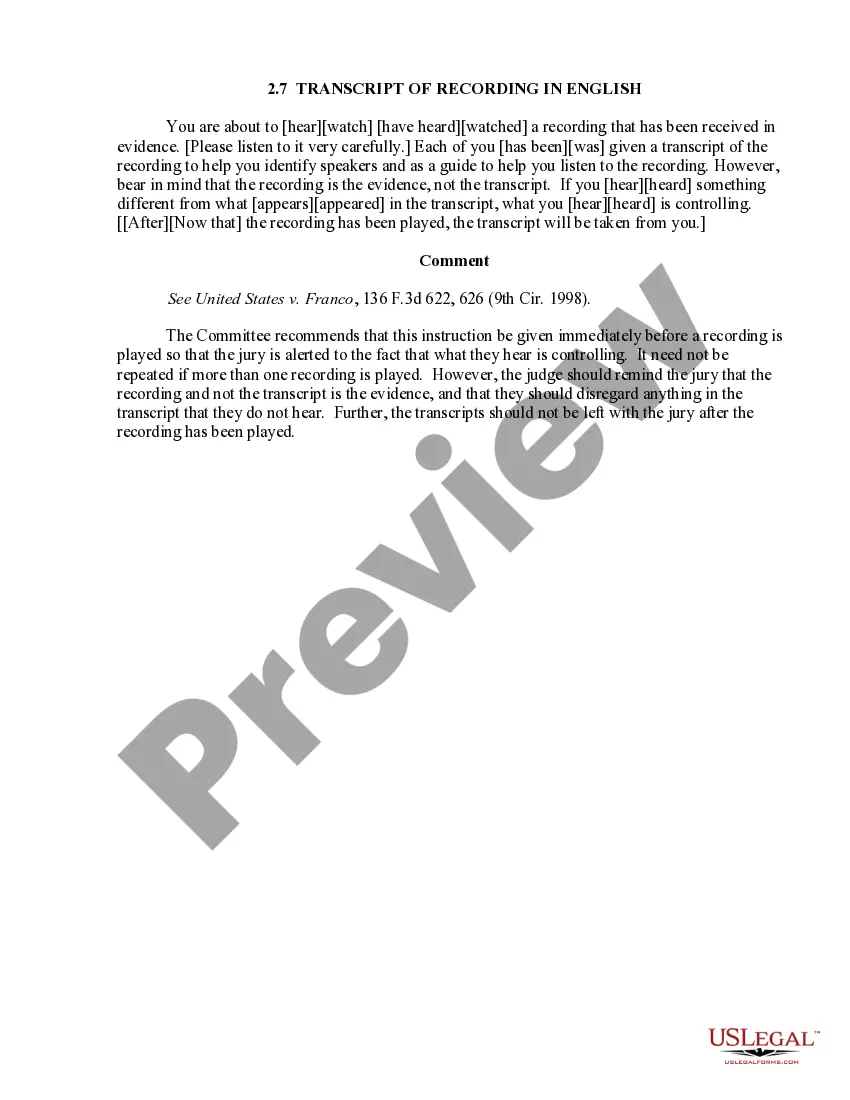
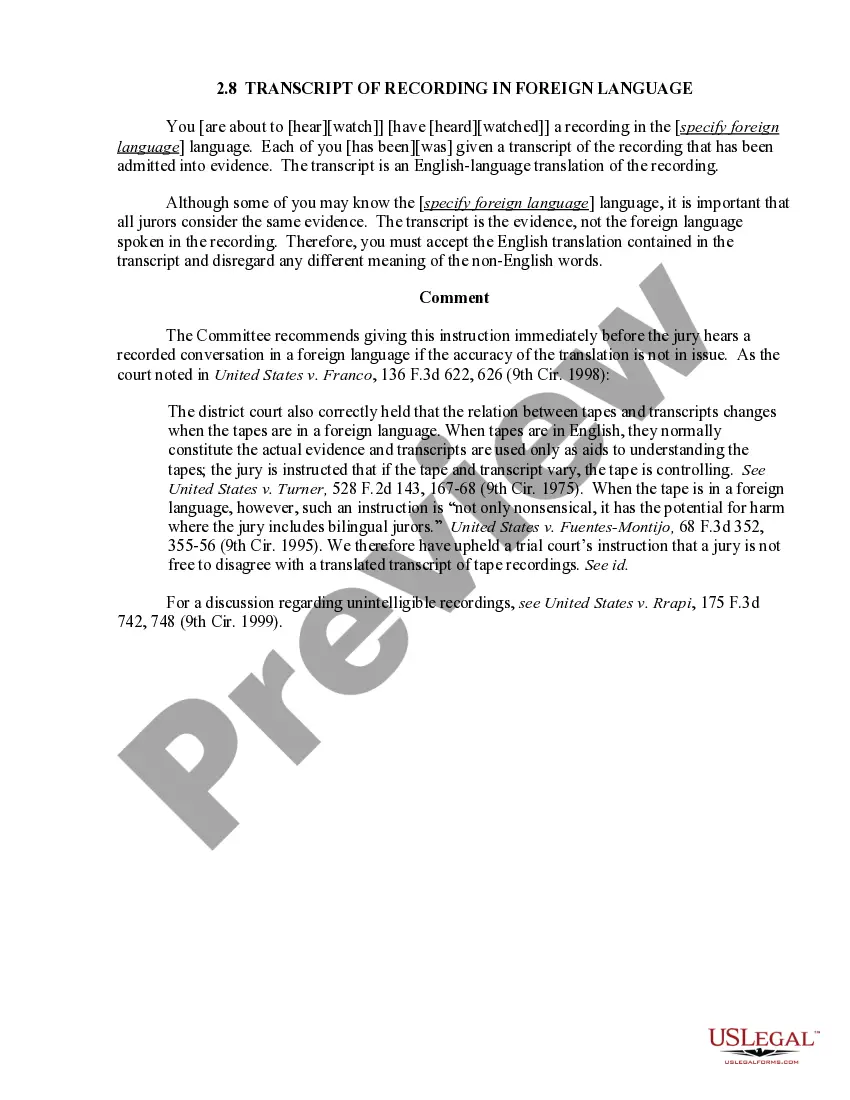
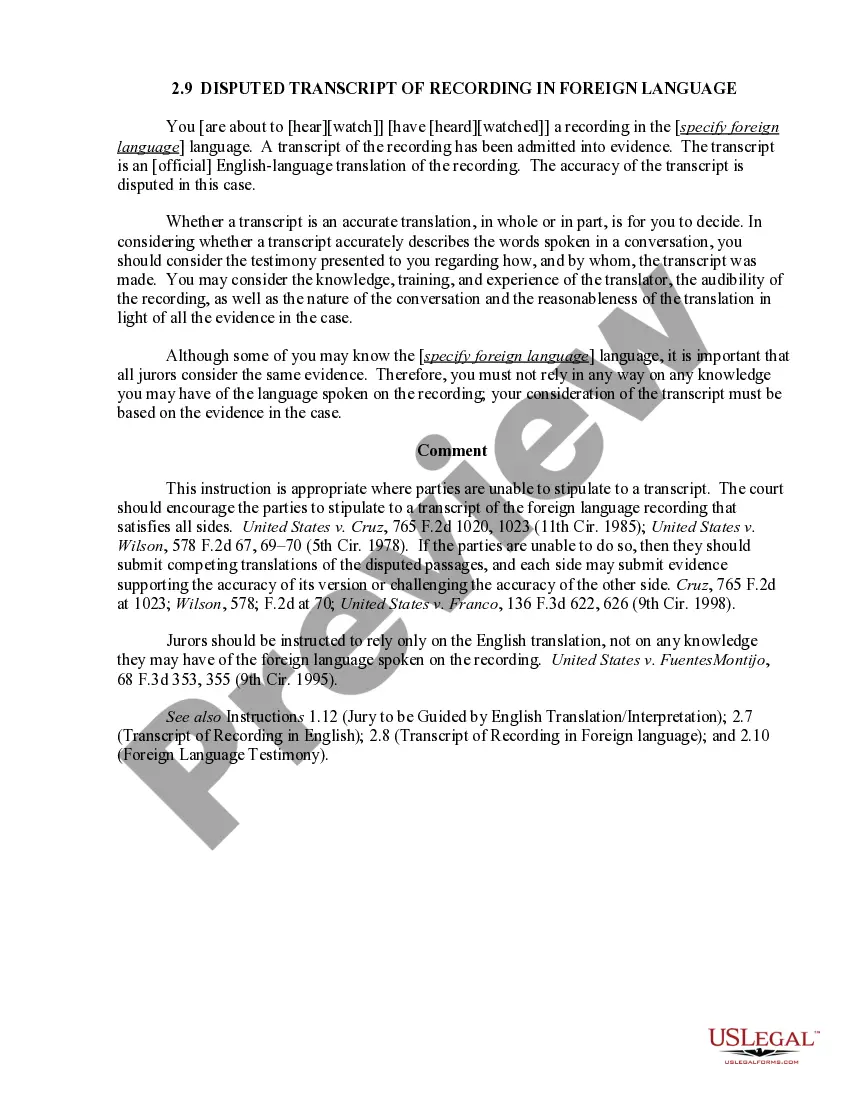
The 3.15 Foreign Language Recordings/English Transcripts form provides guidelines for jurors regarding the consideration of non-English audio recordings and their English transcripts during a trial. This specific instruction is essential for ensuring that jurors assess the accuracy of translated content based solely on trial evidence, rather than personal knowledge of the foreign language. This form differs from other jury instructions by focusing on handling foreign language materials in legal proceedings.
Main sections of this form
- Instructions on evaluating the accuracy of English transcripts from foreign language recordings.
- Consideration of the translator's qualifications and the context of the conversation.
- Guidance on how jurors should not rely on their own knowledge of the foreign language.
- Provisions for observing non-verbal cues from video recordings to aid in understanding.
- Commentary on situations where the instruction may not be necessary if translations are stipulated as accurate by parties.
When to use this document
This form is crucial during trials that involve evidence presented in a foreign language. It is used when jurors are tasked with evaluating audio recordings not originally in English. The form ensures that jurors have the necessary guidance to assess the translations provided against the evidential context of the trial.
Who should use this form
- Jurors in a trial where foreign language recordings are admitted as evidence.
- Judges who manage court instructions related to the consideration of translated materials.
- Attorneys who present evidence that includes foreign language components.
How to prepare this document
- Identify the language of the foreign recordings being evaluated.
- Review the provided English transcripts during deliberation.
- Assess the accuracy of the transcripts based on evidence presented in the trial.
- Consider the qualifications of the translator and the context in which the recordings were made.
- Take into account visual cues, such as actions and expressions in video recordings, to aid comprehension.
Does this form need to be notarized?
Notarization is not commonly needed for this form. However, certain documents or local rules may make it necessary. Our notarization service, powered by Notarize, allows you to finalize it securely online anytime, day or night.
Get your form ready online
Our built-in tools help you complete, sign, share, and store your documents in one place.
Make edits, fill in missing information, and update formatting in US Legal Forms—just like you would in MS Word.
Download a copy, print it, send it by email, or mail it via USPS—whatever works best for your next step.
Sign and collect signatures with our SignNow integration. Send to multiple recipients, set reminders, and more. Go Premium to unlock E-Sign.
If this form requires notarization, complete it online through a secure video call—no need to meet a notary in person or wait for an appointment.
We protect your documents and personal data by following strict security and privacy standards.

Make edits, fill in missing information, and update formatting in US Legal Forms—just like you would in MS Word.

Download a copy, print it, send it by email, or mail it via USPS—whatever works best for your next step.

Sign and collect signatures with our SignNow integration. Send to multiple recipients, set reminders, and more. Go Premium to unlock E-Sign.

If this form requires notarization, complete it online through a secure video call—no need to meet a notary in person or wait for an appointment.

We protect your documents and personal data by following strict security and privacy standards.
Common mistakes to avoid
- Relying on personal knowledge of the foreign language instead of the translated transcripts.
- Failing to consider the qualifications of the translator as part of the evaluation process.
- Overlooking non-verbal communications in video evidence that could clarify meaning.
- Assuming all translations are accurate without critical assessment.
Benefits of completing this form online
- Convenient access to professionally drafted instructions for quick reference during trials.
- Editability allows for tailoring instructions to specific case needs.
- Reliable format provided by licensed attorneys ensures legal compliance.
Legal use & context
- This form guides jurors in legal proceedings involving foreign language evidence, ensuring fair evaluation.
- Improves the clarity and understanding of jurors regarding complex translations.
- May be used in federal trials across multiple jurisdictions, reflecting standardized legal practices.
Looking for another form?



Form popularity
FAQ
Foreign language transcription is the process of taking spoken words on an audio or video recording in one language and converting them into written text in another language.
Transcription in the linguistic sense is the systematic representation of spoken language in written form. The source can either be utterances (speech or sign language) or preexisting text in another writing system.
Choose the languages you want to translate to and from. From: At the bottom left, select the speaker's language. To: At the bottom right, select the translation language.
There are two primary transcription types: Verbatim and non-verbatim transcription. Each of these types of transcription serves a unique purpose and suits a specific kind of project.