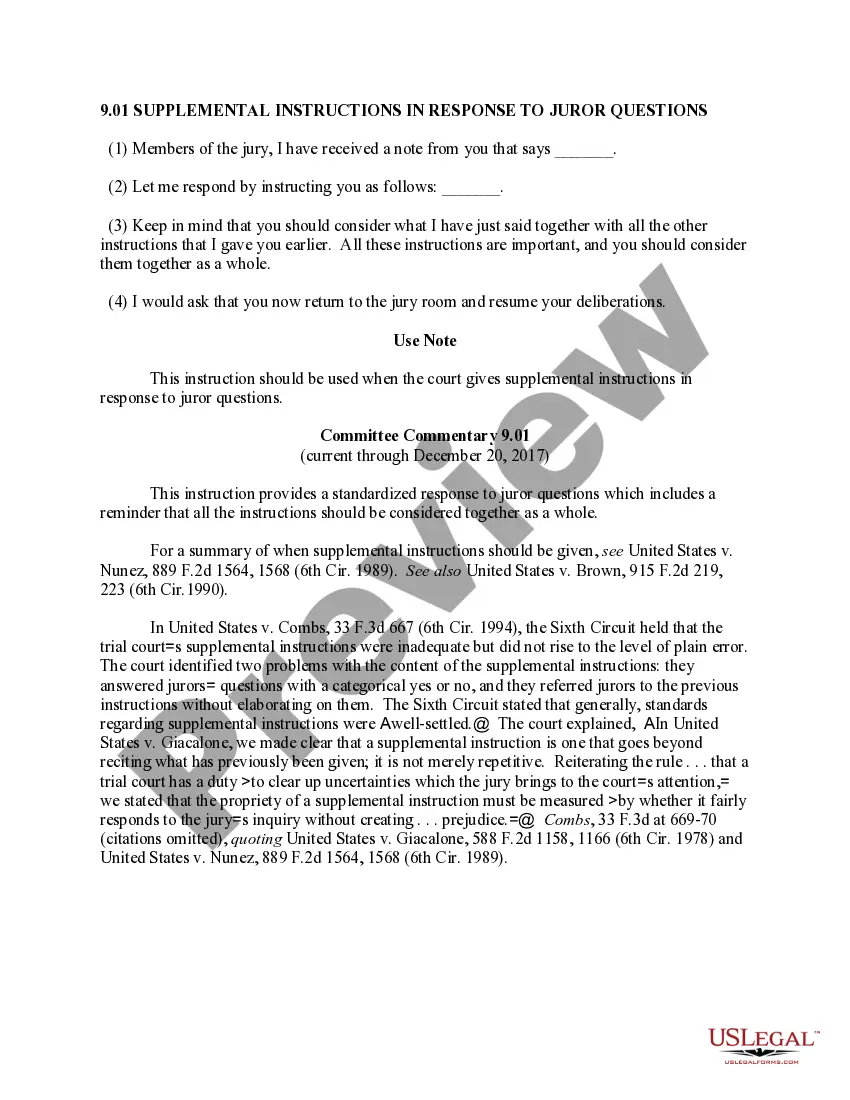
SUPPLEMENTAL INSTRUCTIONS IN RESPONSE TO JUROR QUESTIONS
Understanding this form
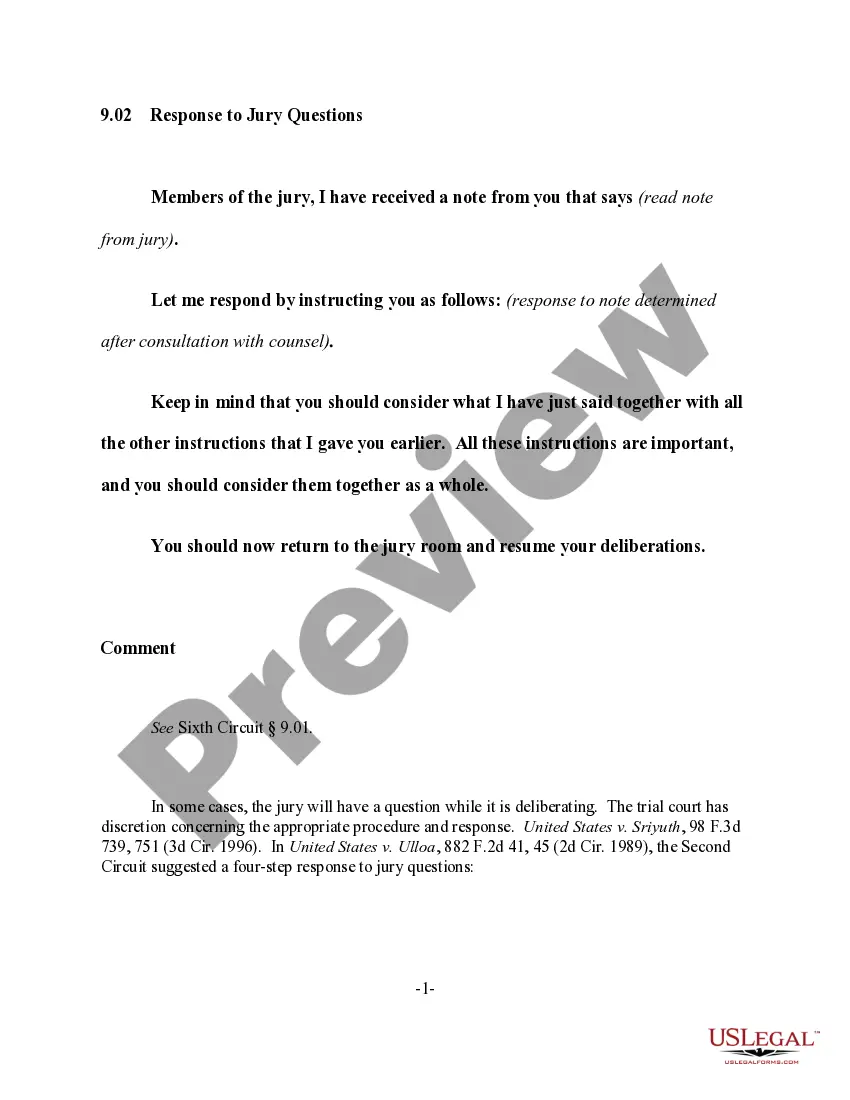
The Supplemental Instructions in Response to Juror Questions is a legal document used by judges to provide clarity when jurors seek additional guidance during deliberations. This form is unique because it offers a standardized response to juror inquiries, ensuring that all instructions are understood as a cohesive whole, thus helping jurors effectively reach a decision in a trial.
Key parts of this document
- A section for the judge to acknowledge the juror's question.
- Specific instructions addressing the juror's inquiry.
- A reminder that the supplemental instructions should be considered along with previous instructions.
- A request for jurors to return and continue deliberations.
When this form is needed
This form should be used in criminal trials when jurors have submitted questions to the judge during deliberations. It is particularly necessary when jurors express confusion about the case, requiring clarification that is consistent with prior instructions. The use of this form helps to ensure that jurors have a clear understanding of the legal principles involved in their case.
Who can use this document
- Judges presiding over jury trials.
- Legal practitioners involved in trial processes.
- Court clerks responsible for jury instructions.
How to complete this form
- Receive the juror's note with the specific question.
- Draft a clear and comprehensive instruction to address the inquiry.
- Include a reminder that all previous instructions must be considered together.
- Read the supplemental instruction aloud in open court.
- Invite the jury to return to their deliberations after providing the instruction.
Is notarization required?
This form does not typically require notarization unless specified by local law. It is primarily used within courtroom procedures for providing juror instructions.
Get your form ready online
Our built-in tools help you complete, sign, share, and store your documents in one place.
Make edits, fill in missing information, and update formatting in US Legal Forms—just like you would in MS Word.
Download a copy, print it, send it by email, or mail it via USPS—whatever works best for your next step.
Sign and collect signatures with our SignNow integration. Send to multiple recipients, set reminders, and more. Go Premium to unlock E-Sign.
If this form requires notarization, complete it online through a secure video call—no need to meet a notary in person or wait for an appointment.
We protect your documents and personal data by following strict security and privacy standards.

Make edits, fill in missing information, and update formatting in US Legal Forms—just like you would in MS Word.

Download a copy, print it, send it by email, or mail it via USPS—whatever works best for your next step.

Sign and collect signatures with our SignNow integration. Send to multiple recipients, set reminders, and more. Go Premium to unlock E-Sign.

If this form requires notarization, complete it online through a secure video call—no need to meet a notary in person or wait for an appointment.

We protect your documents and personal data by following strict security and privacy standards.
Common mistakes
- Failing to clarify the juror's question adequately.
- Providing instructions that simply repeat previous information without additional context.
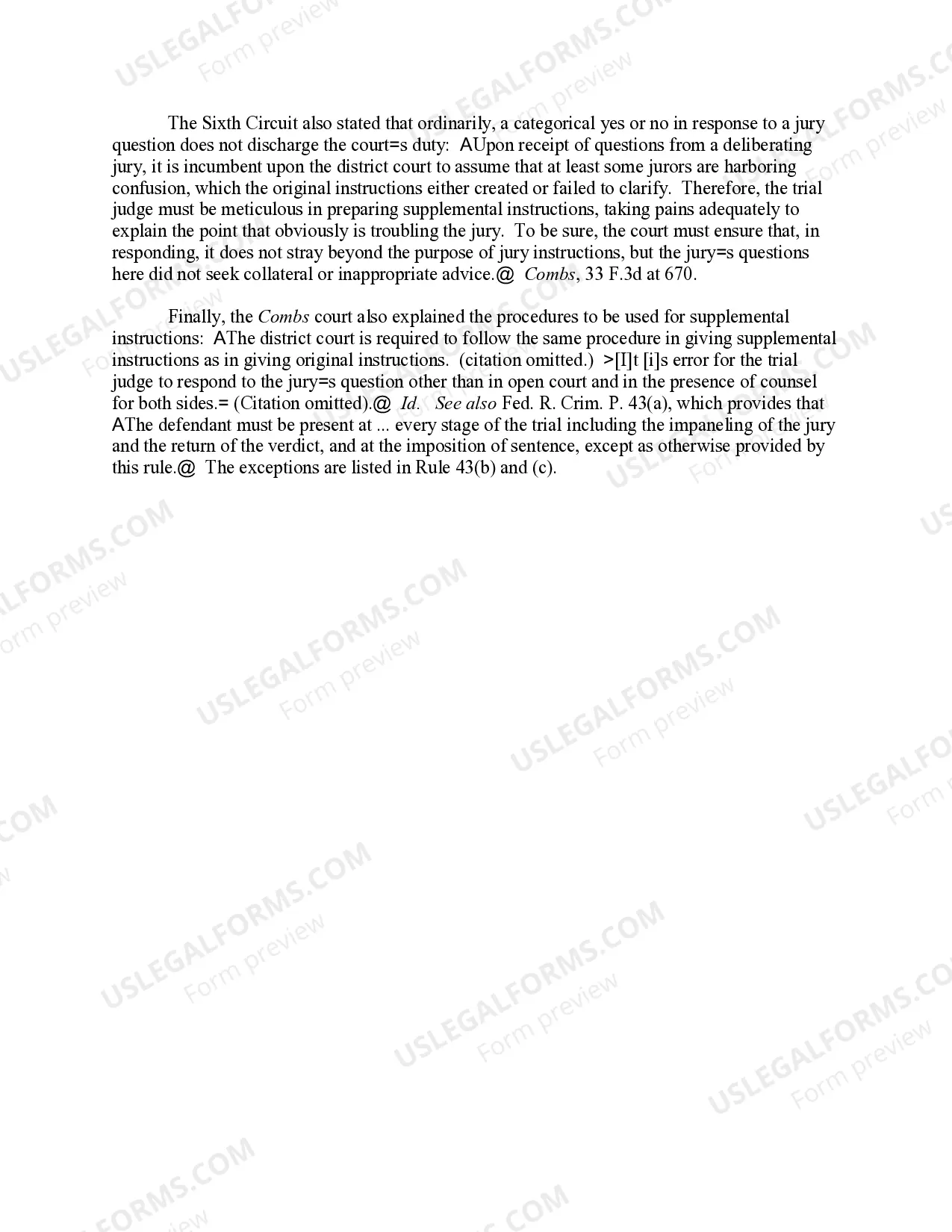
- Reading the instructions outside of open court or without counsel present.
Benefits of completing this form online
- Convenient access to properly formatted legal instructions.
- Editable templates that can be tailored to specific case needs.
- Reliable resources drafted by licensed attorneys ensuring legal accuracy.
Legal use & context
- Supplemental instructions must clarify juror inquiries without introducing new, unrelated information.
- Jurisdictions often require that responses to juror questions be made in open court.
- The judge bears the responsibility to ensure that supplemental instructions adequately address juror confusion.
Looking for another form?



Form popularity
FAQ
The goal of these instructions is to improve the quality of jury decision making by providing standardized instructions that accurately state the law in a way that is understandable to the average juror.
In its current form, Rule 30 requires that the court instruct the jury after the arguments of counsel. In some districts, usually where the state practice is otherwise, the parties prefer to stipulate to instruction before closing arguments.
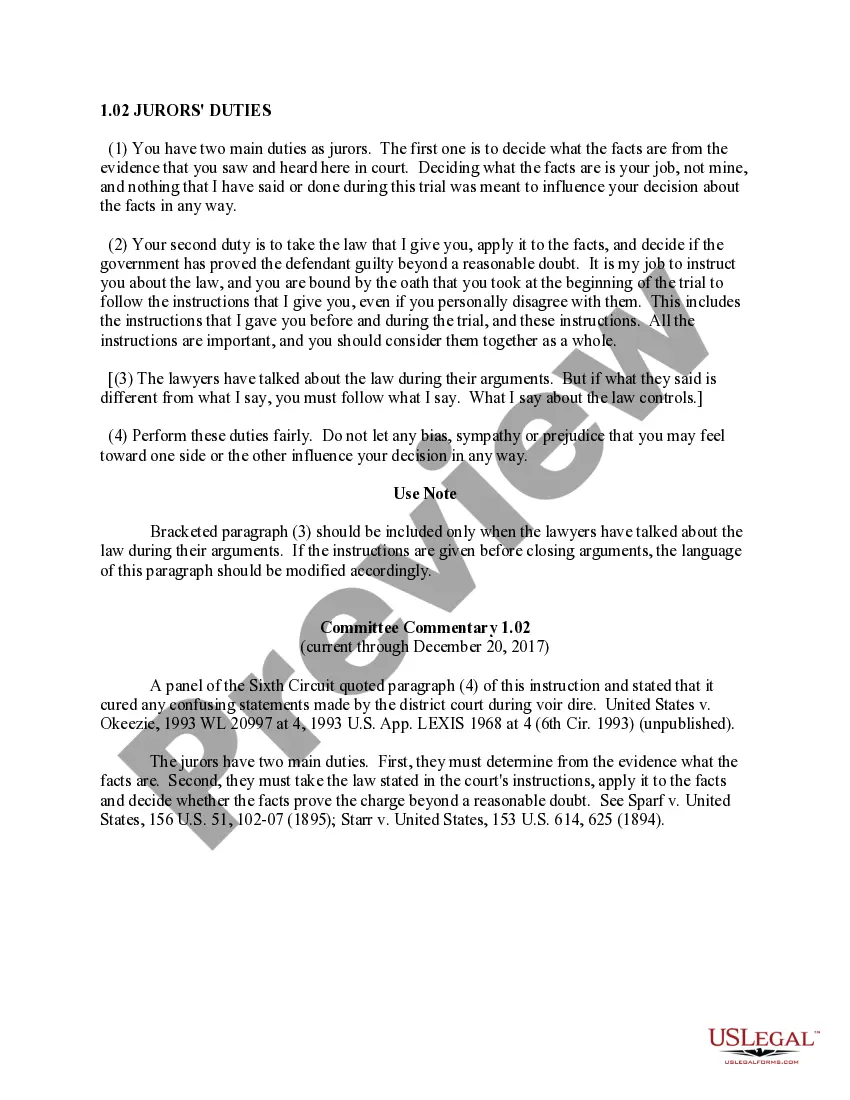
These instructions explain your duties as jurors and define the law that applies to this case. It is your duty to determine the facts, to apply the law set forth in these instructions to those facts, and in this way, to decide the case.
Jury instructions, also known as charges or directions, are a set of legal guidelines given by a judge to a jury in a court of law.
What is the juries main function in a criminal trial? Their main role is to decide wether the defendant is guilty or not guilty. They hear evidence from the prosecution first then the defendant.
The judge will instruct the jury in each separate case as to the law of that case. For example, in each criminal case, the judge will tell the jury, among other things, that a defendant charged with a crime is presumed to be innocent and the burden of proving his guilt beyond a reasonable doubt is upon the Government.
Jury instructions are directions from the judge to the jury regarding the applicable law specific to the case being tried.
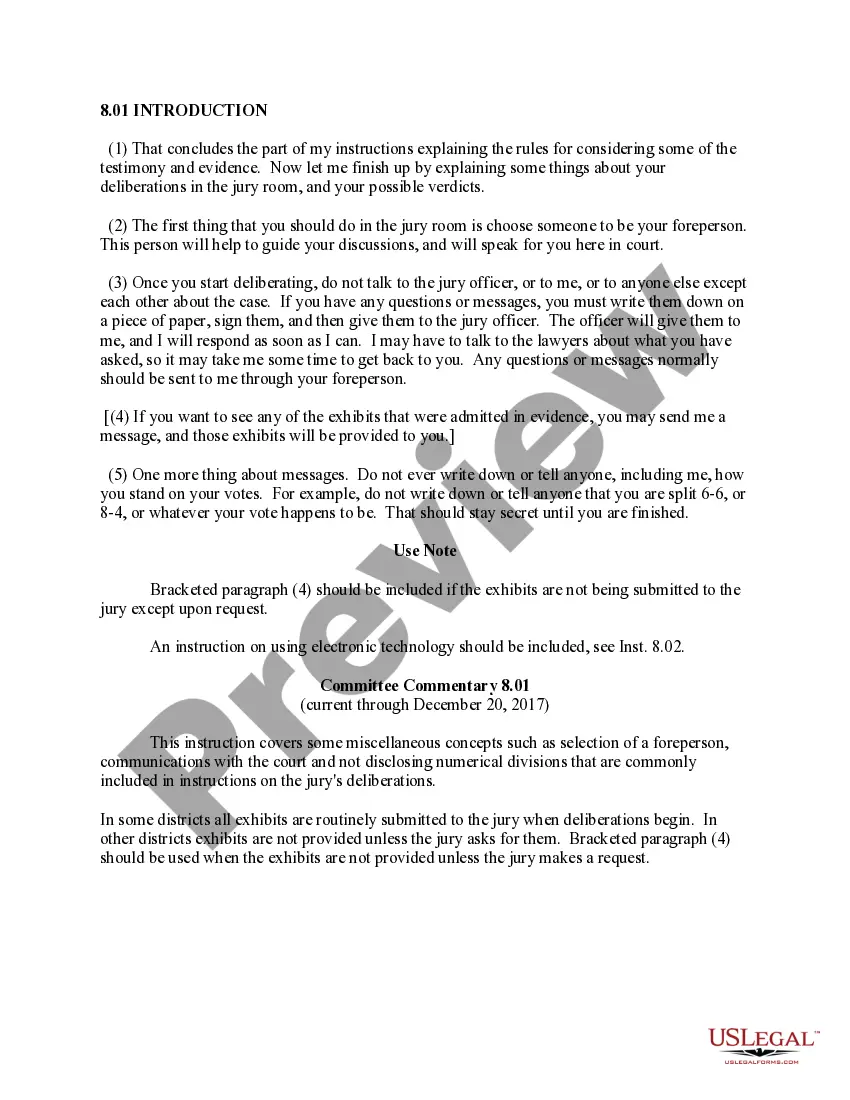
A jury instruction is given by the judge to the jury to explain what is happening in the court, to explain the points of law relevant to the case, to explain certain aspects of the evidence presented and to assist the jurors in understanding their duties in reaching a verdict.