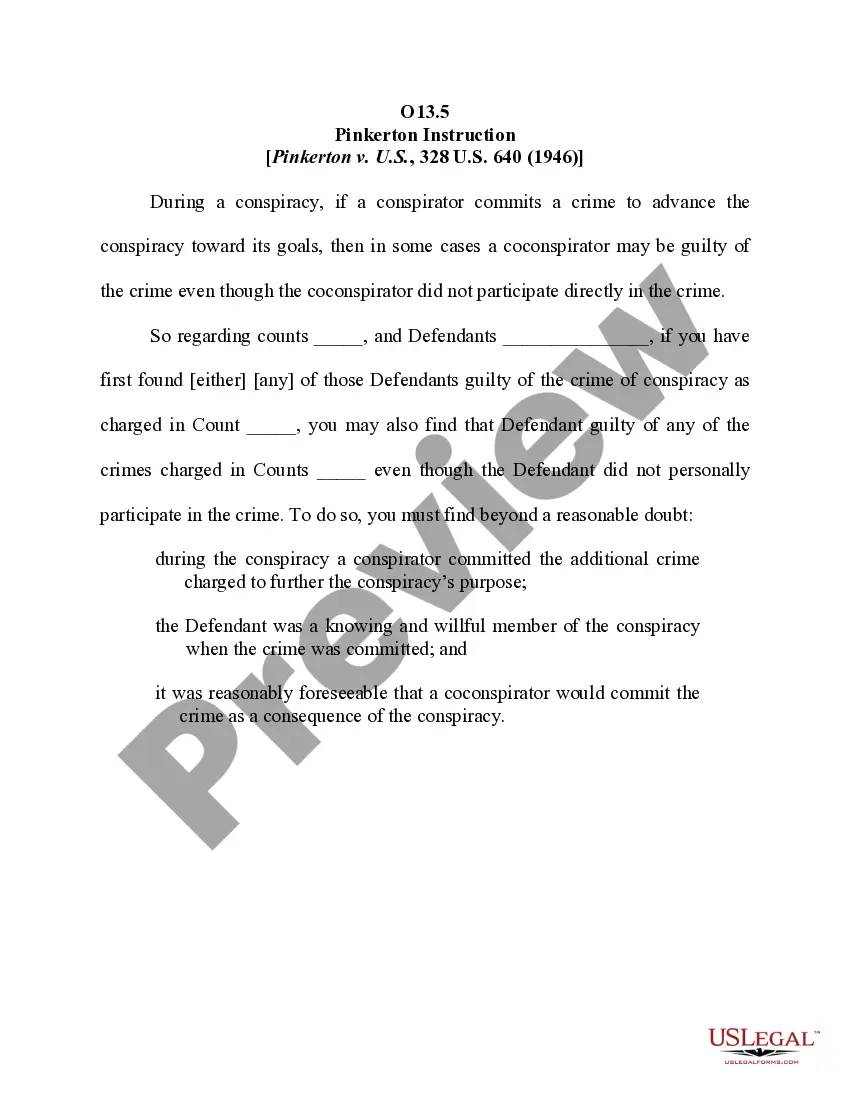
Pinkerton Instruction
Understanding this form
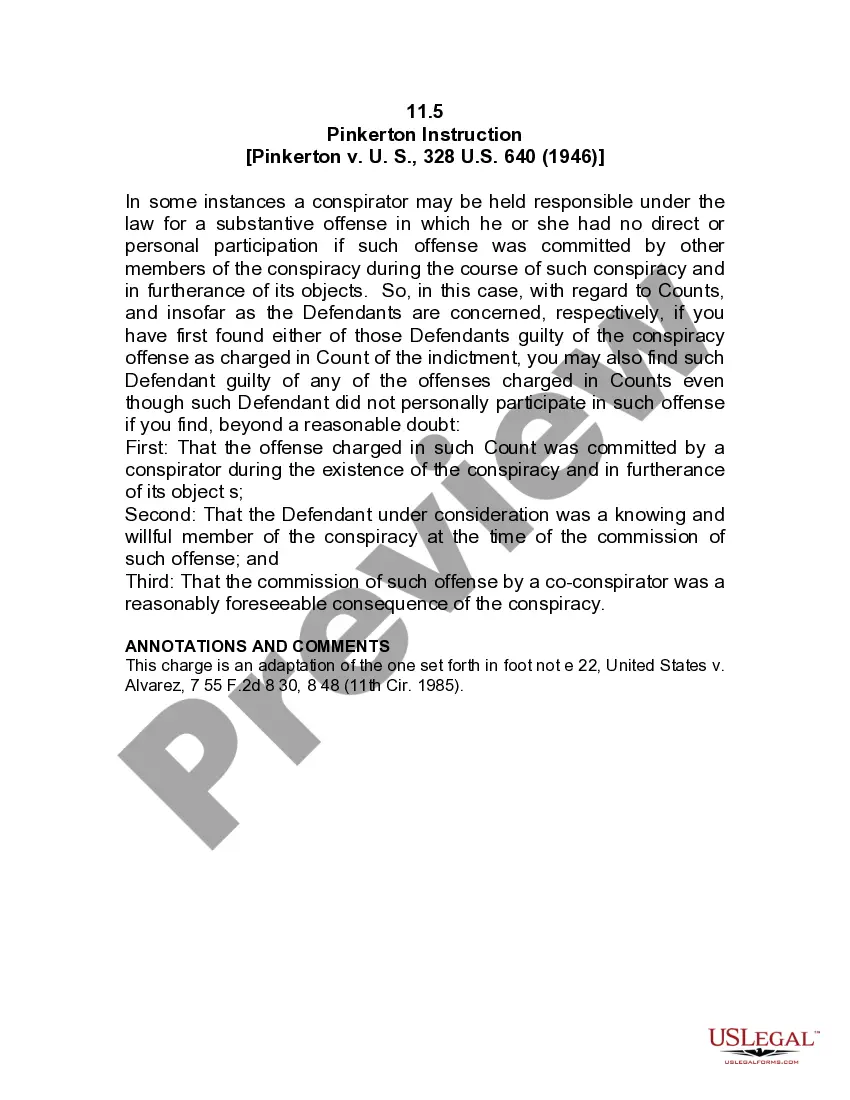
The Pinkerton Instruction is a legal guideline derived from the landmark case Pinkerton v. U.S., that clarifies the liability of coconspirators in criminal cases. It states that if one member of a conspiracy commits a crime to further the conspiracy's goals, other members may also be found guilty, even if they did not directly participate in that crime. This instruction is designed for use in federal court proceedings and differs from other legal instructions by focusing specifically on the implications of conspiracy-related misconduct.
Key components of this form
- Definition of conspiracy and coconspirator involvement in a crime.
- Criteria for establishing a coconspirator's guilt for crimes committed during the conspiracy.
- Requirement for the jury to find guilt beyond a reasonable doubt.
- Specific references to counts and defendants involved in the case.
When to use this document
This form is typically used during federal criminal trials involving conspiracy charges. It informs jurors on how to assess the involvement and liability of each defendant based on their participation in the conspiracy and related crimes, helping them draw legal conclusions about guilt and intent.
Intended users of this form
- Attorneys representing defendants in federal conspiracy cases.
- Jurors in cases where Pinkerton liability may apply.
- Legal professionals involved in the preparation or delivery of jury instructions.
How to prepare this document
- Identify the specific counts and defendants involved in the conspiracy.
- Confirm that any involved defendant has been found guilty of conspiracy.
- Determine whether the coconspirator committed a crime to advance the conspiracy.
- Establish that the defendant was a knowing and willing member of the conspiracy.
- Assess if the crime committed was reasonably foreseeable to the coconspirators.
Is notarization required?
In most cases, this form does not require notarization. However, some jurisdictions or signing circumstances might. US Legal Forms offers online notarization powered by Notarize, accessible 24/7 for a quick, remote process.
Get your form ready online
Our built-in tools help you complete, sign, share, and store your documents in one place.
Make edits, fill in missing information, and update formatting in US Legal Forms—just like you would in MS Word.
Download a copy, print it, send it by email, or mail it via USPS—whatever works best for your next step.
Sign and collect signatures with our SignNow integration. Send to multiple recipients, set reminders, and more. Go Premium to unlock E-Sign.
If this form requires notarization, complete it online through a secure video call—no need to meet a notary in person or wait for an appointment.
We protect your documents and personal data by following strict security and privacy standards.

Make edits, fill in missing information, and update formatting in US Legal Forms—just like you would in MS Word.

Download a copy, print it, send it by email, or mail it via USPS—whatever works best for your next step.

Sign and collect signatures with our SignNow integration. Send to multiple recipients, set reminders, and more. Go Premium to unlock E-Sign.

If this form requires notarization, complete it online through a secure video call—no need to meet a notary in person or wait for an appointment.

We protect your documents and personal data by following strict security and privacy standards.
Mistakes to watch out for
- Failing to properly establish the connection between the conspiracy and the additional crime.
- Neglecting to clarify juror instructions related to the definitions of conspiracy and coconspirator.
- Not ensuring the jury understands the requirement for guilt beyond a reasonable doubt.
Why complete this form online
- Immediate access to accurate legal instructions tailored by licensed attorneys.
- Convenience of downloading and using the form at any time.
- Editability allows users to customize the form for their specific case needs.
Looking for another form?
Form popularity
FAQ
A defendant can be held vicariously liable for a substantive offense committed by another member of a conspiracy if: (1) the defendant was a party to the conspiracy; (2) the offense was ?within the scope of the unlawful project?; (3) the offense was committed in furtherance of the conspiracy; and (4) the defendant
United States, 328 U.S. 640 (1946) Any crime in furtherance of a conspiracy that is reasonably foreseeable may lead to criminal liability for any member of the conspiracy.
United States, 328 U.S. 640 (1946) Any crime in furtherance of a conspiracy that is reasonably foreseeable may lead to criminal liability for any member of the conspiracy.
The Pinkerton rule determines when an individual can be convicted of a substantive crime they didn't directly commit. It upholds that all conspiracy members are liable for their co-conspirators' substantive crimes intended to further the conspiracy.
Wharton's Rule A criminal offense that requires two parties cannot be the object of a conspiracy that consists of two parties. This rule is called Wharton's rule, or the concert of action rule (USLegal, 2011).
Pinkerton is a vicarious liability rule that makes conspirators criminally responsible for the foreseeable crimes of their coconspirators committed in furtherance of the conspiracy.