APPENDIX A CIVIL RIGHTS - SPECIAL INTERROGATORIES - 42 U.S.C. Sec. 1983 CLAIMS
Overview of this form
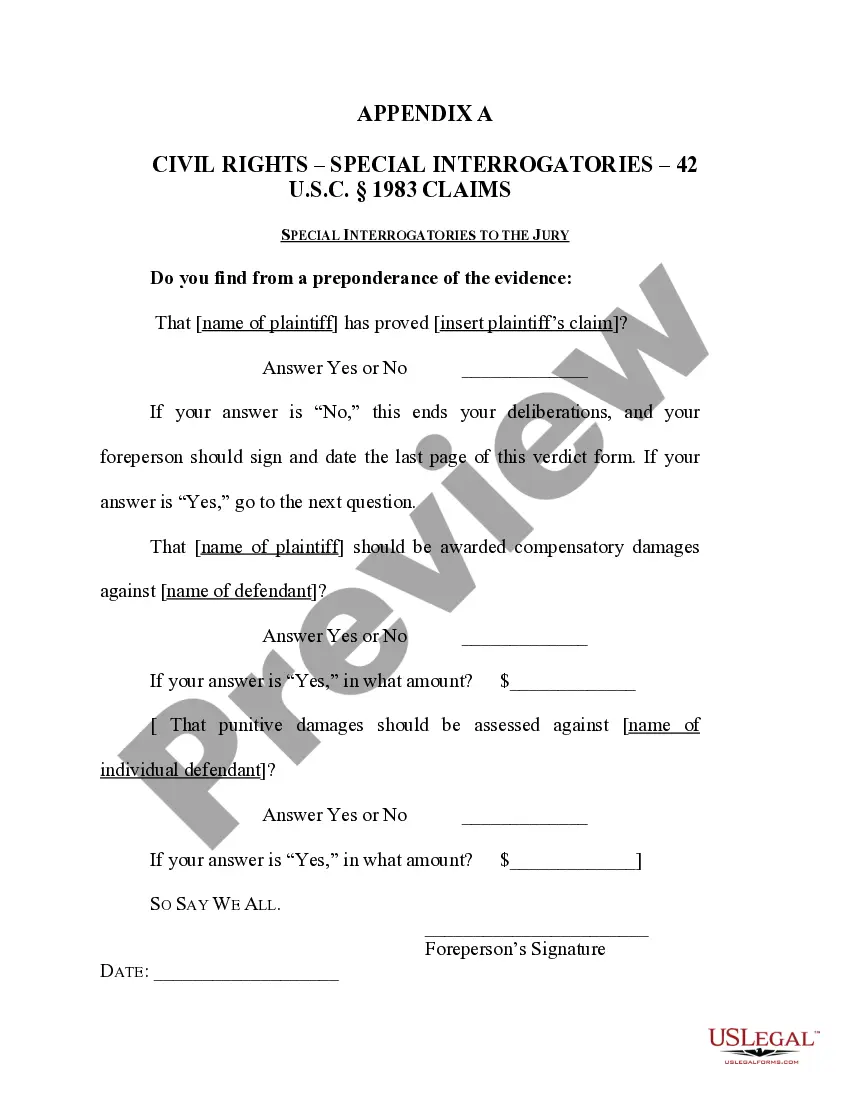
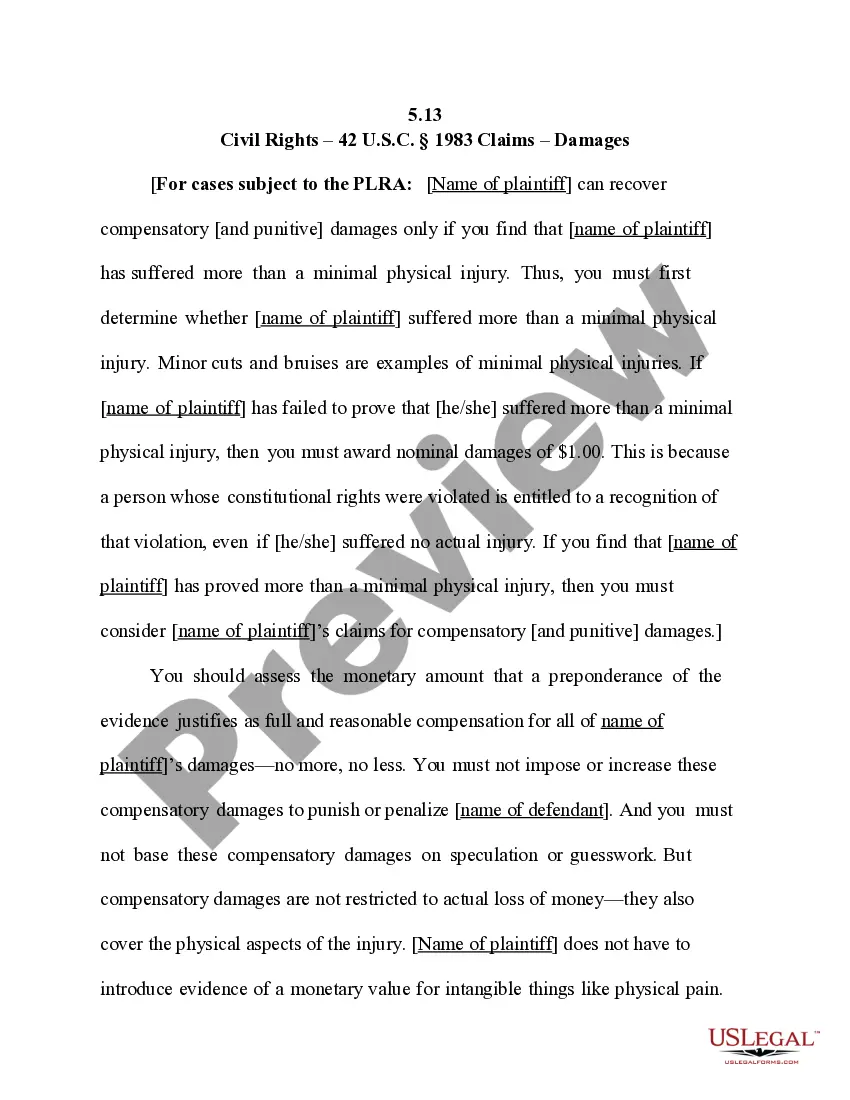
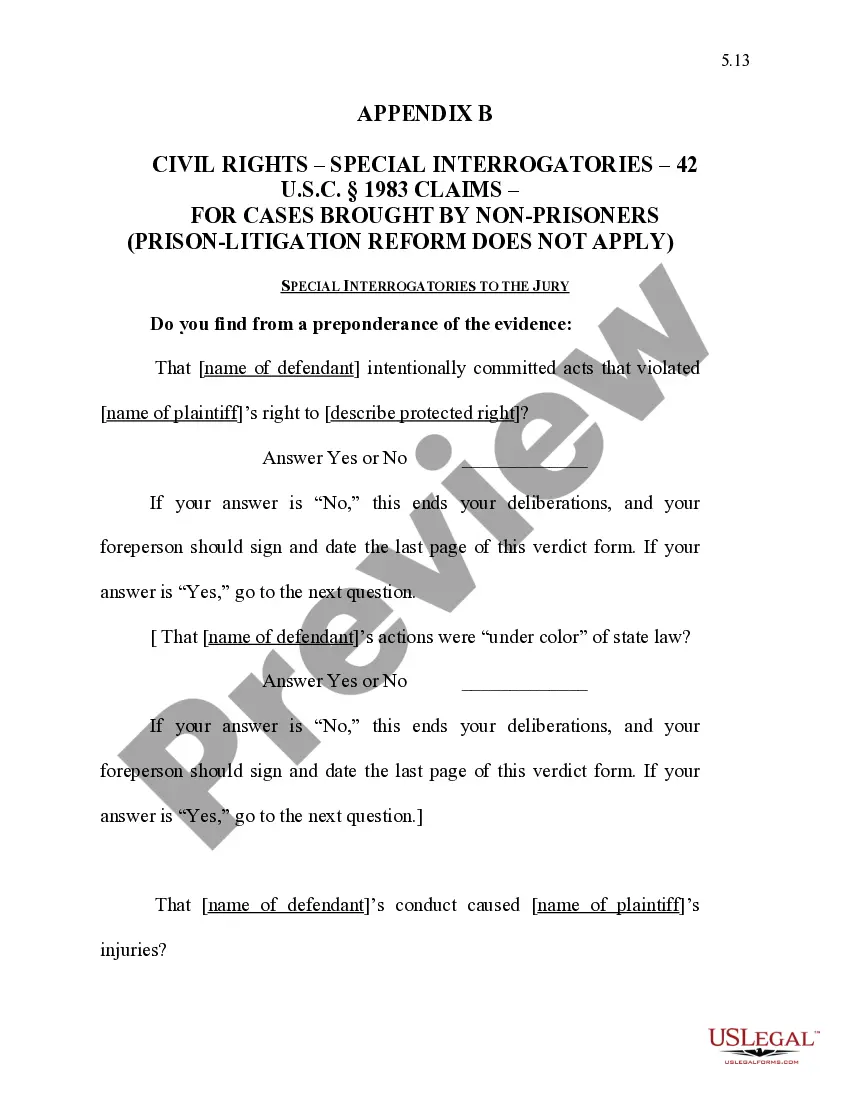
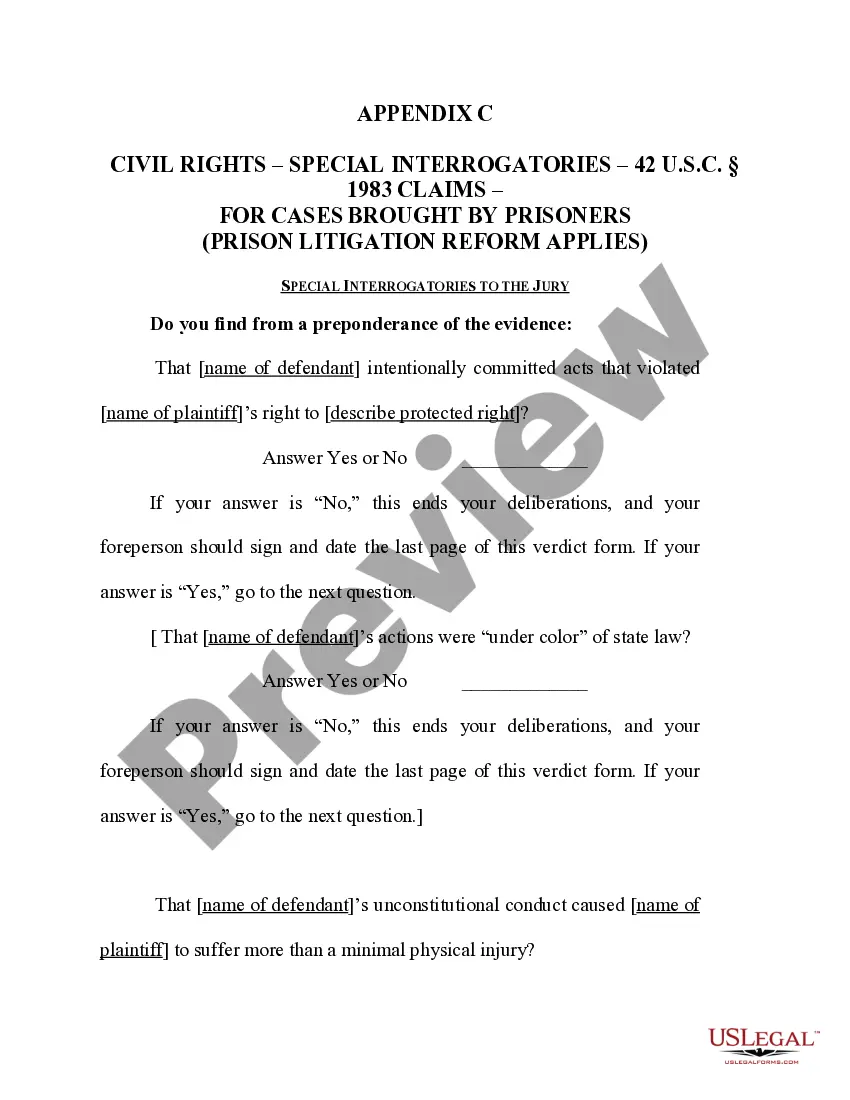
The Appendix A Civil Rights - Special Interrogatories - 42 U.S.C. Sec. 1983 Claims form is a legal document used in civil rights litigation. It helps a jury determine the outcome of a case involving claims under Section 1983, which provides a mechanism for individuals to sue for violations of their constitutional rights by government officials. This form specifically outlines the special interrogatories that the jury must consider regarding the plaintiffâs claims and potential damages, making it distinctive from general jury instructions or other legal forms.
What’s included in this form
- Interrogatory questions directed at the jury regarding the plaintiff's claims.
- Sections for answering "Yes" or "No" to determine liability.
- Fields for specifying the amount of compensatory and punitive damages, if applicable.
- A signature section for the jury foreperson to validate the verdict.
Situations where this form applies
This form is used during jury deliberations in cases alleging violations of civil rights under 42 U.S.C. § 1983. It is applicable when jurors need to assess whether the plaintiff has met the burden of proof on their claims and determine the appropriate damages if liability is established. It is essential in cases where the actions of government officials have potentially infringed on personal rights.
Who can use this document
This form is intended for:
- Jurors participating in civil rights litigation cases.
- Attorneys representing plaintiffs or defendants in such cases.
- Court officers overseeing jury instructions.
How to prepare this document
Follow these steps to complete the form:
- Review the plaintiff's claims presented in the trial.
- Determine if the evidence presented supports the claims by answering the first interrogatory.
- If the answer is "Yes," assess the appropriate amount of compensatory damages to award.
- Evaluate if punitive damages should be assessed and specify the amount if applicable.
- Have the foreperson sign and date the verdict as completion confirmation.
Does this form need to be notarized?
This form does not typically require notarization unless specified by local law. In standard civil rights cases, the integrity of the juryâs decision is upheld by the deliberation process, negating the need for notarization.
Get your form ready online
Our built-in tools help you complete, sign, share, and store your documents in one place.
Make edits, fill in missing information, and update formatting in US Legal Forms—just like you would in MS Word.
Download a copy, print it, send it by email, or mail it via USPS—whatever works best for your next step.
Sign and collect signatures with our SignNow integration. Send to multiple recipients, set reminders, and more. Go Premium to unlock E-Sign.
If this form requires notarization, complete it online through a secure video call—no need to meet a notary in person or wait for an appointment.
We protect your documents and personal data by following strict security and privacy standards.

Make edits, fill in missing information, and update formatting in US Legal Forms—just like you would in MS Word.

Download a copy, print it, send it by email, or mail it via USPS—whatever works best for your next step.

Sign and collect signatures with our SignNow integration. Send to multiple recipients, set reminders, and more. Go Premium to unlock E-Sign.

If this form requires notarization, complete it online through a secure video call—no need to meet a notary in person or wait for an appointment.

We protect your documents and personal data by following strict security and privacy standards.
Typical mistakes to avoid
- Failing to properly understand the legal definitions of compensatory and punitive damages.
- Neglecting to answer all required interrogatories before signing the form.
- Forgetting to date the form after completing it.
Why complete this form online
- Access to standardized language drafted by licensed attorneys.
- Ease of use with downloadable and fillable formats.
- Time-efficient process, allowing for quick completion and submission.
- This form is utilized in federal courts for civil rights claims under Section 1983.
- Compliance with federal judicial standards is essential for enforceability.
- Consult with legal professionals to understand limitations and legal procedures involved.
Summary of main points
- The form facilitates jury deliberation on civil rights claims.
- Key components address liability and potential damages in civil rights cases.
- Proper completion is critical to uphold the integrity of the trial process.
Looking for another form?

Form popularity
FAQ
The elements of a § 1983 claim are (1) the action occurred ?under color of state law? and (2) the action resulted in the deprivation of a constitutional right or federal statutory right.
To establish a claim pursuant to Section 1983, a plaintiff must ?demonstrate a violation of a right secured by the Constitution and the laws of the United States and that alleged deprivation was committed by a person acting under the color of state law.? Id.
What are the elements of a section 1983 claim? a person subjected the plaintiff to conduct that occurred under color of state law, and. this conduct deprived the plaintiff of rights, privileges, or immunities guaranteed under the U.S. Constitution or federal law.
Section 1983 provides an individual the right to sue state government employees and others acting "under color of state law" for civil rights violations. Section 1983 does not provide civil rights; it is a means to enforce civil rights that already exist.
Under 42 U.S.C. § 1983, you may sue state or local officials for the ?deprivation of any rights, privileges, or immunities secured by the Constitution and federal laws.? Under Bivens v.
To succeed on a Section 1983 claim, a plaintiff must prove that his constitutional rights were violated, and that the violation was caused by a person acting under color of law.
To state a section 1983 claim, a person must show: that the conduct complained of was committed by a person acting under color of state law; and. that the conduct deprived the person of a constitutional right.