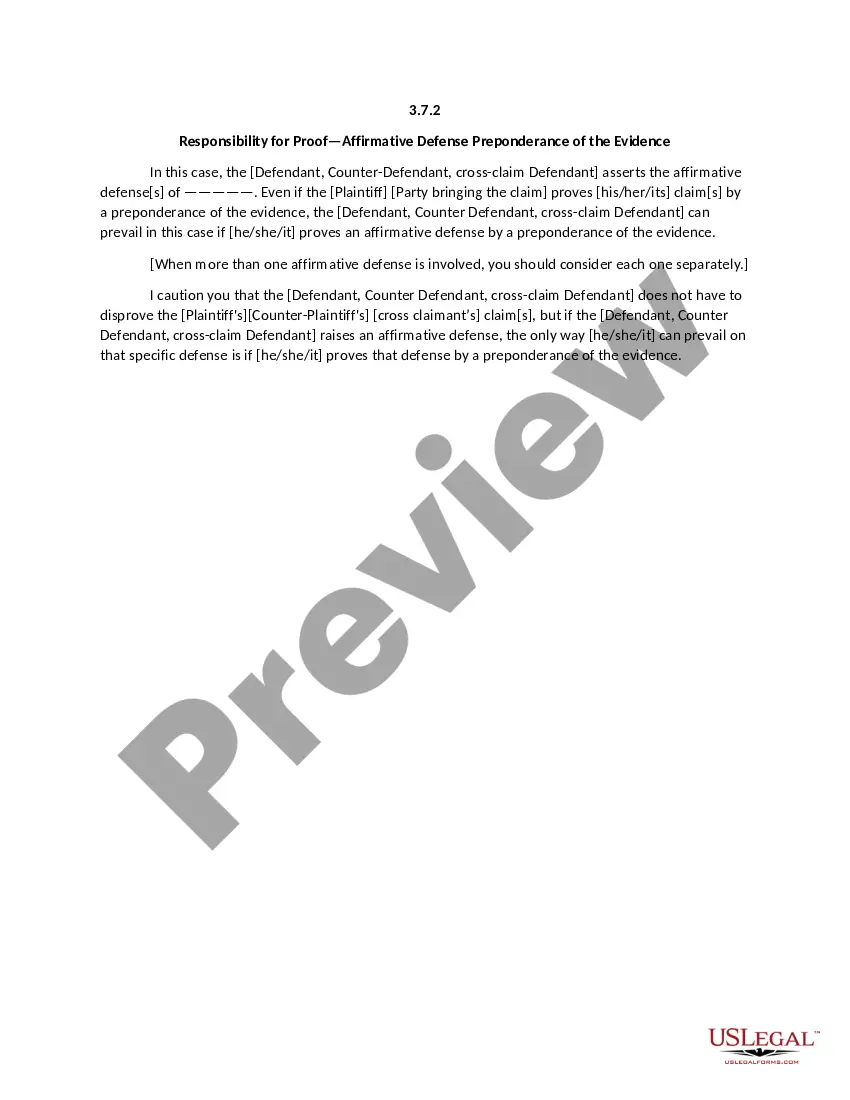
Responsibility for Proof-Affirmative Defense Preponderance of the Evidence
About this form
The Responsibility for Proof-Affirmative Defense Preponderance of the Evidence form provides guidance on affirmative defenses in legal cases. It outlines the responsibility of the Defendant, Counter-Defendant, or cross-claim Defendant to prove their affirmative defenses by a preponderance of the evidence, even if the Plaintiff has already established their claims. This form is essential for understanding the nuances of presenting affirmative defenses in court and differentiates from similar jury instruction forms by focusing explicitly on the burden of proof in affirmative defenses.
Key parts of this document
- Definition of affirmative defenses and their legal implications.
- Clarification that the Defendant does not need to disprove the Plaintiff's claims but must prove any affirmative defenses raised.
- Instructions for considering multiple affirmative defenses separately.
- Requirement for the Defendant to prove their defense by a preponderance of the evidence.



When to use this document
This form should be used in legal proceedings where a Defendant asserts affirmative defenses against a Plaintiff's claims. It is particularly relevant in civil litigation cases, such as personal injury, contract disputes, or other situations where a claim is being contested, and the legal standard requires the Defendant to demonstrate the validity of their defenses to prevail in the case.
Who this form is for
- Defendants in civil lawsuits who wish to assert affirmative defenses.
- Legal representatives or attorneys preparing for trial in cases with an affirmative defense strategy.
- Individuals involved in litigation who need clarity on the requirements for proving defenses against claims.
How to prepare this document
- Identify the parties involved in the case, specifically naming the Defendant, Plaintiff, and any Counter-Defendants.
- Clearly outline the affirmative defenses that the Defendant plans to assert.
- Ensure that each affirmative defense is detailed to allow consideration of individual elements.
- Provide factual evidence to support each affirmative defense to satisfy the preponderance of the evidence standard.
- Review all sections for accuracy and completeness before submission.
Does this form need to be notarized?
This form usually doesn’t need to be notarized. However, local laws or specific transactions may require it. Our online notarization service, powered by Notarize, lets you complete it remotely through a secure video session, available 24/7.
Get your form ready online
Our built-in tools help you complete, sign, share, and store your documents in one place.
Make edits, fill in missing information, and update formatting in US Legal Forms—just like you would in MS Word.
Download a copy, print it, send it by email, or mail it via USPS—whatever works best for your next step.
Sign and collect signatures with our SignNow integration. Send to multiple recipients, set reminders, and more. Go Premium to unlock E-Sign.
If this form requires notarization, complete it online through a secure video call—no need to meet a notary in person or wait for an appointment.
We protect your documents and personal data by following strict security and privacy standards.

Make edits, fill in missing information, and update formatting in US Legal Forms—just like you would in MS Word.

Download a copy, print it, send it by email, or mail it via USPS—whatever works best for your next step.

Sign and collect signatures with our SignNow integration. Send to multiple recipients, set reminders, and more. Go Premium to unlock E-Sign.

If this form requires notarization, complete it online through a secure video call—no need to meet a notary in person or wait for an appointment.

We protect your documents and personal data by following strict security and privacy standards.
Mistakes to watch out for
- Failing to clearly state each affirmative defense, which can lead to confusion in court.
- Not providing sufficient evidence to support the claims made in the affirmative defenses.
- Overlooking the need to analyze each affirmative defense separately, which can weaken the overall argument.
Legal use & context
- This form is used to establish the Defendant's burden in proving their affirmative defenses during trial.
- It is vital to understand that prevailing on an affirmative defense does not negate the Plaintiff's claim but allows the Defendant to potentially win the case based on their defenses.
- Each jurisdiction may have specific interpretations of what constitutes a preponderance of evidence, so understanding local court standards is crucial.
Key takeaways
- The form serves as a guide for Defendants to understand their obligations when asserting affirmative defenses.
- Proof must be established by a preponderance of the evidence for the Defendant to win on any affirmative defense.
- Correctly utilizing this form can significantly affect the outcome of a legal dispute by clarifying the legal responsibilities of the Defendant.
Looking for another form?
Form popularity
FAQ
The party raising the affirmative defense has the burden of proof on establishing that it applies. Raising an affirmative defense does not prevent a party from also raising other defenses.
In criminal defense cases, the burden of proof usually lies with the prosecution. This means that it is up to them to prove that the defendant committed the crime they're being accused of. The jury must be convinced by this evidence before they can make a guilty verdict or find someone innocent in court.
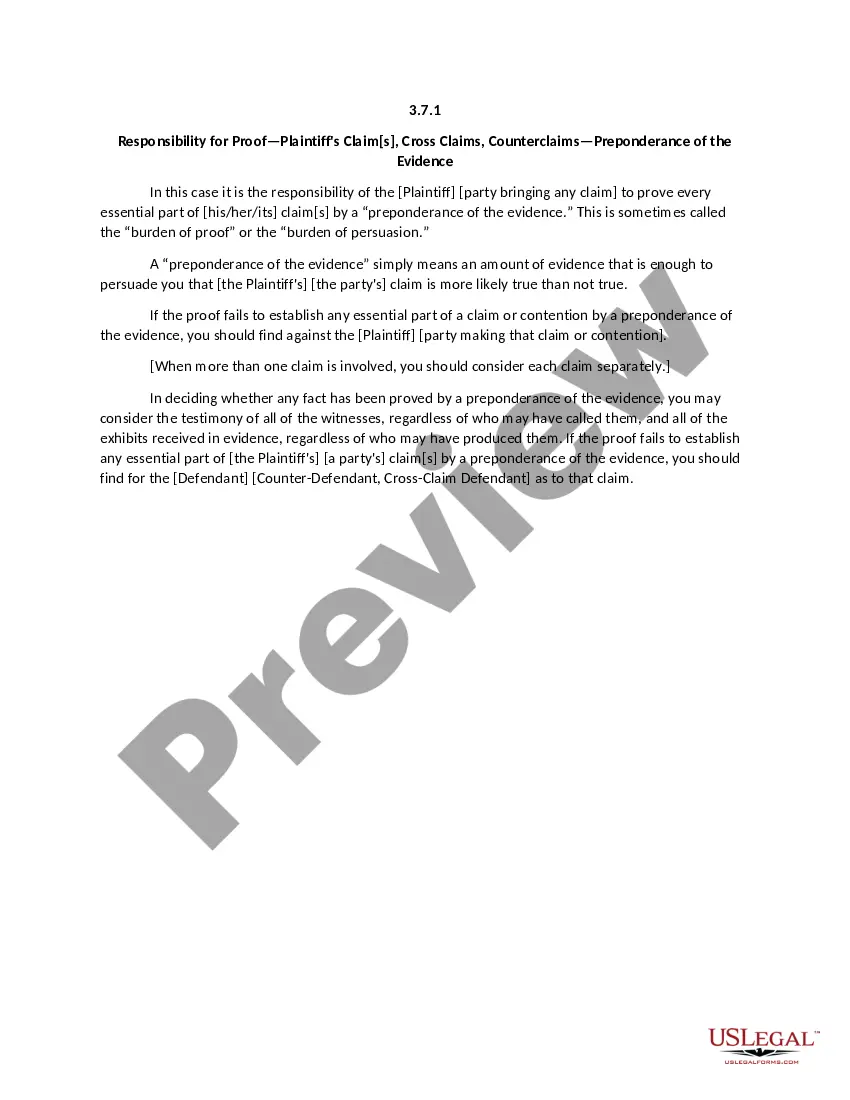
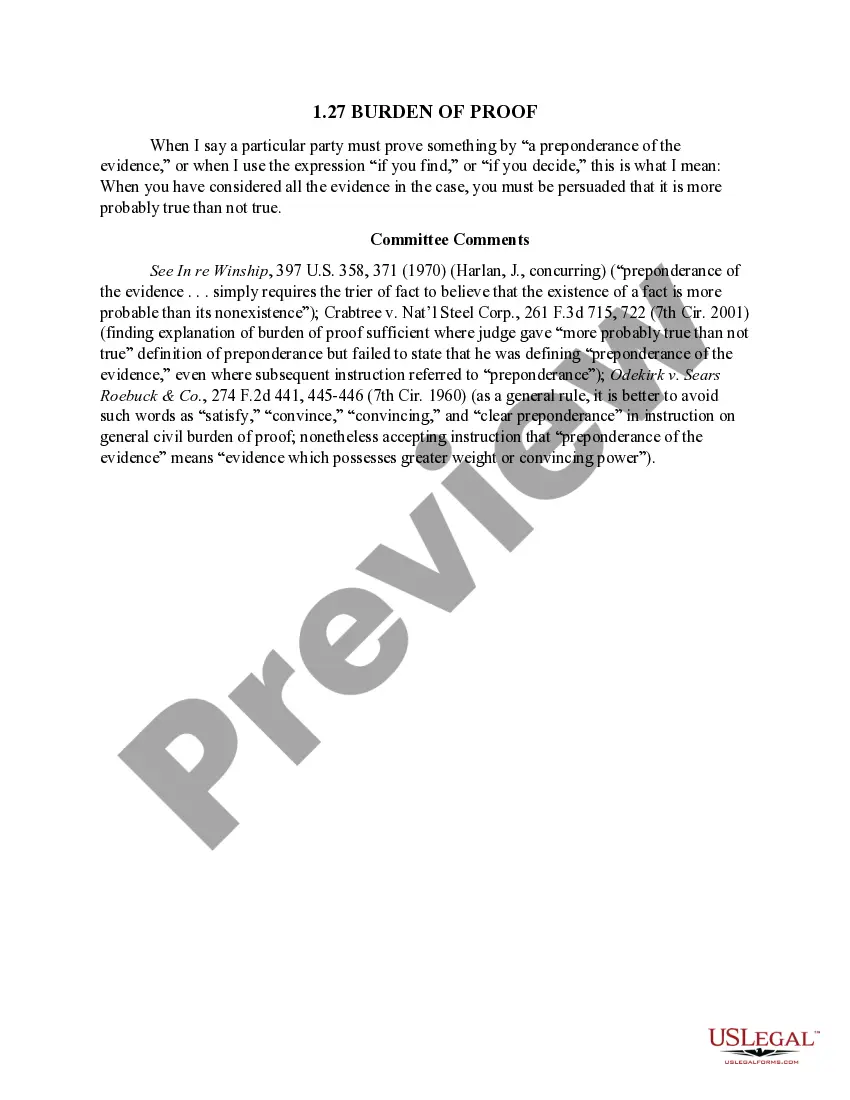
When a party has the burden of proving any claim or affirmative defense by a preponderance of the evidence, it means you must be persuaded by the evidence that the claim or affirmative defense is more probably true than not true.
The burden of proof (?onus probandi? in Latin) is the obligation to provide sufficient supporting evidence for claims that you make. For example, if someone claims that ghosts exist, then the burden of proof means that they need to provide evidence that supports this.
Almost always, the burden of proof rests on the prosecution, and the defendant need not prove innocence. Still, there are situations where a defendant may wish to prove their innocence, such as during claims of self-defense and insanity.
The three burdens of proof for criminal cases are "beyond a reasonable doubt," "probable cause," and "reasonable suspicion."
The burden of proof determines which party is responsible for putting forth evidence and the level of evidence they must provide in order to prevail. In most cases, the plaintiff (the party bringing the claim) has the burden of proof. As an initial matter, they must meet the burden of production.
When arguing an affirmative defense, a defendant must meet the ?preponderance of the evidence? burden of proof ? a much lower standard. Subsequently, the burden of proof shifts back to the prosecution who must disprove the affirmative defense raised beyond a reasonable doubt.