Responsibility for Proof-Plaintiff's Claim[s], Cross Claims, Counterclaims-Preponderance of the Evidence
Understanding this form
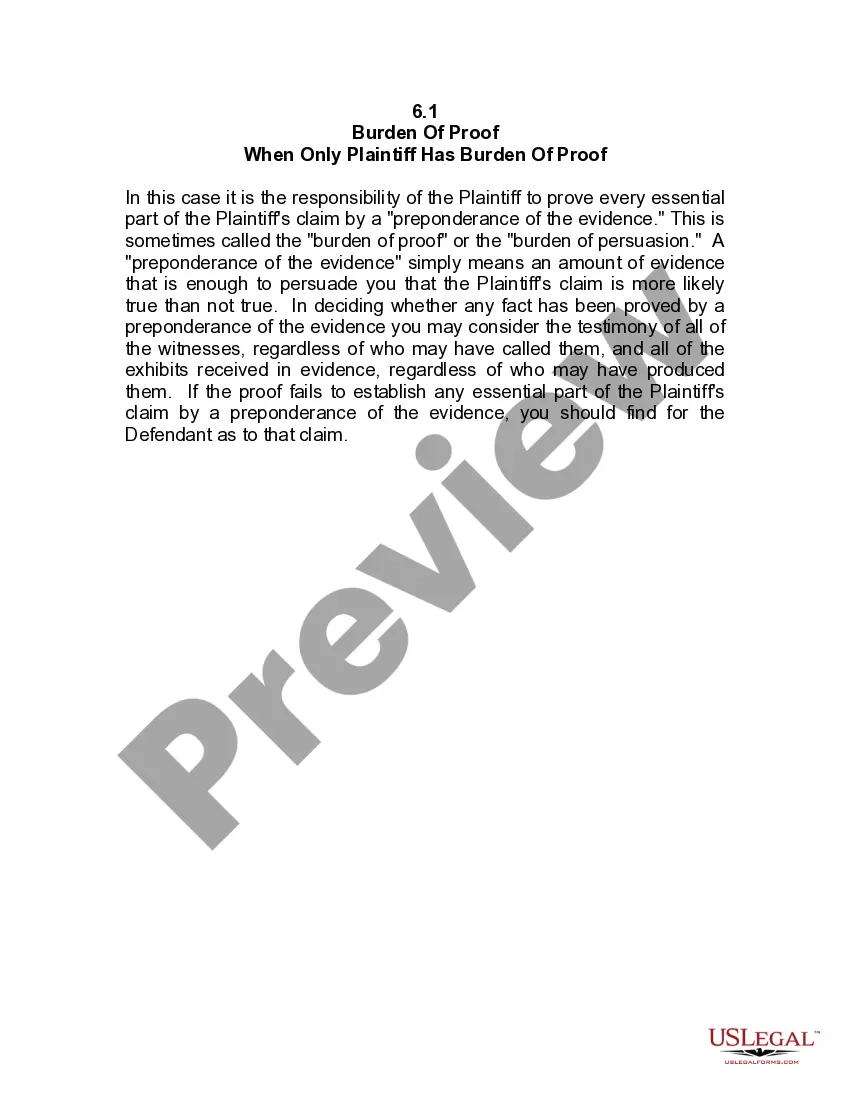
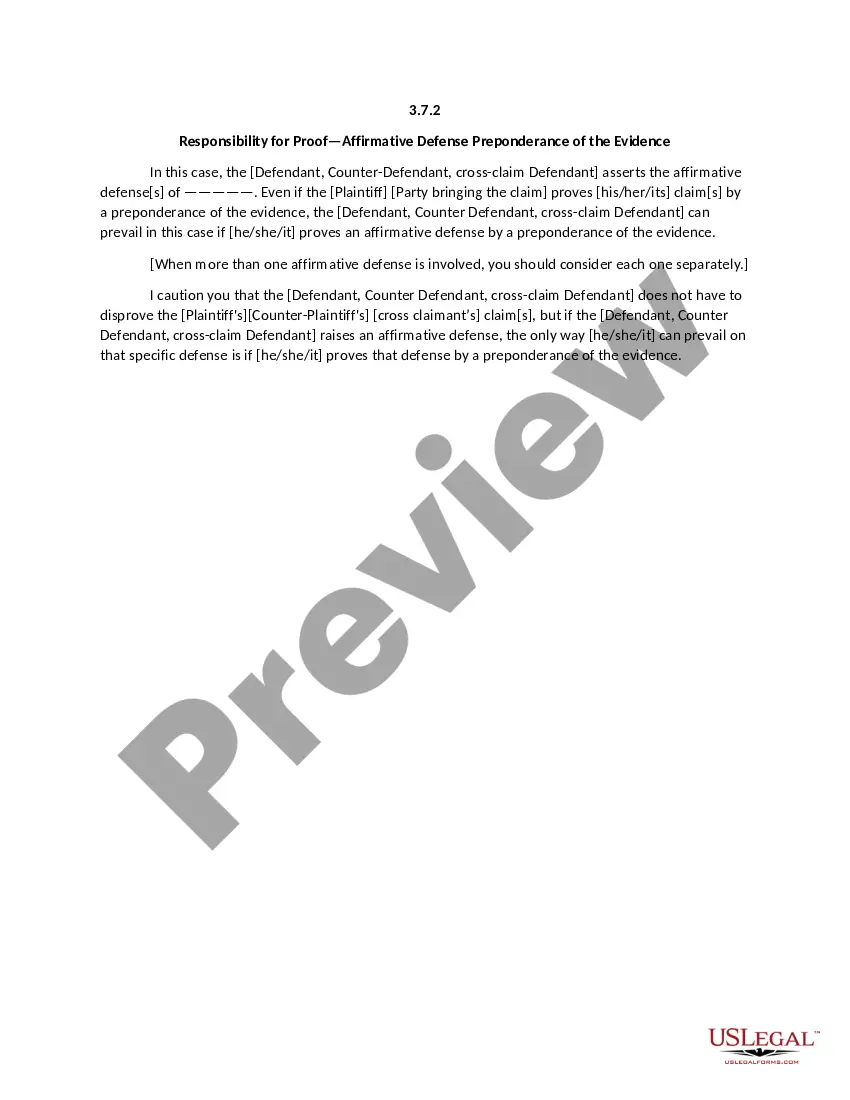
The Responsibility for Proof-Plaintiff's Claim[s], Cross Claims, Counterclaims-Preponderance of the Evidence form is a legal instruction used in civil court cases. This pattern jury instruction from the 11th Circuit Federal Court of Appeals clarifies the burden of proof that rests on the plaintiff. It distinguishes the necessity of demonstrating each element of a claim to a certain level of certaintyâknown as the preponderance of the evidenceâsetting it apart from forms related to criminal cases or other civil proceedings with different standards of proof.
Form components explained
- Understanding of burden of proof as applied to the plaintiff's claims
- Clarification that the plaintiff must prove claims by a preponderance of the evidence
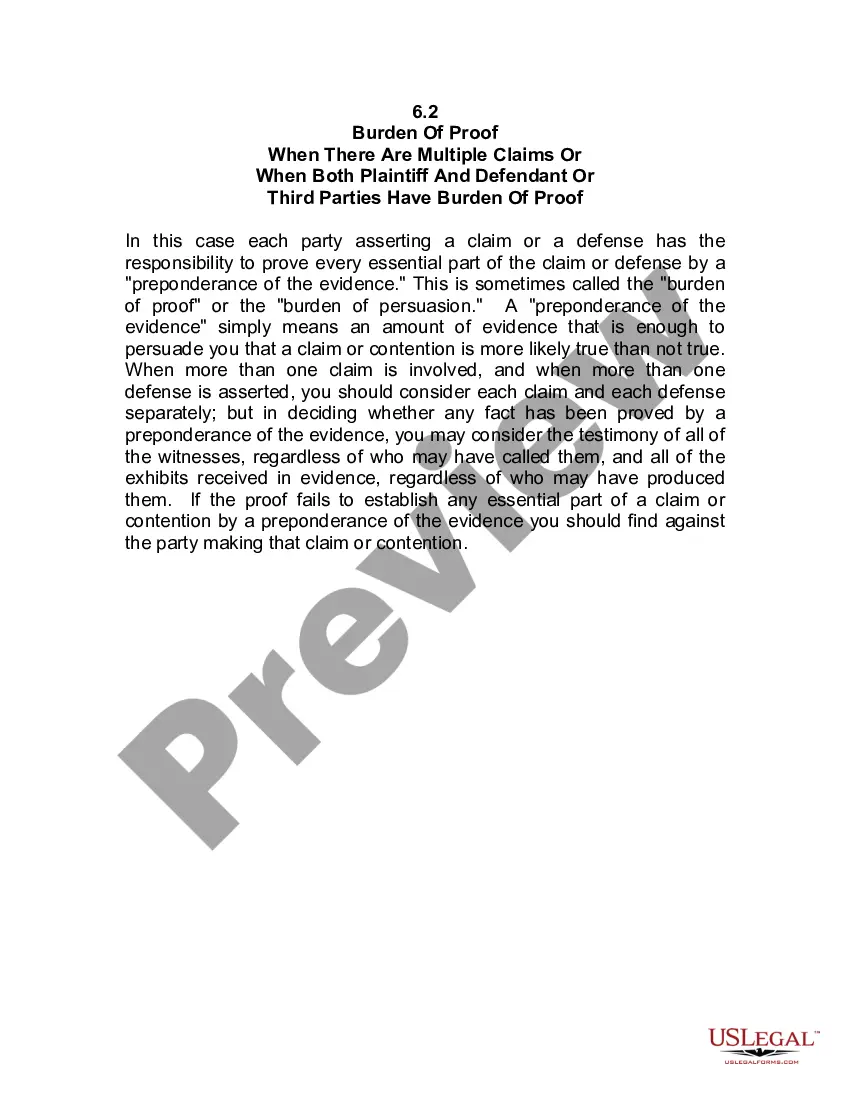
- Instruction on evaluating separate claims individually
- Guidance on considering all evidence and witness testimonies
When to use this form
This form is used during civil litigation when a plaintiff is making multiple claims against a defendant. It is essential in cases where the court must determine whether the evidence presented sufficiently supports the plaintiff's claims, especially in jury trials. The instruction is applicable when clarifying to jurors the standard they must use in evaluating the evidence and making their decision.
Who should use this form
- Legal professionals involved in civil litigation
- Plaintiffs who are bringing multiple claims in court
- Defendants who need to understand the claims against them
- Jurors needing clarity on their responsibilities when evaluating claims
Steps to complete this form
- Identify the party bringing the claims being assessed.
- Review the evidence presented to determine if it meets the preponderance standard.
- Assess each claim separately, taking into account the requisite evidence for each.
- Consider all witness testimonies and exhibits when making decisions.
- Document any findings regarding the sufficiency of the evidence and reach a verdict based on these determinations.
Does this form need to be notarized?
This form does not typically require notarization unless specified by local law.
Get your form ready online
Our built-in tools help you complete, sign, share, and store your documents in one place.
Make edits, fill in missing information, and update formatting in US Legal Forms—just like you would in MS Word.
Download a copy, print it, send it by email, or mail it via USPS—whatever works best for your next step.
Sign and collect signatures with our SignNow integration. Send to multiple recipients, set reminders, and more. Go Premium to unlock E-Sign.
If this form requires notarization, complete it online through a secure video call—no need to meet a notary in person or wait for an appointment.
We protect your documents and personal data by following strict security and privacy standards.

Make edits, fill in missing information, and update formatting in US Legal Forms—just like you would in MS Word.

Download a copy, print it, send it by email, or mail it via USPS—whatever works best for your next step.

Sign and collect signatures with our SignNow integration. Send to multiple recipients, set reminders, and more. Go Premium to unlock E-Sign.

If this form requires notarization, complete it online through a secure video call—no need to meet a notary in person or wait for an appointment.

We protect your documents and personal data by following strict security and privacy standards.
Mistakes to watch out for
- Failing to understand the distinction between preponderance of the evidence and reasonable doubt.
- Ignoring the requirement to assess each claim separately.
- Overlooking the relevance of certain evidence or witness testimonies.
Benefits of using this form online
- Convenient access to up-to-date legal information at any time.
- Editable templates that can be tailored to specific case needs.
- Reliability of forms drafted by licensed attorneys to ensure compliance with legal standards.
Legal use & context
- The standard of preponderance of the evidence is critical for civil litigation, differing from criminal standards.
- Understanding this form can help jurors make informed decisions based on the evidence they study.
- This form aids in ensuring the jury's focus on relevant evidence when deliberating claims.
Summary of main points
- The plaintiff carries the burden of proof to show claims are more likely true than not.
- Each claim must be considered independently.
- All evidence and witness testimonies play a role in jury decision-making.
Looking for another form?

Form popularity
FAQ
?Preponderance of the evidence? means evidence that has more convincing force than that opposed to it. If the evidence is so evenly balanced that you are unable to say that the evidence on either side of an issue preponderates, your finding on that issue must be against the party who had the burden of proving it.
To meet this standard of proof on a preponderance of the evidence, the plaintiff must show that their allegations have more than a 50% chance of being true. You can understand this as the ?more likely than not? principle.
A counterclaim is defined as a claim for relief filed against an opposing party after the original claim is filed. Most commonly, a claim by the defendant against the plaintiff.
claim is a claim by one party against a coparty (e.g., a defendant claiming against another defendant, or a plaintiff claiming against another plaintiff, arising out of the original complaint.)
A counterclaim allows you (now called the ?counterclaimant?) to have your claim decided along with the claim the plaintiff (now called the ?counterdefendant?) brought against you.
The counterclaim is made to offset the liability against the claim of the claimant or an independent claim of a person with related interests or obligations.
Examples of counterclaims include: After a bank has sued a customer for an unpaid debt, the customer counterclaims (sues back) against the bank for fraud in procuring the debt. The court will sort out the different claims in one lawsuit (unless the claims are severed).
Counterclaim. The defendant may file a counterclaim, which asserts that the plaintiff has injured the defendant in some way, and should pay damages.
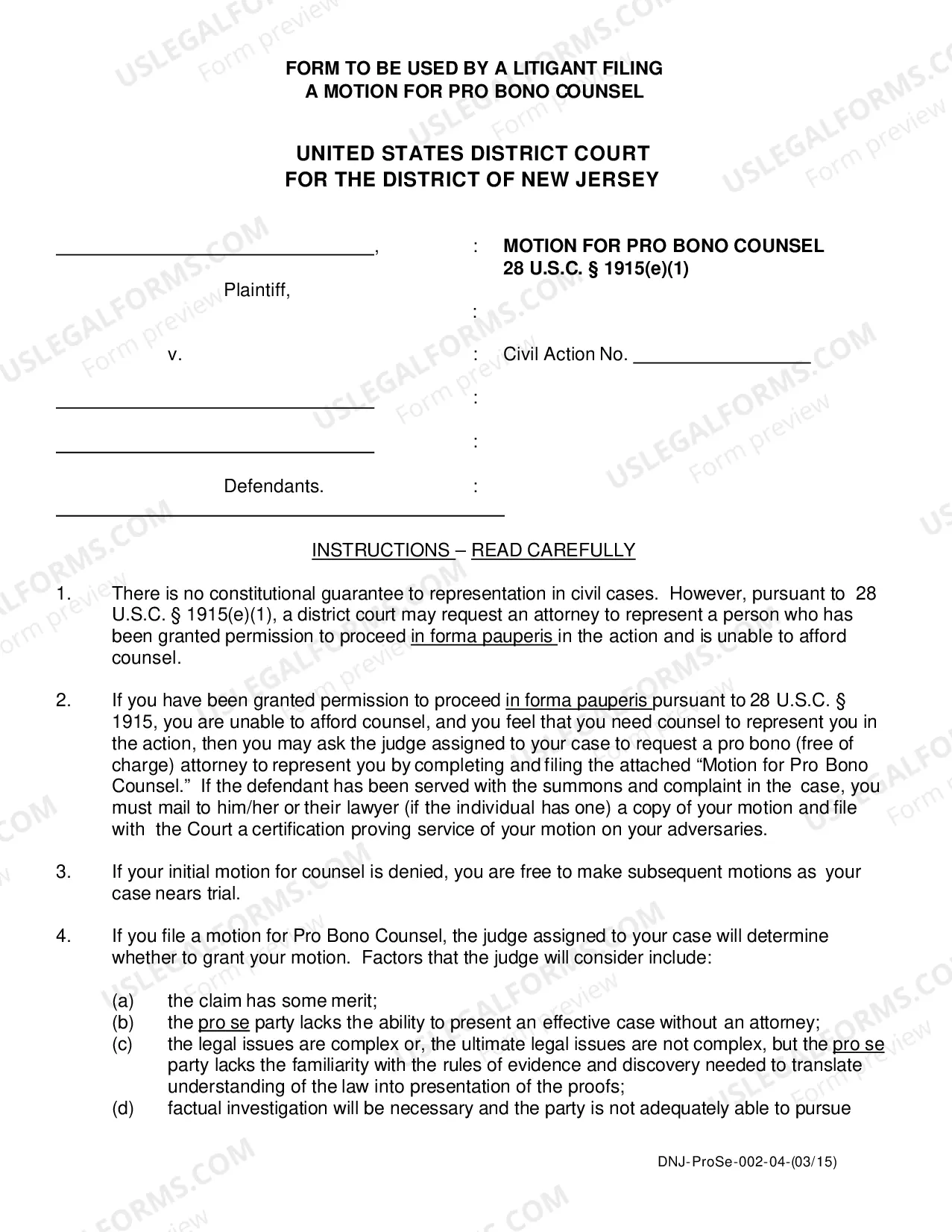
![Preview Responsibility for Proof-Plaintiff's Claim[s], Cross Claims, Counterclaims-Preponderance of the Evidence](https://cdn.uslegal.com/uslegal-preview/US/US-JURY-11THCIR-3-7-1/webp/1.webp "Get Responsibility for Proof-Plaintiff's Claim[s], Cross Claims, Counterclaims-Preponderance of the Evidence")