Records Retention Policy
Understanding this form
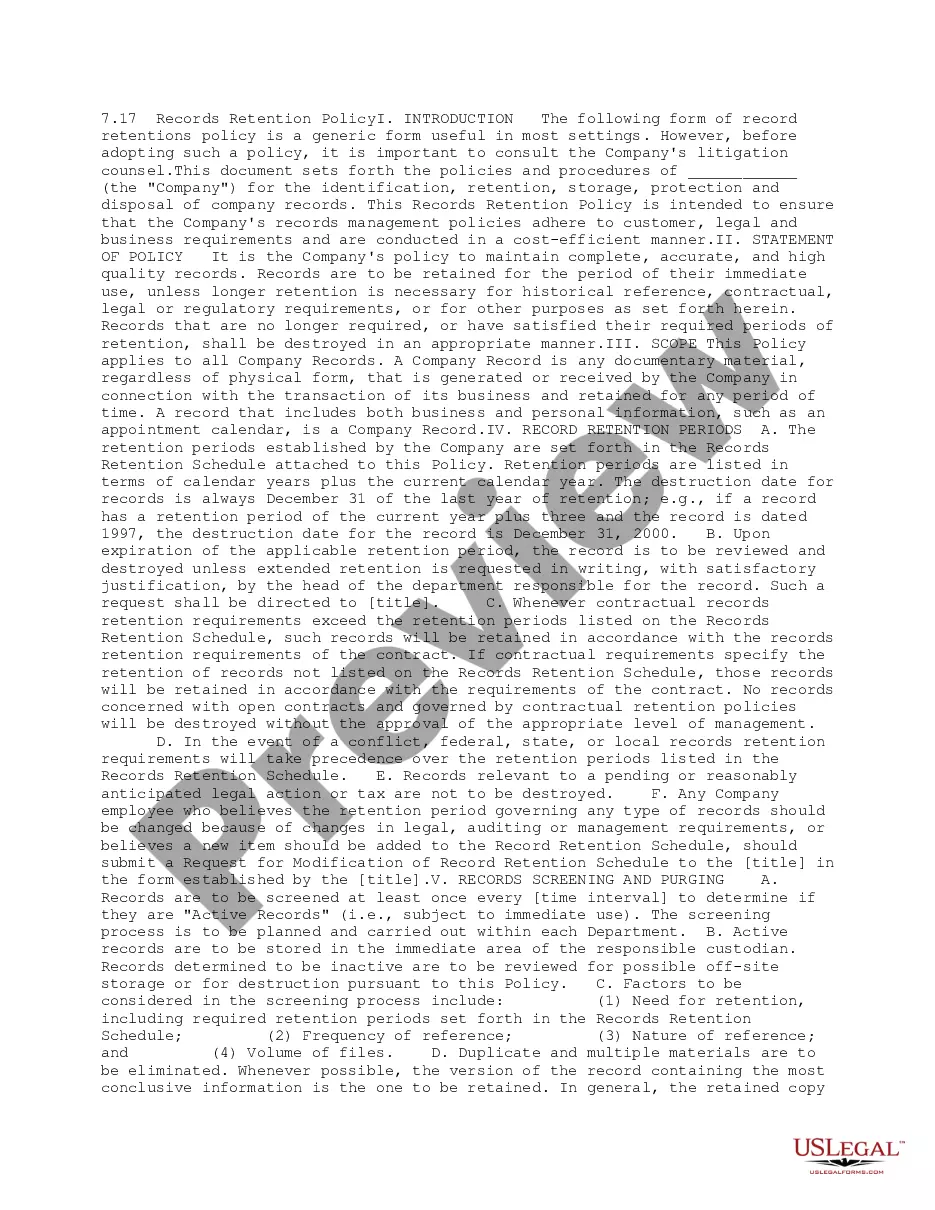
The Records Retention Policy is a crucial document that outlines the procedures for the identification, retention, storage, protection, and disposal of company records. This form is essential for ensuring compliance with legal and business requirements, differentiating it from similar forms by providing a comprehensive structure that helps organizations manage their records effectively and cost-efficiently.
Main sections of this form
- Introduction: Overview of the policy's purpose and context within the company.
- Statement of Policy: Definitions and commitments regarding the quality and retention of records.
- Scope: Identification of what constitutes a Company Record.
- Records Retention Periods: Guidelines for how long different types of records should be kept.
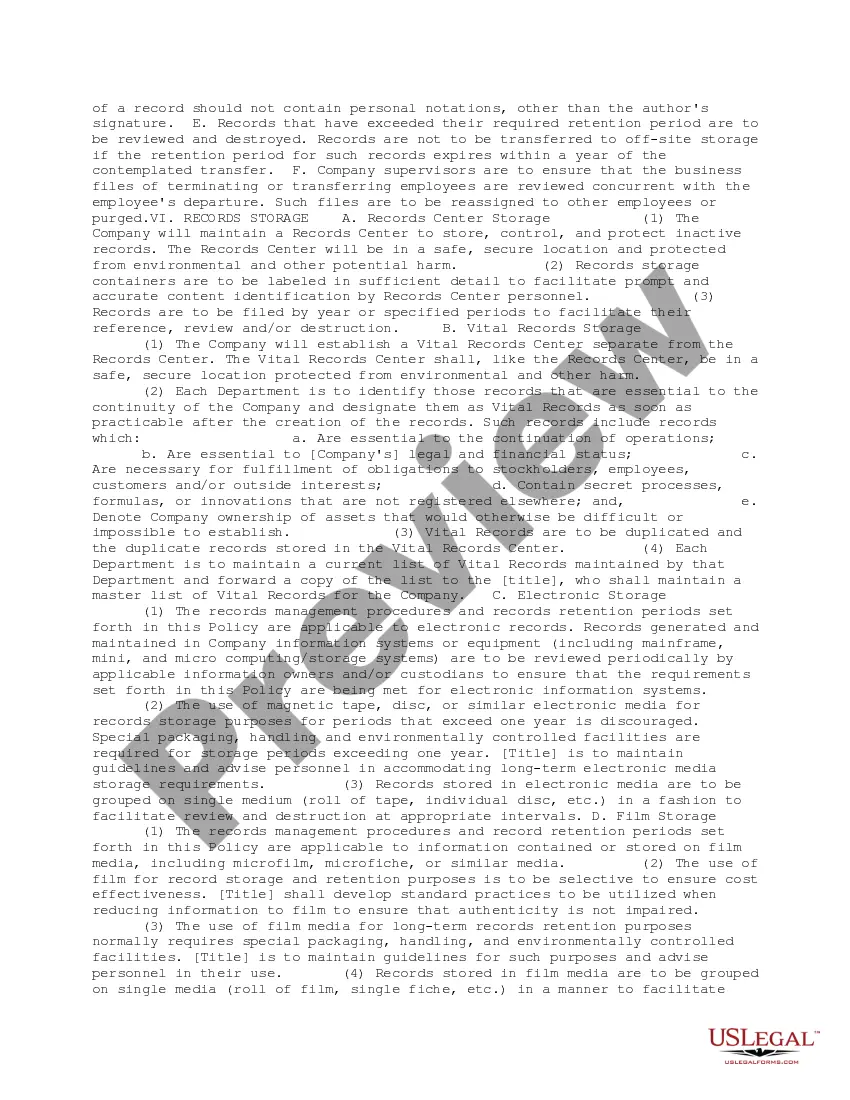
- Records Screening and Purging: Procedures for evaluating and disposing of records that are no longer needed.
- Records Storage: Best practices for storing various types of records, including electronic and film storage.
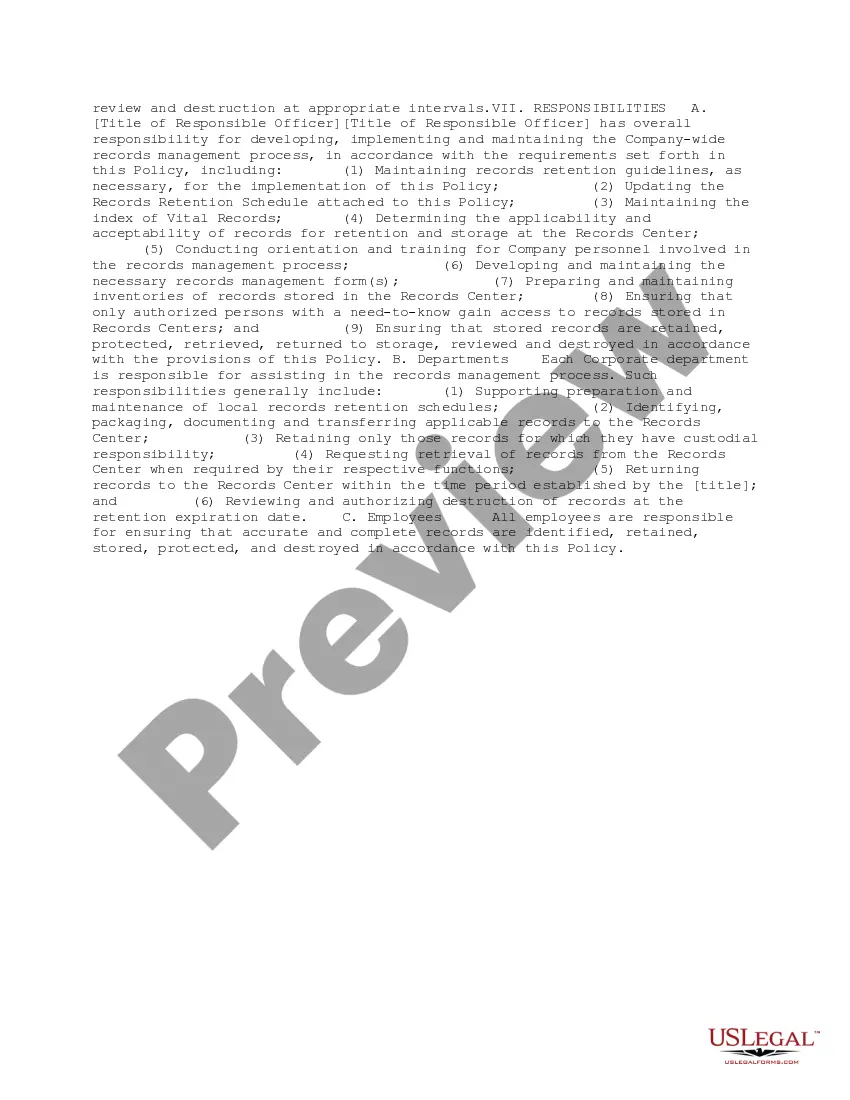
- Responsibilities: Assignment of roles for managing adherence to the Records Retention Policy.
When to use this form
This form should be used when an organization needs to establish a systematic approach to managing company records. It is applicable when there is a need to comply with legal, regulatory, or contractual retention requirements and helps to ensure efficient operations by managing records in a cost-effective manner.
Who can use this document
- Organizations of all sizes that require structured record-keeping processes.
- Businesses seeking to enhance compliance with record retention laws and regulations.
- Department heads responsible for managing departmental records and maintaining adherence to the policy.
- Employees involved in the preservation, storage, or destruction of company records.
How to prepare this document
- Identify the company name and insert it where indicated.
- Define the types of records that will fall under this policy.
- Establish and document the retention periods for each record type.
- Assign responsibilities for maintaining and updating the records management process.
- Ensure distribution of the policy to all employees involved in record management and retention.
Does this form need to be notarized?
Notarization is not commonly needed for this form. However, certain documents or local rules may make it necessary. Our notarization service, powered by Notarize, allows you to finalize it securely online anytime, day or night.
Get your form ready online
Our built-in tools help you complete, sign, share, and store your documents in one place.
Make edits, fill in missing information, and update formatting in US Legal Forms—just like you would in MS Word.
Download a copy, print it, send it by email, or mail it via USPS—whatever works best for your next step.
Sign and collect signatures with our SignNow integration. Send to multiple recipients, set reminders, and more. Go Premium to unlock E-Sign.
If this form requires notarization, complete it online through a secure video call—no need to meet a notary in person or wait for an appointment.
We protect your documents and personal data by following strict security and privacy standards.

Make edits, fill in missing information, and update formatting in US Legal Forms—just like you would in MS Word.

Download a copy, print it, send it by email, or mail it via USPS—whatever works best for your next step.

Sign and collect signatures with our SignNow integration. Send to multiple recipients, set reminders, and more. Go Premium to unlock E-Sign.

If this form requires notarization, complete it online through a secure video call—no need to meet a notary in person or wait for an appointment.

We protect your documents and personal data by following strict security and privacy standards.
Typical mistakes to avoid
- Failing to review and update the retention policy regularly to reflect changes in laws.
- Not training employees on the importance of compliance with the policy.
- Neglecting to properly classify records, leading to improper retention or destruction.
Advantages of online completion
- Convenience of downloading and customizing the template to suit your specific business needs.
- Editability allows for easy updates to reflect changes in laws or company practices.
- Reliable access to a professionally drafted form, ensuring compliance with best practices in records management.
Legal use & context
- Establishes a legal framework for record retention and destruction in compliance with applicable laws.
- Helps protect the organization during audits or legal proceedings by demonstrating a systematic approach to record management.
- Facilitates the defense against claims related to improper record handling by adhering to established retention schedules.
Summary of main points
- The Records Retention Policy is essential for effective records management in any organization.
- Properly defining retention schedules is crucial for compliance with legal and business standards.
- Regular training and updates to the policy ensure long-term adherence and effectiveness.
Looking for another form?
Form popularity
FAQ
Perform a record inventory of all physical and electronic records. Establish a standardized record classification system. Conduct research on all federal, state, and local requirements.
Good examples. Length of time in a data retention policy ranges from minutes to years. As a result, it's important to use a policy engine that involves many different fields, such as user, department, folder and file type. A data retention policy should include email messages.
Build a team. Sort data into categories. Determine which regulations, policies, and laws need to apply to each data item. Compose the policy. Set time limits. Communicate the policy. Revisit the policy.
Data retention, also called records retention, is the continued storage of an organization's data for compliance or business reasons.Minimum records retention requirements regulations vary by state and by data type, but typically they range from three years to permanent.
A data retention policy is a set of guidelines that helps organisations keep track of how long information must be kept and how to dispose of the information when it's no longer needed. The policy should also outline the purpose for processing the personal data.
Keep records for 3 years from the date you filed your original return or 2 years from the date you paid the tax, whichever is later, if you file a claim for credit or refund after you file your return. Keep records for 7 years if you file a claim for a loss from worthless securities or bad debt deduction.
Set up a Universal Retention Schedule. An organization should plan a universal retention schedule for all its departments. Determine Document Retention Periods. Implement a Disposition Schedule. Review and Update Periodically. Time to Rollout.
Retention periods vary with different types of information, based on content and a variety of other factors, including internal organizational need, regulatory requirements for inspection or audit, legal statutes of limitation, involvement in litigation, and taxation and financial reporting needs, as well as other
What Is a Data Retention Period? A data retention period refers to the amount of time that an organization holds onto information. Different data should have different retention periods. Best practice dictates that data should only be kept only as long as it's useful.