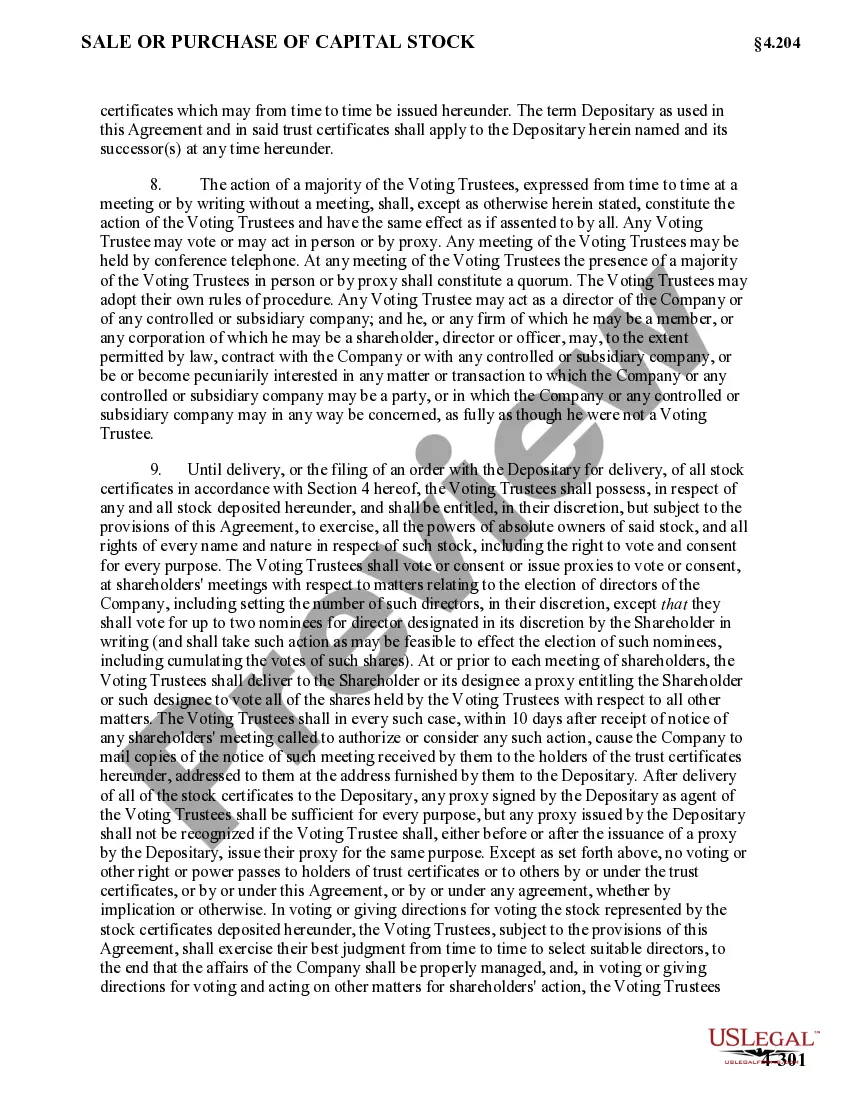
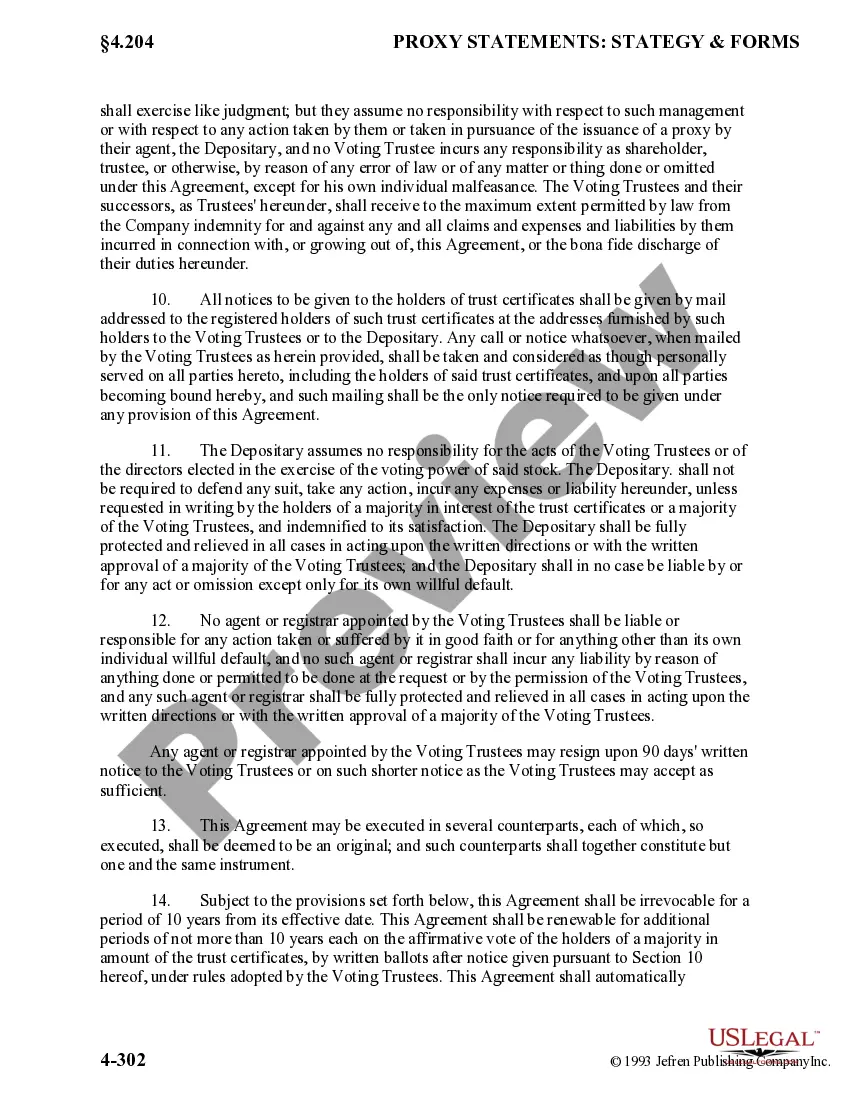
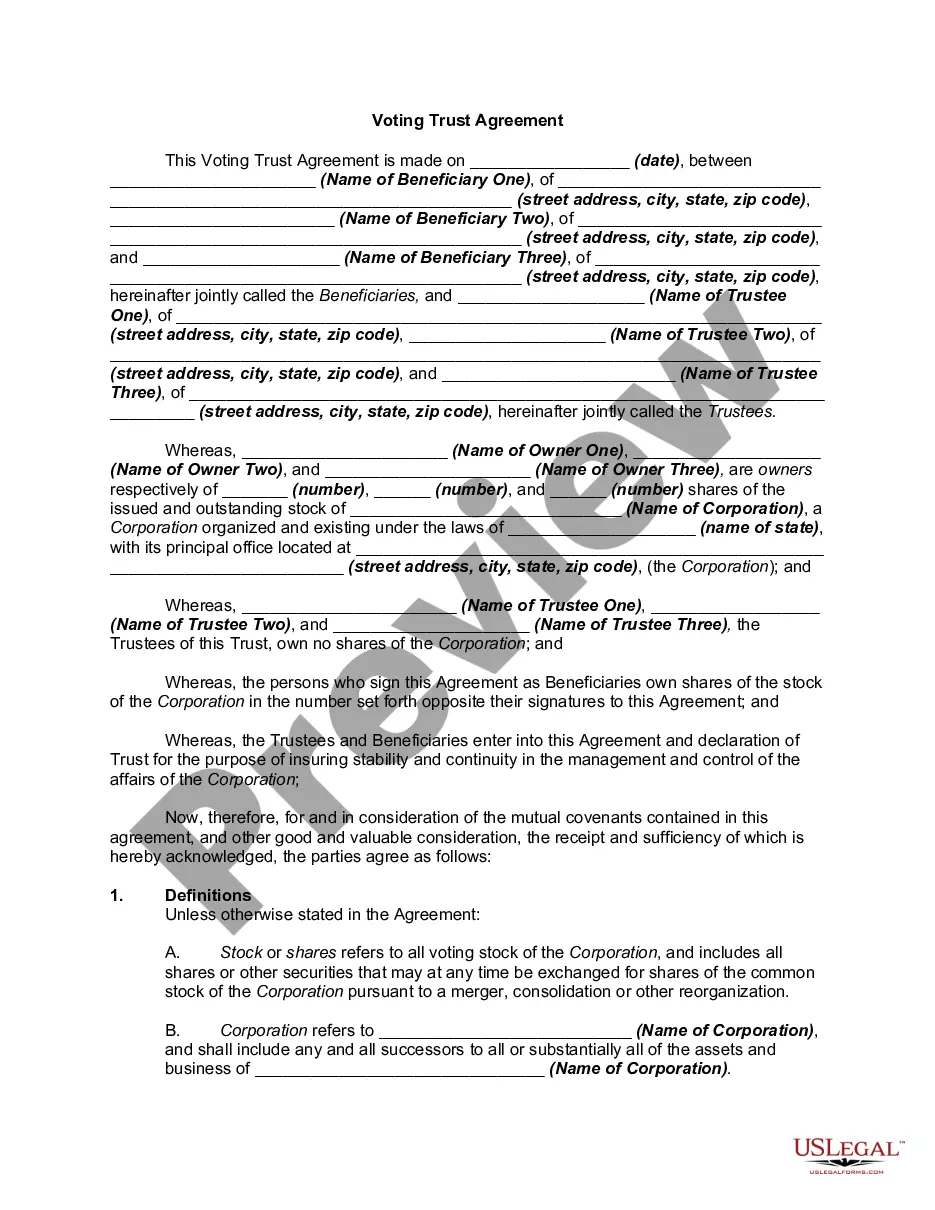
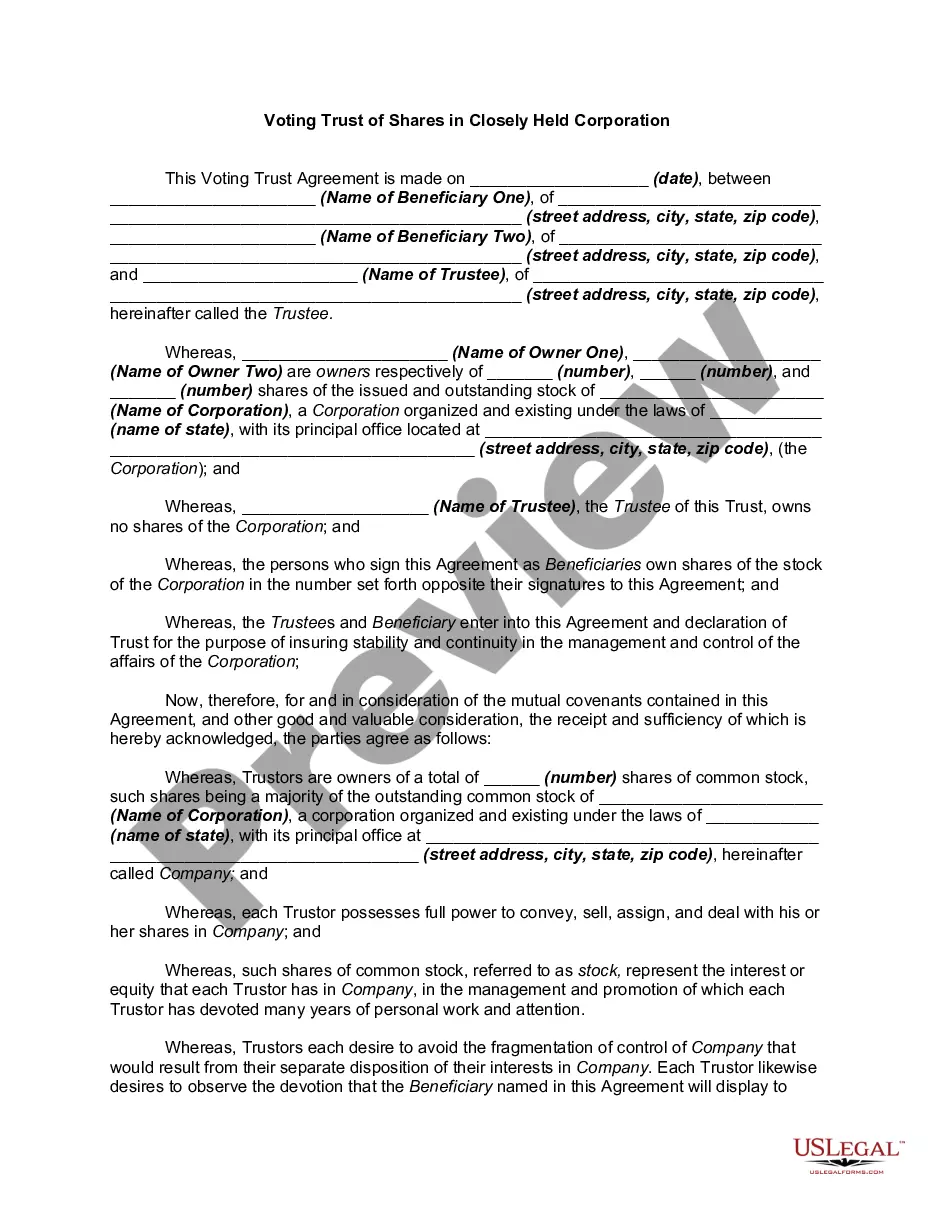
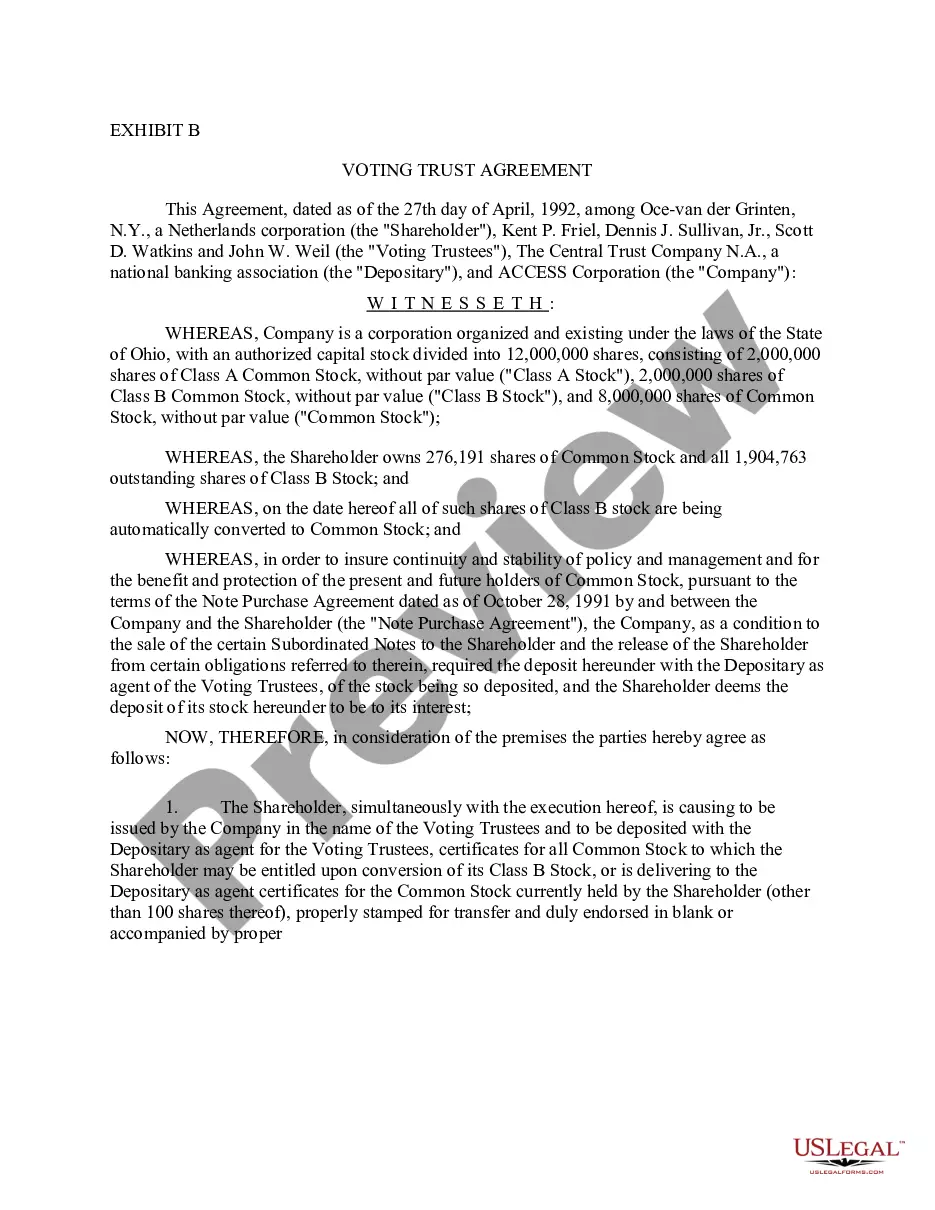
Voting Trust Agreement which provides that the shareholder has issued certificates in the care of the depositary in the name of the voting trustees
What this document covers
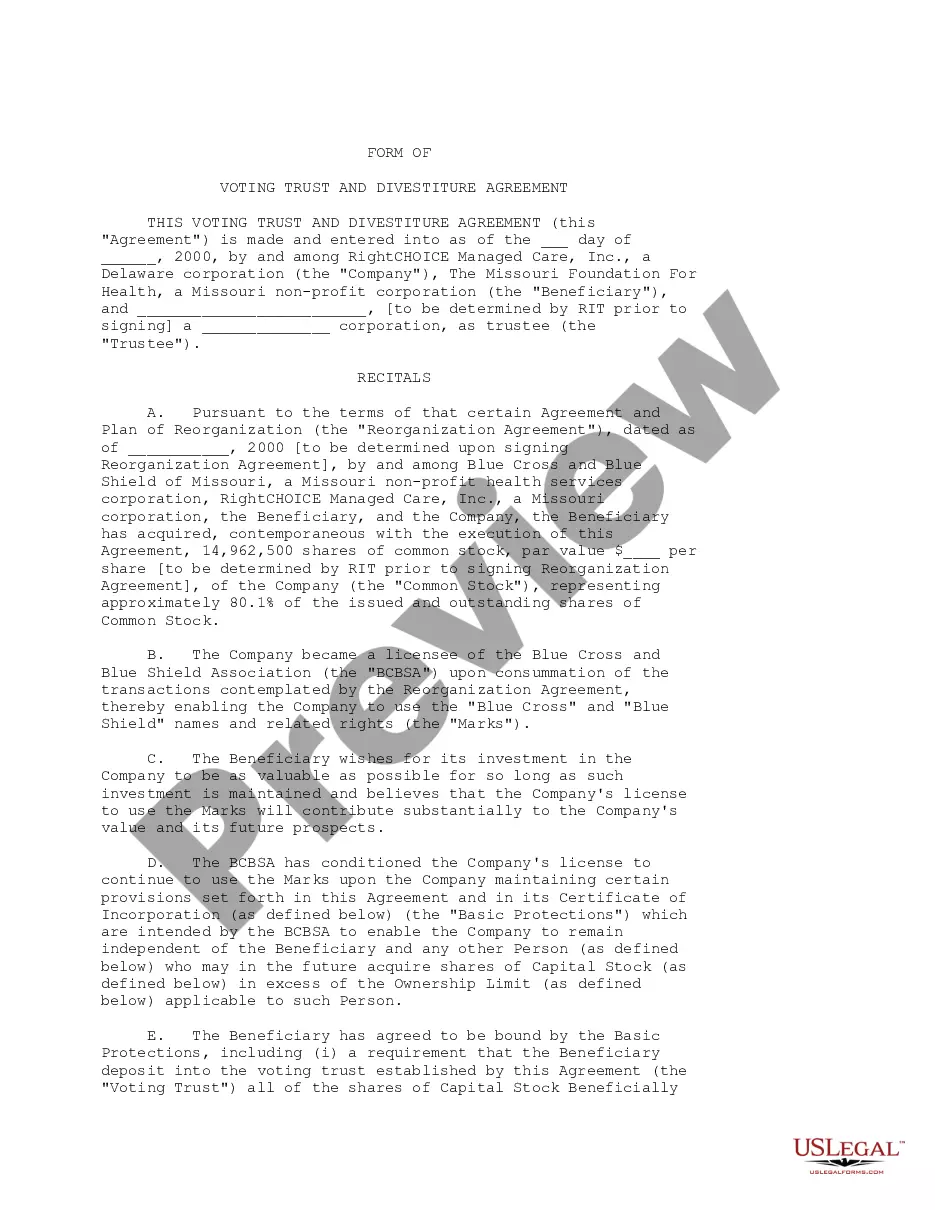
A Voting Trust Agreement is a legal document that establishes a voting trust for shareholders. Through this agreement, a shareholder deposits stock certificates with designated voting trustees, who then exercise the voting rights on behalf of the shareholders. This form provides structure and stability in managing corporate governance, ensuring that the interests of current and future shareholders are maintained. Unlike other agreements, it specifically outlines the responsibilities of the voting trustees and the depositary, facilitating better management of common stock voting rights.
Key components of this form
- The date and parties involved in the agreement.
- Details regarding the issuance of stock certificates to the voting trustees.
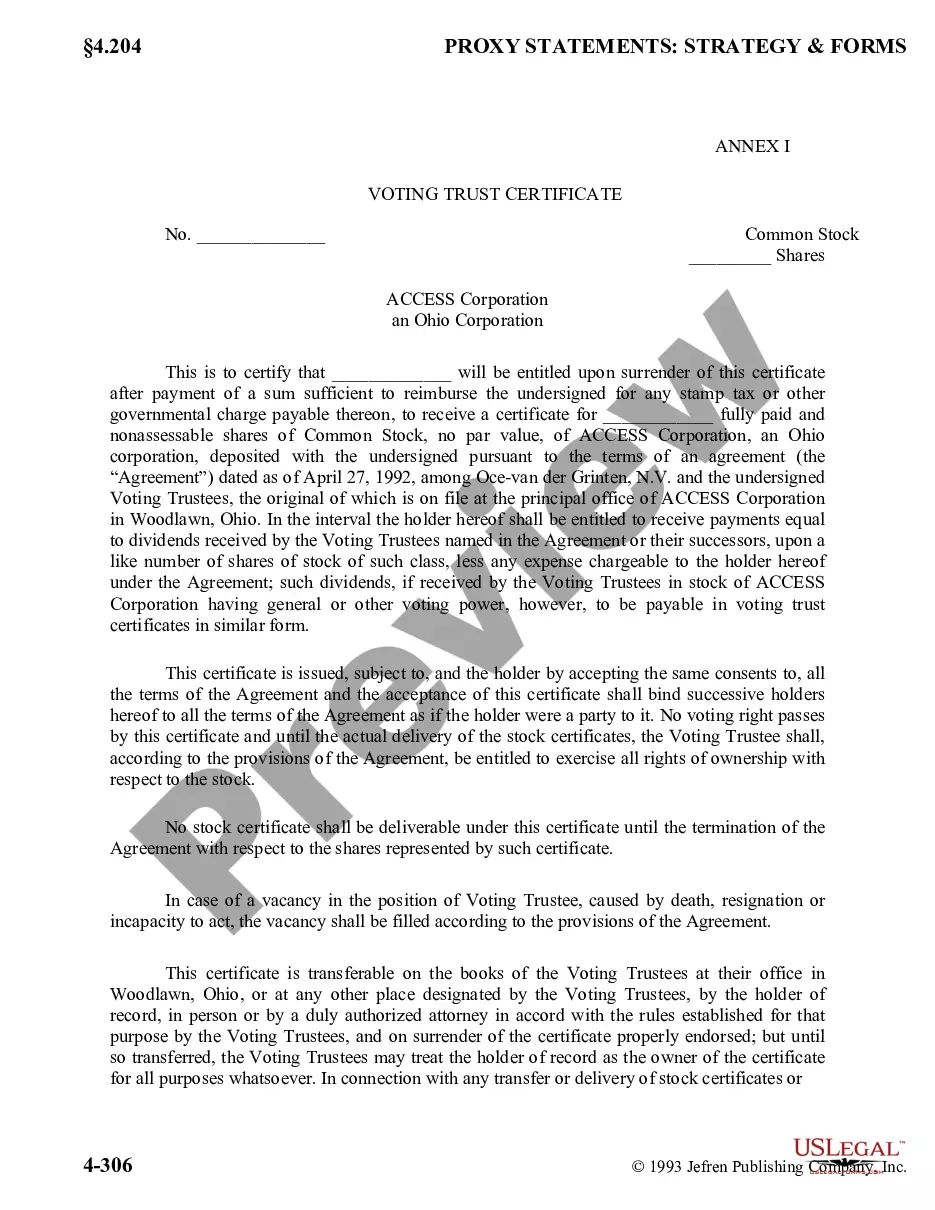
- Trust certificates issued to the shareholders in exchange for common stock.
- Process for transferring shares and handling dividends.
- Provisions for the resignation and appointment of voting trustees.
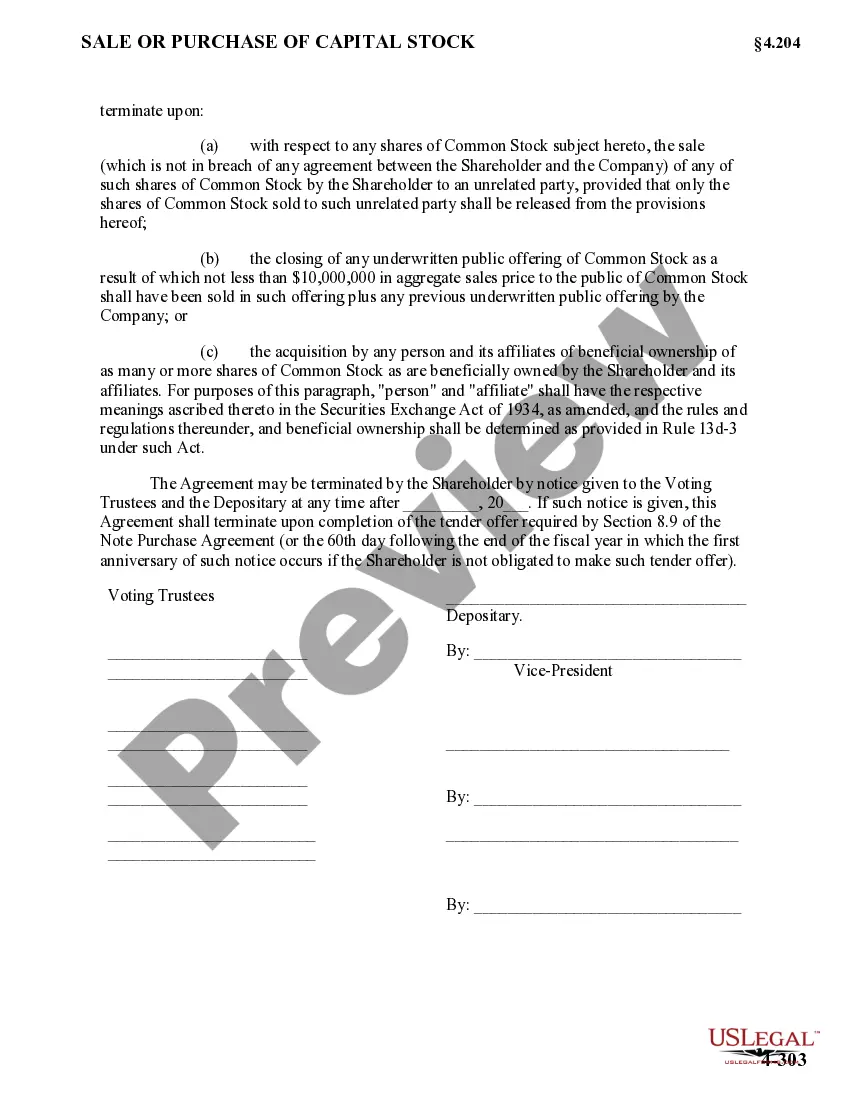
- Terms for the termination of the agreement and its renewal.
When this form is needed
This form is used when a shareholder wants to establish a voting trust for their shares of a corporation, particularly when there is a need for stability in shareholder voting, such as during management transitions or restructuring. It is also beneficial for facilitating the collective interests of multiple shareholders in influencing corporate governance decisions.
Who should use this form
- Shareholders of a corporation seeking to delegate their voting rights.
- Corporations wanting to ensure stable management through a voting trust.
- Investors looking to organize their voting power with others.
- Legal professionals preparing voting trust agreements for clients.
Completing this form step by step
- Identify the parties involved, including shareholders, voting trustees, and the depositary.
- Enter the date of the agreement and details regarding the corporationâs common stock.
- Specify the number of shares being placed in trust and ensure proper endorsements are included.
- Detail the provisions for resignation and replacement of voting trustees.
- Include terms for transfer of trust certificates and distribution of dividends.
- Review the document for completeness and obtain necessary signatures.
Does this form need to be notarized?
This form does not typically require notarization unless specified by local law. However, having the agreement notarized can enhance its legitimacy and may be advisable depending on the jurisdiction in which it is used.
Get your form ready online
Our built-in tools help you complete, sign, share, and store your documents in one place.
Make edits, fill in missing information, and update formatting in US Legal Forms—just like you would in MS Word.
Download a copy, print it, send it by email, or mail it via USPS—whatever works best for your next step.
Sign and collect signatures with our SignNow integration. Send to multiple recipients, set reminders, and more. Go Premium to unlock E-Sign.
If this form requires notarization, complete it online through a secure video call—no need to meet a notary in person or wait for an appointment.
We protect your documents and personal data by following strict security and privacy standards.

Make edits, fill in missing information, and update formatting in US Legal Forms—just like you would in MS Word.

Download a copy, print it, send it by email, or mail it via USPS—whatever works best for your next step.

Sign and collect signatures with our SignNow integration. Send to multiple recipients, set reminders, and more. Go Premium to unlock E-Sign.

If this form requires notarization, complete it online through a secure video call—no need to meet a notary in person or wait for an appointment.

We protect your documents and personal data by following strict security and privacy standards.
Avoid these common issues
- Failing to accurately specify the number of shares in trust.
- Not properly endorsing stock certificates before depositting.
- Leaving out important provisions related to the resignation of trustees.
- Forgetting to sign and date the agreement, which may lead to invalidation.
Advantages of online completion
- Convenience of downloading and filling out the form at your own pace.
- Ability to customize the agreement according to specific needs.
- Access to legal guidance through the support of licensed attorneys.
- Secure storage and retrieval of your completed documents.
Looking for another form?
Form popularity
FAQ
A voting trust is a contract between shareholders in which their shares and voting rights are temporarily transferred to a trustee.
A shareholder's agreement establishes the rights of majority and minority shareholders of the corporation while also establishing the responsibilities of the board of directors and officers for that corporation. It is beneficial to have in place when the corporation only has a few shareholders.
A "shareholder trust" is a trust which holds shares in a corporation.Any fiduciary duties that might otherwise exist between those in control of the entity and other interest holders such as the shareholder trust may run only to the trust.
A shareholder agrees to vote its voting shares generally or in favour of a specific proposal and against any contrary proposal. Voting agreements are commonly used in business combination transactions to assure the purchaser that significant shareholders will vote to approve the subject transaction.
A voting trust certificate is issued to a stockholder in exchange for his or her common stock, and represents all of the normal rights of a shareholder (e.g., receiving dividends) except the right to vote.
Shareholders cast votes at a company's annual meeting. If they cannot attend, they may utilize a proxy vote to convey their wishes. Typically common shares carry one vote per share, while preferred shares have no voting rights.
A shareholders' agreement is an agreement entered into between all or some of the shareholders in a company. It regulates the relationship between the shareholders, the management of the company, ownership of the shares and the protection of the shareholders. They also govern the way in which the company is run.
Common problem areas include the following: Directors -v- members. Transfer of shares. Approving a change in business direction. Managing changes in the roles shareholders play. Injection of debt. Competition. Exit.