Equal Pay Checklist
About this form
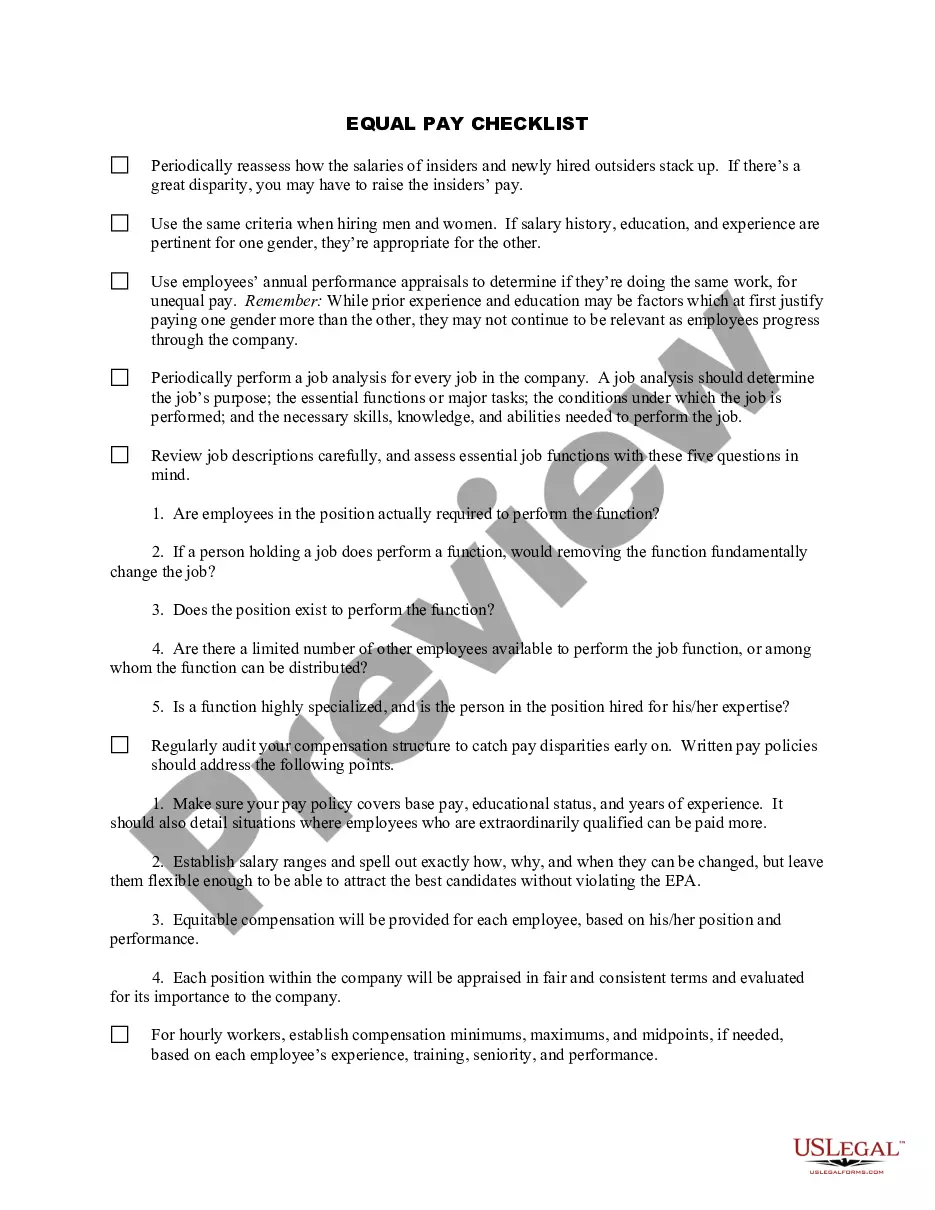
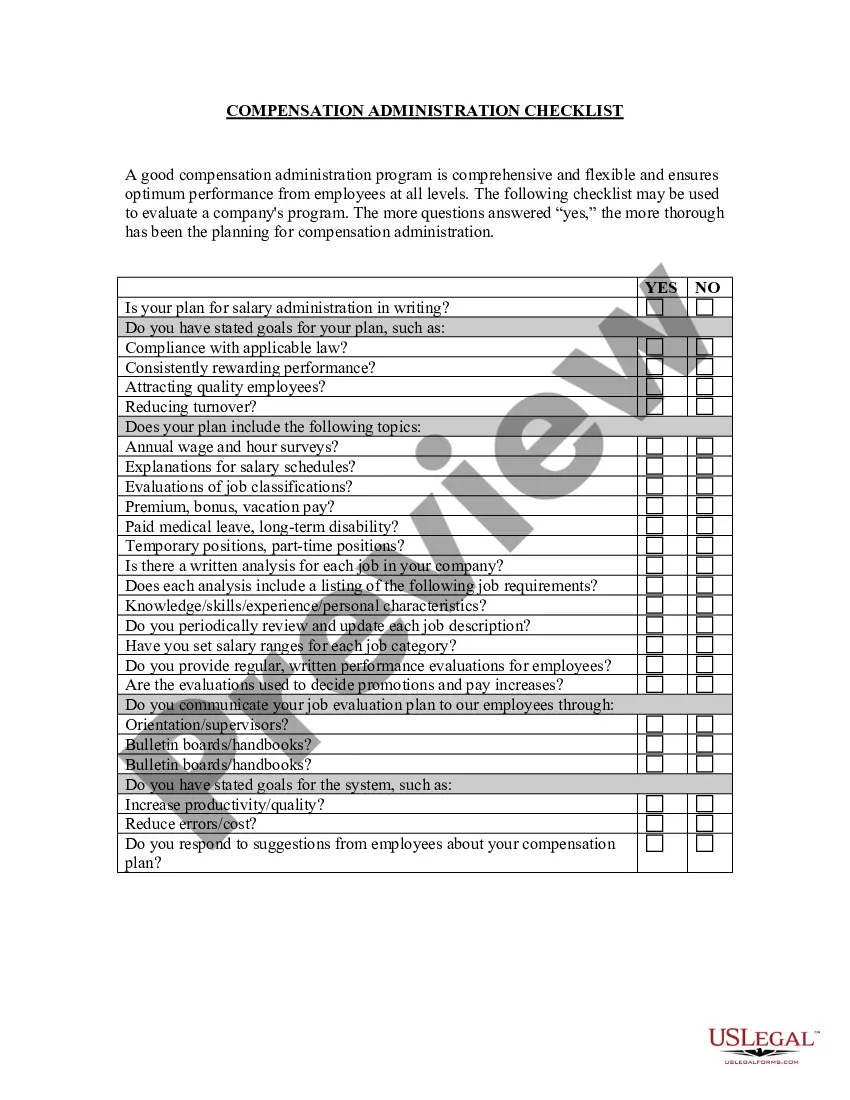
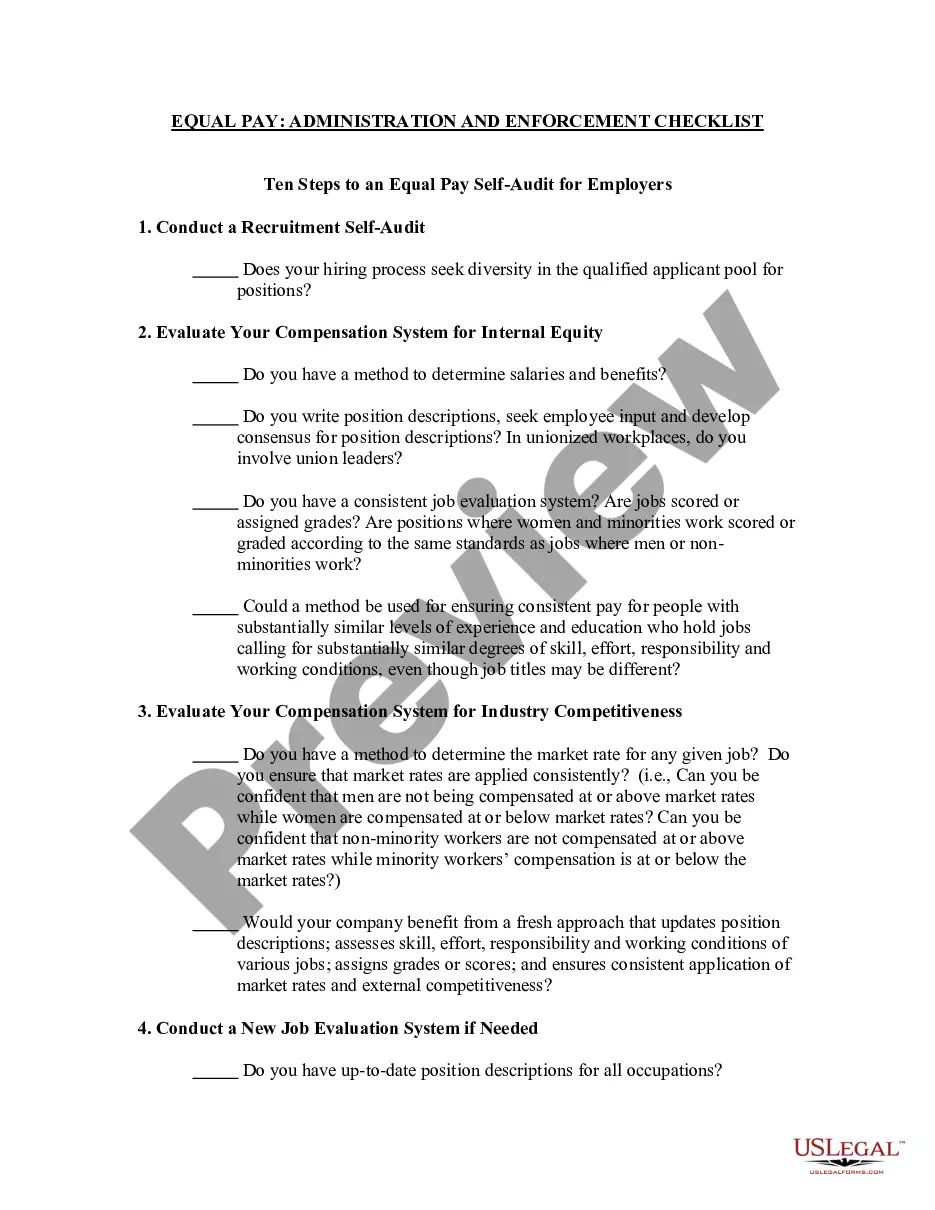
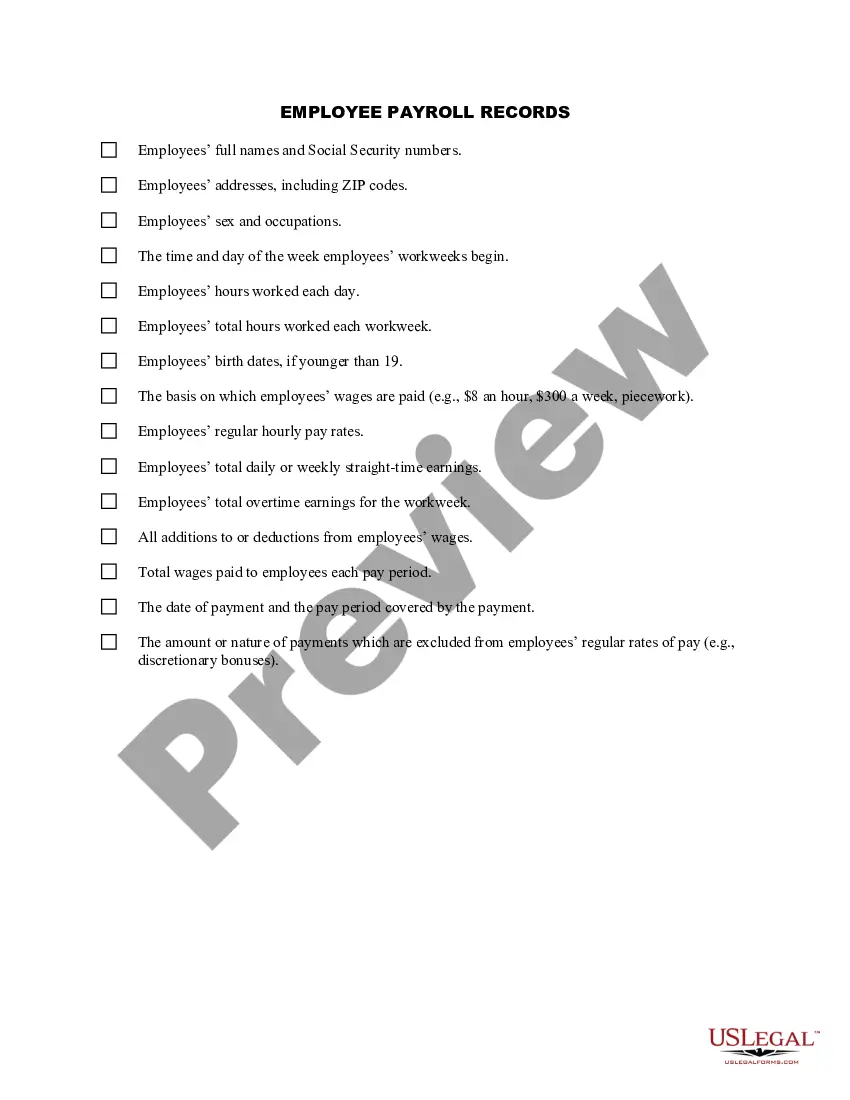
The Equal Pay Checklist is a useful tool designed to help organizations ensure they comply with equal pay laws and maintain fair compensation practices. Unlike general employment forms, this checklist focuses specifically on evaluating pay equity among employees, allowing companies to identify disparities in compensation related to gender, experience, or job responsibilities.
What’s included in this form
- Periodic salary assessments to ensure equitable compensation.
- Criteria for hiring and evaluating employee credentials, such as education and experience.
- Utilization of annual performance appraisals to assess job equality.
- Job analysis for key roles to determine essential functions and skills required.
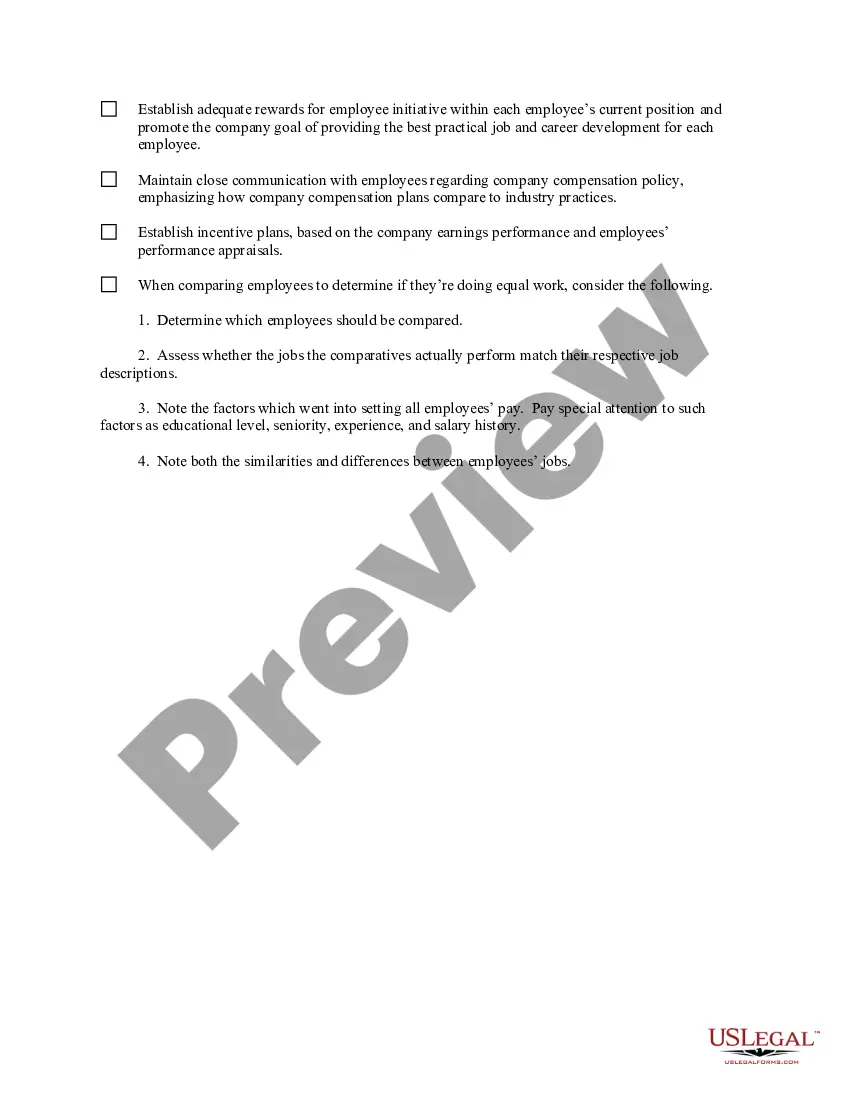
- Regular auditing of compensation structures to identify and rectify pay disparities.
- Establishing clear compensation policies and reward systems for employee initiatives.
Common use cases
This checklist is essential for organizations looking to comply with equal pay legislation, particularly when conducting salary reviews, during hiring processes, or when planning pay structure adjustments. It can also be used when evaluating employee performance and roles within the company to ensure fairness in compensation.
Who can use this document
This checklist is intended for:
- Human resource professionals seeking to evaluate and maintain fair pay practices.
- Company managers involved in salary reviews and employee evaluations.
- Business owners who wish to establish equitable compensation policies for their employees.
- Compliance officers responsible for ensuring adherence to equal pay laws.
How to complete this form
- Conduct a salary assessment to compare current employee salaries with industry standards.
- Review hiring criteria to ensure consistency in how qualifications are evaluated for all candidates.
- Evaluate employee performance using consistent methods to determine if they perform the same job functions.
- Regularly analyze job descriptions and conduct job analyses to ensure clarity in job functions and requirements.
- Develop and maintain an equitable compensation policy that addresses employees' pay based on performance and skills.
Does this form need to be notarized?
Notarization is generally not required for this form. However, certain states or situations might demand it. You can complete notarization online through US Legal Forms, powered by Notarize, using a verified video call available anytime.
Get your form ready online
Our built-in tools help you complete, sign, share, and store your documents in one place.
Make edits, fill in missing information, and update formatting in US Legal Forms—just like you would in MS Word.
Download a copy, print it, send it by email, or mail it via USPS—whatever works best for your next step.
Sign and collect signatures with our SignNow integration. Send to multiple recipients, set reminders, and more. Go Premium to unlock E-Sign.
If this form requires notarization, complete it online through a secure video call—no need to meet a notary in person or wait for an appointment.
We protect your documents and personal data by following strict security and privacy standards.

Make edits, fill in missing information, and update formatting in US Legal Forms—just like you would in MS Word.

Download a copy, print it, send it by email, or mail it via USPS—whatever works best for your next step.

Sign and collect signatures with our SignNow integration. Send to multiple recipients, set reminders, and more. Go Premium to unlock E-Sign.

If this form requires notarization, complete it online through a secure video call—no need to meet a notary in person or wait for an appointment.

We protect your documents and personal data by following strict security and privacy standards.
Typical mistakes to avoid
- Neglecting to periodically reassess salaries, which can lead to unnoticed pay disparities.
- Failing to apply the same hiring criteria for all candidates, resulting in unequal starting salaries for similar roles.
- Ignoring the need for regular audits of pay structures and facing potential compliance issues.
- Overlooking job functions and essential responsibilities when conducting evaluations.
Why complete this form online
- Easy accessibility allows for quick revisions and updates based on the latest legal standards.
- Downloadable format enables use across multiple platforms, ensuring widespread accessibility.
- Reliable and professionally crafted, aiding in compliance efforts and organizational transparency.
Legal use & context
- This checklist assists in identifying and rectifying wage disparities to ensure compliance with federal and state equal pay laws.
- Use of this form can help defend against claims of wage discrimination and enhance organizational reputation.
Quick recap
- The Equal Pay Checklist is a vital tool for maintaining equitable pay practices within organizations.
- Consistent assessments and reviews are crucial in preventing pay disparities among employees.
- Regular audits of compensation structures can help organizations identify and address potential inequalities.
Looking for another form?

Form popularity
FAQ
Produce an equal pay policy. Create clear and transparent job descriptions and titles. Follow a job evaluation scheme. Look at your grading structures. Consider more action for a fair pay system.
Key facts. People doing the same job or work of equal value should get the same or equal pay; but in many cases they don't, even though though the law says they should.You are entitled to the same pay as anyone doing the same or broadly similar job, or a job of equal value, regardless of gender.
By law, men and women must get equal pay for doing 'equal work' (work that equal pay law classes as the same, similar, equivalent or of equal value). This means someone must not get less pay compared to someone who is both: the opposite sex. doing equal work for the same employer.
Calculation. The non-adjusted gender pay gap, or gender wage gap is typically the median or mean average difference between the remuneration for all working men and women in the sample chosen.The gender pay gap can, for example, be measured by ethnicity, by city, by job, or within a single organization.
Please see www.dfeh.ca.gov or call 1-800- 864-1684 or the Equal Employment Opportunity Commission at www.eeoc.gov or call 1-800-669-4000. As indicated above, the Labor Commissioner's Office does handle claims under the Equal Pay Act alleging unequal pay (based on sex, race, or ethnicity).
Conduct a pay audit. Awareness is the first step to solving a problem. Ensure that hiring and promotions are fair. Make sure women have equal opportunities for advancement. Make it a norm for women to negotiate.
Prevent salary disparities before making new hires. Review employee compensation on a regular basis. Separate compensation reviews from performance reviews. Disclose salary ranges for different positions and levels. Advocate for your people.
Under a Title VII wage discrimination claim, an employee must first prove: 1) membership in a protected group and that he or she was qualified for the position worked in; 2) an employer is practicing wage differentials based on the employee's membership in the protected group and this has given rise to an inference of
As set out in the Equality Act 2010, men and women in the same employment performing equal work must receive equal pay, unless any difference in pay can be justified. It is the law and employers must follow it.