16.63 ELEMENTS OF DEFENSE: CREATIVE PROFESSIONAL EXEMPTION
Overview of this form
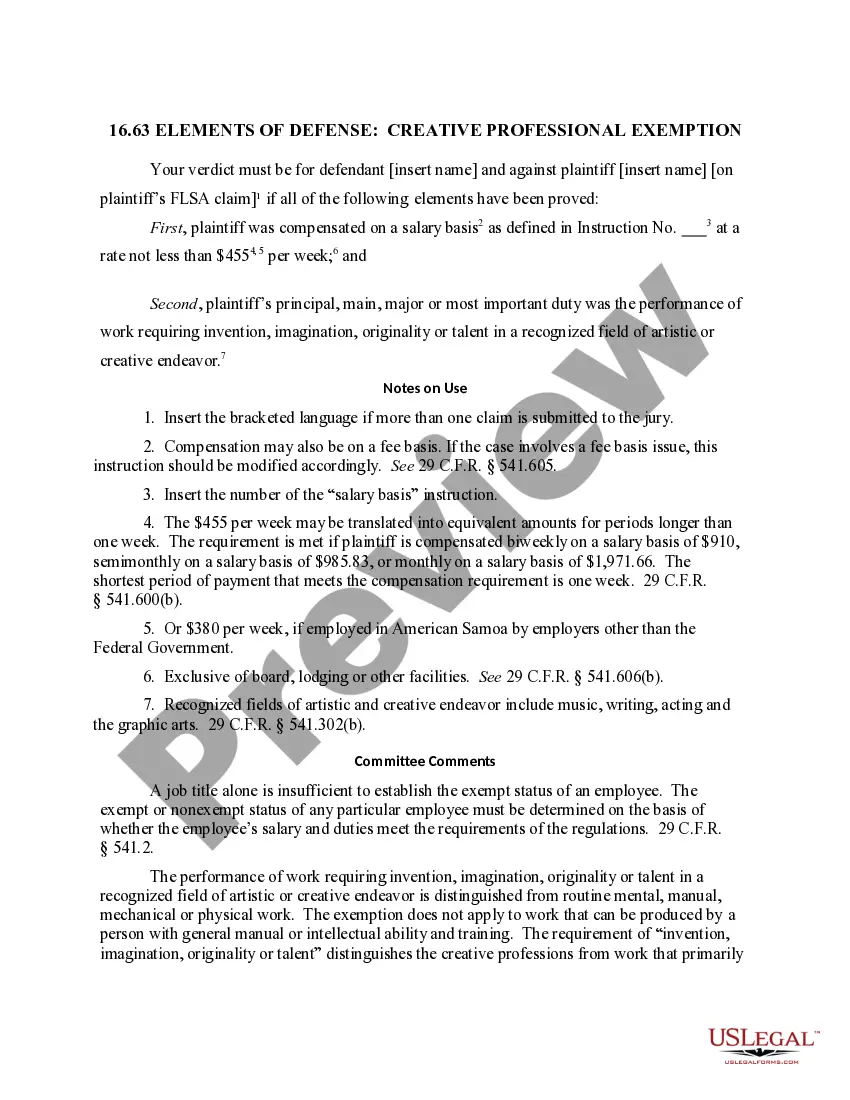
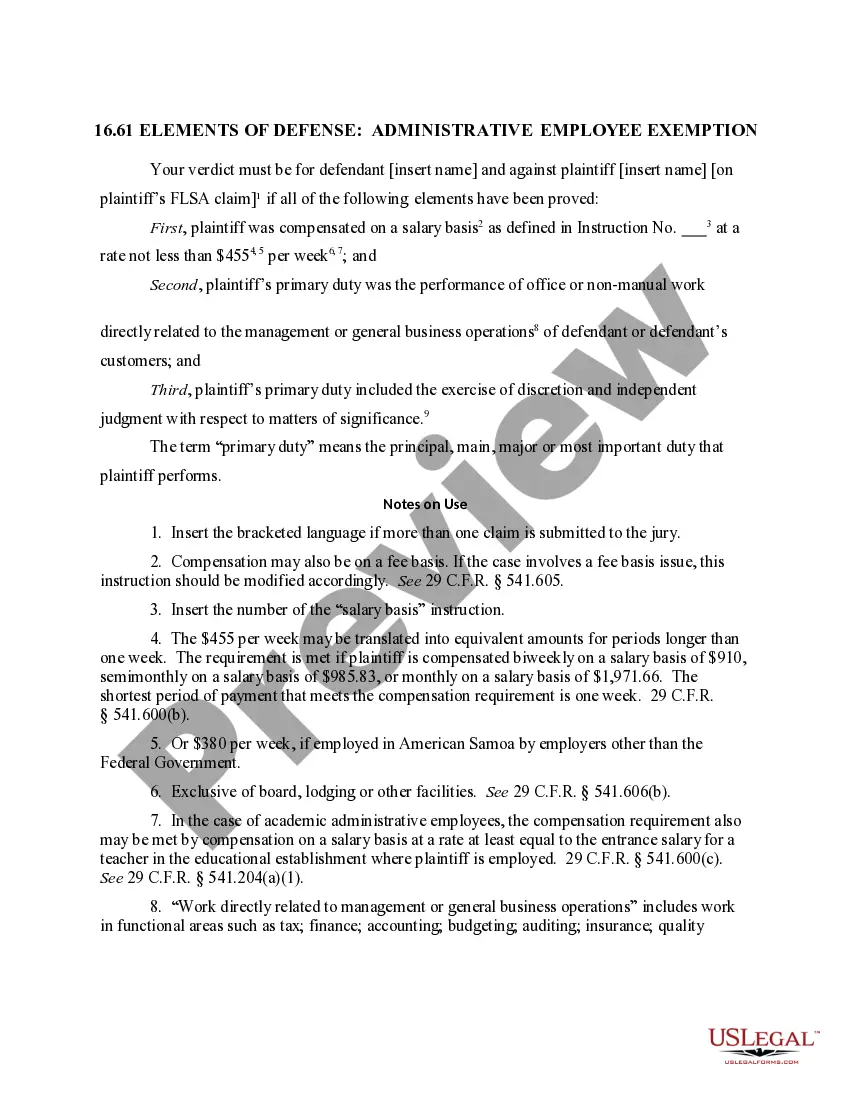
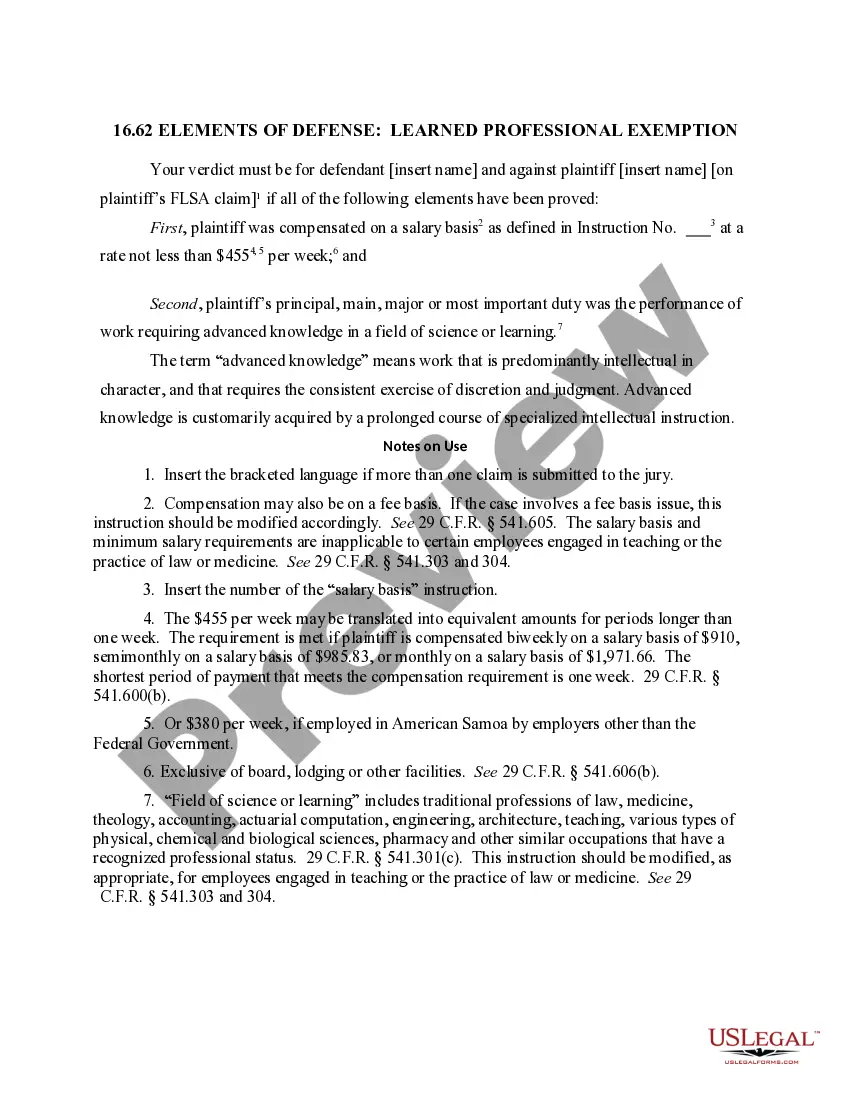
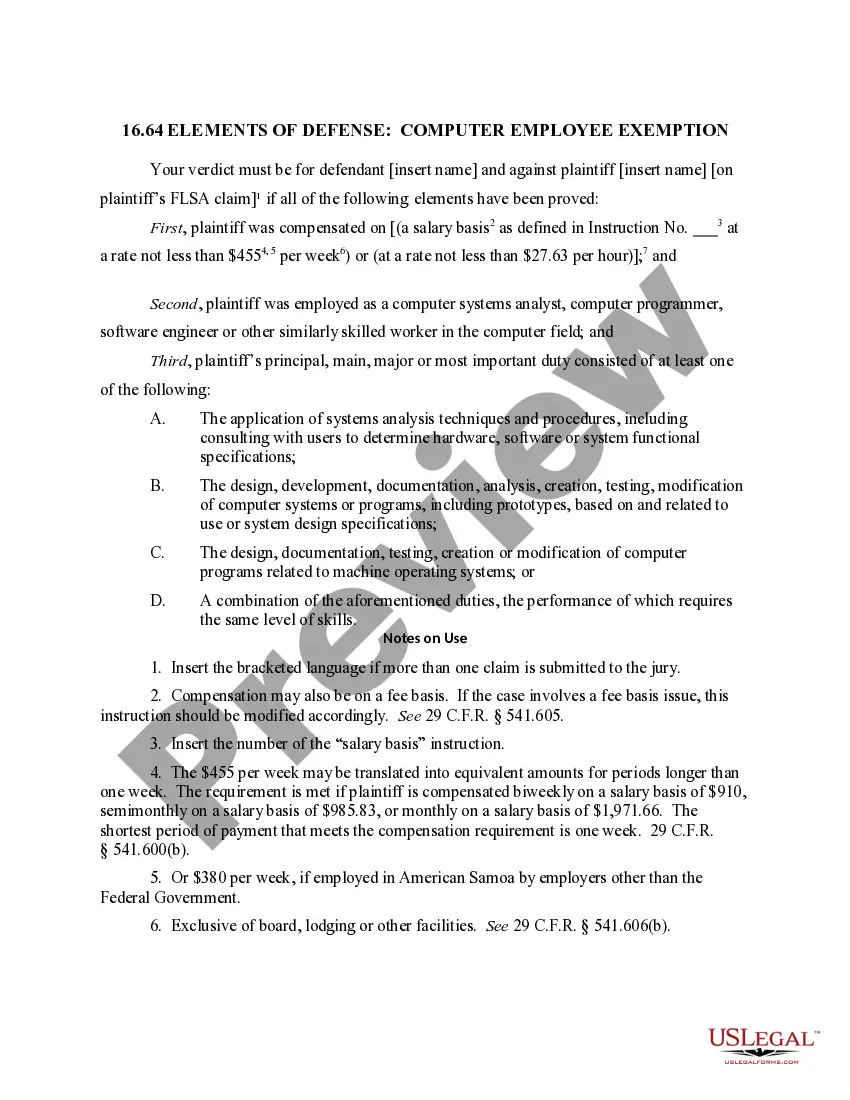
The "16.63 Elements of Defense: Creative Professional Exemption" form is used to establish whether a plaintiff qualifies for an exemption under the Fair Labor Standards Act (FLSA) as a creative professional. This form differentiates itself from other defense forms by specifically focusing on creative roles that require a high level of skill and originality, such as artists, writers, and musicians. It outlines the criteria that must be met to assert the creative professional exemption in legal proceedings.
Key components of this form
- The plaintiff must be paid on a salary basis, meeting a minimum weekly compensation threshold.
- The plaintiff's primary duties must involve work requiring creativity, originality, or talent.
- Includes specific salary requirements for different pay periods.
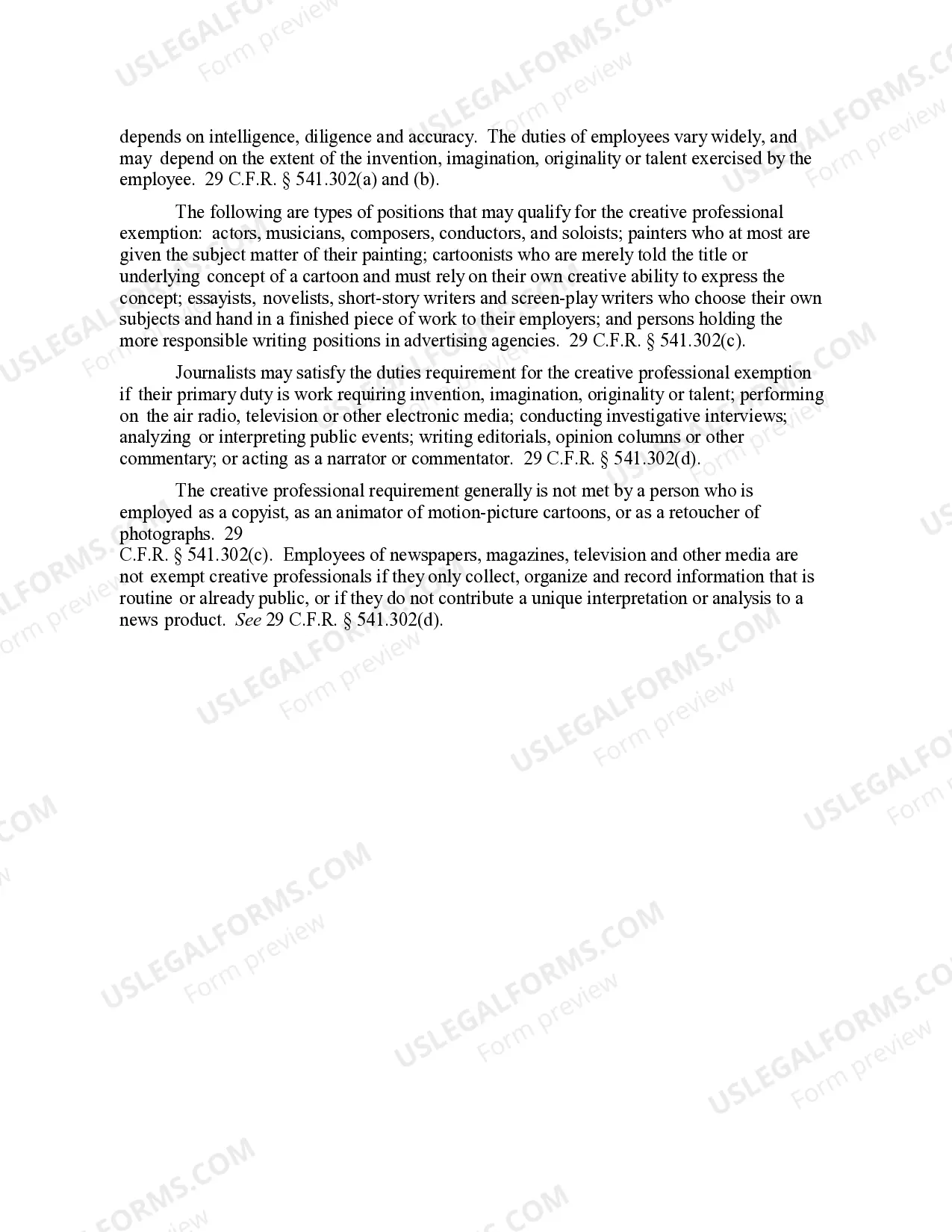
- Distinction between creative work and routine tasks which do not qualify for the exemption.
- Notes on various job titles that may or may not meet the exemption criteria.
Situations where this form applies
This form should be used in cases where a plaintiff is claiming a violation of the FLSA regarding overtime pay or minimum wage, and the defendant aims to assert that the plaintiff qualifies for the creative professional exemption. It can be crucial during legal proceedings, like labor disputes or wrongful termination cases, where the status of the plaintiff's employment classification is in question.
Who should use this form
- Employers or defendants in labor disputes involving FLSA claims.
- Legal representatives defending against claims of unpaid wages from creative professionals.
- Creative professionals seeking to understand their exempt status under the FLSA.
Steps to complete this form
- Identify the parties involved: insert the names of the plaintiff and defendant.
- Specify compensation details: confirm that the plaintiff is paid on a qualifying salary basis.
- Clarify the main duties: describe how the plaintiff's work requires creativity or unique talent.
- Reference salary requirements: ensure that the amount meets the established thresholds for exemption.
- Insert any additional relevant claims or arguments for context.
Notarization guidance
This form does not typically require notarization to be legally valid. However, some jurisdictions or document types may still require it. US Legal Forms provides secure online notarization powered by Notarize, available 24/7 for added convenience.
Get your form ready online
Our built-in tools help you complete, sign, share, and store your documents in one place.
Make edits, fill in missing information, and update formatting in US Legal Forms—just like you would in MS Word.
Download a copy, print it, send it by email, or mail it via USPS—whatever works best for your next step.
Sign and collect signatures with our SignNow integration. Send to multiple recipients, set reminders, and more. Go Premium to unlock E-Sign.
If this form requires notarization, complete it online through a secure video call—no need to meet a notary in person or wait for an appointment.
We protect your documents and personal data by following strict security and privacy standards.

Make edits, fill in missing information, and update formatting in US Legal Forms—just like you would in MS Word.

Download a copy, print it, send it by email, or mail it via USPS—whatever works best for your next step.

Sign and collect signatures with our SignNow integration. Send to multiple recipients, set reminders, and more. Go Premium to unlock E-Sign.

If this form requires notarization, complete it online through a secure video call—no need to meet a notary in person or wait for an appointment.

We protect your documents and personal data by following strict security and privacy standards.
Mistakes to watch out for
- Failing to establish that the plaintiff is paid on a salary basis.
- Misclassifying the plaintiff's job duties as exempt without adequate evidence.
- Not adjusting the salary figures for different payment periods correctly.
Why use this form online
- Convenience of instant access to essential legal documentation.
- Editable templates allow for easy customization based on specific case details.
- Reliability with professionally drafted forms providing peace of mind during legal proceedings.
Legal use & context
- The form establishes the criteria necessary for asserting the creative professional exemption in court.
- Understanding the legal nuances of exempt status can impact labor dispute outcomes significantly.
- Proper use of this form can help defend against FLSA claims effectively.
Summary of main points
- Determine if a plaintiff qualifies for the creative professional exemption under the FLSA.
- The form outlines essential criteria including salary basis and the nature of work performed.
- It is crucial for employers and employees in creative fields to understand their rights and responsibilities regarding wage claims.
Looking for another form?

Form popularity
FAQ
Executive, administrative, professional and outside sales employees: (as defined in Department of Labor regulations) and who are paid on a salary basis are exempt from both the minimum wage and overtime provisions of the FLSA.
A few employers, including small farms?those that use relatively little outside paid labor?are explicitly exempt from the FLSA. Many airline employees are exempt from the FLSA's overtime provisions. And most companions for the elderly are exempt from both minimum wage and overtime provisions.
Invention, Imagination, Originality or Talent This requirement distinguishes the creative professions from work that primarily depends on intelligence, diligence and accuracy. Exemption as a creative professional depends on the extent of the invention, imagination, originality or talent exercised by the employee.
Highly compensated employees performing office or non-manual work and paid total annual compensation of $100,000 or more (which must include at least $455 per week paid on a salary or fee basis) are exempt from the FLSA if they customarily and regularly perform at least one of the duties of an exempt executive,
An employee is covered by the FLSA if he or she is engaged in interstate commerce or in the production of goods for interstate commerce.
(a) To qualify for the creative professional exemption, an employee's primary duty must be the performance of work requiring invention, imagination, originality or talent in a recognized field of artistic or creative endeavor as opposed to routine mental, manual, mechanical or physical work.
In most cases, there are three simple requirements to determine whether a worker is an exempt employee under California law: Minimum Salary. The employee must be paid a salary that is at least twice the state minimum wage for full-time employment.White Collar Duties.Independent Judgment.
Key Takeaways. An exempt employee is an employee who does not receive overtime pay or qualify for minimum wage. Exempt employees are paid a salary rather than by the hour, and they work in professional, administrative, executive, outside sales, and computer-related fields.