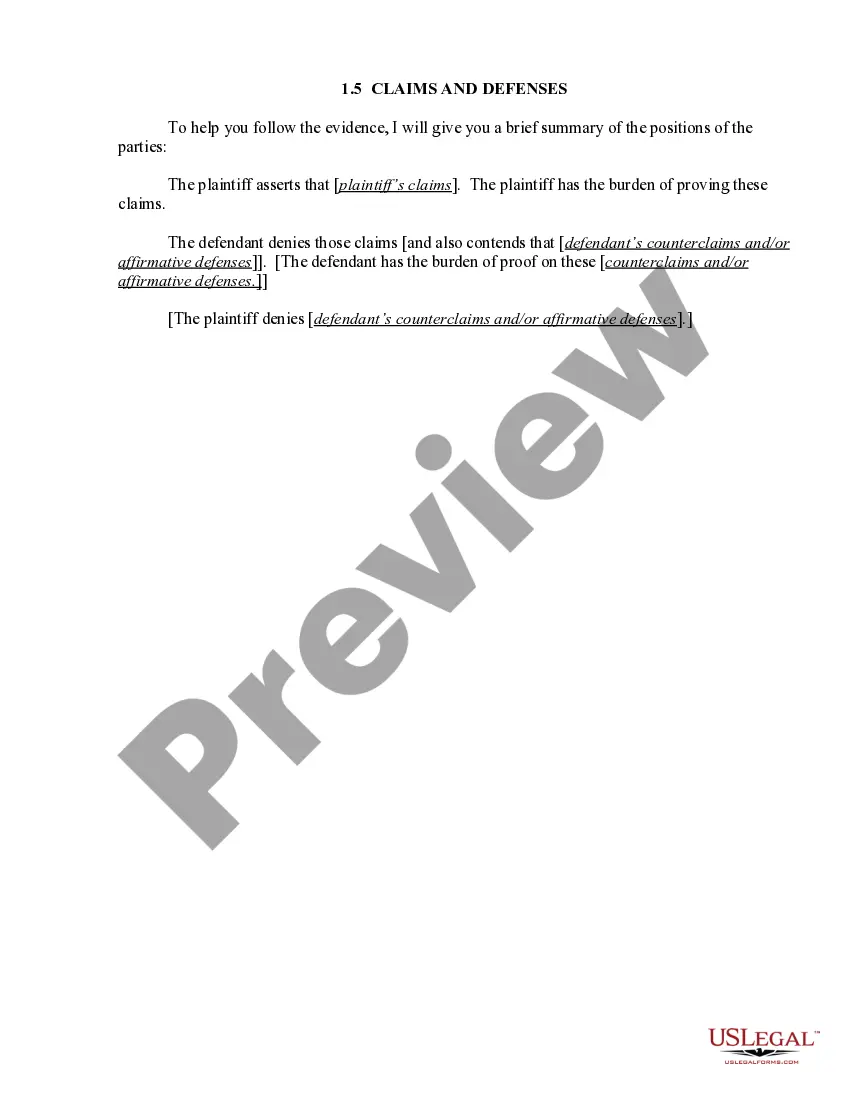
1.5 Claims and Defenses
Does this form need to be notarized?
Notarization is not commonly needed for this form. However, certain documents or local rules may make it necessary. Our notarization service, powered by Notarize, allows you to finalize it securely online anytime, day or night.
Get your form ready online
Our built-in tools help you complete, sign, share, and store your documents in one place.
Make edits, fill in missing information, and update formatting in US Legal Forms—just like you would in MS Word.
Download a copy, print it, send it by email, or mail it via USPS—whatever works best for your next step.
Sign and collect signatures with our SignNow integration. Send to multiple recipients, set reminders, and more. Go Premium to unlock E-Sign.
If this form requires notarization, complete it online through a secure video call—no need to meet a notary in person or wait for an appointment.
We protect your documents and personal data by following strict security and privacy standards.

Make edits, fill in missing information, and update formatting in US Legal Forms—just like you would in MS Word.

Download a copy, print it, send it by email, or mail it via USPS—whatever works best for your next step.

Sign and collect signatures with our SignNow integration. Send to multiple recipients, set reminders, and more. Go Premium to unlock E-Sign.

If this form requires notarization, complete it online through a secure video call—no need to meet a notary in person or wait for an appointment.

We protect your documents and personal data by following strict security and privacy standards.
Looking for another form?
Form popularity
FAQ
In its current form, Rule 30 requires that the court instruct the jury after the arguments of counsel. In some districts, usually where the state practice is otherwise, the parties prefer to stipulate to instruction before closing arguments.
Jury instructions are the only guidance the jury should receive when deliberating and are meant to keep the jury on track regarding the basic procedure of the deliberation and the substance of the law on which their decision is based.
Summary: Preliminary substantive jury instructions are instructions provided to jurors at the start of a trial, before the presentation of evidence by the parties, on the elements of a claim or defense.
If a judge gives the jury the wrong legal standards to apply or otherwise improper instructions, they may find a defendant guilty when they should have reached a different verdict. If the judge in your case gave the jury incomplete or incorrect instructions, you may appeal your conviction and seek a new trial.
The Supreme Court has summarized application of Criminal Rule 52 as involving four elements: (1) there must be an error; (2) the error must be plain; (3) the error must affect substantial rights; and (4) the error must seriously affect the fairness, integrity, or public reputation of judicial proceedings.
The Ohio Jury Instructions (OJI) are written by a committee of the Ohio Judicial Conference. The Law Library has the OJI in its Westlaw database as well as in print. You can buy Ohio Jury Instructions in print or electronically from LexisNexis.
The judge instructs the jury about the relevant laws that should guide its deliberations. (In some jurisdictions, the court may instruct the jury at any time after the close of evidence. This sometimes occurs before closing arguments.) The judge reads the instructions to the jury.
?Preponderance of the evidence? means evidence that has more convincing force than that opposed to it. If the evidence is so evenly balanced that you are unable to say that the evidence on either side of an issue preponderates, your finding on that issue must be against the party who had the burden of proving it.