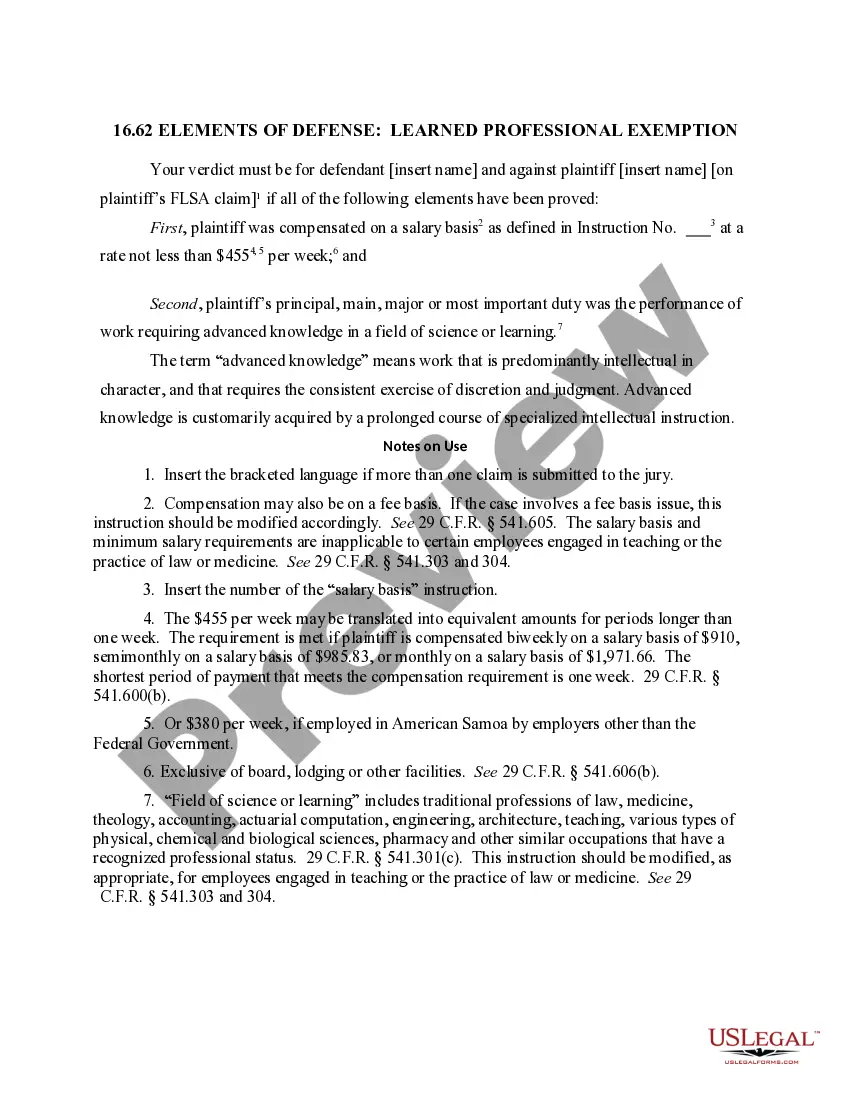
16.62 ELEMENTS OF DEFENSE: LEARNED PROFESSIONAL EXEMPTION
What this document covers
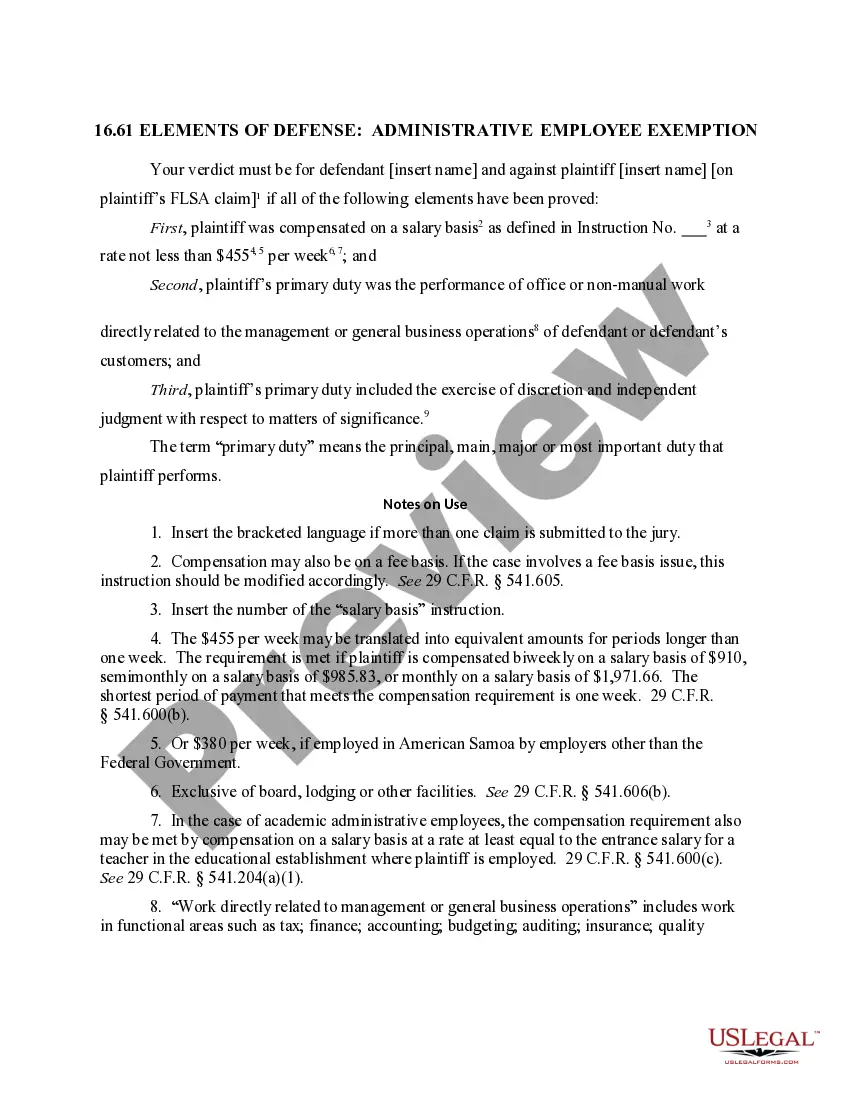
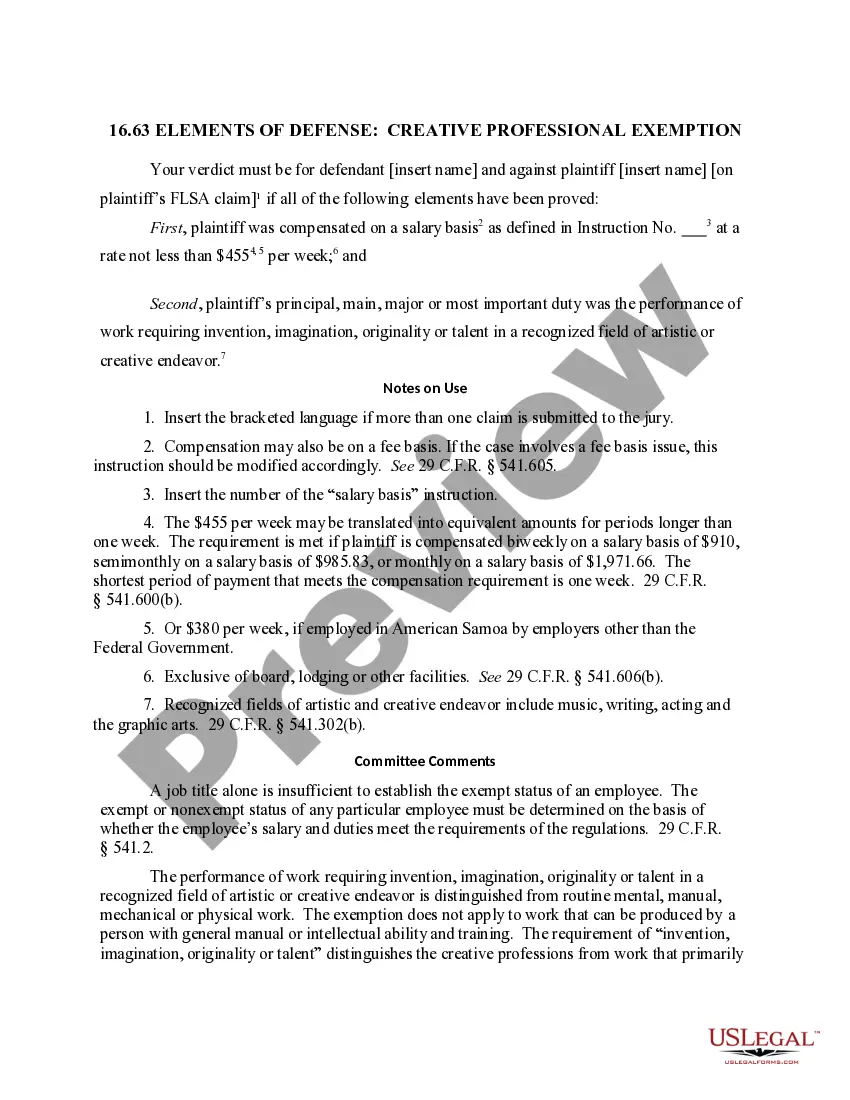
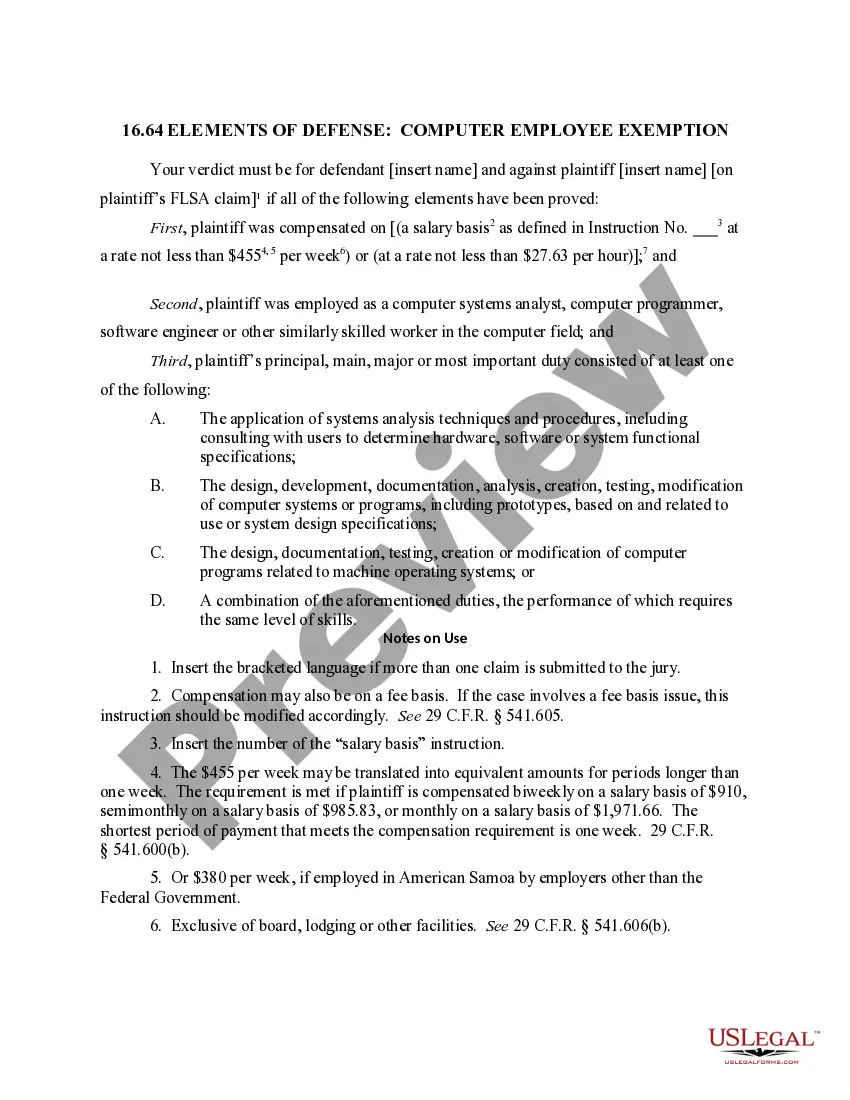
The 16.62 Elements of Defense: Learned Professional Exemption form is a legal document used in employment law cases, specifically related to claims under the Fair Labor Standards Act (FLSA). This form outlines the criteria that must be met to classify an employee as exempt from overtime pay based on their professional status. It serves as a guide for juries to determine if an employee qualifies for this exemption, distinguishing it from other employment related forms that may not focus on professional qualifications.
Key components of this form
- Definition of salary basis: Defines what it means for an employee to be compensated on a salary basis, including minimum salary standards.
- Advanced knowledge requirement: Outlines that the employee's primary duty should involve advanced knowledge acquired through extensive education.
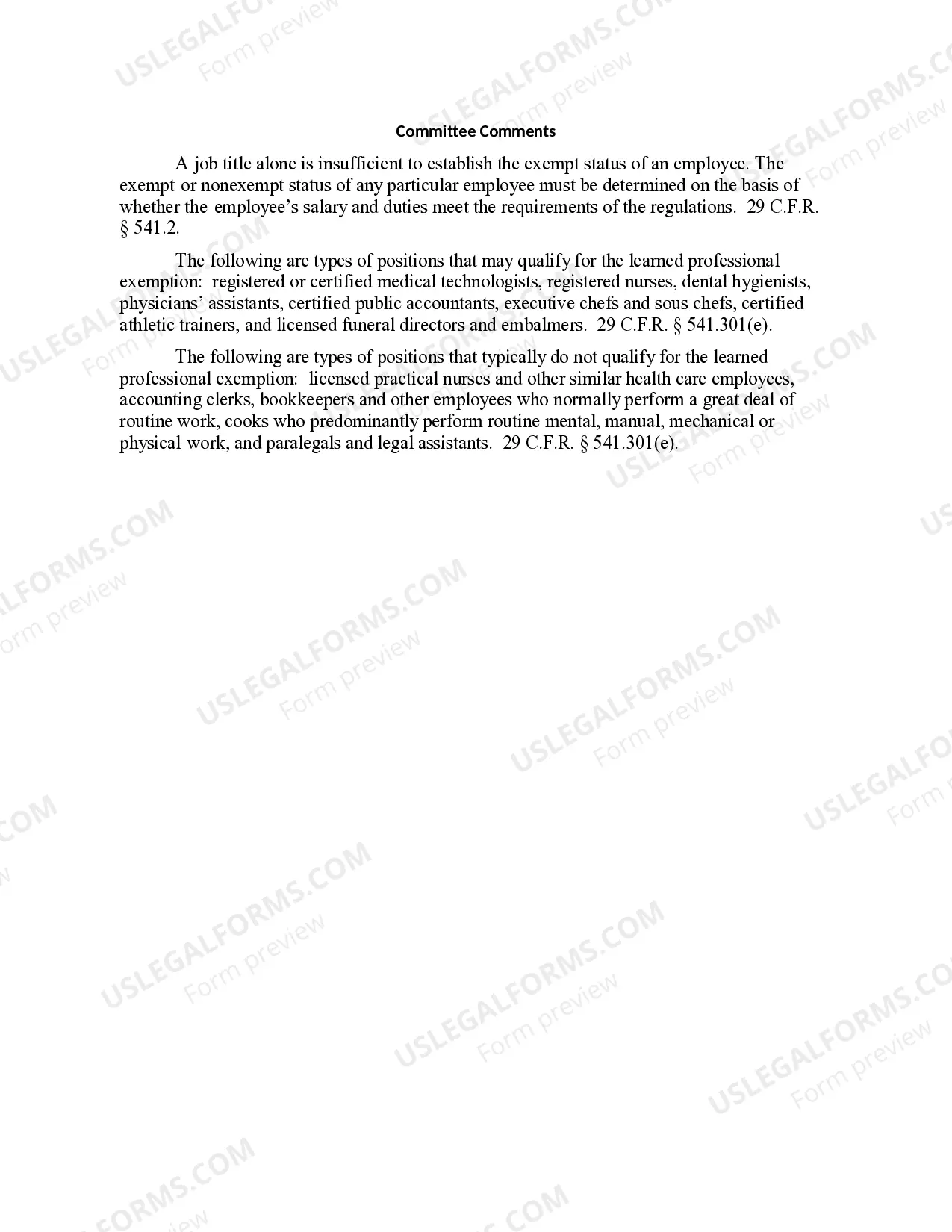
- Job classification examples: Provides examples of positions that may qualify and those that typically do not qualify for the learned professional exemption.
- Usage notes: Includes notes on how to adapt the instructions based on the specific circumstances of the case.
When to use this document
This form is needed in legal cases where an employee's exempt status under the FLSA is being questioned. Employers can use this form to defend their classification of employees as exempt based on their professional duties, particularly in disputes relating to unpaid overtime claims. It is particularly relevant in cases involving professionals in fields such as law, medicine, and science.
Who should use this form
- Employers seeking to defend their classification of employees under the FLSA.
- Legal professionals involved in employment law litigation.
- Employees disputing their exempt classification in wage and hour claims.
How to prepare this document
- Identify the defendant and plaintiff: Clearly state the names of the parties involved.
- Verify salary information: Confirm that the employee was paid on a salary basis, meeting the minimum salary threshold.
- Describe job duties: Specify that the employee's primary responsibilities involve the exercise of advanced knowledge.
- Insert necessary legal citations: Reference any relevant regulations that support the exemption classification.
- Review and submit: Ensure all parts of the form are filled out accurately and submit as part of the legal proceedings.
Notarization requirements for this form
This form does not typically require notarization unless specified by local law. Always check any jurisdiction-specific requirements to ensure compliance.
Get your form ready online
Our built-in tools help you complete, sign, share, and store your documents in one place.
Make edits, fill in missing information, and update formatting in US Legal Forms—just like you would in MS Word.
Download a copy, print it, send it by email, or mail it via USPS—whatever works best for your next step.
Sign and collect signatures with our SignNow integration. Send to multiple recipients, set reminders, and more. Go Premium to unlock E-Sign.
If this form requires notarization, complete it online through a secure video call—no need to meet a notary in person or wait for an appointment.
We protect your documents and personal data by following strict security and privacy standards.

Make edits, fill in missing information, and update formatting in US Legal Forms—just like you would in MS Word.

Download a copy, print it, send it by email, or mail it via USPS—whatever works best for your next step.

Sign and collect signatures with our SignNow integration. Send to multiple recipients, set reminders, and more. Go Premium to unlock E-Sign.

If this form requires notarization, complete it online through a secure video call—no need to meet a notary in person or wait for an appointment.

We protect your documents and personal data by following strict security and privacy standards.
Common mistakes
- Failing to meet the salary requirement: Not verifying that the employee's pay meets the established threshold.
- Overlooking advanced knowledge criteria: Ignoring the necessity for the employee to perform tasks that demand specialized education.
- Inaccurate job descriptions: Providing incomplete or inadequate definitions of the employeeâs duties.
Why complete this form online
- Convenient access to legal templates from anywhere at any time.
- Editable fields allow for easy customization based on specific case circumstances.
- Reliable and legally vetted content drafted by licensed attorneys.
Legal use & context
- This form helps clarify the criteria for determining exempt status under the FLSA.
- Proper use of this form can prevent costly wage disputes for employers.
- The learned professional exemption is strictly applied based on defined criteria, ensuring fairness in wage practices.
Looking for another form?

Form popularity
FAQ
Doctors and Lawyers Normally are Exempt Professionals Physicians and lawyers are considered exempt if they have a valid license or certificate permitting the practice of medicine and law.
To qualify for the professional exemption under New York law, the employee's primary duty must consist of performing work that requires advanced knowledge in a field of science or learning customarily acquired by a prolonged course of specialized intellectual instruction and study.
Tests to Determine the Professional Exemption California imposes two tests to determine whether an employee can be classified as an exempt professional employee. Those are: The salary test,?13 and. The job duties test.
A learned professional must work in a ?field of science or learning.? This phrase is broadly defined, and the regulations give several examples including law, medicine, theology, accounting, actuarial computation, engineering, and architecture.
Employees perform exempt professional job duties if their work involves advanced, usually specialized, learning or credentials. Doctors, lawyers, and teachers fall under this category. Typically, a professionally exempt employee will hold a specialized academic degree in his or her field.
A learned professional must work in a ?field of science or learning.? This phrase is broadly defined, and the regulations give several examples including law, medicine, theology, accounting, actuarial computation, engineering, and architecture.
In most cases, there are three simple requirements to determine whether a worker is an exempt employee under California law: Minimum Salary. The employee must be paid a salary that is at least twice the state minimum wage for full-time employment.White Collar Duties.Independent Judgment.
Exempt professional employees include lawyers, physicians, teachers, architects, registered nurses and other employees performing work requiring advanced education or training. These jobs typically require specialized education.