Issues-Claim for Damages Based Upon Battery-Burden of Proof
Overview of this form
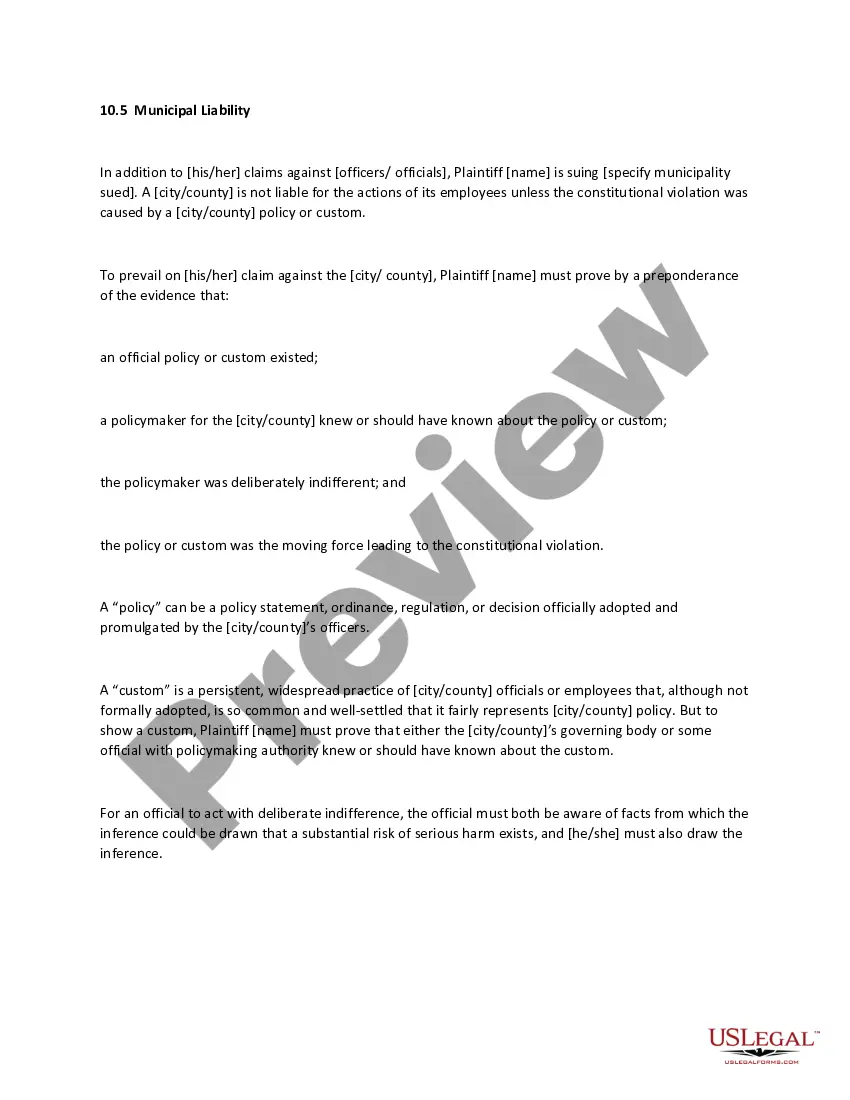
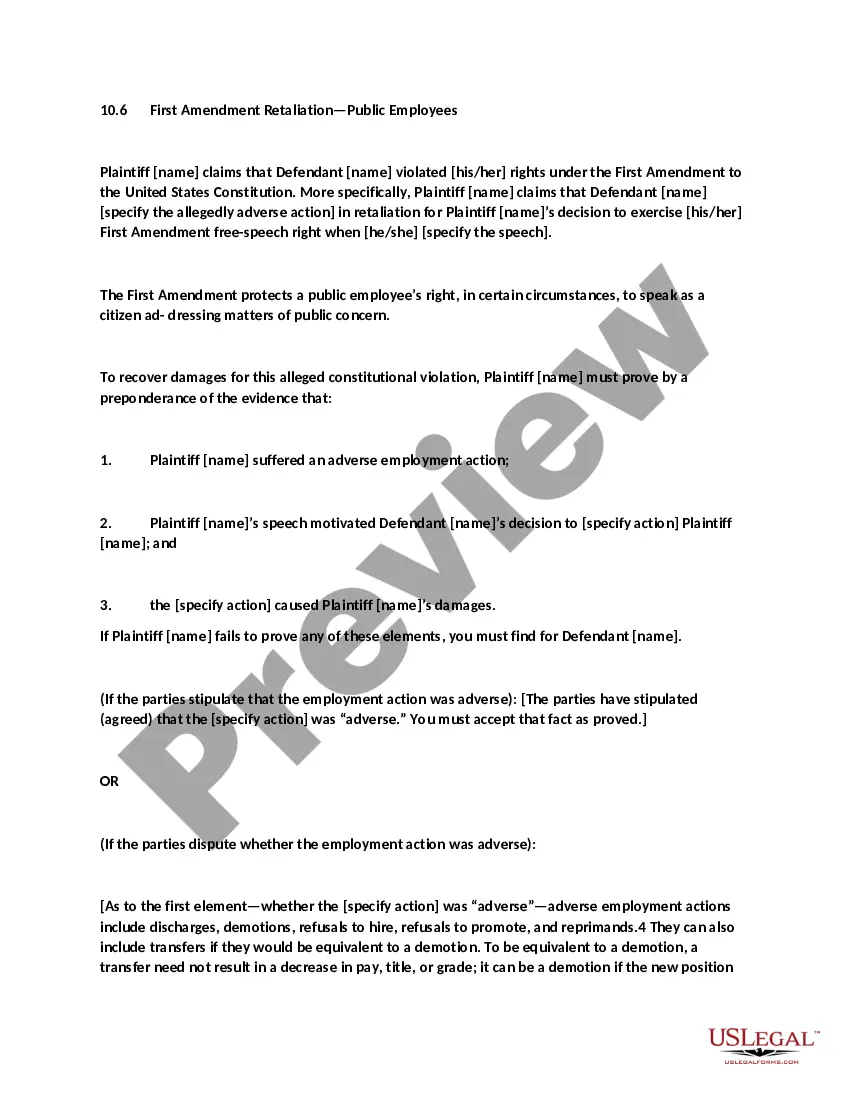
The Issues-Claim for Damages Based Upon Battery-Burden of Proof form is a legal document used to claim damages resulting from a battery incident. This form outlines the necessary elements a plaintiff must establish to hold a municipality liable for the actions of its employees, distinguishing it from other personal injury claims. It provides specific guidelines for proving that a local government entity had a policy or custom that directly led to the violation of constitutional rights.
Key parts of this document
- Identification of the parties involved in the claim.
- Specification of the municipality being sued.
- Requirements to demonstrate a municipal policy or custom.
- Criteria for proving deliberate indifference by municipal officials.
- Standards for establishing the constitutional violation occurred.
Common use cases
This form is essential when a plaintiff seeks to hold a municipality liable for damages caused by battery. It is particularly relevant in cases where an individual believes that their constitutional rights were violated due to actions taken by a city's or county's employees. If you have encountered harm due to a municipal policy or consistent practice that led to the violation, this form is necessary for pursuing your claim.
Intended users of this form
- Individuals who have been victims of battery involving municipal employees.
- Claimants seeking to hold a city or county accountable for violations of constitutional rights.
- Legal representatives handling cases of municipal liability.
- Anyone needing to document the burden of proof required for such claims.
Instructions for completing this form
- Identify all parties involved, including the plaintiff and the municipality.
- Clearly specify the municipality being sued, including details such as city or county.
- Detail the official policy or custom that allegedly led to the constitutional violation.
- Provide evidence supporting the claims of deliberate indifference by municipal officials.
- Ensure all information is accurate and complete before filing.
Is notarization required?
This form usually doesn’t need to be notarized. However, local laws or specific transactions may require it. Our online notarization service, powered by Notarize, lets you complete it remotely through a secure video session, available 24/7.
Get your form ready online
Our built-in tools help you complete, sign, share, and store your documents in one place.
Make edits, fill in missing information, and update formatting in US Legal Forms—just like you would in MS Word.
Download a copy, print it, send it by email, or mail it via USPS—whatever works best for your next step.
Sign and collect signatures with our SignNow integration. Send to multiple recipients, set reminders, and more. Go Premium to unlock E-Sign.
If this form requires notarization, complete it online through a secure video call—no need to meet a notary in person or wait for an appointment.
We protect your documents and personal data by following strict security and privacy standards.

Make edits, fill in missing information, and update formatting in US Legal Forms—just like you would in MS Word.

Download a copy, print it, send it by email, or mail it via USPS—whatever works best for your next step.

Sign and collect signatures with our SignNow integration. Send to multiple recipients, set reminders, and more. Go Premium to unlock E-Sign.

If this form requires notarization, complete it online through a secure video call—no need to meet a notary in person or wait for an appointment.

We protect your documents and personal data by following strict security and privacy standards.
Typical mistakes to avoid
- Failing to properly identify the municipality involved in the claim.
- Neglecting to provide adequate evidence of the policy or custom.
- Overlooking specific legal standards required for proving deliberate indifference.
- Submitting the form without reviewing it for accuracy and completeness.
Why complete this form online
- Convenient access to legally drafted templates ready for download.
- Editable format allows for customization to meet individual needs.
- Time-efficient, enabling users to complete the form at their convenience.
- Reliable legal guidance provided through expertly created content.
Looking for another form?
Form popularity
FAQ
When a person intentionally causes harmful or offensive contact with another person, the act is battery. However, if the plaintiff expressly consented to such an act or gave implied consent by participating in a particular event or situation (e.g., playing sports with the defendant), they are not liable.
Battery is a general intent offense. This means that the actor doesn't need to intend the specific harm resulting from unwanted contact, but only intends to commit an act of unwanted contact.
A plaintiff or complainant in a case for battery does not have to prove an actual physical injury. Rather, the plaintiff must prove unlawful and unpermitted contact with his or her person or property in a harmful or offensive manner.
A common example of an intentional tort is battery, which is when one person causes harmful or physical contact to another. Battery covers many different types of offensive contact, including medical procedures that an unconscious patient did not consent to while conscience.
The prima facie case for battery contains 4 components: The defendant acts. The defendant intends to cause contact with the victim. The defendant's contact with the victim is harmful or offensive. The defendant's contact causes the victim to suffer a contact that is harmful or offensive.
Elements of Battery Battery has, however, three specific elements: The first element is that the defendant acts intending to cause ; second, a harmful or offensive conduct ; third, with the plaintiff's person .
Some courts use the single intent rule which seeks to determine whether or not the defendant intended to touch the plaintiff, while some courts use the dual intent rule which seeks to determine whether or not the defendant sought to harm or offend by touching.
Single v. Double Intent ? Single is the intent to make contact; dual is the intent to make contact and that it be harmful or offensive.