Issues-Claim for Damages Based Upon Assault-Burden of Proof
What this document covers
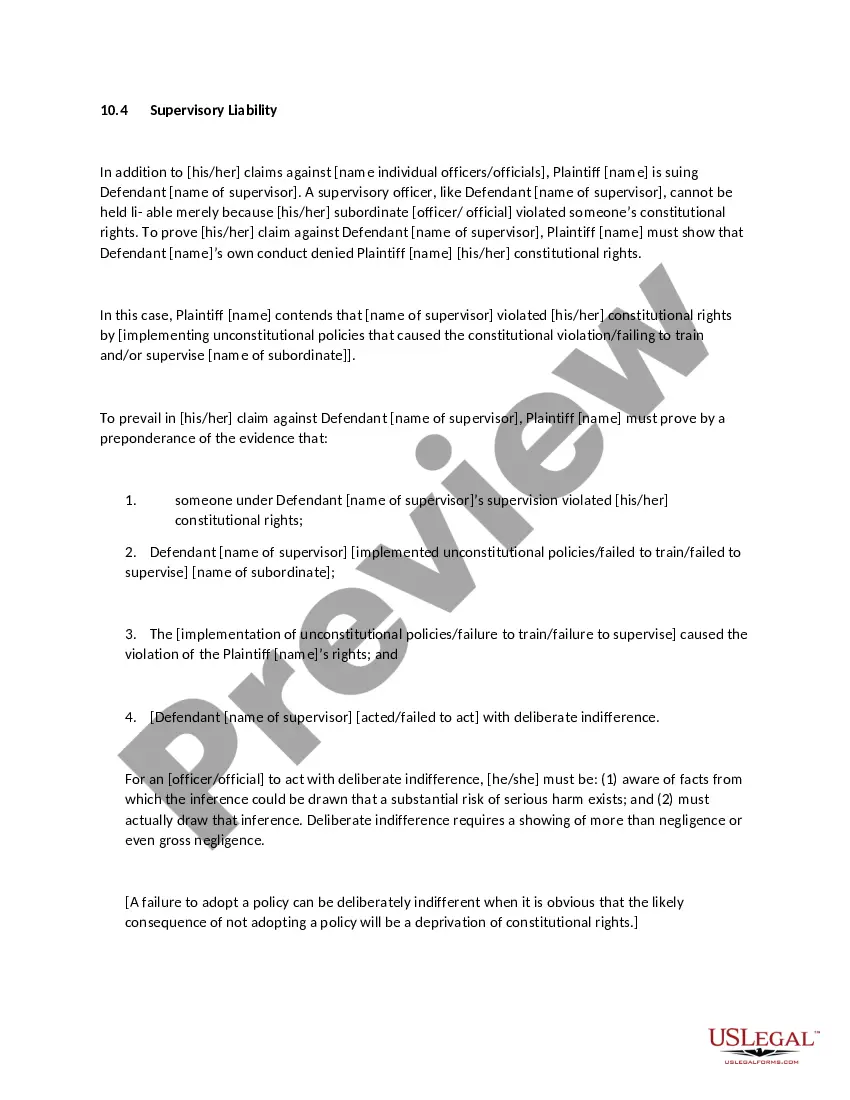
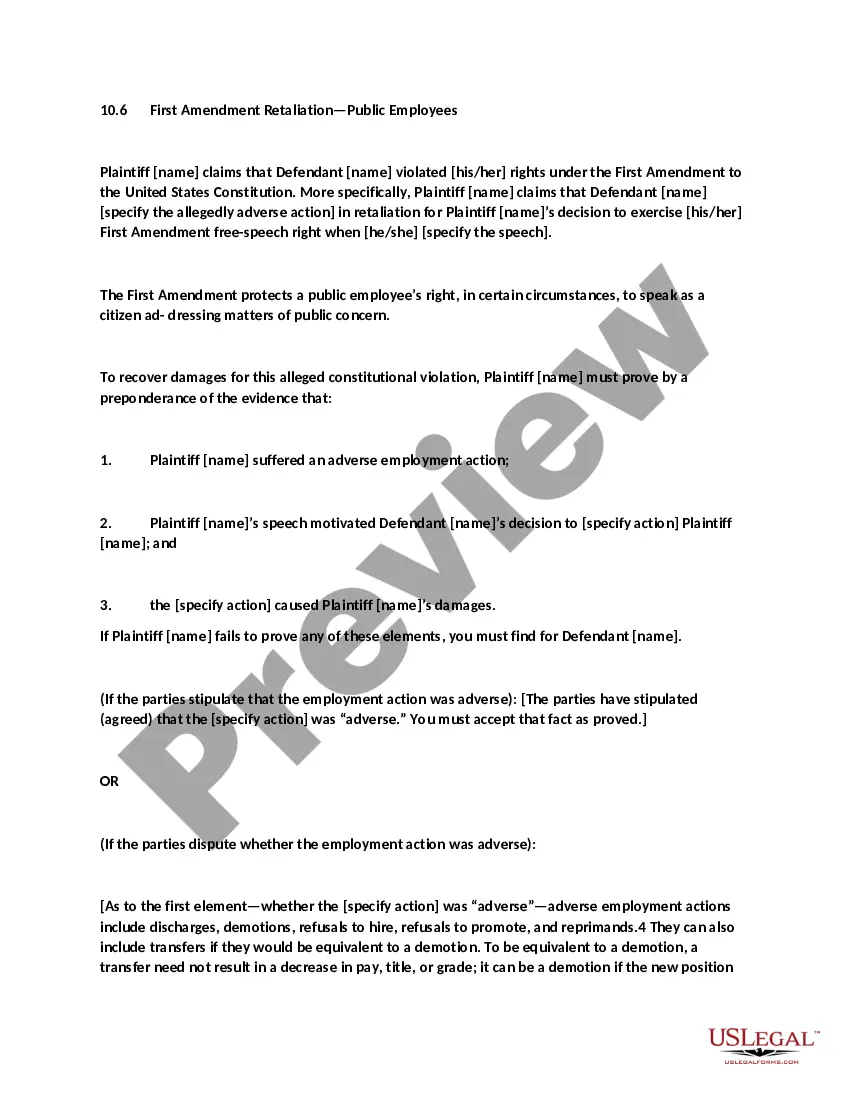
The Issues-Claim for Damages Based Upon Assault-Burden of Proof is a legal document used by victims of assault to assert their claims for damages against responsible parties. This form specifically addresses the burden of proof needed to establish supervisory liability, distinguishing it from other assault-related claims. By detailing the necessary elements required to prove that a supervisor's actions or inactions led to a violation of constitutional rights, it guides plaintiffs through the legal process of seeking compensation for their injuries.
Key parts of this document
- Identification of the plaintiff and defendants, including individual officers and their supervisors.
- Sections detailing claims against defendants based on supervisory liability.
- Criteria for proving a supervisor's liability, including policy implementation and failure to train.
- Explanations of the concept of deliberate indifference in relation to constitutional violations.
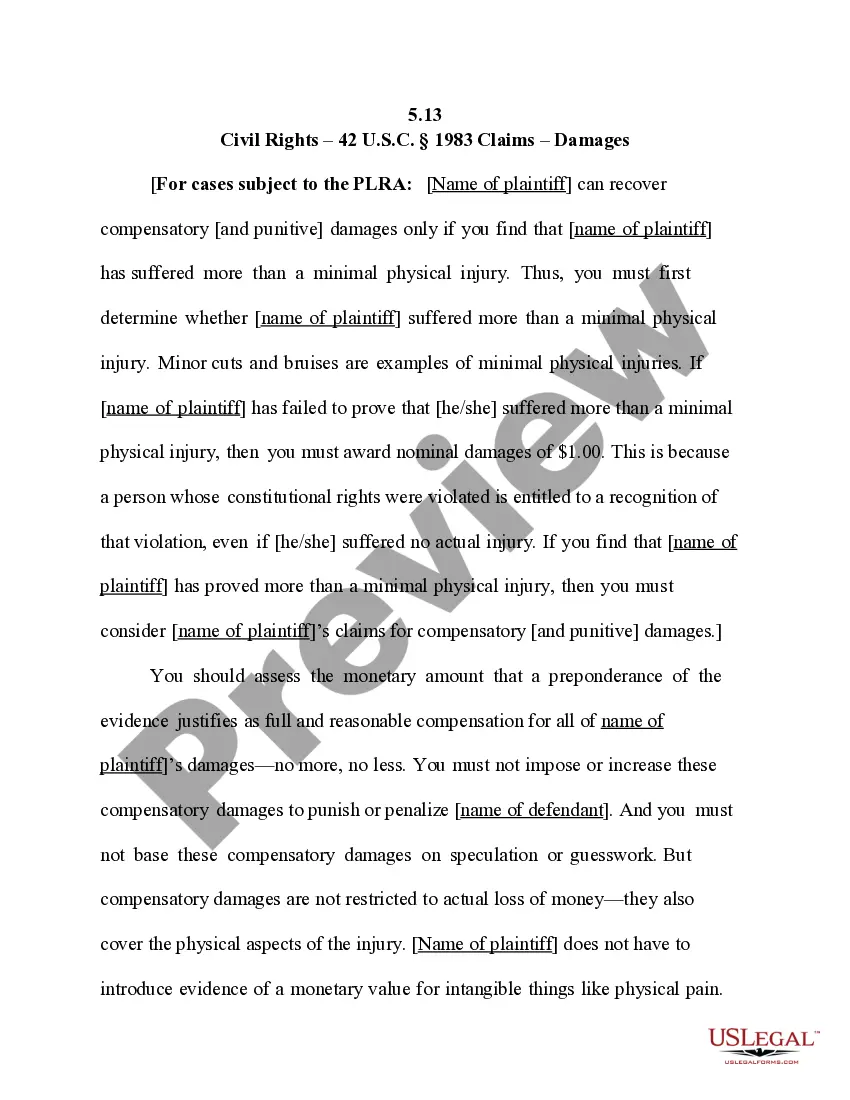
- Evidence requirements, including the preponderance of the evidence needed to support the claim.

Common use cases
This form should be used when an individual seeks to file a legal claim for damages resulting from an assault while also alleging that a supervisor failed to prevent the constitutional violation. Common scenarios include cases involving law enforcement misconduct or other situations where supervisors are accountable for their subordinates' actions. If there are concerns about systemic issues, such as improper training leading to a violation of rights, this form is essential for establishing the supervisor's culpability.
Who should use this form
This form is intended for individuals who have been victims of assault and are seeking legal redress, especially in cases involving claims of supervisory liability. The following individuals should consider using this form:
- Victims of assault who wish to hold not just the offender, but also their supervisor accountable.
- Individuals who have evidence of constitutional rights violations due to the actions or policies of supervisors.
- Legal professionals representing clients in cases involving supervisory liability in assault claims.
How to prepare this document
- Identify the parties involved, including the plaintiff and all defendants.
- Clearly state the basis for the claim against the supervisor, including allegations of unconstitutional policies or failure to train.
- Provide evidence supporting the claims against the supervisor, demonstrating deliberate indifference.
- Include any supporting documents or testimonies that substantiate the claims made.
- Review the completed form for accuracy before filing it with the appropriate court.
Does this form need to be notarized?
This form does not typically require notarization unless specified by local law. However, it is always advisable to check state-specific guidelines to ensure compliance.
Get your form ready online
Our built-in tools help you complete, sign, share, and store your documents in one place.
Make edits, fill in missing information, and update formatting in US Legal Forms—just like you would in MS Word.
Download a copy, print it, send it by email, or mail it via USPS—whatever works best for your next step.
Sign and collect signatures with our SignNow integration. Send to multiple recipients, set reminders, and more. Go Premium to unlock E-Sign.
If this form requires notarization, complete it online through a secure video call—no need to meet a notary in person or wait for an appointment.
We protect your documents and personal data by following strict security and privacy standards.

Make edits, fill in missing information, and update formatting in US Legal Forms—just like you would in MS Word.

Download a copy, print it, send it by email, or mail it via USPS—whatever works best for your next step.

Sign and collect signatures with our SignNow integration. Send to multiple recipients, set reminders, and more. Go Premium to unlock E-Sign.

If this form requires notarization, complete it online through a secure video call—no need to meet a notary in person or wait for an appointment.

We protect your documents and personal data by following strict security and privacy standards.
Mistakes to watch out for
- Failing to properly identify all parties involved in the case.
- Not providing sufficient evidence to support claims of supervisory liability.
- Rushing through the evidence requirements, which can lead to unclear arguments.
- Neglecting to review the form for accuracy and completeness before submission.
Why use this form online
- Immediate access to professionally drafted legal documents tailored to your situation.
- The ability to edit and customize the form according to your specific needs.
- Time-saving features that allow for quick downloads and printing.
- Reliability, ensuring that you are using a form that meets current legal standards.
Legal use & context
- This form is used to initiate a legal claim for damages resulting from assault under supervisory liability.
- The burden of proof lies with the plaintiff to establish the supervisor's liability based on their actions.
- Claims must be supported by evidence demonstrating a direct link between the supervisory failings and the violation of rights.
Key takeaways
- The Issues-Claim for Damages Based Upon Assault clarifies the conditions under which a supervisor can be held liable.
- Clear evidence of negligent supervision and its direct impact on the violation of rights is crucial for success.
- Understanding deliberate indifference is essential to successfully navigate supervisory liability claims.
Looking for another form?
Form popularity
FAQ
Since one party must prove their case to the court for them to prevail, this means that a criminal defendant must present sufficient evidence to convince a jury or judge that they are not guilty beyond a reasonable doubt. Any defendant must understand their rights and responsibilities when facing prosecution in court.
In most cases, the plaintiff (the party bringing the claim) has the burden of proof. As an initial matter, they must meet the burden of production. This requires the plaintiff to put forth evidence in the form of witness testimony, documents, or objects.
During the trial, it is up to the plaintiff to present facts to support the claim against the defendant. In a civil suit, the plaintiff must prove that it is probable that the defendant is legally responsible, or liable, because a civil case is decided on a balance of probabilities.
In a civil case, the plaintiff must convince the jury by a ?preponderance of the evidence? (i.e., that it is more likely than not) that the defendant is responsible for the harm the plaintiff has suffered.
In a civil lawsuit, the burden of proof rests on the plaintiff or the person filing the suit. The plaintiff should prove that the allegations are true and that the defendant, or the other party, caused damages. When it comes to establishing a civil case, the plaintiff must usually do so by a preponderance of evidence.
In civil cases, the plaintiff has the burden of proving their case by a preponderance of the evidence, which means the plaintiff merely needs to show that the fact in dispute is more likely than not.
In order to prove the tort of abuse of process, a plaintiff must establish the following elements: (1) a legal procedure set in motion in proper form, even with probable cause, and even with ultimate success, but (2) perverted to accomplish an ulterior purpose for which it was not designed, and (3) a willful act in the
THE PROSECUTION IN A CRIMINAL CASE BEARS THE BURDEN OF PROVING TO THE JURY BEYOND A REASONABLE DOUBT ALL OF THE ELEMENTS NECESSARY TO ESTABLISH THE GUILT OF THE DEFENDANT.