Florida Special Warranty Deed Individual to Trust
What this document covers
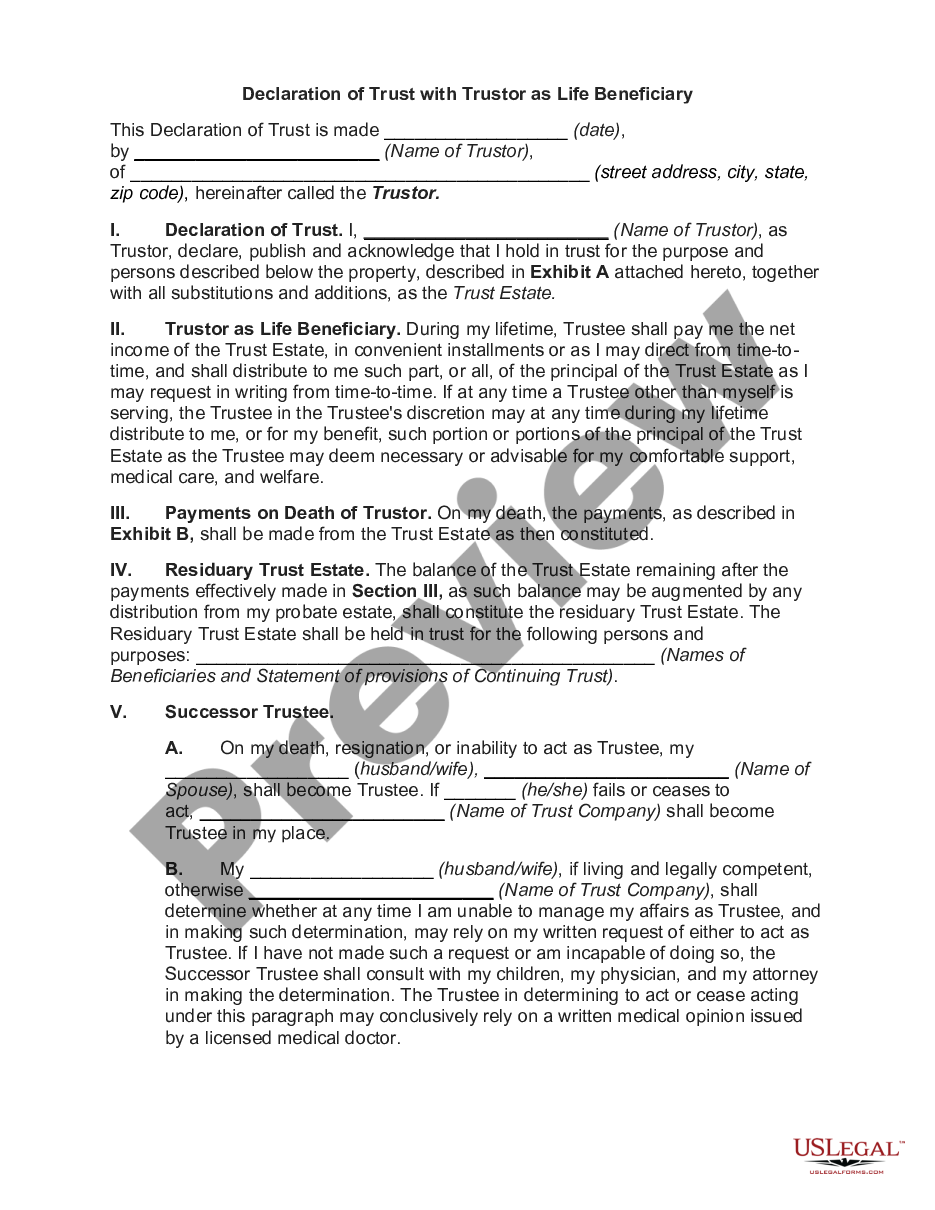
The Special Warranty Deed Individual to Trust is a legal document that allows an individual (the grantor) to transfer property to a trust (the grantee). This deed includes specific warranties of title and complies with state laws, making it distinct from general warranty deeds. It is used when the property owner wishes to convey their interest to a trust for estate planning or asset management purposes.
Form components explained
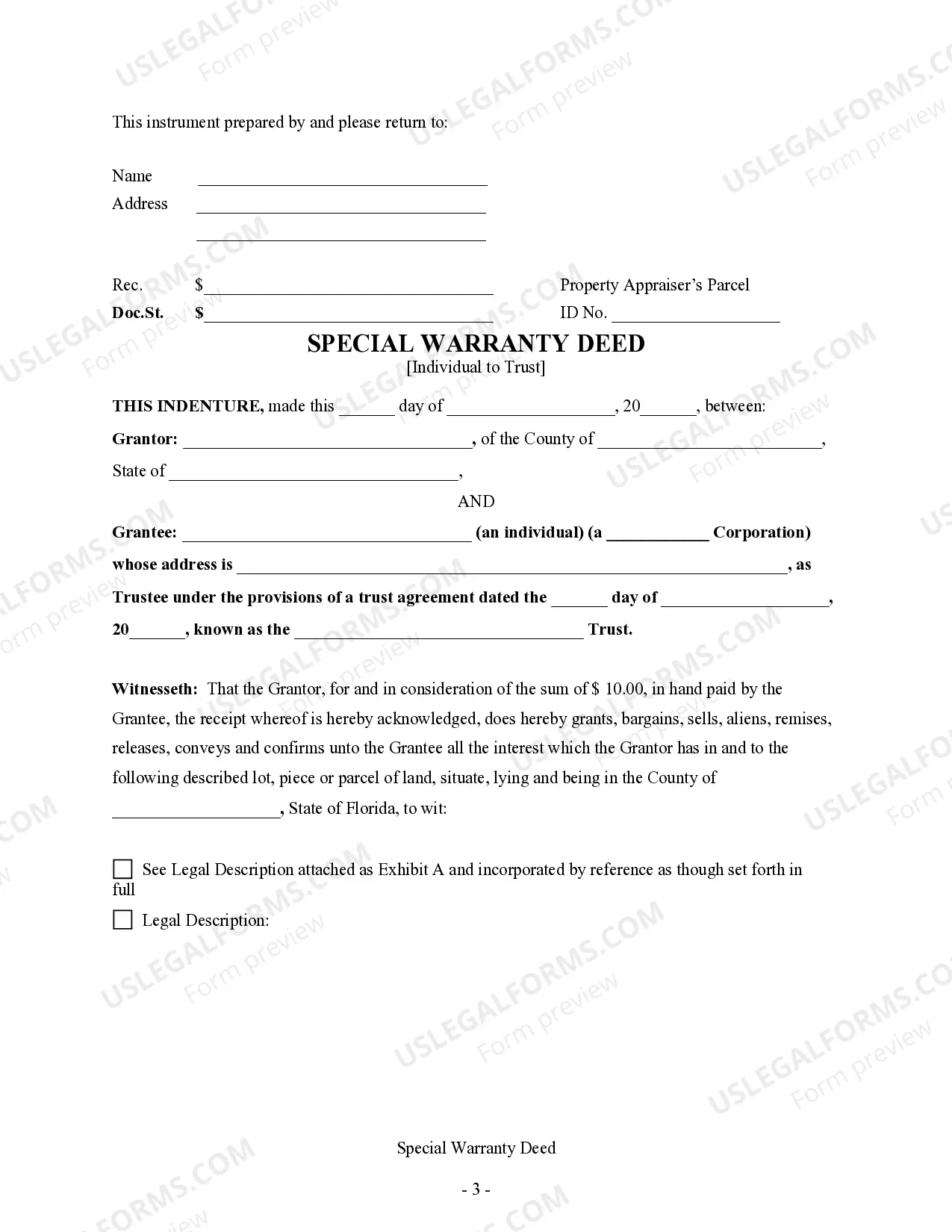
- Identification of the grantor and grantee.
- Description of the property being transferred.
- Warranties made by the grantor regarding the title.
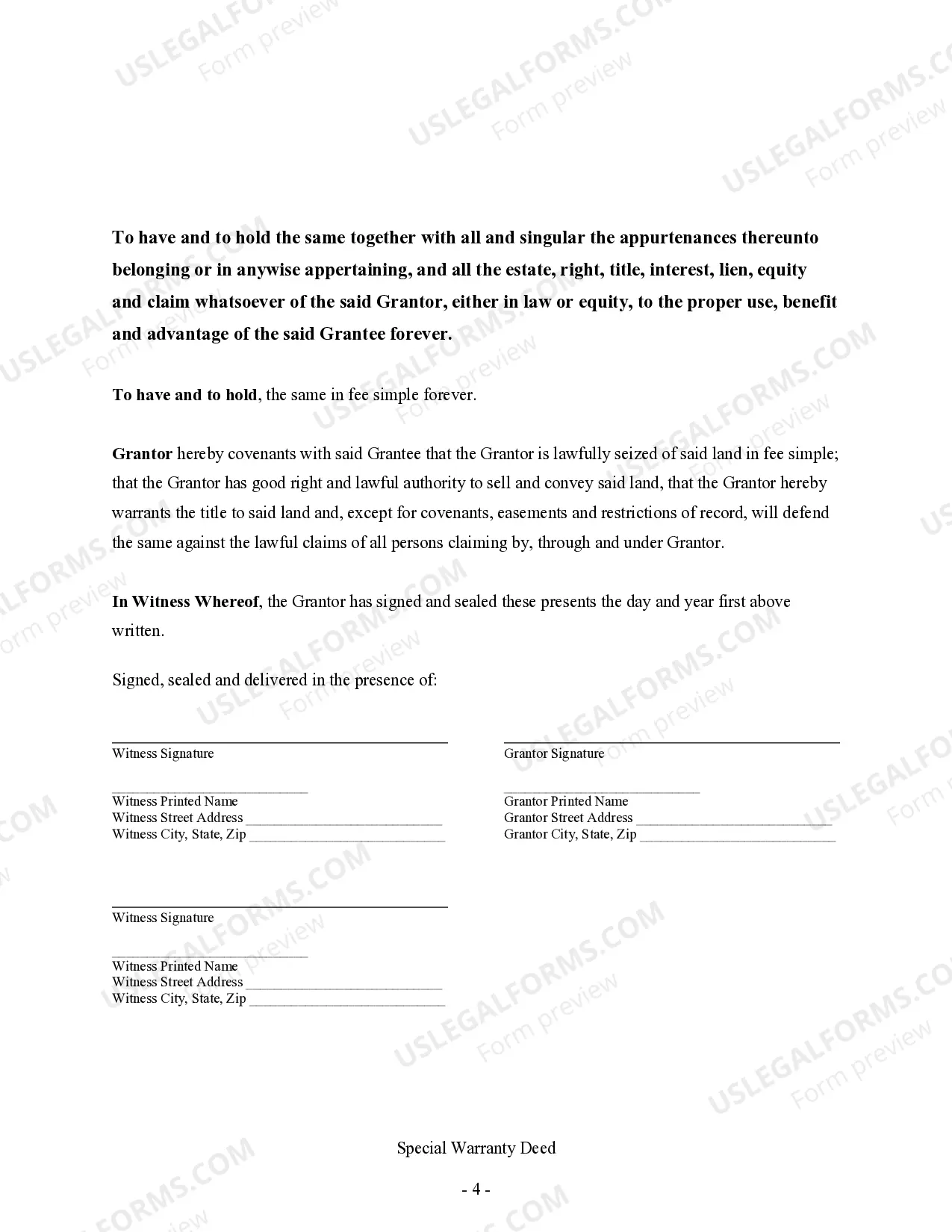
- Execution details, including signatures and witnesses.



When this form is needed
This form is useful when an individual wants to transfer real estate into a trust. It may be used for various situations, including estate planning, protecting assets, or managing property for beneficiaries. For example, if someone wishes to place their home into a trust to facilitate smoother inheritance for heirs, this form is appropriate.
Who should use this form
This form is intended for:
- Individuals transferring property to a trust.
- Trustees managing assets within the trust.
- Estate planners seeking a reliable means of property transfer.
Instructions for completing this form
- Identify the parties involved by entering the names of the grantor and the trust.
- Specify the property being transferred, focusing on accurate descriptions.
- Include the date of the transfer and ensure all legal names are correct.
- Have the form signed by the grantor in the presence of witnesses.
- Confirm that the document meets any additional requirements for your state or situation.
Does this form need to be notarized?
This form does not typically require notarization unless specified by local law. However, increasing the document's validity is advisable, and U.S. Legal Forms offers integrated online notarization for added convenience.
Get your form ready online
Our built-in tools help you complete, sign, share, and store your documents in one place.
Make edits, fill in missing information, and update formatting in US Legal Forms—just like you would in MS Word.
Download a copy, print it, send it by email, or mail it via USPS—whatever works best for your next step.
Sign and collect signatures with our SignNow integration. Send to multiple recipients, set reminders, and more. Go Premium to unlock E-Sign.
If this form requires notarization, complete it online through a secure video call—no need to meet a notary in person or wait for an appointment.
We protect your documents and personal data by following strict security and privacy standards.

Make edits, fill in missing information, and update formatting in US Legal Forms—just like you would in MS Word.

Download a copy, print it, send it by email, or mail it via USPS—whatever works best for your next step.

Sign and collect signatures with our SignNow integration. Send to multiple recipients, set reminders, and more. Go Premium to unlock E-Sign.

If this form requires notarization, complete it online through a secure video call—no need to meet a notary in person or wait for an appointment.

We protect your documents and personal data by following strict security and privacy standards.
Common mistakes to avoid
- Failing to accurately describe the property.
- Not having the required signatures and witnesses.
- Using outdated forms that do not comply with current laws.
Advantages of online completion
- Convenience of downloading and completing the form at your own pace.
- Editability, allowing you to correct mistakes before finalizing.
- Reliability from forms drafted by licensed attorneys, ensuring legal compliance.
Main things to remember
- A Special Warranty Deed transfers property from an individual to a trust with specific warranties of title.
- Ensure all details are complete and accurate to avoid legal complications.
- This form is beneficial for estate planning and asset management.
Looking for another form?
Form popularity
FAQ
Another common name for a special warranty deed is a 'limited warranty deed.' This term reflects its limited nature, as it offers warranties solely for the seller’s time of ownership. Utilizing the Florida Special Warranty Deed Individual to Trust ensures you understand exactly what protections you receive. Accessing platforms like US Legal Forms can simplify this process and provide the necessary documentation.
While you are not legally required to hire a lawyer to transfer a deed in Florida, consulting with one can be advantageous. Navigating the legalities of a Florida Special Warranty Deed Individual to Trust may seem daunting without proper guidance. If you choose to go it alone, consider using online legal services like US Legal Forms to assist with the preparation and filing of your deed correctly.
Yes, a warranty deed can indeed be transferred. In the context of a Florida Special Warranty Deed Individual to Trust, the property ownership can change hand while ensuring that the warranty covers only the time the seller owned the property. This type of deed assures the buyer against any claims that may arise from the seller's period of ownership, making it a secure option for significant transactions.
Transferring a warranty deed in Florida involves drafting the deed document and having it signed before a notary. You will then file it with the county recorder’s office where the property is located. It’s essential that you understand local practices, so leveraging platforms like US Legal Forms can guide you through creating and filing a Florida Special Warranty Deed Individual to Trust accurately.
To transfer a warrant deed in Florida, you must prepare the deed and then sign it in front of a notary. The Florida Special Warranty Deed Individual to Trust should clearly indicate the grantor and grantee, as well as any legal descriptions of the property. After signing, you must record the deed with the appropriate county office. This final step legally finalizes the transfer of ownership.
Yes, you can file a warranty deed yourself in Florida if you understand the process. However, using a Florida Special Warranty Deed Individual to Trust might be complex without guidance. It's always beneficial to consider using services like US Legal Forms, which can help streamline the process and ensure compliance with local laws. This way, you minimize the chances of errors and ensure that your deed is processed correctly.
Filling out a special warranty deed requires similar steps to a general warranty deed. Start with the basic details, including the grantor's and grantee's names, addresses, and a complete legal description of the property being transferred. Specify that this is a Florida Special Warranty Deed Individual to Trust, as this indicates limited warranties regarding the property. After filling out the necessary details, sign the document in front of a notary public to finalize the deed.
To fill out a warranty deed in Florida, begin by obtaining the correct form, such as a Florida Special Warranty Deed Individual to Trust. Clearly list the grantor and grantee information, including addresses and legal descriptions of the property. Next, include any necessary terms that specify the type of trust involved. Lastly, sign the deed in the presence of a notary public to ensure it is legally binding.
One of the biggest mistakes parents make when setting up a trust fund is failing to clearly define the beneficiaries and their respective shares. This can lead to confusion and conflict later on. Additionally, neglecting to fund the trust properly can result in assets not being distributed as intended. To avoid such pitfalls, carefully consider your family dynamics and consult professionals if needed.
Transferring a deed to a trust in Florida involves drafting a Florida Special Warranty Deed Individual to Trust. You will need to detail the property description and name the trust as the new owner. After executing the deed with notarization, file it with the county clerk's office to complete the process. This formalizes the transfer and ensures your property is legally held in the trust.