Failure to Register as Sex offender
About this form
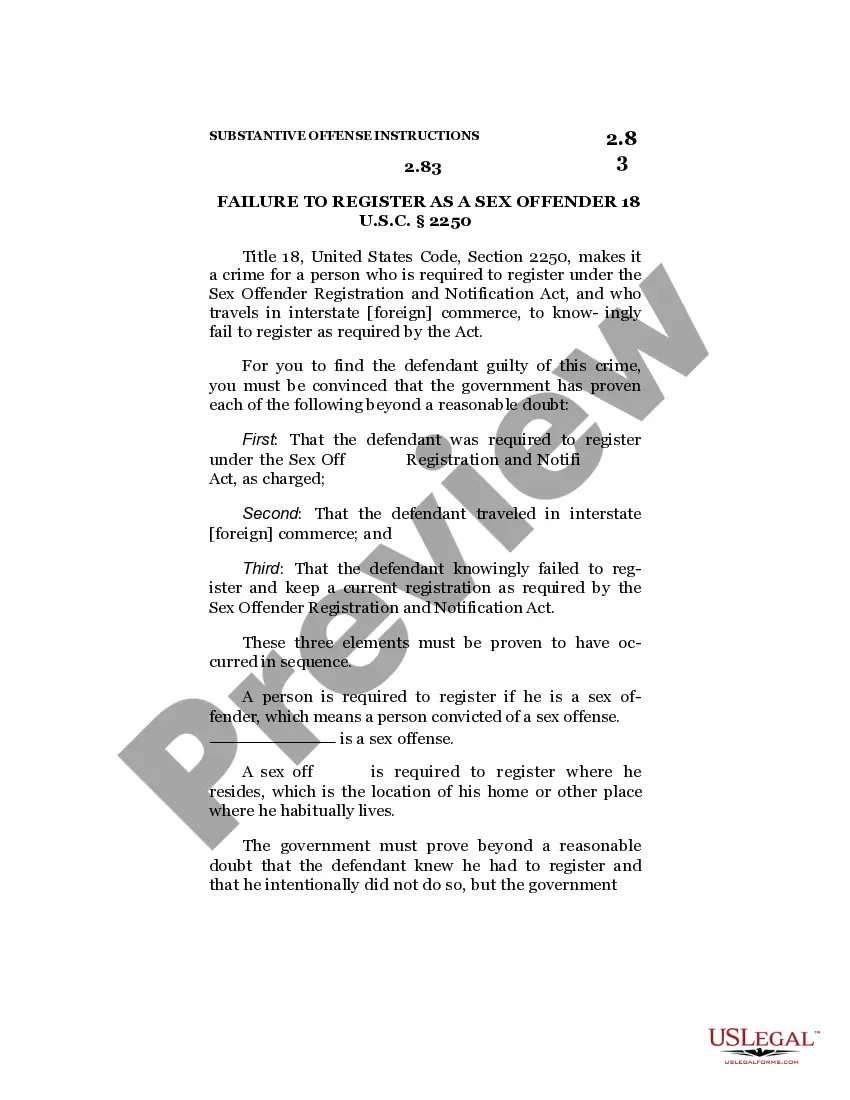
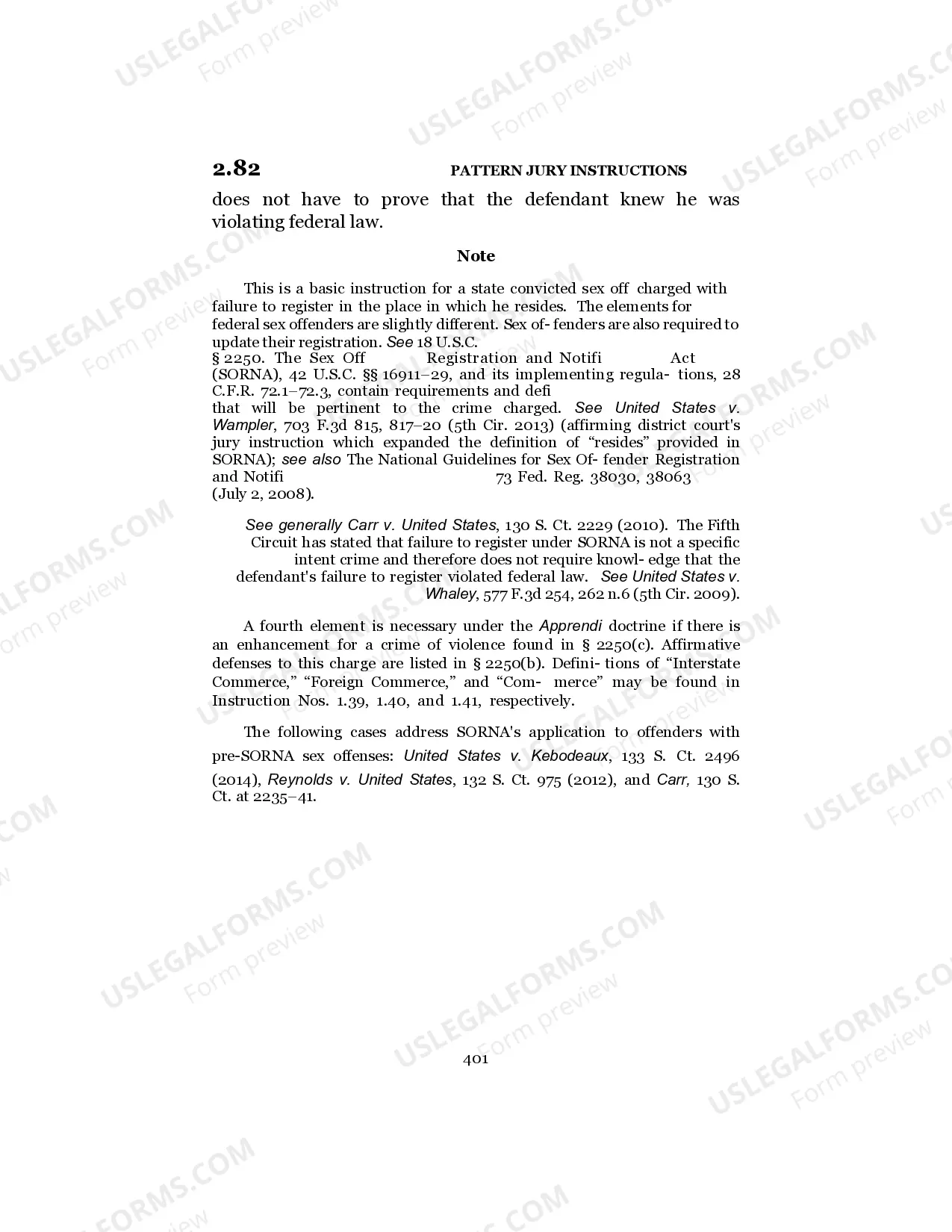
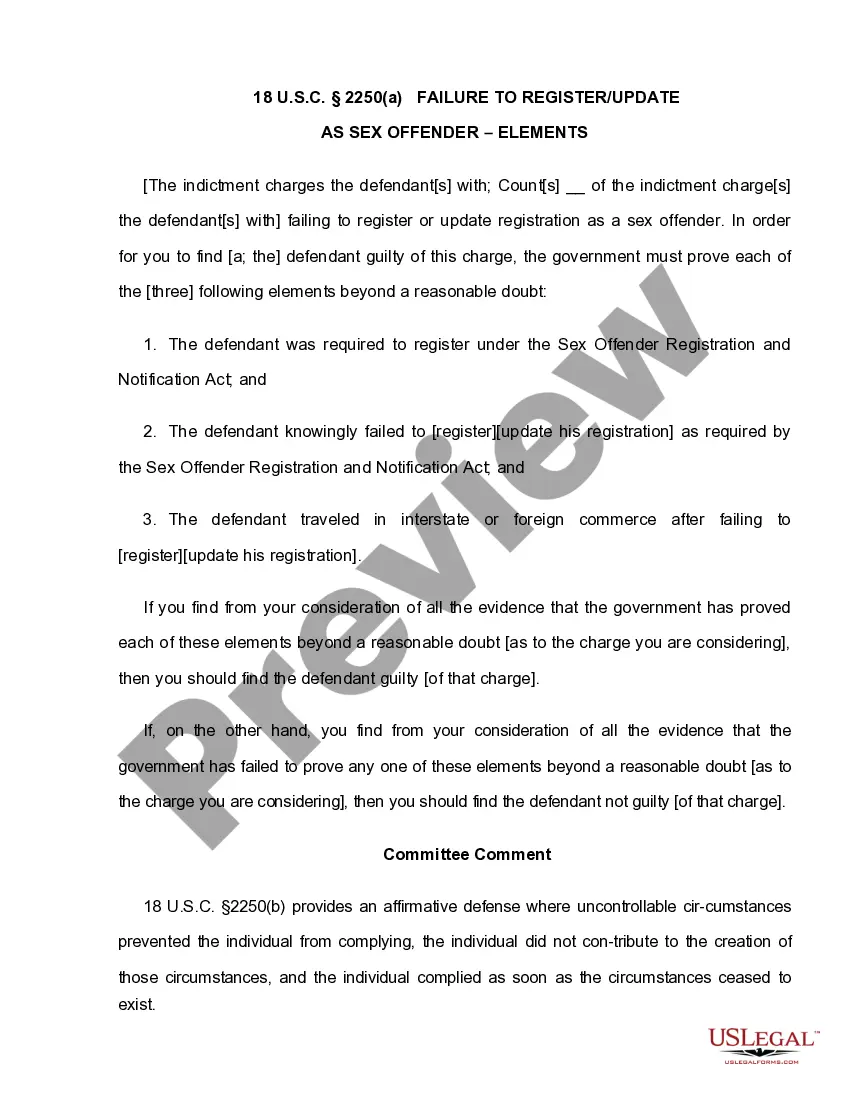
The Failure to Register as a Sex Offender form is a legal document used in cases involving individuals who have been convicted of a sex offense and are required to register under the Sex Offender Registration and Notification Act (SORNA). This form outlines the legal requirements and implications for those who knowingly fail to register or update their registration as mandated. This form is crucial for understanding the legal obligations that come with being labeled a sex offender and the consequences of non-compliance.
Key parts of this document
- Definitions of sex offender and requirements for registration
- Legal obligations to register under SORNA
- Consequences of failing to register as specified by federal law
- Proof requirements for the prosecution to establish guilt
- Details regarding interstate and foreign commerce related to registration
When this form is needed
This form should be used when an individual, who has been previously convicted of a sex offense, has failed to register or update their registration as required by law. It is pertinent in situations where legal action is taken against the individual for non-compliance with the registration requirements, especially in cases involving travel across state lines or international borders.
Intended users of this form
- Individuals convicted of a sex offense required to register under SORNA
- Legal representatives or attorneys working on behalf of sex offenders
- Law enforcement agencies handling cases of failure to register
How to prepare this document
- Gather necessary information about the defendant, including their conviction details.
- Identify the specific federal law under which the charge is filed.
- Document the evidence of travel in interstate or foreign commerce.
- Prepare to show proof that the defendant was aware of their registration requirements.
- Complete all sections of the form accurately before submission.
Does this form need to be notarized?
Notarization is not commonly needed for this form. However, certain documents or local rules may make it necessary. Our notarization service, powered by Notarize, allows you to finalize it securely online anytime, day or night.
Get your form ready online
Our built-in tools help you complete, sign, share, and store your documents in one place.
Make edits, fill in missing information, and update formatting in US Legal Forms—just like you would in MS Word.
Download a copy, print it, send it by email, or mail it via USPS—whatever works best for your next step.
Sign and collect signatures with our SignNow integration. Send to multiple recipients, set reminders, and more. Go Premium to unlock E-Sign.
If this form requires notarization, complete it online through a secure video call—no need to meet a notary in person or wait for an appointment.
We protect your documents and personal data by following strict security and privacy standards.

Make edits, fill in missing information, and update formatting in US Legal Forms—just like you would in MS Word.

Download a copy, print it, send it by email, or mail it via USPS—whatever works best for your next step.

Sign and collect signatures with our SignNow integration. Send to multiple recipients, set reminders, and more. Go Premium to unlock E-Sign.

If this form requires notarization, complete it online through a secure video call—no need to meet a notary in person or wait for an appointment.

We protect your documents and personal data by following strict security and privacy standards.
Avoid these common issues
- Failing to provide accurate information about previous convictions
- Neglecting to include evidence of interstate travel
- Submitting the form without verifying state-specific requirements
- Overlooking deadlines for registration or updates
Benefits of using this form online
- Convenience of easy access from anywhere at any time
- Editability allows for corrections before finalizing
- Reliable templates drafted by licensed attorneys
- Time-saving compared to traditional legal processes
Looking for another form?
Form popularity
FAQ
Failing to Register Can Equal Prison If convicted, the offender faces a prison term for a first-degree felony in Ohio, which is between three and 11 years.
Under Ohio law, all convicted sex offenders must remain on a state list anywhere from 15 years to a lifetime. Registration became law under ?Megan's Law?. Ohio's Sex Offender Registration & Notification Law (Sorn Law), governed by Ohio Revised Code Title 29 Chapter 2950, is an offense-based registry system.
A Tier I sex offender is a person who has been convicted of, or pleaded guilty to, a sexually oriented offense that is not a Tier II or Tier III offense. 23 ORC 2950.01(E)(3).
If you are required to register as a sex offender and fail to do so, there will be severe repercussions. A first conviction for failing to report your address is punished by a prison term between one and thirty years. A second conviction for failing to register will be a prison term between five and thirty years.
Failing to register as a sex offender is a class E felony unless the person is required to register based on having committed an offense in chapter 566 which was an unclassified felony, a class A or B felony, or a felony involving a child under the age of fourteen, in which case it is a class D felony.
Failure to register as a sex offender from misdemeanor or a fourth- or fifth-degree felony conviction will incur a fourth-degree felony charge resulting in anywhere from six to 18 months in prison.
3 of the most common defenses to a criminal charge of failing to register as a sex offender are: extenuating circumstances outside of the defendant's control caused the failure to register, the defendant justifiably was not aware of their need to register, and. the defendant did, in fact, register.
Tier III offenders remain on the public registry for life, and must verify registration information every 90 days.