Authorization for Release of Personal Information
Understanding this form
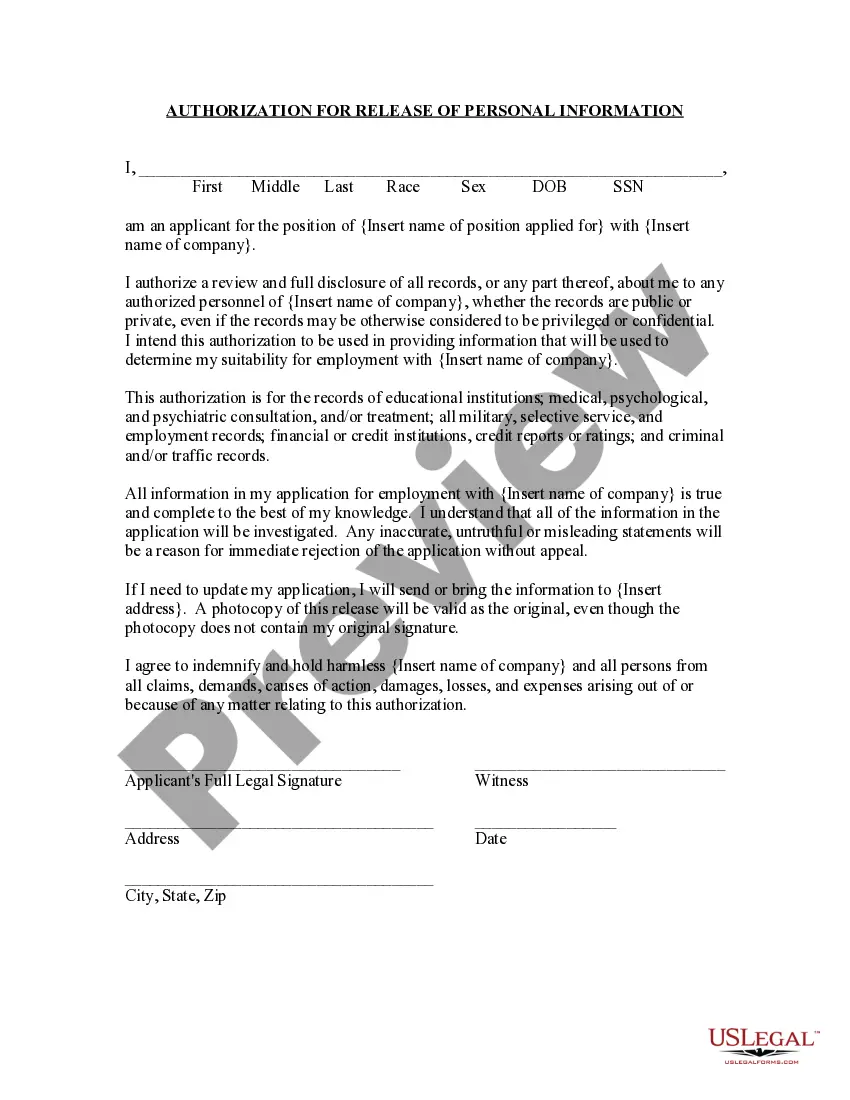
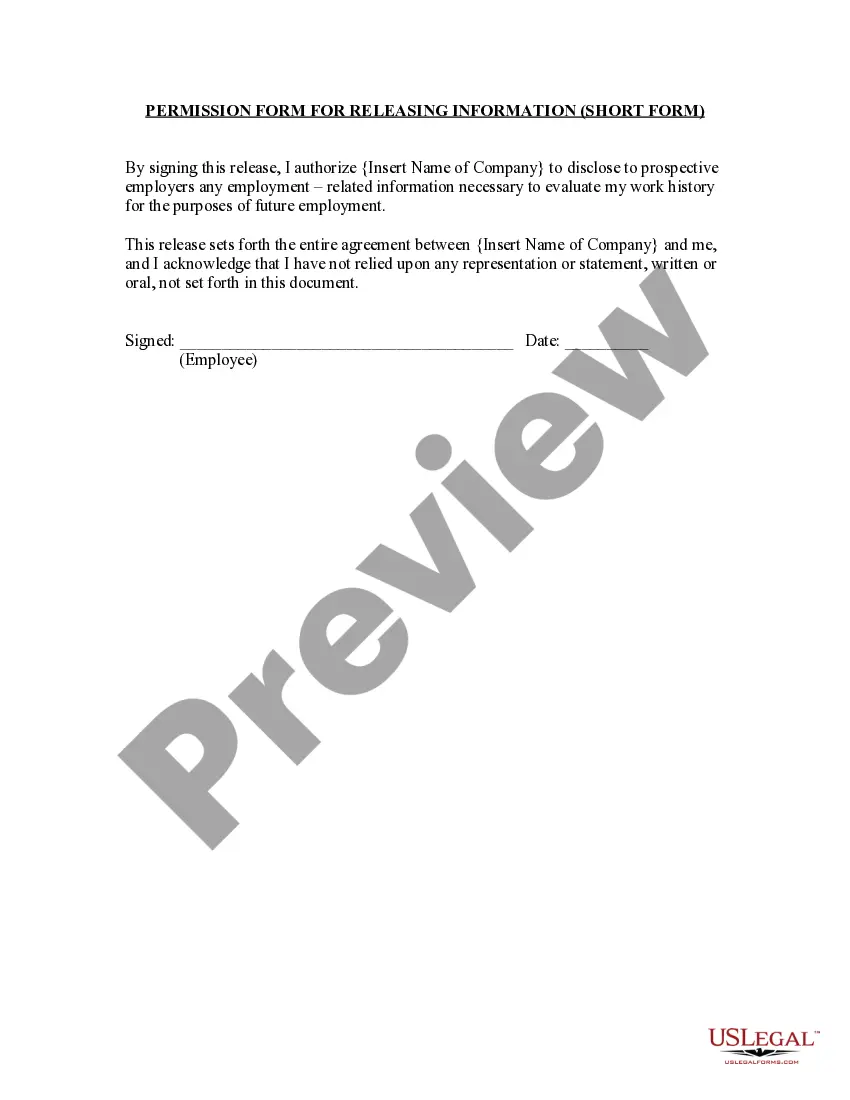
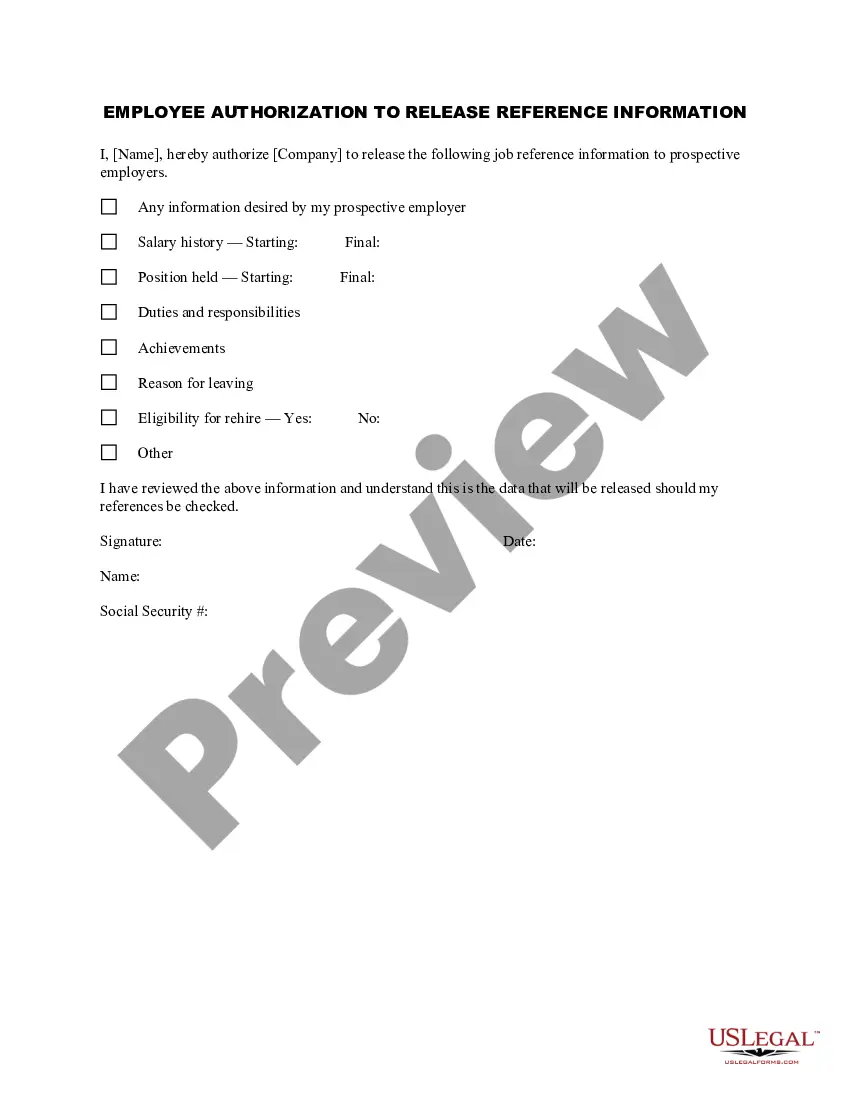
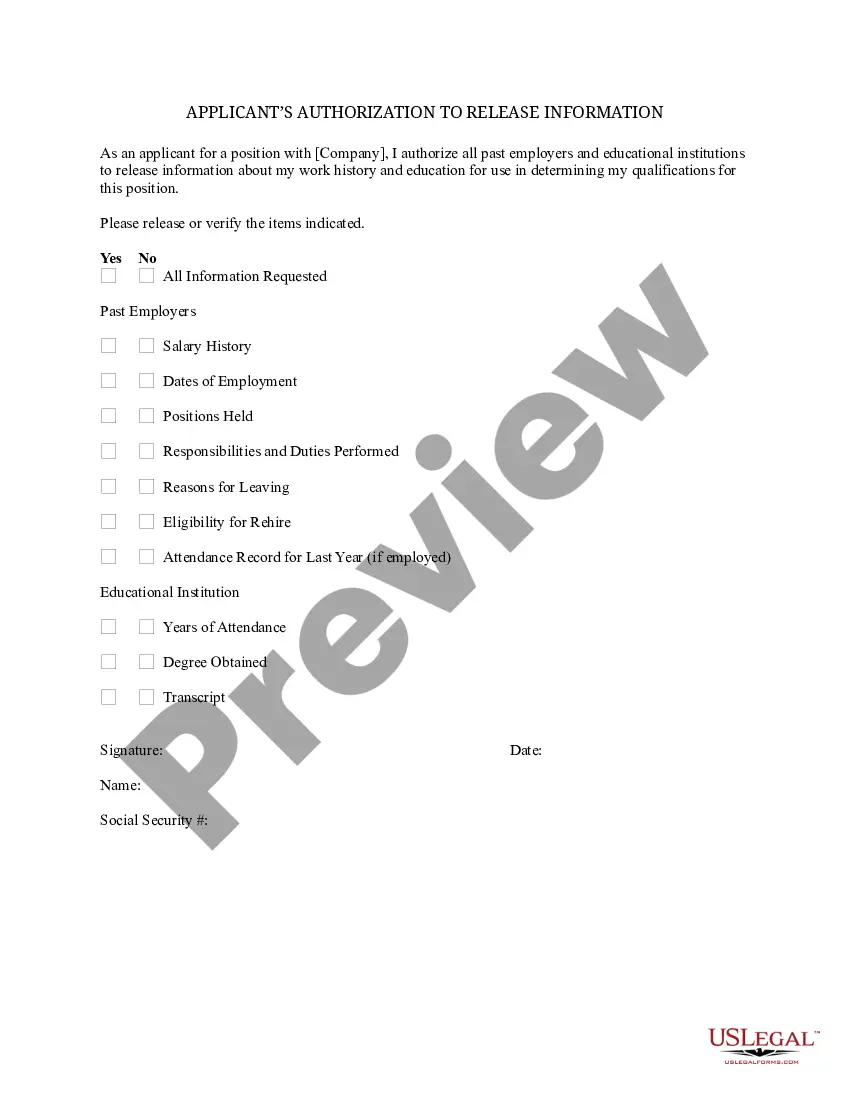
The Authorization for Release of Personal Information is a legal document that allows employers to obtain information about job applicants. This form is essential for employers of all sizes to ensure they have access to relevant personal records, which helps them assess the applicant's suitability for employment. It differs from other employment forms by specifically focusing on obtaining consent to review various personal records, including educational, medical, and employment documents.
What’s included in this form
- Applicant's full legal name and personal details
- Job position applied for and company name
- Authorization for review of educational, medical, and employment records
- Disclosure agreement regarding the validity of application information
- Signatures of the applicant and a witness
Common use cases
Who can use this document
This form is intended for:
- Job applicants seeking employment at various organizations
- Employers who need to perform background checks before hiring
- HR professionals managing the hiring process
Completing this form step by step
- Enter the applicant's full legal name, including first, middle, and last names.
- Specify the job position applied for and the name of the company.
- Complete the personal details section, including race, sex, date of birth, and Social Security number.
- Sign the form in the designated area, and have a witness sign as well.
- Provide the address and date at the bottom of the form.
Does this document require notarization?
This form usually doesn’t need to be notarized. However, local laws or specific transactions may require it. Our online notarization service, powered by Notarize, lets you complete it remotely through a secure video session, available 24/7.
Get your form ready online
Our built-in tools help you complete, sign, share, and store your documents in one place.
Make edits, fill in missing information, and update formatting in US Legal Forms—just like you would in MS Word.
Download a copy, print it, send it by email, or mail it via USPS—whatever works best for your next step.
Sign and collect signatures with our SignNow integration. Send to multiple recipients, set reminders, and more. Go Premium to unlock E-Sign.
If this form requires notarization, complete it online through a secure video call—no need to meet a notary in person or wait for an appointment.
We protect your documents and personal data by following strict security and privacy standards.

Make edits, fill in missing information, and update formatting in US Legal Forms—just like you would in MS Word.

Download a copy, print it, send it by email, or mail it via USPS—whatever works best for your next step.

Sign and collect signatures with our SignNow integration. Send to multiple recipients, set reminders, and more. Go Premium to unlock E-Sign.

If this form requires notarization, complete it online through a secure video call—no need to meet a notary in person or wait for an appointment.

We protect your documents and personal data by following strict security and privacy standards.
Typical mistakes to avoid
- Failing to fill in all required personal details.
- Neglecting to obtain a witness signature.
- Not specifying the job position or company name accurately.
- Leaving the date field blank or incorrect.
Advantages of online completion
- Convenience of downloading and printing the form as needed.
- Editability allows for accurate completion before submission.
- Access to professionally drafted templates ensures legal reliability.
Legal use & context
- This authorization form is important for protecting both the applicant's rights and the employer's need for complete and accurate information.
- It ensures that the employer can legally access necessary personal records to make informed hiring decisions.
Key takeaways
- The Authorization for Release of Personal Information is essential for job applicants and employers.
- Completing the form accurately is critical to avoid delays in hiring.
- Understand your rights regarding personal information disclosure when signing this form.
Looking for another form?
Form popularity
FAQ
No, you should not sign the HIPAA authorization for the release of your medical records. Often, the insurance company will act as though they cannot begin to decide how much money to offer you until they have all of your medical records.
Your authorization allows the Health Plan (your health insurance carrier or HMO) to release your protected health information to a person or organization that you choose.Revoking this authorization will not affect any action taken prior to receipt of your written request.
Release of information (ROI) in healthcare is critical to the quality of the continuity of care provided to the patient. It also plays an important role in billing, reporting, research, and other functions. Many laws and regulations govern how, when, what, and to whom protected health information (PHI) is released.
A HIPAA-compliant HIPAA release form must, at the very least, contain the following information: A description of the information that will be used/disclosed. The purpose for which the information will be disclosed. The name of the person or entity to whom the information will be disclosed.
Patient requests must be written without requiring a "formal" release form. Include signature, printed name, date, and records desired. Release a copy only, not the original. The physician may prepare a summary of the medical record, if acceptable to the patient.
An authorization is a detailed document that gives covered entities permission to use protected health information for specified purposes, which are generally other than treatment, payment, or health care operations, or to disclose protected health information to a third party specified by the individual.
The core elements of a valid authorization include: A meaningful description of the information to be disclosed. The name of the individual or the name of the person authorized to make the requested disclosure. The name or other identification of the recipient of the information.
The patient's legal name, date of birth, gender, Social Security number, address, telephone number, guarantor, subscriber, or next-of-kin are key identifying elements that assist in establishing the proper individual.