Request for Accommodation under the ADA
About this form
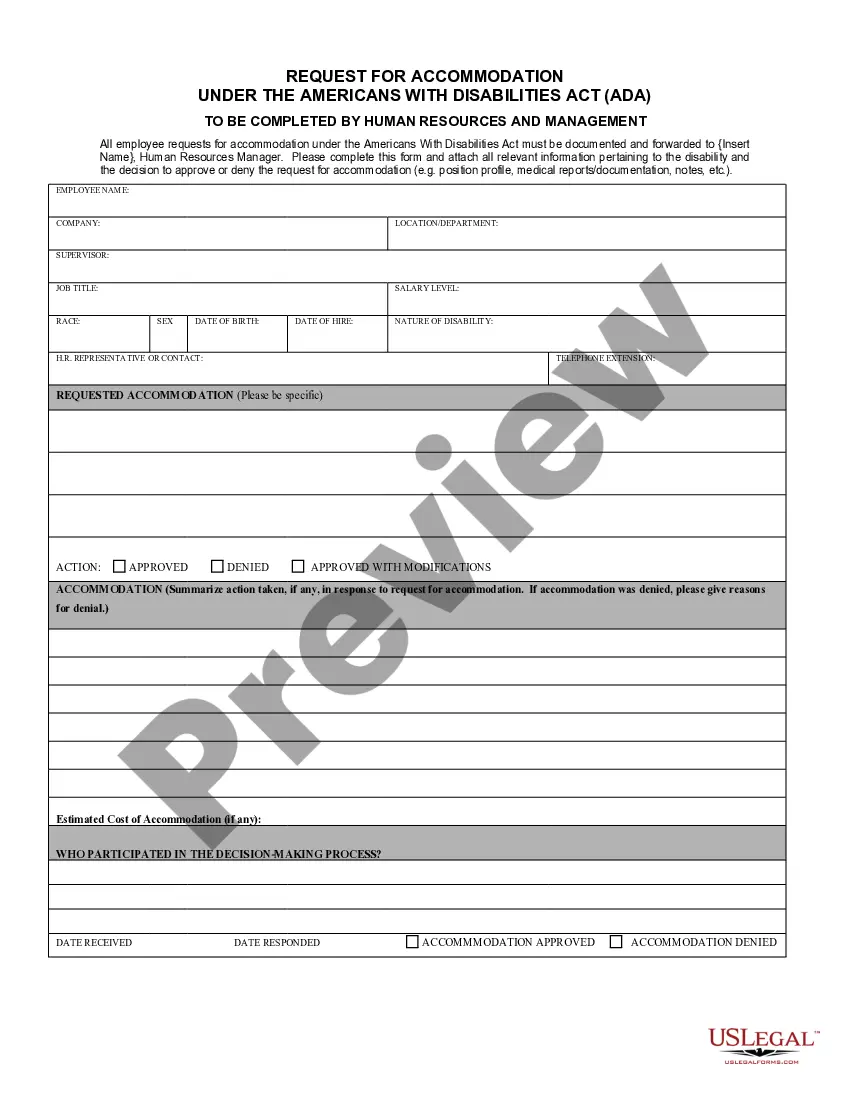
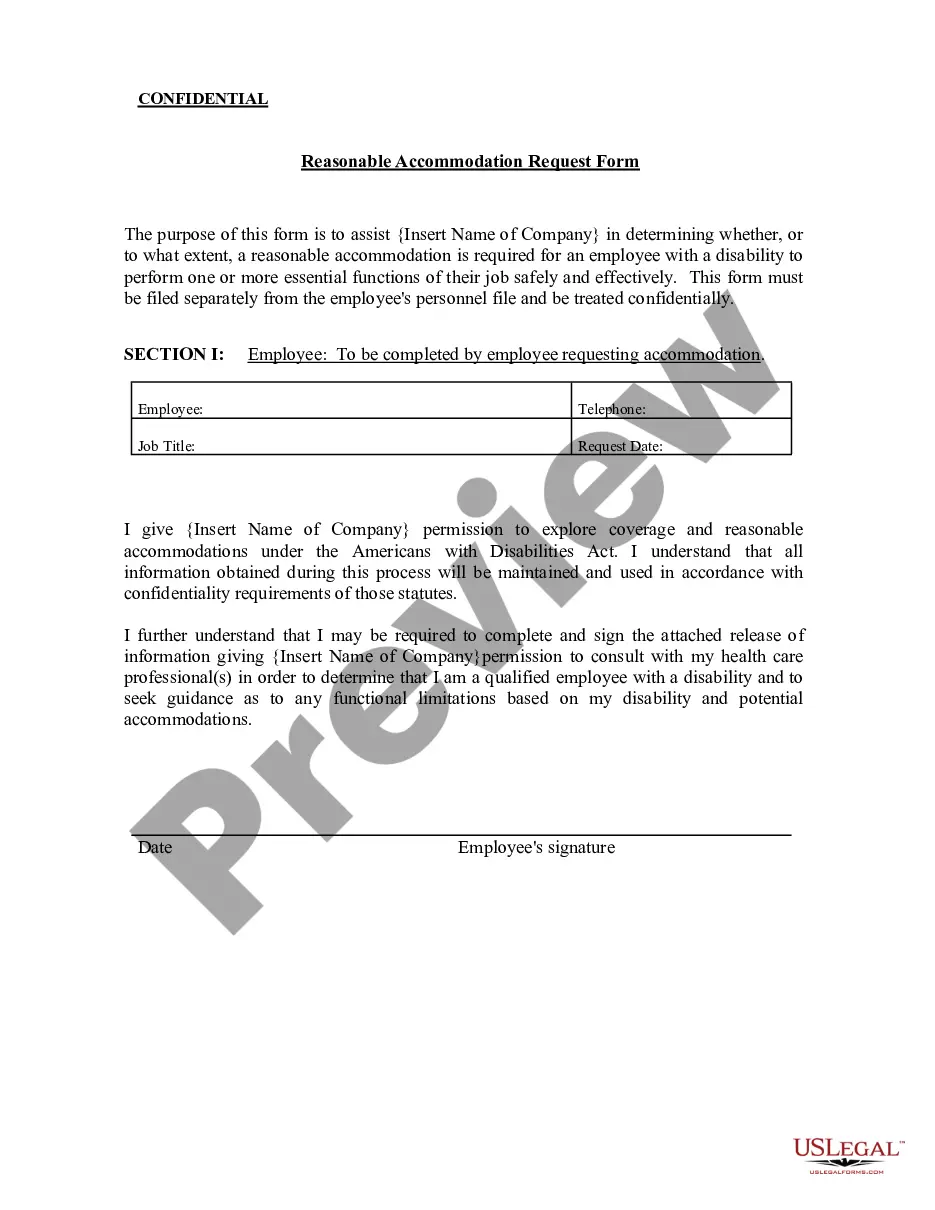
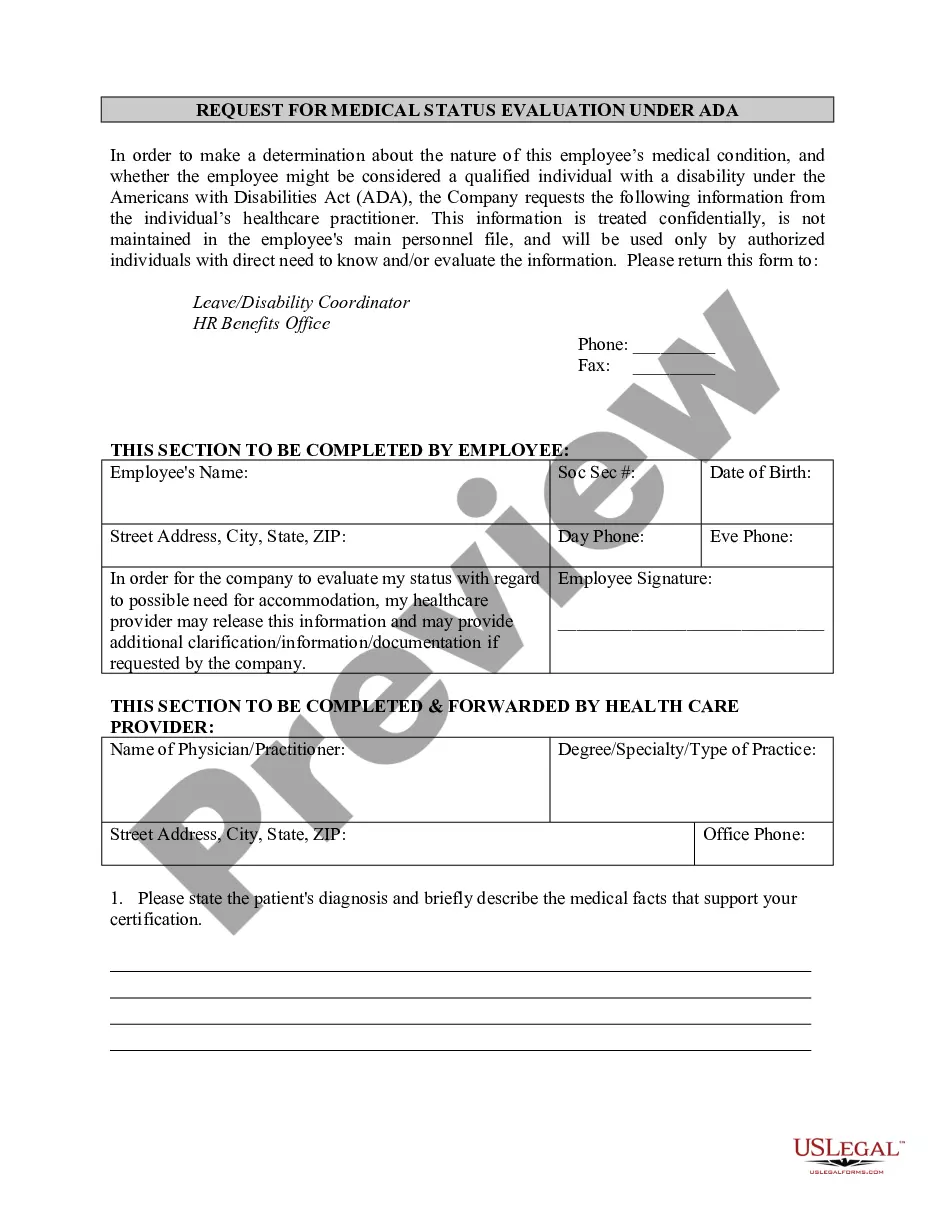
The Request for Accommodation under the ADA is a legal document that allows an employee to formally request accommodations for a disability under the Americans with Disabilities Act (ADA). This form is essential in ensuring that employers consider the needs of employees with disabilities, facilitating a supportive work environment. Unlike other workplace forms, this request specifically addresses the rights and accommodations related to disabilities, making it crucial for both employees and employers to navigate these legal requirements appropriately.
Key parts of this document
- Employee details: Sections where the employee provides personal information and job-related details.
- Nature of request: A part dedicated to specifying the requested accommodation.
- Medical documentation: Information on the requirement for supporting documentation from a healthcare provider.
- Employer response: Sections designated for management's acknowledgment and response to the accommodation request.
- Signature and date: Fields for both employee and employer signatures to validate the request and response.
When to use this document
This form should be used when an employee with a disability requires adjustments or accommodations to perform their job effectively. Common situations include needing modified work hours, specialized equipment, or changes in work duties to account for limitations caused by a disability. Using this form formally communicates the request to human resources and management, ensuring that proper processes are followed.
Who needs this form
- Employees: Those who have disabilities and require workplace accommodations to fulfill their job responsibilities.
- Human resources professionals: Staff responsible for processing accommodation requests and ensuring compliance with the ADA.
- Managers and supervisors: Individuals who will review the accommodation requests and determine the appropriateness of the requested changes.
Steps to complete this form
- Complete personal information: Fill in your name, contact details, and job title.
- Describe your disability: Provide details about your disability and how it impacts your work.
- Specify your requested accommodation: Clearly outline what adjustments you need to perform your job.
- Include medical documentation: Attach or indicate any necessary medical information that supports your request.
- Sign and date: Both the employee and a management representative should sign and date the document to confirm receipt and understanding of the request.
Notarization guidance
This form does not typically require notarization unless specified by local law. It should be noted that the signature of both the employee making the request and a representative from management is necessary to validate the process.
Get your form ready online
Our built-in tools help you complete, sign, share, and store your documents in one place.
Make edits, fill in missing information, and update formatting in US Legal Forms—just like you would in MS Word.
Download a copy, print it, send it by email, or mail it via USPS—whatever works best for your next step.
Sign and collect signatures with our SignNow integration. Send to multiple recipients, set reminders, and more. Go Premium to unlock E-Sign.
If this form requires notarization, complete it online through a secure video call—no need to meet a notary in person or wait for an appointment.
We protect your documents and personal data by following strict security and privacy standards.

Make edits, fill in missing information, and update formatting in US Legal Forms—just like you would in MS Word.

Download a copy, print it, send it by email, or mail it via USPS—whatever works best for your next step.

Sign and collect signatures with our SignNow integration. Send to multiple recipients, set reminders, and more. Go Premium to unlock E-Sign.

If this form requires notarization, complete it online through a secure video call—no need to meet a notary in person or wait for an appointment.

We protect your documents and personal data by following strict security and privacy standards.
Mistakes to watch out for
- Failing to provide sufficient medical documentation to support the request.
- Not clearly specifying the accommodation needed, leading to misunderstandings.
- Neglecting to keep a copy of the submitted form for personal records.
- Submitting the request without signatures, which may delay the process.
Why use this form online
- Convenience: Easily fill out the form from any location without needing a physical appointment.
- Editability: Make changes readily if circumstances change or if additional information is needed.
- Secure storage: Digital forms can be securely stored and accessed later, ensuring that important documents are not misplaced.
Legal use & context
- The form is used to record an official request for accommodations under federal law.
- Employees are protected from retaliation for requesting accommodations.
- Employers are required to respond to accommodation requests in a timely manner.
Main things to remember
- This form helps facilitate ADA accommodation requests for employees with disabilities.
- Completing the form accurately is crucial for a successful request.
- Understanding the process helps in navigating workplace rights under the ADA.
Looking for another form?
Form popularity
FAQ
Step 1: Determine Whether the Employer Is Covered by the ADA. Step 2: Ensure a Policy and Procedure Exist for Handling Accommodation Requests. Step 3: Determine Whether the Employee with a Disability Is "Qualified" Step 4: Initiate the Interactive Process. Step 5: Assess if the Employee Has a Disability Under the ADA.
State that you are requesting accommodations under the ADA (or the Rehabilitation Act of 1973 if you are a federal employee) Identify your specific problematic job tasks. Identify your accommodation ideas. Request your employer's accommodation ideas.
Needed accommodations may include providing: Accessible training sites; Training materials in alternate formats (e.g., large print, Braille, audiotape, or electronic format) to accommodate a disability; and. Sign language interpreters or captioning.
In general, an accommodation is any change in the work environment or in the way things are customarily done that enables an individual with a disability to enjoy equal employment opportunities. Under the ADA, employers are required to provide reasonable accommodations for employees with disabilities.
An individual meets the Americans with Disabilities with Act definition act of disability that would qualify them for reasonable accommodations if they have a physical or mental impairment that substantially limits one or more major life activities (sometimes referred to in the regulations as an actual disability)
To be protected by the ADA, one must have a disability, which is defined by the ADA as a physical or mental impairment that substantially limits one or more major life activities, a person who has a history or record of such an impairment, or a person who is perceived by others as having such an impairment.
Step One: Determine whether an individual has a disability and meets minimum qualification standards. Step Two: Determine the essential functions of the job. Step Three: Identify the abilities and limitations of the individual. Step Four: Identify potential accommodations.
Step 1: Determine Whether the Employer Is Covered by the ADA. Step 2: Ensure a Policy and Procedure Exist for Handling Accommodation Requests. Step 3: Determine Whether the Employee with a Disability Is "Qualified" Step 4: Initiate the Interactive Process. Step 5: Assess if the Employee Has a Disability Under the ADA.
Under Title I of the Americans with Disabilities Act (ADA), a reasonable accommodation is a modification or adjustment to a job, the work environment, or the way things are usually done during the hiring process.