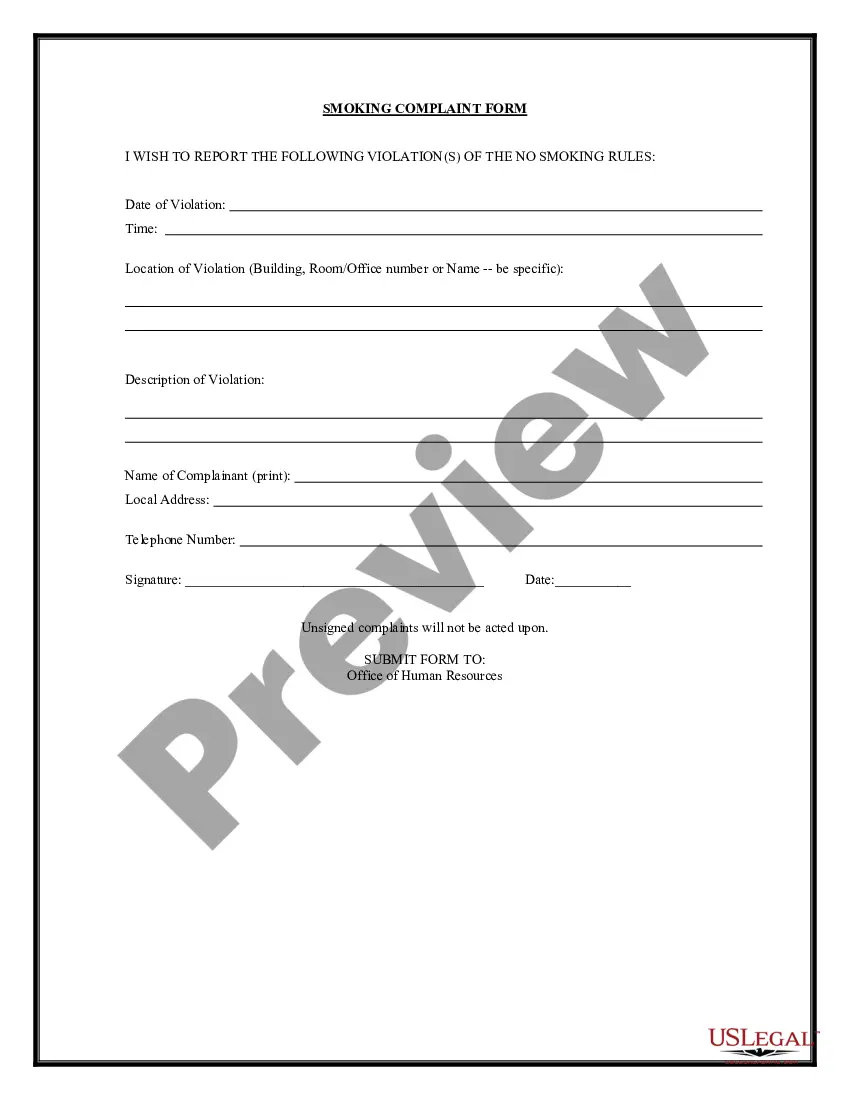
Smoking Complaint Form
What is this form?
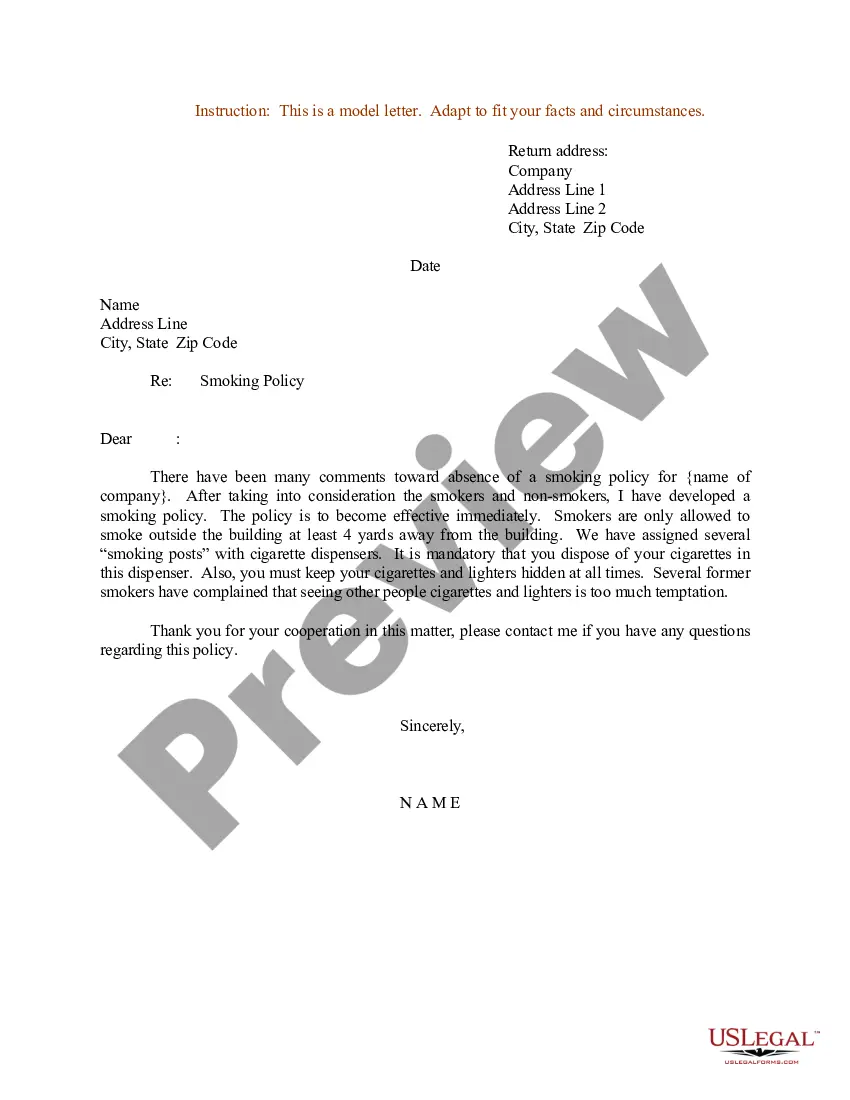
The Smoking Complaint Form is a legal document used to formally report incidents of smoking in non-smoking areas. This form helps individuals initiate a complaint that allows authorities to address violations of smoking policies. It is specifically designed for situations where smoking regulations are not being followed, making it distinct from other complaint forms related to general conduct or behavior in the workplace or public areas.
Key components of this form
- Complainant's contact information
- Details of the smoking incident
- Location of the violation
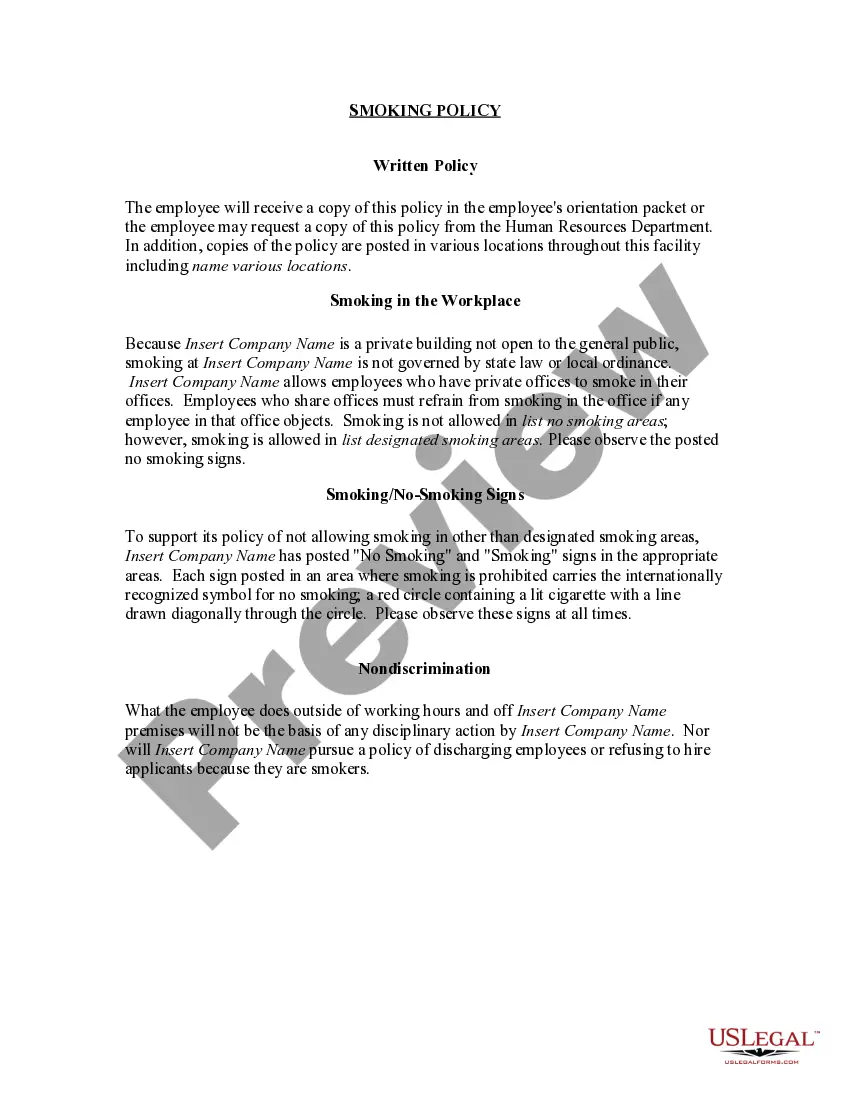
- Statement of the non-smoking policy
- Signature of the complainant
Situations where this form applies
This form should be used when you have witnessed smoking in an area designated as non-smoking. Typical situations include reporting smoking behavior in workplaces, public facilities, or any area where smoking is prohibited by law or local policy. By filing this complaint, you help ensure that smoking regulations are enforced and promote a healthier environment.
Intended users of this form
- Employees who observe smoking in non-smoking areas at their workplace
- Visitors to public spaces where smoking is prohibited
- Individuals who are affected by secondhand smoke in designated non-smoking areas
- Residents in multi-unit housing looking to report violations
Steps to complete this form
- Enter your full name and contact information in the designated fields.
- Describe the incident by including details such as date, time, and location.
- Specify the non-smoking policy that was violated.
- Sign the form to validate the complaint.
- Submit the completed form to the Office of Human Resources as instructed.
Does this document require notarization?
Notarization is not commonly needed for this form. However, certain documents or local rules may make it necessary. Our notarization service, powered by Notarize, allows you to finalize it securely online anytime, day or night.
Get your form ready online
Our built-in tools help you complete, sign, share, and store your documents in one place.
Make edits, fill in missing information, and update formatting in US Legal Forms—just like you would in MS Word.
Download a copy, print it, send it by email, or mail it via USPS—whatever works best for your next step.
Sign and collect signatures with our SignNow integration. Send to multiple recipients, set reminders, and more. Go Premium to unlock E-Sign.
If this form requires notarization, complete it online through a secure video call—no need to meet a notary in person or wait for an appointment.
We protect your documents and personal data by following strict security and privacy standards.

Make edits, fill in missing information, and update formatting in US Legal Forms—just like you would in MS Word.

Download a copy, print it, send it by email, or mail it via USPS—whatever works best for your next step.

Sign and collect signatures with our SignNow integration. Send to multiple recipients, set reminders, and more. Go Premium to unlock E-Sign.

If this form requires notarization, complete it online through a secure video call—no need to meet a notary in person or wait for an appointment.

We protect your documents and personal data by following strict security and privacy standards.
Avoid these common issues
- Failing to provide complete contact information.
- Leaving fields blank or unclear regarding the incident details.
- Not signing the form, which may result in rejection of the complaint.
- Not specifying the applicable non-smoking policy, which could weaken your case.
Benefits of completing this form online
- Convenient access to necessary legal documentation from anywhere.
- Ease of filling out and editing the document as needed.
- Reliable templates drafted by licensed attorneys ensure accuracy.
Quick recap
- The Smoking Complaint Form is essential for formally addressing violations of non-smoking regulations.
- Complete all relevant sections accurately to validate your complaint.
- Submitting the form allows for proper oversight in enforcing smoking policies.
Looking for another form?

Form popularity
FAQ
Smokers smoke for the nicotine but are harmed by the tar and other chemicals. Many of them can cause cancer. Others are poisonous, such as hydrogen cyanide, carbon monoxide and ammonia. When you smoke, these chemicals can damage your lungs but also pass into your blood and spread through your body.
Conclusions Smoking only about one cigarette per day carries a risk of developing coronary heart disease and stroke much greater than expected: around half that for people who smoke 20 per day. No safe level of smoking exists for cardiovascular disease.
Smoking five or fewer cigarettes a day can cause almost as much damage to your lungs as smoking two packs a day. That's according to a recent study from Columbia University that examined the lung function of 25,000 people, including smokers, ex-smokers, and those who have never smoked.
Even when you smoke a little bit; over the weekend or once or twice a week, the study is showing that that is not safe and the sooner you try to quit, the better. It's helpful to have research that can show the health risks of smoking just a few cigarettes a day, Dr. Choi says.
Evidence is growing that cigarette smoking and nicotine may prevent or ameliorate Parkinson's disease, and could do so in Alzheimer's dementia.
Light and intermittent smoking, or social smoking, is better for you than heavy smoking. But it still increases the risks of heart disease, lung cancer, cataract, and a host of other conditions.
THURSDAY, Jan. 25, 2018 (HealthDay News) -- If you think having just one cigarette a day won't do any harm, you're wrong. British researchers say lighting up just once a day was linked to a much higher risk of heart disease and stroke than might be expected.
The study shows that smokers die relatively young. An estimated 23 percent of consistent heavy smokers never reach the age of 65. This is 11 percent among light smokers and 7 percent among non-smokers. Life expectancy decreases by 13 years on average for heavy smokers compared to people who have never smoked.