Jury Instruction - Forceful Intimidation Because Of Race - Occupancy Of Dwelling - No Bodily Injury
What is this form?
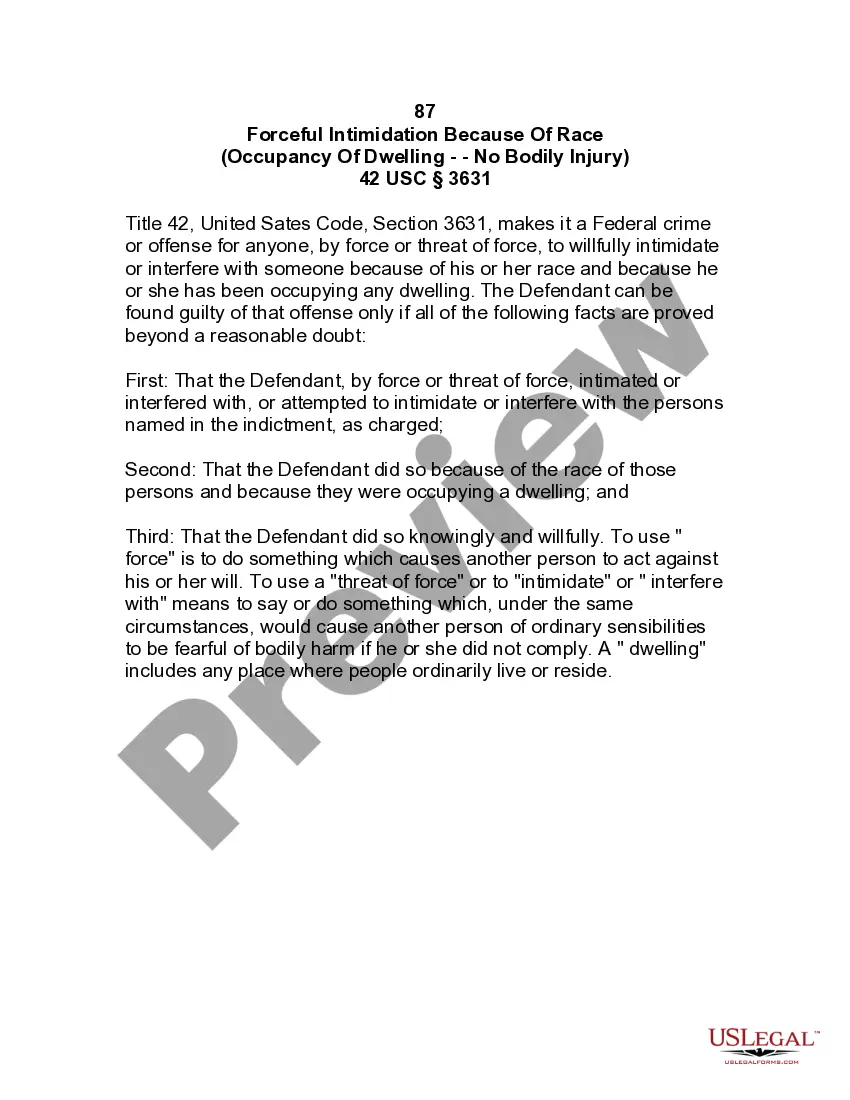
This Jury Instruction form regarding Forceful Intimidation Because of Race is designed to provide clear guidelines for juries in cases involving racial intimidation related to the occupancy of a dwelling. It serves as a model that can be adapted to fit specific cases, ensuring that juries understand the legal thresholds required for a conviction based on racial discrimination. This form is distinct from other jury instructions as it specifically addresses offenses under 42 USC 3631, focusing on situations where no bodily injury has occurred.
Key parts of this document
- Definition of forceful intimidation and its legal implications.
- Criteria for proving race-based intimidation beyond a reasonable doubt.
- Clarification of what constitutes a dwelling in legal terms.
- Distinction between actions that cause fear versus actions that result in bodily harm.
- Maximum penalties for violations of this federal law.


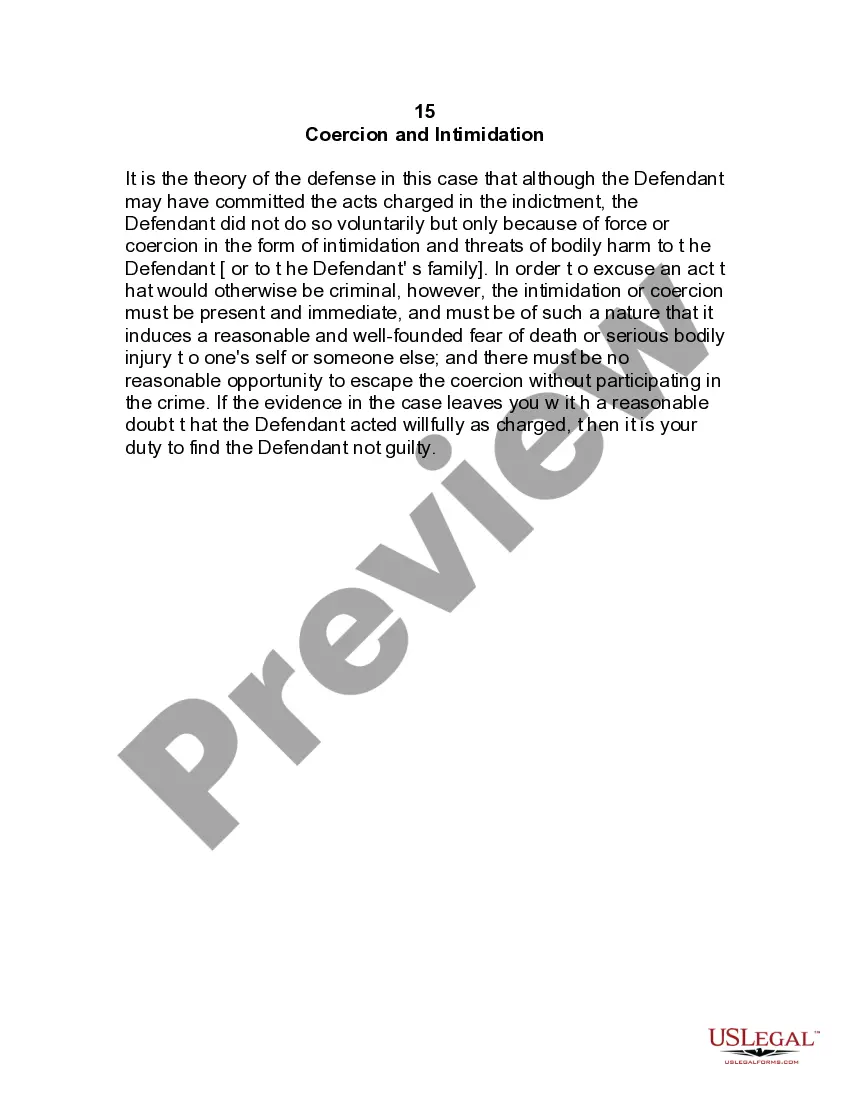
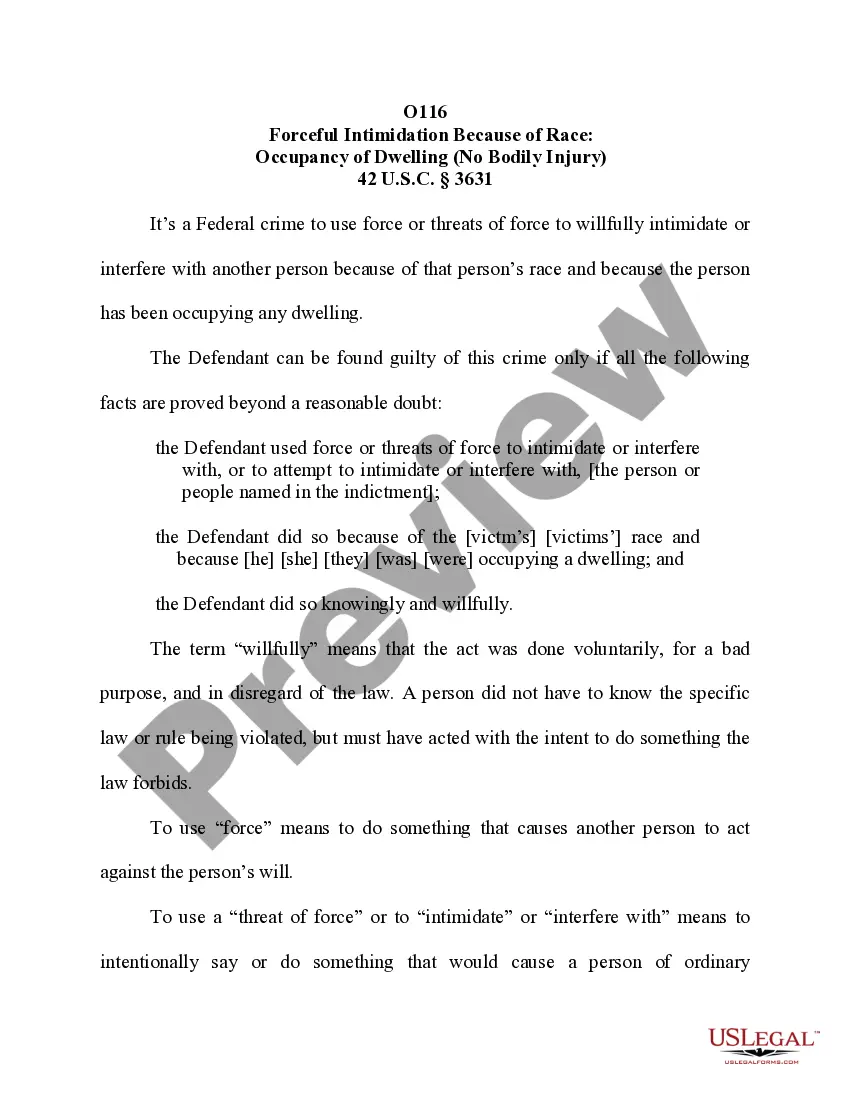
When to use this document
This form should be utilized in situations where a defendant is charged with intimidating or interfering with individuals based on their race while they are occupying a residence. It is relevant in cases where the intimidation did not result in bodily injury but was carried out through threats or other forms of coercion. Legal representatives can use this template to equip jurors with the necessary instructions for deliberating such cases effectively.
Who this form is for
- Legal professionals preparing jury instructions for race-related intimidation cases.
- Judges requiring a standard framework for instructing juries on this sensitive subject.
- Attorneys representing defendants or plaintiffs in federal racially motivated intimidation cases.
- Law students or legal scholars studying federal intimidation statutes.
How to prepare this document
- Review the definition of forceful intimidation to ensure a clear understanding of the term.
- Specify the elements that must be proven for the charge, detailing each criterion.
- Identify the parties involved, including the defendant and the individuals affected by the intimidation.
- Outline the legal implications stemming from the intimidation based on race.
- Incorporate any additional context relevant to the specific case to guide the jury appropriately.
Notarization guidance
Notarization is not commonly needed for this form. However, certain documents or local rules may make it necessary. Our notarization service, powered by Notarize, allows you to finalize it securely online anytime, day or night.
Get your form ready online
Our built-in tools help you complete, sign, share, and store your documents in one place.
Make edits, fill in missing information, and update formatting in US Legal Forms—just like you would in MS Word.
Download a copy, print it, send it by email, or mail it via USPS—whatever works best for your next step.
Sign and collect signatures with our SignNow integration. Send to multiple recipients, set reminders, and more. Go Premium to unlock E-Sign.
If this form requires notarization, complete it online through a secure video call—no need to meet a notary in person or wait for an appointment.
We protect your documents and personal data by following strict security and privacy standards.

Make edits, fill in missing information, and update formatting in US Legal Forms—just like you would in MS Word.

Download a copy, print it, send it by email, or mail it via USPS—whatever works best for your next step.

Sign and collect signatures with our SignNow integration. Send to multiple recipients, set reminders, and more. Go Premium to unlock E-Sign.

If this form requires notarization, complete it online through a secure video call—no need to meet a notary in person or wait for an appointment.

We protect your documents and personal data by following strict security and privacy standards.
Typical mistakes to avoid
- Failing to clearly define what constitutes "force" in the legal context.
- Overlooking the requirement to prove intent in cases of intimidation.
- Neglecting to specify the race of the individuals when relevant to the case.
- Using vague language that may lead to juror confusion regarding their responsibilities.
Why use this form online
- Convenience of accessing a professionally drafted jury instruction anytime.
- Editability allows for customization to fit specific case facts and circumstances.
- Reliability of content created by licensed attorneys ensures legal accuracy.
- Quick download and printing helps streamline the jury instruction preparation process.
Looking for another form?
Form popularity
FAQ
How can a teacher assist a child who has been hospitalized with a traumatic brain injury return to school? Teachers should schedule academic instruction during peak performance periods. Chronic fatigue may necessitate a reduced class load.
Brain Injury. Broken/Fractured Bones. Burn Injury. Catastrophic Injury. Drowning. Electrocution. Fire/Burn Injury. Spinal Cord/Back Injury.
The most common short-term complications associated with TBIs include cognitive impairment, difficulties with sensory processing and communication, immediate seizures, hydrocephalus, cerebrospinal fluid (CSF) leakage, vascular or cranial nerve injuries, tinnitus, organ failure, and polytrauma.
An injury is damage to your body. It is a general term that refers to harm caused by accidents, falls, hits, weapons, and more.
Reduce distractions in the student's work area (i.e., have the student remove extra pencils, books) Divide work into smaller sections (i.e., have the student complete one section at a time; suggest times and expectations for completion)