Jury Instruction - Counterfeiting
About this form
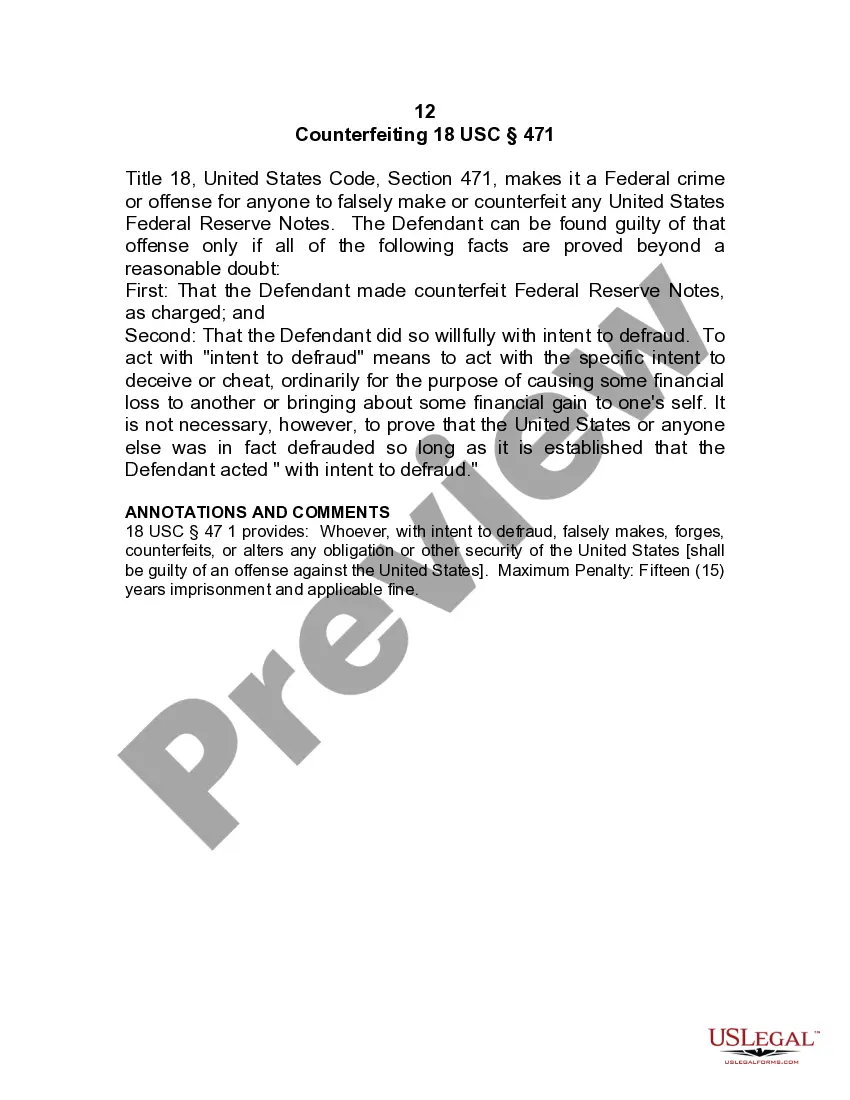
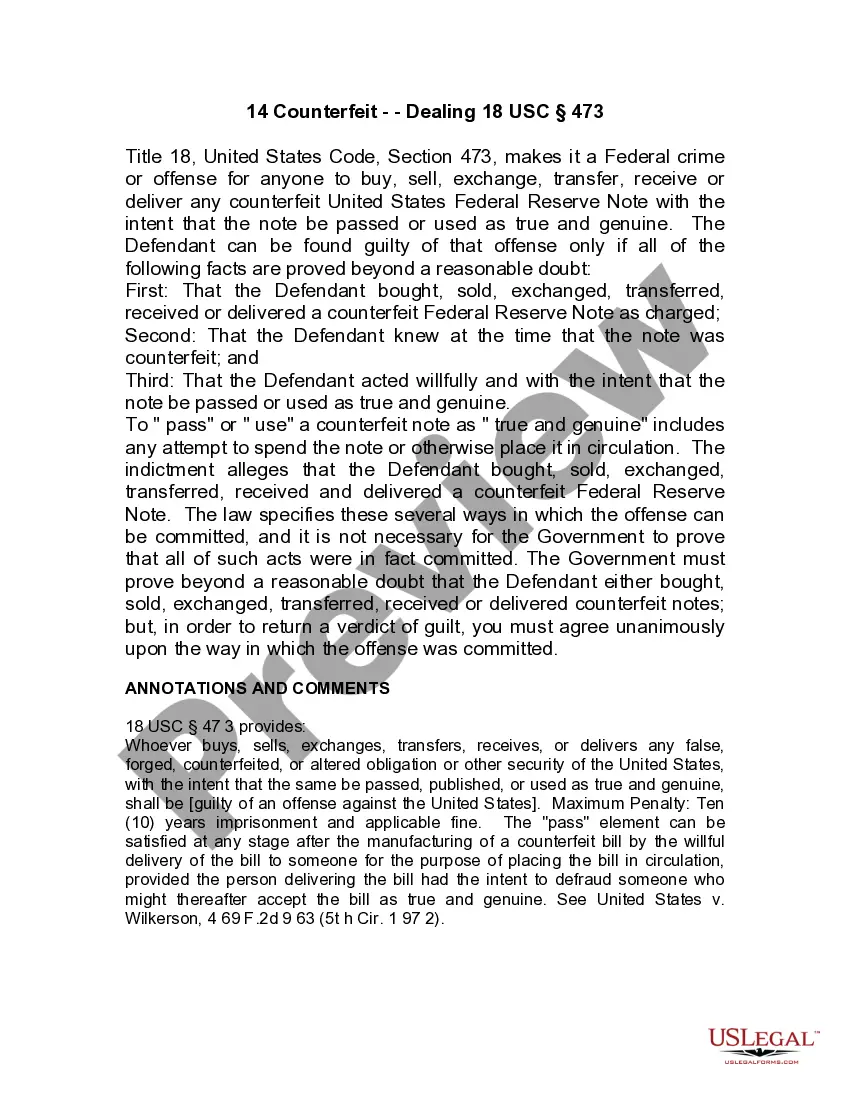
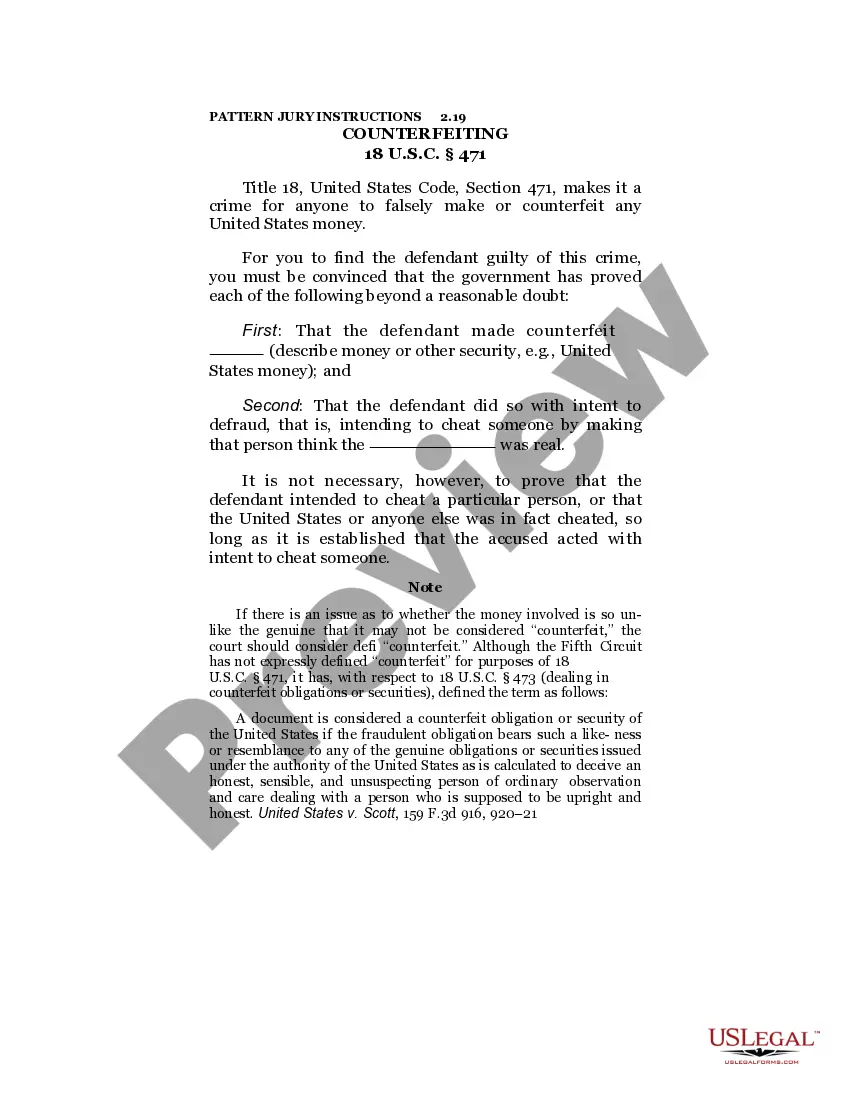
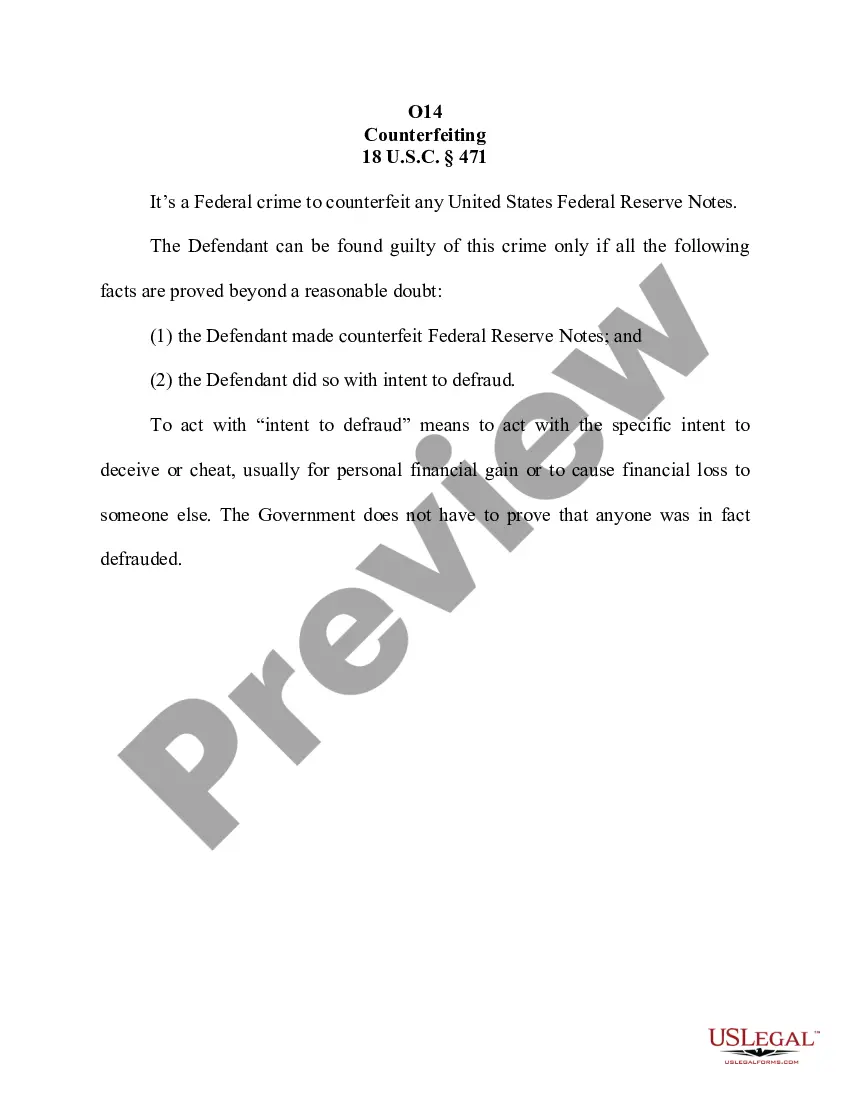
The Jury Instruction - Counterfeiting form provides sample jury instructions used in federal counterfeiting cases, specifically referencing Title 18, United States Code, Section 471. This form is designed to guide jury members through their decision-making process by outlining essential legal principles and requirements for establishing guilt or innocence in counterfeiting matters. It differs from similar forms by focusing specifically on the elements needed to prove the crime of counterfeiting, including the defendant's intent to defraud.
Key parts of this document
- Definition of counterfeiting as per Title 18, United States Code, Section 471.
- Elements required to prove guilt, including the requirement for the defendant's intent to defraud.
- Clarification on the need for intent to defraud even without actual financial loss.
- Information on the maximum penalty for the crime of counterfeiting.
When to use this document
This form should be used in cases where a defendant is charged with counterfeiting United States currency. It is applicable in any federal court where such a case is being tried and serves to ensure that jury members properly understand the legal standards they must apply in reaching their verdict.
Who needs this form
This form is intended for:
- Legal professionals preparing jury instructions for counterfeiting trials.
- Judges requiring a template to guide jury deliberations on counterfeiting charges.
- Attorneys representing clients in federal criminal cases involving counterfeiting allegations.
Completing this form step by step
- Review the key legal concepts related to counterfeiting as outlined in the form.
- Modify the jury instructions to suit the specifics of your case and the parties involved.
- Ensure that each essential element of the crime is clearly articulated for jury comprehension.
- Verify that the instructions align with current federal law and any relevant case law.
- Present the final version to the court for approval before the jury is instructed on the law.
Notarization guidance
In most cases, this form does not require notarization. However, some jurisdictions or signing circumstances might. US Legal Forms offers online notarization powered by Notarize, accessible 24/7 for a quick, remote process.
Get your form ready online
Our built-in tools help you complete, sign, share, and store your documents in one place.
Make edits, fill in missing information, and update formatting in US Legal Forms—just like you would in MS Word.
Download a copy, print it, send it by email, or mail it via USPS—whatever works best for your next step.
Sign and collect signatures with our SignNow integration. Send to multiple recipients, set reminders, and more. Go Premium to unlock E-Sign.
If this form requires notarization, complete it online through a secure video call—no need to meet a notary in person or wait for an appointment.
We protect your documents and personal data by following strict security and privacy standards.

Make edits, fill in missing information, and update formatting in US Legal Forms—just like you would in MS Word.

Download a copy, print it, send it by email, or mail it via USPS—whatever works best for your next step.

Sign and collect signatures with our SignNow integration. Send to multiple recipients, set reminders, and more. Go Premium to unlock E-Sign.

If this form requires notarization, complete it online through a secure video call—no need to meet a notary in person or wait for an appointment.

We protect your documents and personal data by following strict security and privacy standards.
Mistakes to watch out for
- Failing to clearly define "intent to defraud," which is crucial for the jury's understanding.
- Using outdated legal language that may confuse jurors.
- Neglecting to tailor the instructions to the specific circumstances of the case.
Advantages of online completion
- Easy to access and download, allowing quick adjustments based on case needs.
- Editable templates ensure that you can personalize the instructions efficiently.
- Provides peace of mind with legally vetted instructions created by licensed attorneys.
Looking for another form?



Form popularity
FAQ
The Court emphasizes that the information compiled from jury questionnaire responses is CONFIDENTIAL. It is used strictly for jury selection; and is not disseminated to any other agencies or parties unless specifically authorized by Federal or State law or by Court order.
Jury instructions, directions to the jury, or judge's charge are legal rules that jurors should follow when deciding a case.
Instructions to the Jury The judge instructs the jury about the relevant laws that should guide its deliberations. (In some jurisdictions, the court may instruct the jury at any time after the close of evidence. This sometimes occurs before closing arguments.) The judge reads the instructions to the jury.
Jury Instructions. instructions that are given by the trial judge that specifically state what the defendant can be found guilty of and what the prosecution or plaintiff has to prove in order for a guilty verdict.
Name, address, age, employment, and education are the questions commonly asked in court-generated questionnaires. That information is better than nothing, but such questionnaires usually leave out questions on relevant attitudes.
Jury Service Is MandatoryIf you do not appear, a judge can charge you with the misdemeanor of failure to appear or with contempt of court and issue a bench warrant for your arrest. A bench warrant directs the police to take you into custody and bring you before the court to address your failure to appear.
A curative instruction is given to a jury by the judge in a case to negate the prejudicial effect of an erroneous instruction or tainted evidence.
A jury instruction is given by the judge to the jury to explain what is happening in the court, to explain the points of law relevant to the case, to explain certain aspects of the evidence presented and to assist the jurors in understanding their duties in reaching a verdict.
The email is fraudulent and has no connection to either the federal courts or to eJuror.Requests by courts to complete a qualification questionnaire would be initiated by formal written correspondence. Such letters tell jury participants how to access an authenticated, secure online connection.