Notice to Client of Proposed Settlement
Understanding this form
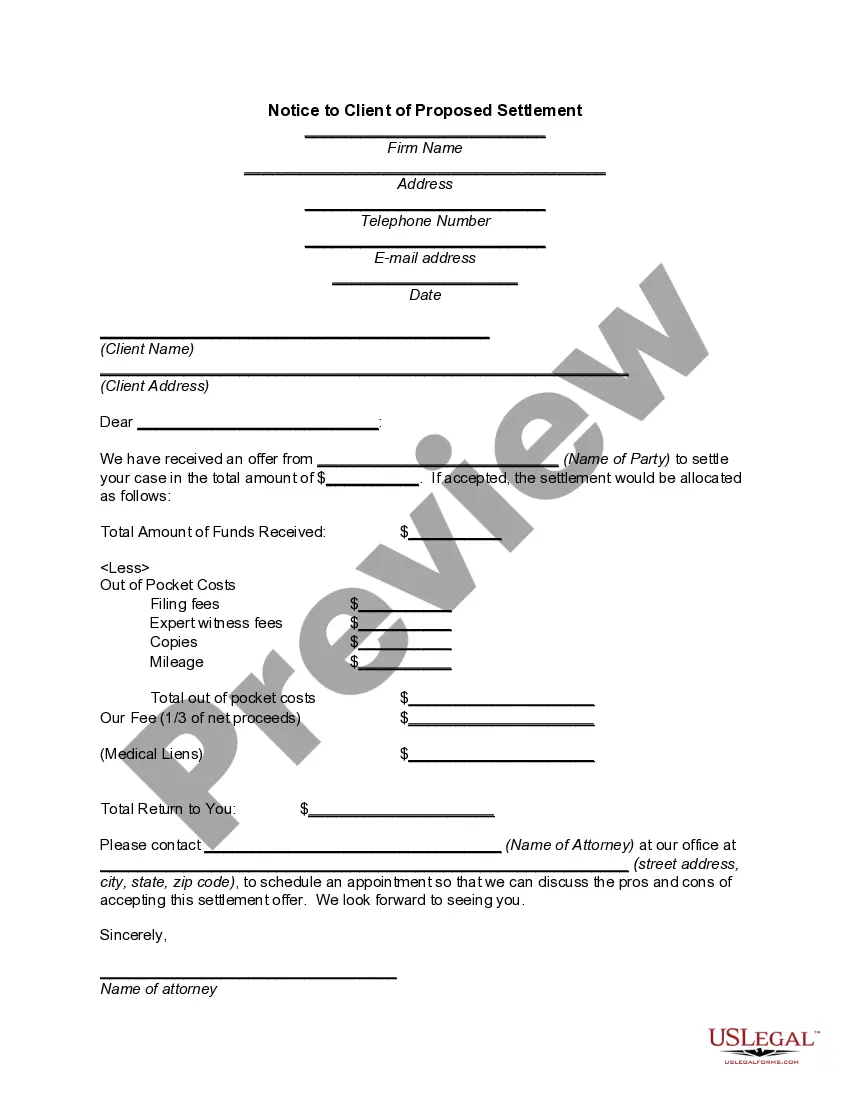
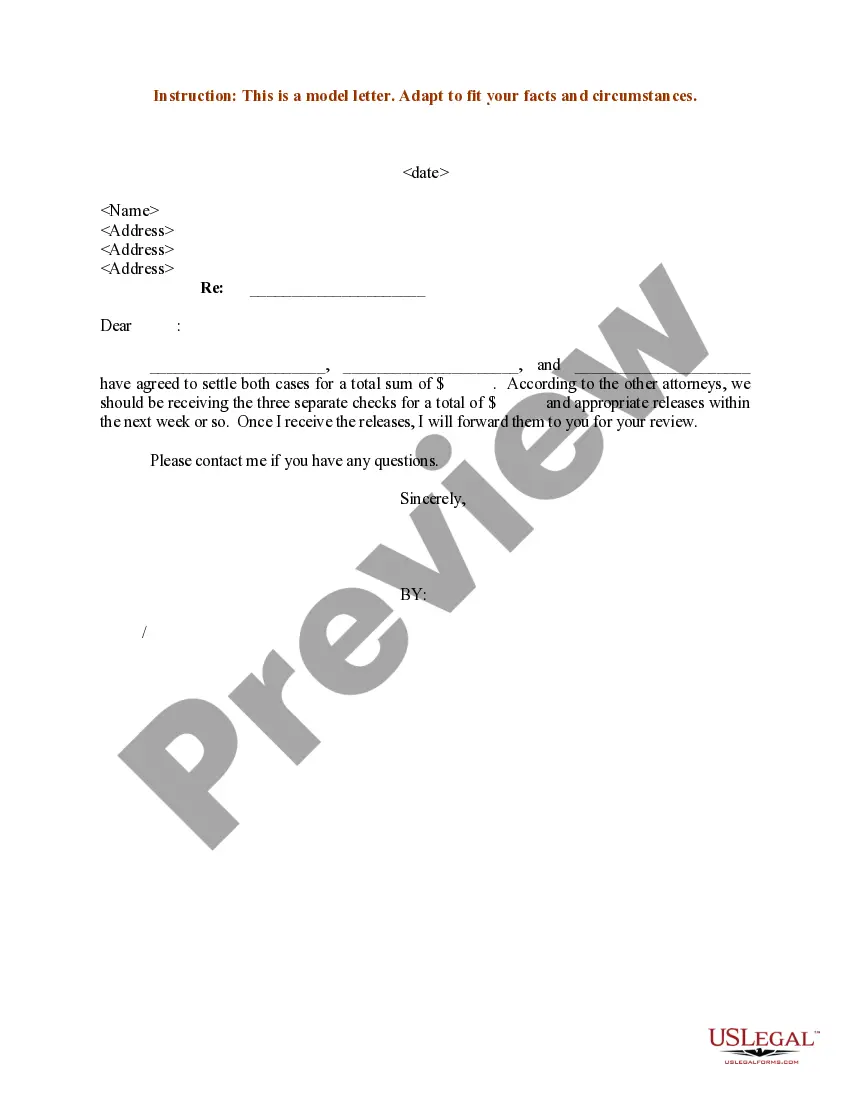
The Notice to Client of Proposed Settlement is a legal document that provides clients with detailed information regarding a proposed settlement offer related to their legal dispute. This form specifically outlines the terms of the settlement and invites the client to arrange a meeting with their attorney to discuss the proposal in detail. Unlike other forms that may simply document agreements, this notice serves to inform the client of the financial implications and necessary actions involved in accepting a settlement.
Key components of this form
- Client and attorney contact information, including addresses and phone numbers.
- Details of the settlement offer, including the total amount and its allocation.
- Breakdown of out-of-pocket costs incurred in the case.
- Calculation of attorney fees based on the proposed settlement.
- Overall amount that will be returned to the client after deductions.
- Instructions for scheduling an appointment to discuss the settlement.

When to use this document
This form should be used when an attorney receives a settlement offer on behalf of a client during a legal dispute. It is essential when the attorney wishes to communicate the offer's details to the client, allowing them to understand the implications and decide on the next steps. This notice is particularly important if there are multiple expenses involved and the client needs to be informed of the final amount they will receive.
Who should use this form
- Clients who are involved in legal disputes and have received settlement offers.
- Attorneys representing clients in negotiations or litigation.
- Legal firms that need a structured way to communicate settlement terms to clients.
Instructions for completing this form
- Enter the law firm's name, address, telephone number, and email address at the top of the form.
- Fill in the date of the notice and the client's details, including their name and address.
- Clearly state the name of the party making the settlement offer and the total settlement amount.
- Itemize the out-of-pocket costs and fees to calculate the total return to the client.
- Specify the name of the attorney to contact for further discussions and provide office details.
Does this form need to be notarized?
This form does not typically require notarization unless specified by local law. It is advisable to check your stateâs regulations to ensure compliance.
Get your form ready online
Our built-in tools help you complete, sign, share, and store your documents in one place.
Make edits, fill in missing information, and update formatting in US Legal Forms—just like you would in MS Word.
Download a copy, print it, send it by email, or mail it via USPS—whatever works best for your next step.
Sign and collect signatures with our SignNow integration. Send to multiple recipients, set reminders, and more. Go Premium to unlock E-Sign.
If this form requires notarization, complete it online through a secure video call—no need to meet a notary in person or wait for an appointment.
We protect your documents and personal data by following strict security and privacy standards.

Make edits, fill in missing information, and update formatting in US Legal Forms—just like you would in MS Word.

Download a copy, print it, send it by email, or mail it via USPS—whatever works best for your next step.

Sign and collect signatures with our SignNow integration. Send to multiple recipients, set reminders, and more. Go Premium to unlock E-Sign.

If this form requires notarization, complete it online through a secure video call—no need to meet a notary in person or wait for an appointment.

We protect your documents and personal data by following strict security and privacy standards.
Common mistakes to avoid
- Forgetting to include the complete breakdown of costs and fees.
- Not providing clear instructions for the client to schedule a meeting.
- Omitting the client's name or contact information by mistake.
Advantages of online completion
- Convenient access to legal forms tailored for your needs.
- Editable format allows customization specific to your case.
- Reliability of templates drafted by licensed attorneys ensures legal validity.
Looking for another form?


Form popularity
FAQ
A class member who doesn't want to participate in the lawsuit can just read the notice to receive which should describe what needs to be done to opt out of the case. This usually requires sending back a notice to the settlement administrator stating that you don't want to be included in the settlement.
Your debt settlement proposal letter must be formal and clearly state your intentions, as well as what you expect from your creditors. You should also include all the key information your creditor will need to locate your account on their system, which includes: Your full name used on the account. Your full address.
Seek Preliminary Approval of Settlement. Provide Class Notice to Absent Class Members. Provide CAFA Notice to Appropriate Government Officials. Anticipate Opt-Outs and Objectors. Seek Final Approval of Settlement.
A class action lawsuit is a lawsuit in which a group of people with the same or similar injuries caused by the same product or action file suit against the defendant as a group. Other names for class action lawsuits include mass tort litigation or multi-district litigation (MDL).
Treat the letter as a contract between you and your creditor. Include your personal information and account number for easy identification. You'll need to outline the amount you can pay and what you expect in return. If you want to propose a good settlement offer, consider offering around 30 percent of what you owe.
Sometimes a Proposals for Settlement is filed with the hopes that it will be accepted, and that the litigation will come to an end. When this is done the PFS is used as a settlement tool. However, sometimes a Proposal for Settlement is filed with the hopes that it will not be accepted.
If you received a class action notice in the mail, this simply means that your legal rights may be affected by a lawsuit that was recently filed or settled.Notices are typically sent after a case has settled and will provide instructions on how to claim part of the settlement.
Assuming there are no further appeals, class members generally receive payment about six to nine months after a settlement agreement is submitted to the court for preliminary approval, says Stuart Rossman, director of litigation at the National Consumer Law Center.