Sample Letter for Corrections to Deed, Deed of Trust, and corrected Deed of Trust
Understanding this form
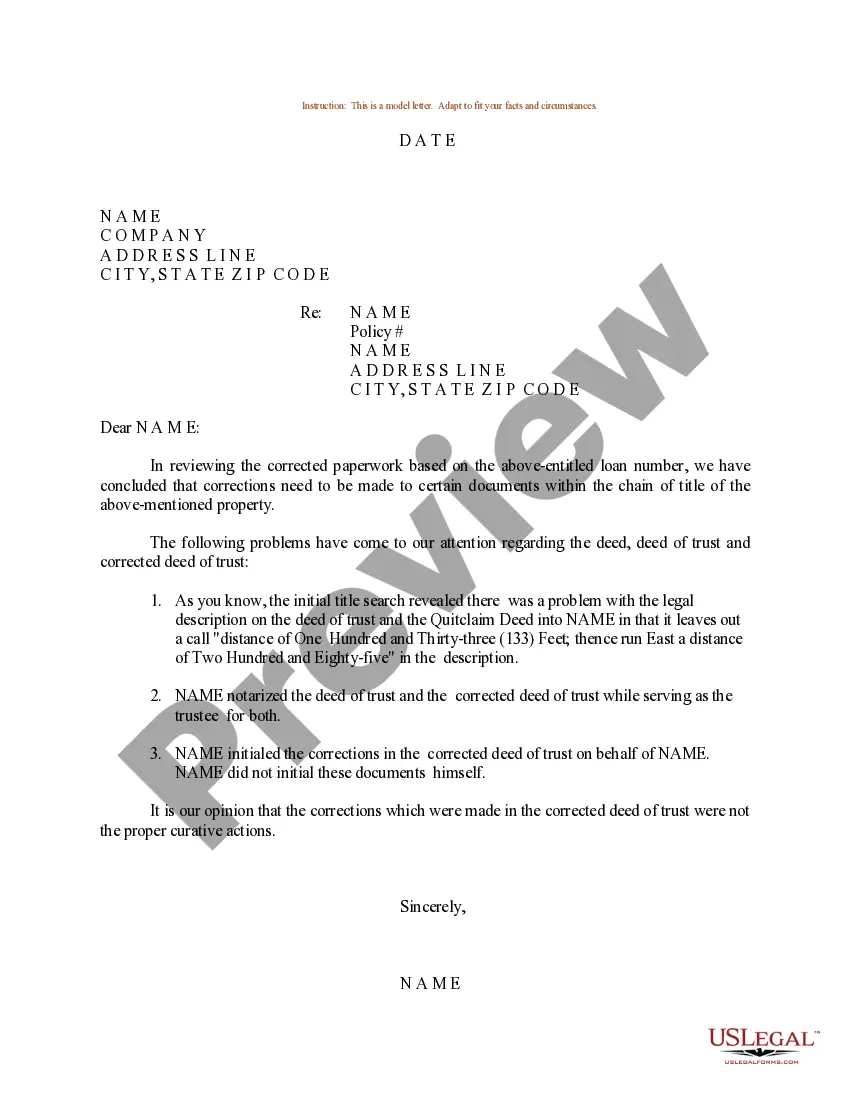
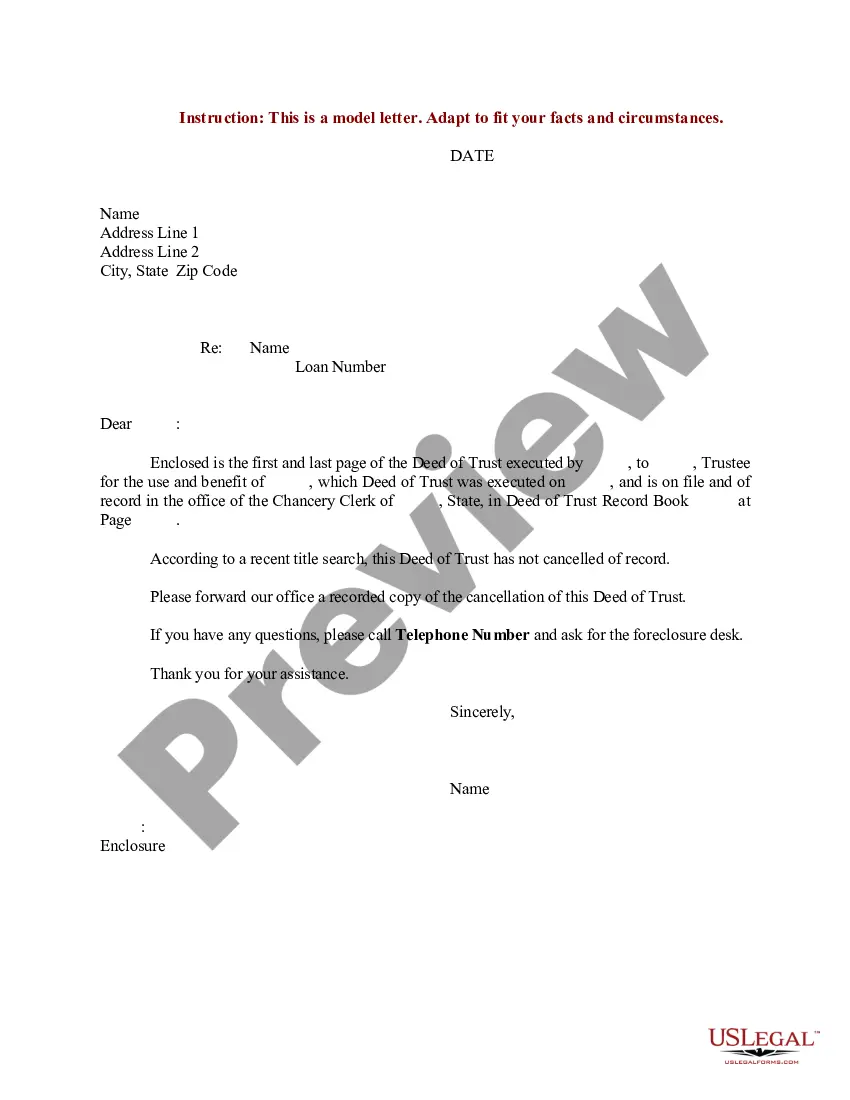
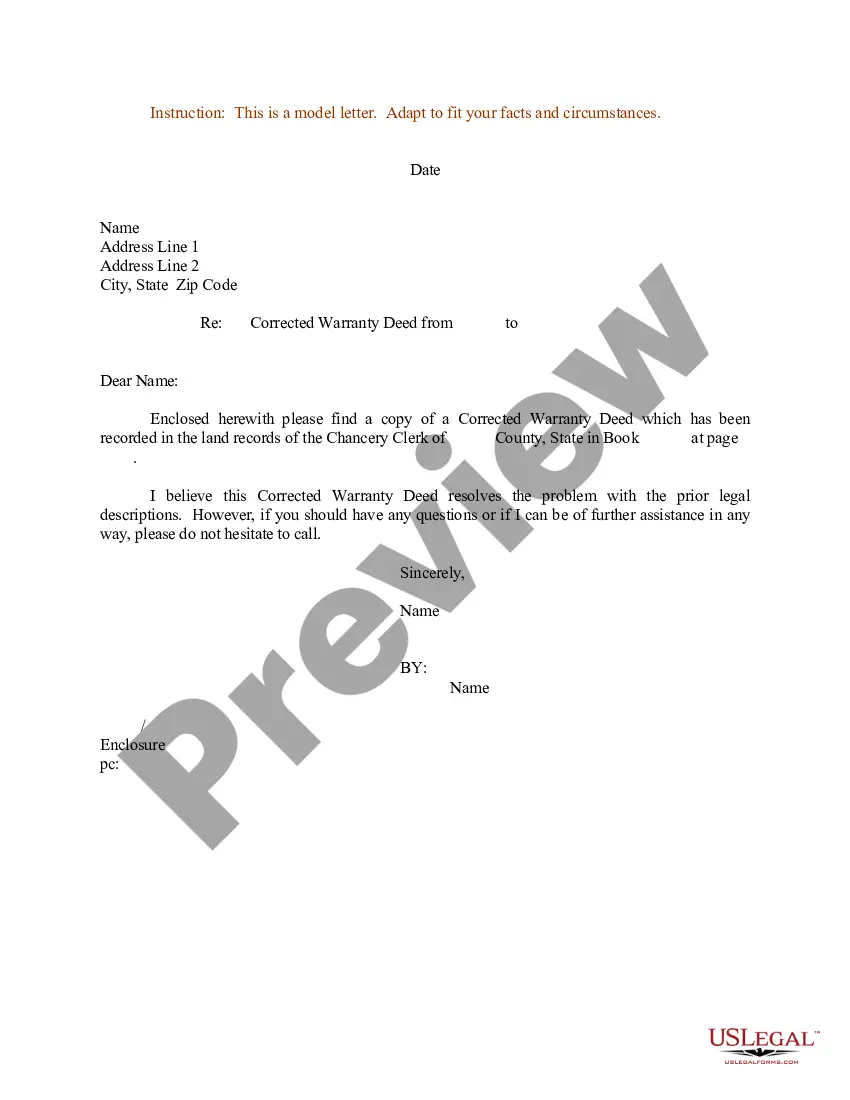
This form is a sample letter used to address corrections needed in a deed, deed of trust, and a corrected deed of trust. It outlines the specific problems identified in these documents, distinguishing it from other legal notices or correspondence. Utilizing this Sample Letter for Corrections can guide property owners and involved parties through the formal process of resolving discrepancies in property documentation.
Key parts of this document
- Date: Document the date of the letter.
- Recipient Information: Include the private name and company address of the party being addressed.
- Subject Heading: Clearly state the purpose of the letter, referencing the specific deeds affected.
- Problem Details: Outline the discrepancies, including missing legal descriptions or incorrect signatures.
- Closing Signature: Space provided for the sender's signature, including printed name for clarity.

When this form is needed
This Sample Letter for Corrections is needed when there are legal discrepancies found in deed documents that require official correction. It is particularly useful in scenarios where property owners realize that essential details, such as legal descriptions or notarizations, are incorrect or missing, thus potentially affecting property rights or ownership claims.
Who should use this form
- Property owners needing to correct inaccuracies in deed documents.
- Trustees involved with property transactions requiring formal communication regarding legal documents.
- Legal professionals assisting clients in rectifying issues with real estate documentation.
Instructions for completing this form
- Begin by entering the current date at the top of the document.
- Provide the recipient's name and address, ensuring it is accurate and up to date.
- Clearly outline the specific issues regarding the deed and corrected deed, enumerating each problem.
- Conclude by signing the letter, and include your printed name for identification.
Notarization requirements for this form
This form does not typically require notarization unless specified by local law. Always check applicable regulations in your jurisdiction to confirm.
Get your form ready online
Our built-in tools help you complete, sign, share, and store your documents in one place.
Make edits, fill in missing information, and update formatting in US Legal Forms—just like you would in MS Word.
Download a copy, print it, send it by email, or mail it via USPS—whatever works best for your next step.
Sign and collect signatures with our SignNow integration. Send to multiple recipients, set reminders, and more. Go Premium to unlock E-Sign.
If this form requires notarization, complete it online through a secure video call—no need to meet a notary in person or wait for an appointment.
We protect your documents and personal data by following strict security and privacy standards.

Make edits, fill in missing information, and update formatting in US Legal Forms—just like you would in MS Word.

Download a copy, print it, send it by email, or mail it via USPS—whatever works best for your next step.

Sign and collect signatures with our SignNow integration. Send to multiple recipients, set reminders, and more. Go Premium to unlock E-Sign.

If this form requires notarization, complete it online through a secure video call—no need to meet a notary in person or wait for an appointment.

We protect your documents and personal data by following strict security and privacy standards.
Common mistakes to avoid
- Failure to include all relevant discrepancies in the letter.
- Not providing sufficient details about the deed for identification.
- Omitting a clear subject line, which could cause confusion for recipients.
Why use this form online
- Convenience: Download and complete the form anytime, from anywhere.
- Editability: Customize the form easily with your specific information.
- Reliability: Access forms drafted by licensed attorneys, ensuring compliance with legal standards.
Looking for another form?


Form popularity
FAQ
Determine if the error is harmless or fatal to the transfer of title. Decide what instrument is best suited to the error. Draft a corrective deed, affidavit, or new deed. Obtain the original signature(s) of the Grantor(s). Re-execute the deed with proper notarization and witnessing.
Re-recording of the original document. With corrections made in the body of the original document. A cover sheet detailing the changes. Must be re-signed and re-acknowledged. Correction Deed. A new deed reflecting the corrections/changes. Must meet all recording requirements of a deed.
Resolving Small Ambiguities: The Scrivener Affidavit. Sometimes an omission attracts attention just after recording. The Correction Deed: Stronger Than a Scrivener's Affidavit. Obtain your correction deed form. Execute the correction deed. Record the correction deed.
Quitclaim Deeds can be complicated legal documents. They are commonly used to add/remove someone to/from real estate title or deed (divorce, name changes, family and trust transfers).
These errors can be rectified through the execution of a supplementary document called rectification deed. Rectification deed is a document executed between parties to correct a mistake in the principal deed.
You can change your name on title deeds by completing form AP1 and providing the relevant documentation, such as a marriage certificate, deed poll certificate or a sworn declaration. You can also change your gender on title deeds using form CNG and providing appropriate proof of the change.
A correction deed is a new deed signed and acknowledged by the grantor. A correction affidavit can be signed by either party but is used in limited situations. This press release was authorized by Mark W. Bidwell, an attorney licensed in California.
Correction Deed - Correcting A Recorded Deed.A corrective deed is most often used for minor mistakes, such as misspelled or incomplete names, missing or wrong middle initials, and omission of marital status or vesting information. It can also be used for obvious errors in the property description.