Release of Security Interest - Termination Statement
About this form
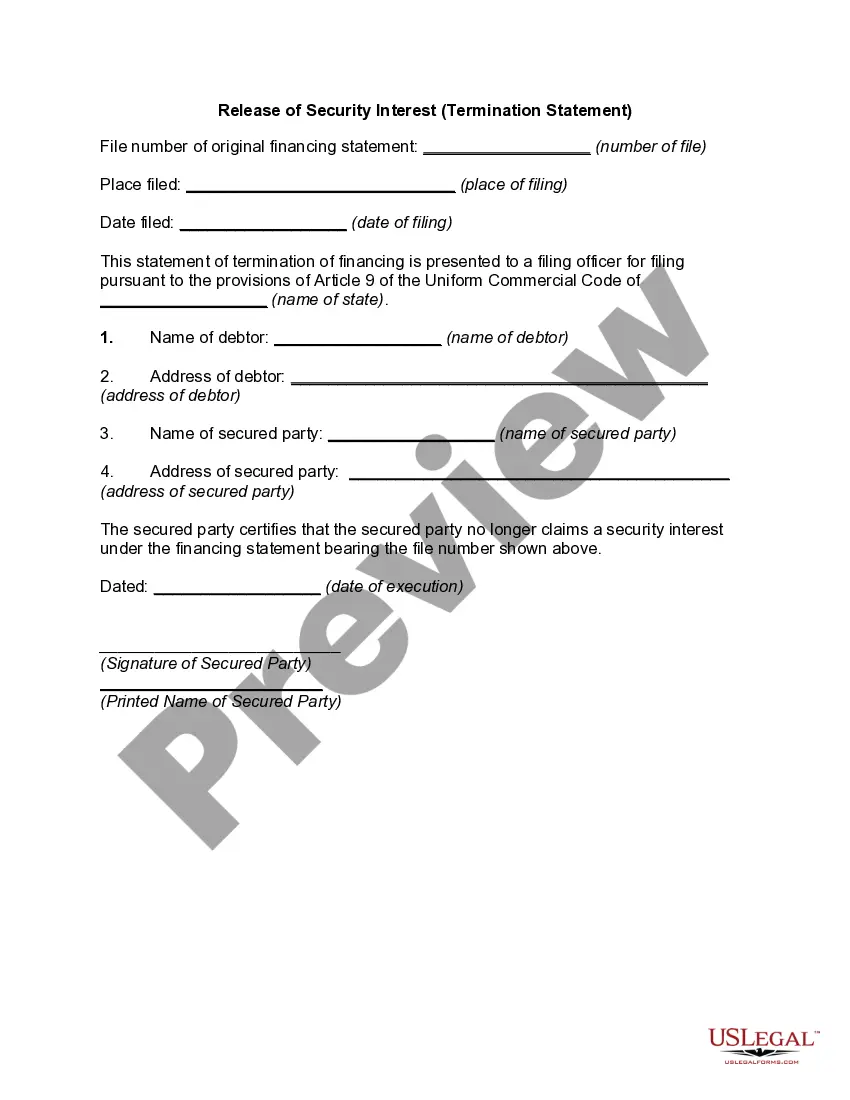
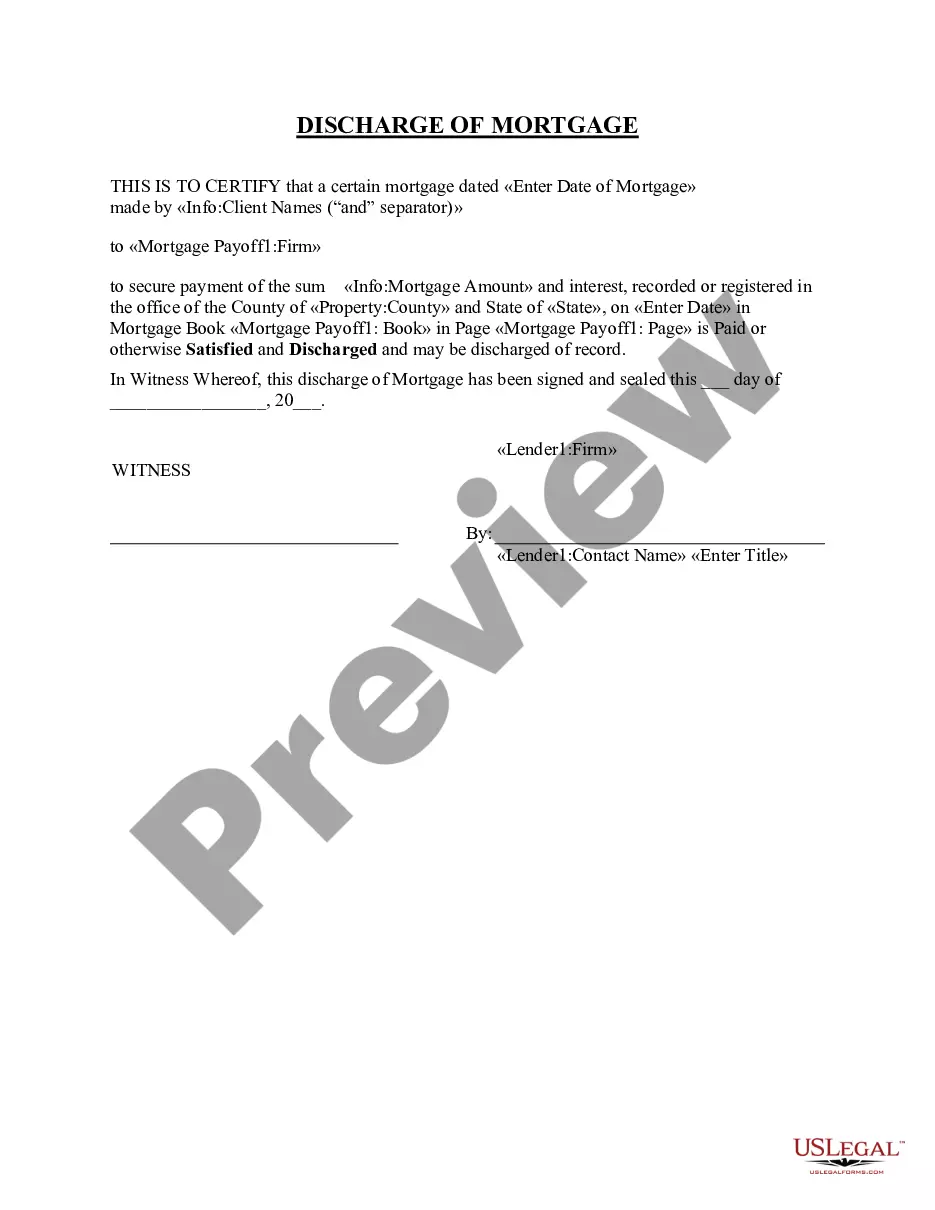
The Release of Security Interest - Termination Statement is a legal document used to formally release a secured party's claim on collateral, thereby terminating the security interest recorded in a financing statement. This form is essential for both debtors and secured parties, as it signifies that the obligation has been fulfilled, allowing the debtor to be free from lien claims. It serves a distinct purpose compared to other forms, such as financing statements, as it enables the legal release of security interests rather than creating or amending them.
Key parts of this document
- File number of the original financing statement
- Place and date of filing of the financing statement
- Name and address of the debtor
- Name and address of the secured party
- Certification by the secured party that the security interest is released
- Date of execution and signature of the secured party
When to use this document
This form should be used when a debtor has fully paid off their debt or has satisfied the obligation for which the security interest was established. It is necessary to formally terminate the security interest when the debtor wants to regain full control of the collateral without any encumbrances. Common scenarios include completing payment in a loan agreement, finalizing settlement terms in business financing, or removing liens on property after fulfilling contractual obligations.
Who can use this document
- Debtors who have satisfied the obligations secured by a prior loan or credit agreement.
- Secured parties aiming to formally terminate their claim on collateral.
- Legal professionals assisting clients in the release of security interests.
How to prepare this document
- Identify and enter the file number of the original financing statement.
- Specify the place and date where the original financing statement was filed.
- Provide the name and address of the debtor clearly.
- Fill in the name and address of the secured party.
- Have the secured party certify that they are releasing the security interest.
- Sign and date the form at the bottom, making sure the details are accurate.
Does this form need to be notarized?
This form does not typically require notarization unless specified by local law. Always review local regulations to ensure compliance.
Get your form ready online
Our built-in tools help you complete, sign, share, and store your documents in one place.
Make edits, fill in missing information, and update formatting in US Legal Forms—just like you would in MS Word.
Download a copy, print it, send it by email, or mail it via USPS—whatever works best for your next step.
Sign and collect signatures with our SignNow integration. Send to multiple recipients, set reminders, and more. Go Premium to unlock E-Sign.
If this form requires notarization, complete it online through a secure video call—no need to meet a notary in person or wait for an appointment.
We protect your documents and personal data by following strict security and privacy standards.

Make edits, fill in missing information, and update formatting in US Legal Forms—just like you would in MS Word.

Download a copy, print it, send it by email, or mail it via USPS—whatever works best for your next step.

Sign and collect signatures with our SignNow integration. Send to multiple recipients, set reminders, and more. Go Premium to unlock E-Sign.

If this form requires notarization, complete it online through a secure video call—no need to meet a notary in person or wait for an appointment.

We protect your documents and personal data by following strict security and privacy standards.
Avoid these common issues
- Failing to enter the correct file number of the original financing statement.
- Neglecting to sign the form, which invalidates the release.
- Omitting the debtor's or secured party's address information.
- Incorrectly stating the date of filing or execution.
Why use this form online
- Convenience of downloading the form anytime and anywhere.
- Easy editability to customize fields as needed.
- Access to reliable, attorney-drafted forms that meet legal standards.
Looking for another form?
Form popularity
FAQ
This document is used to formally release a secured party's claim on collateral and terminate the security interest recorded in a financing statement. It signals that the debtor’s obligation is fulfilled and frees the debtor from lien claims. The form typically includes the original financing statement file number, filing location and date, names/addresses of debtor and secured party, and execution details.
To release a security interest, gather the original financing statement file number and the place/date of filing, identify the debtor and secured party with their names and addresses, obtain the secured party’s certification that the security interest is released, and then sign and date the document. File or record it as required by the applicable jurisdiction.
Fill in the file number of the original financing statement, the place and date of filing, and the names and addresses of the debtor and secured party. Include a certification by the secured party that the security interest is released, and provide the date of execution and signature. Ensure all information matches the original financing statement.
Yes. The Release of Security Interest - Termination Statement is designed to formally terminate a secured party’s claim on collateral after the debtor has fulfilled the obligations secured by the loan or agreement. The document records the release, the parties’ details, and the execution date, effectively removing the lien from the collateral.
Relinquishment of a security interest is the process of surrendering the secured party’s lien on the collateral. The Release of Security Interest - Termination Statement serves this purpose by including the secured party’s certification that the security interest is released and by recording the termination details, allowing the debtor to regain unrestricted control of the collateral.
Both documents terminate a security interest, but this form emphasizes the release by the secured party and records the filing details and execution date. A UCC-3 termination statement is the standard form used to terminate the lien on the public record. This Release form focuses on the certification of release and the involved parties.